SaaS content marketing is like throwing a party where everyone actually wants to come and stay. It’s not about shouting the loudest, but about making content so useful, funny, or interesting that your audience keeps coming back. Imagine turning blog readers into paying users just by giving value first.
That’s the magic of SaaS content marketing: it’s smart, strategic, and, yes, occasionally hilarious if done right. In a world flooded with generic emails and forgettable posts, your content becomes the friend people remember.
SaaS companies that nail this craft win leads, loyalty, and a fan club for life.
What is SaaS Content Marketing?
SaaS content marketing is the process of creating helpful content to attract, educate, and retain users for software subscription products.
It focuses on long-term value instead of quick sales. The goal is to help users understand their problems and show how the software fits into their daily work.
example:
Instead of saying “Buy our project management tool”, a SaaS brand publishes a guide on how remote teams can manage tasks better.
Readers learn first. Trust builds. Sign-ups follow.
That is SaaS content marketing in action.
Core Pillars of SaaS Content Marketing
Every successful SaaS brand builds its growth on a strong content base. That base stands on five clear pillars. When these pillars stay strong, educational SaaS marketing works smoothly and delivers long-term results.
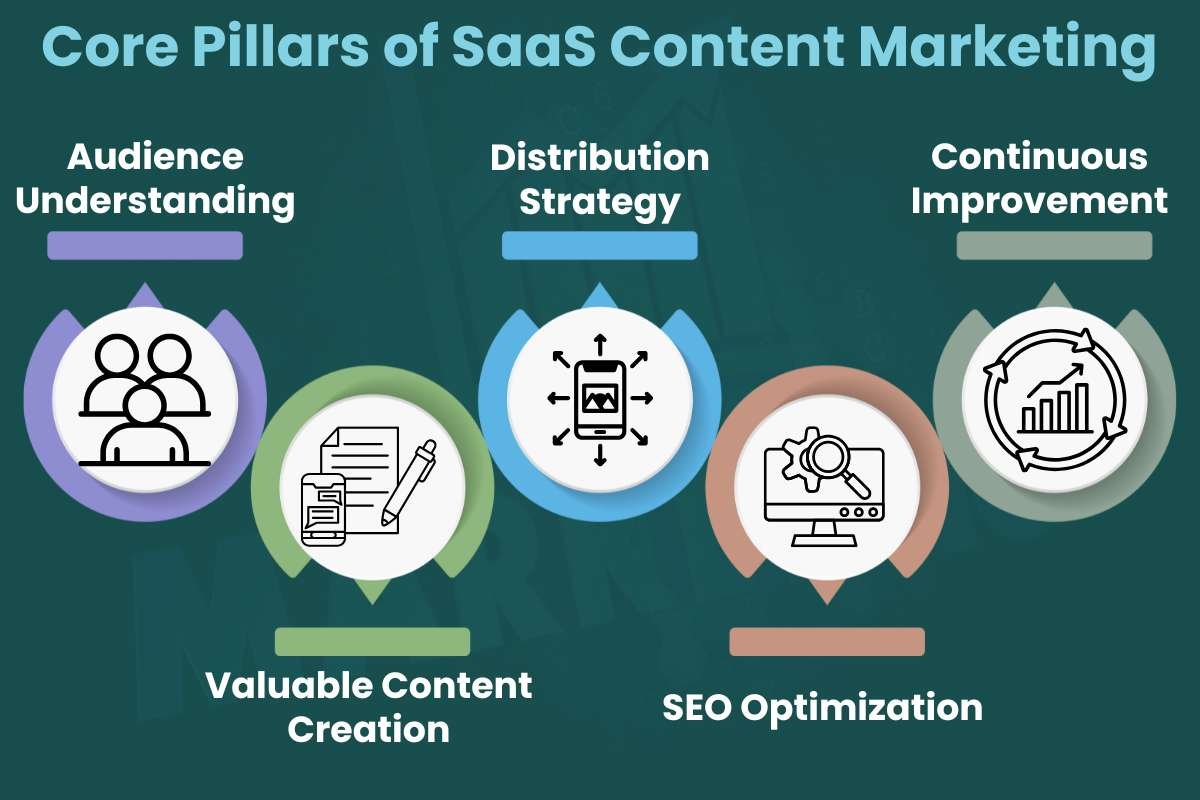
1. Audience Understanding
This is where everything starts. If you do not understand your audience, your content will miss the mark.
Audience understanding means knowing who your ideal customer is. You should know their daily problems, work pressure, goals, and doubts.
Are they founders, marketers, developers, or small business owners?
What keeps them awake at night?
What kind of content do they read during breaks?
When you understand these details, your content feels personal. Readers feel like you are speaking directly to them. This connection builds trust. In SaaS Content, trust matters more than fancy words or aggressive selling.
2. Valuable Content Creation
Good content must help the reader. It should solve a problem, answer a question, or save time.
Valuable content includes blogs, videos, guides, tutorials, case studies, and ebooks. Each piece should give clear takeaways. Readers should finish your content and say, “This helped me.”
In SaaS Content Marketing, value always comes before promotion. When people gain value from your content, they remember your brand. Over time, this trust turns readers into users and users into loyal customers.
3. Distribution Strategy
Even great content fails if no one sees it.
Distribution strategy means sharing content where your audience already spends time. This could be LinkedIn for professionals, Twitter for quick insights, email newsletters for loyal readers, or SaaS communities for niche users.
Educational SaaS marketing is not about posting everywhere. It is about posting in the right places at the right time. Smart distribution ensures your content reaches people who actually care.
4. SEO Optimization
SEO helps your content stay visible for a long time.
SEO optimization means using clear keywords, simple headings, a clean structure, and helpful answers. It allows your content to appear when people search for solutions online.
In SaaS Content, SEO brings steady traffic without daily ad spending. A well-written article can bring leads for months or even years. This makes SEO one of the most powerful pillars.
5. Continuous Improvement
Content is never finished. It improves with time.
Continuous improvement means checking data and learning from it.
Which blogs get more traffic?
Which pages convert better?
Which topics keep users engaged longer?
By reviewing performance, you can improve headlines, update content, and adjust strategy. SaaS Content Marketing grows stronger when you learn from real user behavior instead of guesswork.
What Is the SaaS Content Marketing Funnel?
The SaaS content funnel shows how a stranger slowly becomes a paying customer. It is not magic. It is a journey. People do not wake up and buy software instantly. They first notice a problem, then search for options, and finally choose a solution.
This funnel helps SaaS brands share the right content at the right time, so users feel guided, not pushed.
The educational SaaS marketing funnel shows how users move from problem awareness to product adoption through content.
It has three stages.
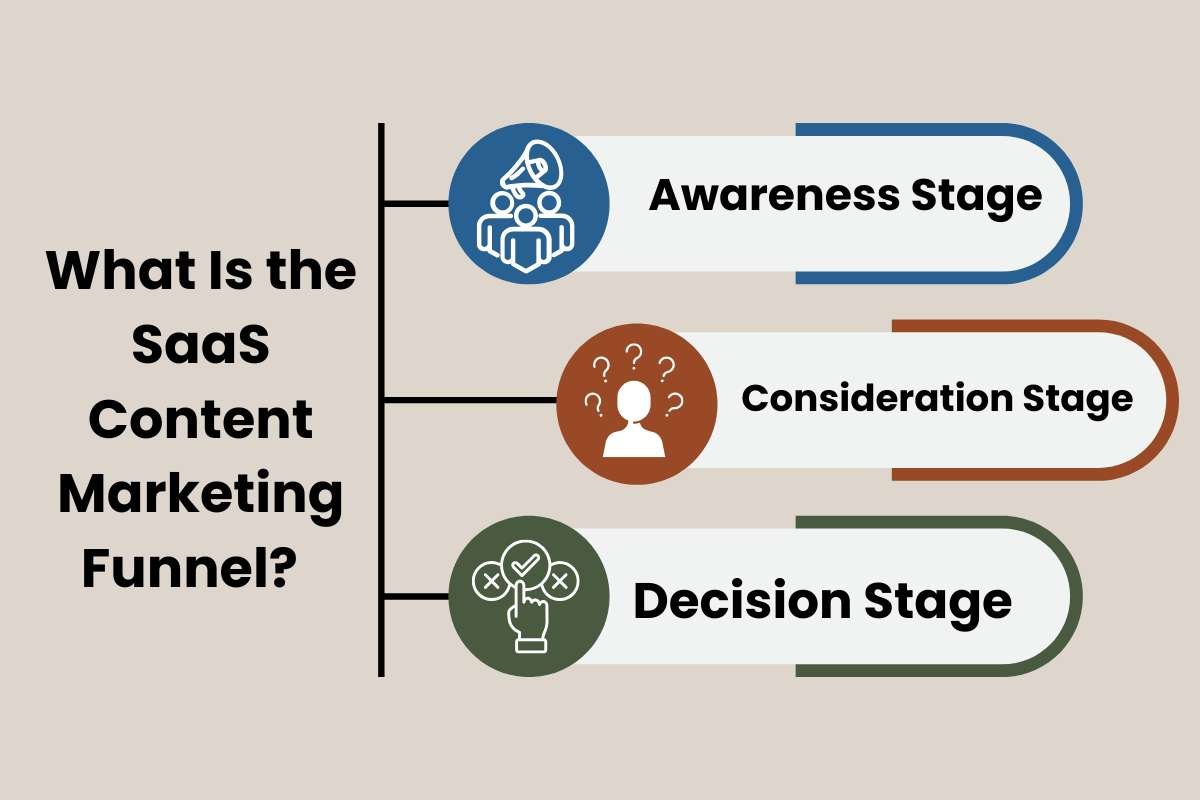
1. Awareness Stage
Goal: Help users understand their problem.
Users search for questions, not tools.
Best content:
- Blogs
- Social posts
- Infographics
Content here educates. It does not sell.
2. Consideration Stage
Goal: Help users compare solutions
Users now evaluate options.
Best content:
- Case studies
- Comparison guides
- Webinars
Content should reduce confusion and explain benefits clearly.
3. Decision Stage
Goal: Remove fear and build confidence
Users are almost ready.
Best content:
- Free trials
- Demos
- Testimonials
- FAQs
This is where Educational SaaS marketing turns interest into action.
SaaS Content Marketing Formats Compared by Funnel Stage & ROI
Different content formats perform differently at each funnel stage:
| Funnel Stage | Content Formats | ROI Potential |
| Awareness | Blogs, Social posts, Infographics | High reach, low immediate conversions |
| Consideration | Webinars, Case studies, Whitepapers | Moderate reach, medium conversion |
| Decision | Demos, Free trials, Testimonials | Lower reach, high conversion |
Blogs are great for SEO and long-term traffic. Webinars engage highly interested users, while free trials convert those ready to purchase. SaaS content marketing success depends on balancing reach, engagement, and conversion across these formats.
Advanced SaaS Content Strategies
Advanced SaaS content strategies focus on going deeper than regular blogs or simple social posts. The goal is not just traffic, but real engagement, trust, and long-term growth. These strategies help your content work harder at every stage of the user journey.
Here is a detailed and easy-to-understand breakdown.
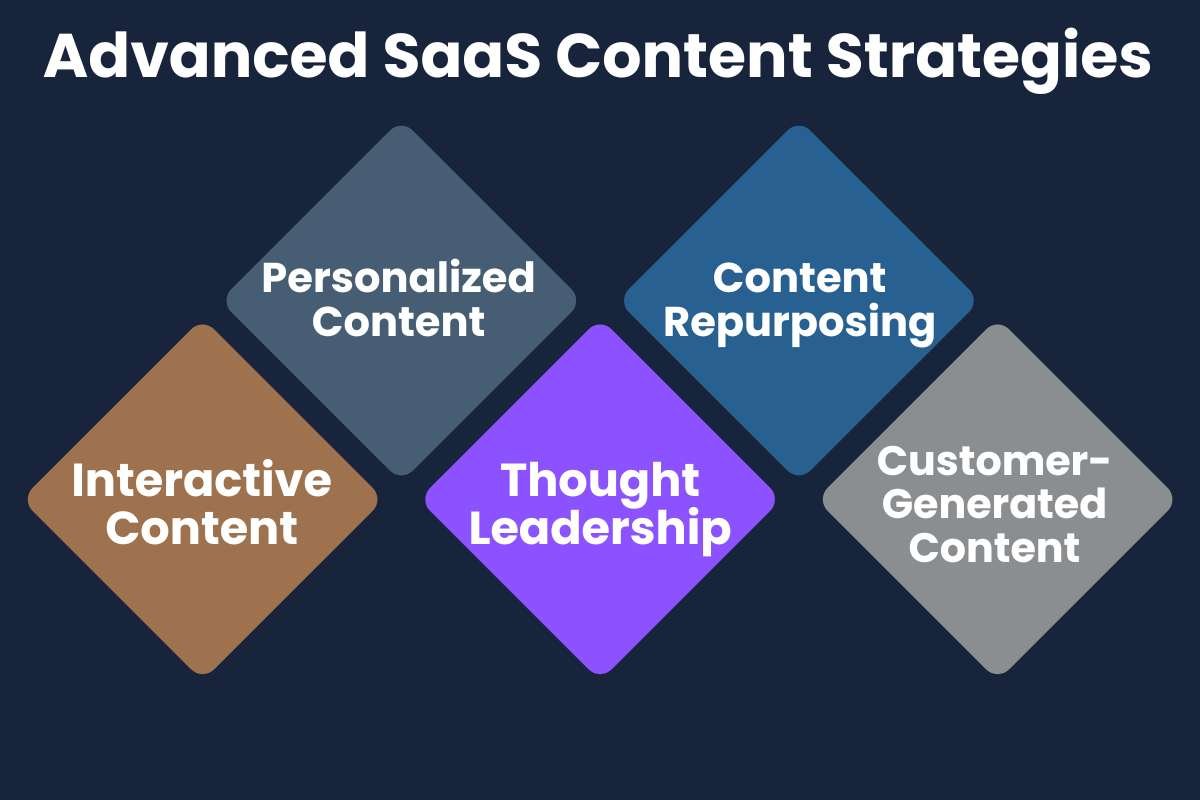
1. Interactive Content
Interactive content invites users to take part instead of just reading and leaving. This could include quizzes, ROI calculators, assessments, or interactive infographics.
For example, an ROI calculator helps users see how much money or time your SaaS tool can save them. A quiz can help users identify their biggest problem and guide them to the right feature or plan. When people interact, they stay longer on your site. A longer time means stronger interest and better chances of conversion.
Interactive content also feels personal and useful. It turns passive visitors into active participants.
2. Personalized Content
Personalized content speaks directly to the user instead of a general audience. This includes tailored emails, custom landing pages, and blog suggestions based on user behavior.
For instance, if a user reads content about team productivity, your next email can suggest tools or articles related to team management. This makes users feel understood, not sold to. When content feels relevant, people open emails more, click more, and trust the brand more.
Personalization builds a one-to-one connection, even at scale.
3. Content Repurposing
Content repurposing means using one strong piece of content in many formats. This saves time and increases reach without lowering quality.
A single webinar can become a blog post, a short video, social media snippets, email content, and even a downloadable guide. Each format reaches a different audience. Some people like reading. Others prefer watching or scrolling.
Repurposing ensures your best ideas do not disappear after one use. It keeps your message consistent across platforms while maximizing value from every effort.
4. Thought Leadership
Thought leadership content shows that your SaaS brand understands the industry deeply. This includes opinion pieces, original research, trend analysis, and expert insights.
Instead of explaining basic features, you share views on where the industry is going or what businesses should prepare for next. This type of content builds authority and credibility. People start trusting your brand before they even try your product.
When users see you as a guide, not just a seller, loyalty grows naturally.
5. Customer-Generated Content
Customer-generated content comes directly from real users. This includes testimonials, reviews, case studies, community posts, and success stories.
Real voices build real trust. When prospects see others benefiting from your SaaS product, doubts reduce. Reviews and stories feel honest and relatable. They answer questions that marketing copy cannot.
Encouraging users to share experiences also builds community. A strong community increases retention and word-of-mouth growth.
Measuring SaaS Content Marketing Success
Metrics matter. Tracking performance ensures your Educational SaaS marketing efforts are paying off:
- Traffic Metrics: Page views, unique visitors, and time spent measure interest and reach.
- Engagement Metrics: Shares, comments, and click-through rates show audience involvement.
- Conversion Metrics: Sign-ups, free trials, and demo requests indicate effectiveness.
- Retention Metrics: Repeat visits and customer feedback reveal long-term value.
- SEO Metrics: Keyword rankings, backlinks, and organic growth reflect search performance.
A successful Educational SaaS marketing campaign constantly evaluates these metrics and optimizes accordingly.
Challenges in SaaS Content Marketing
SaaS content marketing looks simple from the outside. Write blogs. Post on social media. Send emails. But in real life, it comes with real challenges. These challenges test patience, creativity, and consistency.
Let’s break them down one by one in an easy way.
High Competition
The SaaS space is crowded. Very crowded. Hundreds of SaaS companies sell tools for the same problems. Project management. CRM. Marketing automation. Analytics. The result is similar content everywhere.
Everyone writes:
- “Top features you need.”
- “Best tools for teams”
- “How to improve productivity.”
Readers see the same ideas again and again. That makes standing out hard.
To win here, Educational SaaS marketing needs originality. Not louder words, but better angles. Real stories. Honest opinions. Fresh examples. Content that feels written by humans, not templates.
Technical Complexity
SaaS products are often complex by nature. They use dashboards, integrations, workflows, APIs, and data logic.
The challenge is simple: Your users are not engineers.
Explaining features without confusing people is tough. If content feels too technical, readers leave. If it feels too basic, it feels useless.
Good Educational SaaS marketing turns complex ideas into simple explanations. It uses real-life examples. It avoids jargon. It answers “why this matters” before explaining “how it works.”
Clarity beats cleverness every time.
Content Overload
Your audience scrolls all day.
Blogs. Reels. Emails. Ads. Notifications.
They see thousands of content pieces daily. Attention is limited. Patience is lower.
This makes content overload a serious challenge. Even good content can get ignored.
To fight this, SaaS content marketing must respect time. Short paragraphs. Clear points. Strong openings. Useful takeaways. Content should earn attention, not demand it. If it doesn’t help fast, it gets skipped.
Measuring ROI
This is one of the most frustrating challenges.
A reader may:
- Read a blog today
- Subscribe next month
- Start a trial after three months.
- Buy after six months.
Connecting that journey to one piece of content is hard.
SaaS content marketing works long-term. It builds trust slowly. But teams often want instant numbers.
The solution is better tracking. Use attribution tools. Track assisted conversions. Measure engagement, not just sales. Content value goes beyond last-click revenue.
Consistency
Anyone can write a good blog. The real challenge is doing it again. And again. And again.
Educational SaaS marketing demands:
- Regular publishing
- Stable quality
- Clear brand voice
This needs time, people, and planning. Without systems, content becomes irregular. Quality drops. Momentum breaks.
Consistency comes from strong processes. Clear calendars. Simple workflows. Realistic goals. It’s better to publish one strong piece every week than five rushed ones.
How Can These Challenges Be Solved?
These challenges are real, but they are not unbeatable. Smart Educational SaaS marketing focuses on:
- Niche targeting instead of broad topics
- Storytelling instead of feature lists
- Consistent branding instead of random tones
- Smart analytics instead of vanity metrics
When content speaks clearly, feels human, and solves real problems, it cuts through noise. Over time, it builds trust. And trust drives growth.
Facts and Stats About SaaS Content Marketing
- Companies using Educational SaaS marketing generate 3x more leads than those relying solely on paid ads.
- Blogs produce an average ROI of $42 per $1 spent for SaaS companies.
- Video content increases conversions by 80% for SaaS landing pages.
- SaaS buyers engage with 13 pieces of content before making a purchase decision.
- Email newsletters as part of SaaS content marketing see 20% higher retention rates than other channels.
Conclusion
SaaS content marketing is more than just creating blogs or social posts; it’s building a relationship with your audience. Like the party we imagined in the intro, it’s about being memorable, helpful, and a little fun. Done right, it converts casual readers into loyal users while boosting your brand authority.
With clear strategies, smart funnels, and data-driven improvements, SaaS content marketing becomes the secret engine driving growth, engagement, and trust for your business in 2026 and beyond.