Risk Beyond Regulations
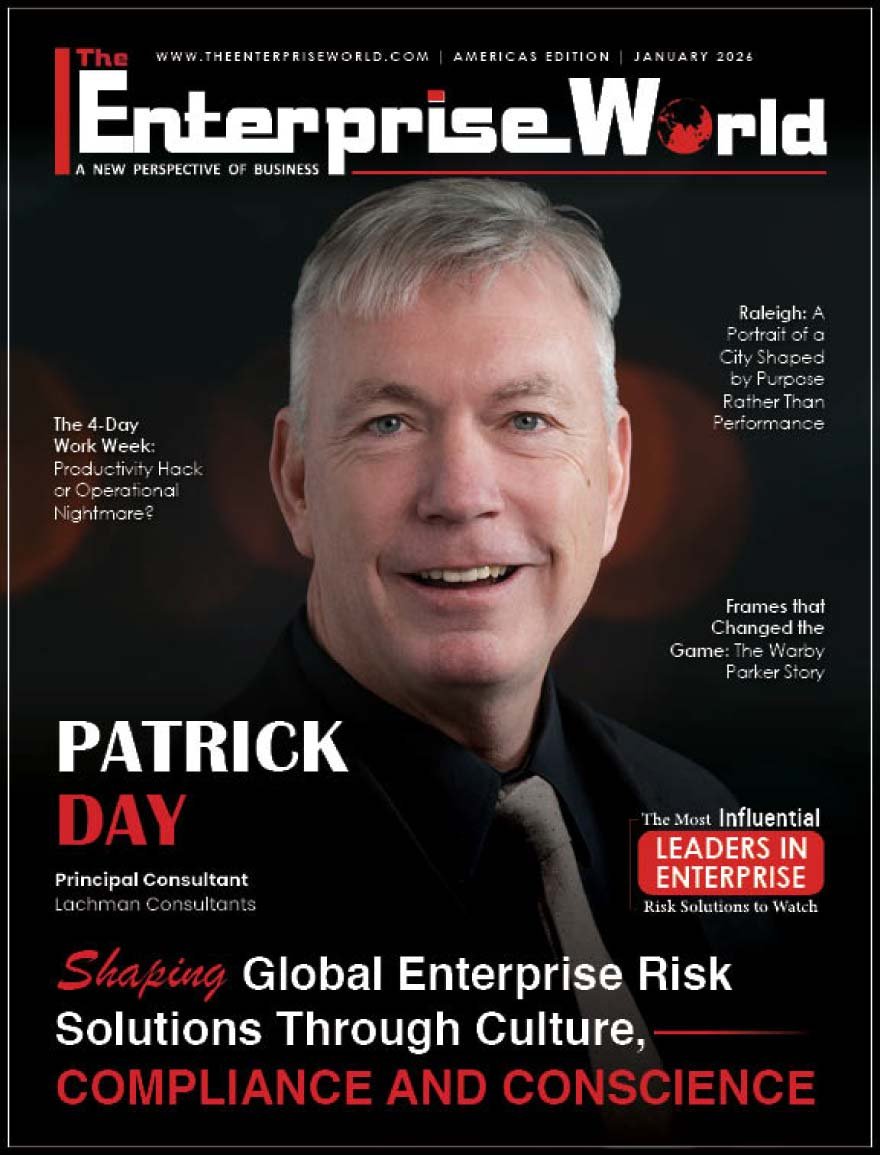
In the highly regulated, high-stakes world of life sciences, enterprise risk management is not merely about compliance; it is about safeguarding patients, enabling innovation, and sustaining trust across global ecosystems. Few leaders embody this philosophy as comprehensively as Patrick Day, Principal Consultant at Lachman Consultants. With a career shaped by perseverance, humility, and deep technical rigor, Day has emerged as a respected voice in global pharmaceutical risk, compliance, and data integrity.
What distinguishes Patrick Day is not only his mastery of regulatory frameworks but his insistence on understanding the human and cultural dimensions of risk. In an industry where a diverse set of potential issues can derail groundbreaking science, Day’s leadership sits at the intersection of engineering discipline, regulatory wisdom, and ethical responsibility.
Formative Years: A Grounded Beginning
Patrick Day’s professional ethos can be traced back to his upbringing in Philadelphia, a city defined by strong communities and resilient working-class values. Growing up in the Frankford neighborhood, the rhythms of the elevated train and the social life of street corners shaped his early worldview. As the fifth of six children in a firefighter’s household, financial limitations were a reality, but so were discipline, service, and perseverance.
Unable to pursue a traditional college path immediately, Day began his academic journey at the Community College of Philadelphia. What initially appeared to be a practical choice later revealed itself as a profound formative experience. Immersed in a diverse, multicultural environment, he developed an appreciation for perspectives beyond his own understanding that would later prove essential in global consulting.
While raising a family and supporting his wife, Maria, through nursing school, Day worked full-time as an instrument technician and attended night school for eight years. He ultimately earned an undergraduate degree in Electrical Engineering, followed by a Master’s degree in Industrial Engineering. This prolonged academic journey instilled a long-term mindset and, more importantly, intellectual humility.
Education, he learned, was not about mastery alone, it was about recognizing how much one does not yet know. This realization became a cornerstone of his leadership philosophy: listen more than you speak, observe before acting, and remain open to learning at every stage.
From Technical Expertise to Strategic Consulting
Patrick Day’s transition into consulting was shaped by his exposure to complex, multinational pharmaceutical organizations. As his work expanded across borders, he encountered a recurring truth: while medicines may be universal, culture is not.
This realization marked a critical turning point in his career. Day observed that regulatory failures, stalled projects, and compliance breakdowns were often not caused by poor science or insufficient resources, but by unseen cultural misalignments. These “invisible forces,” as he describes them, can either accelerate progress or silently obstruct it.
Joining Lachman Consultant Services, Inc. (Lachman) provided Day with a platform to address these challenges holistically. At Lachman, he found an organization whose depth of expertise and mission-driven focus aligned with his belief that compliance should enable, not inhibit innovation.
Lachman Consultants: Built on Trust and Technical Excellence
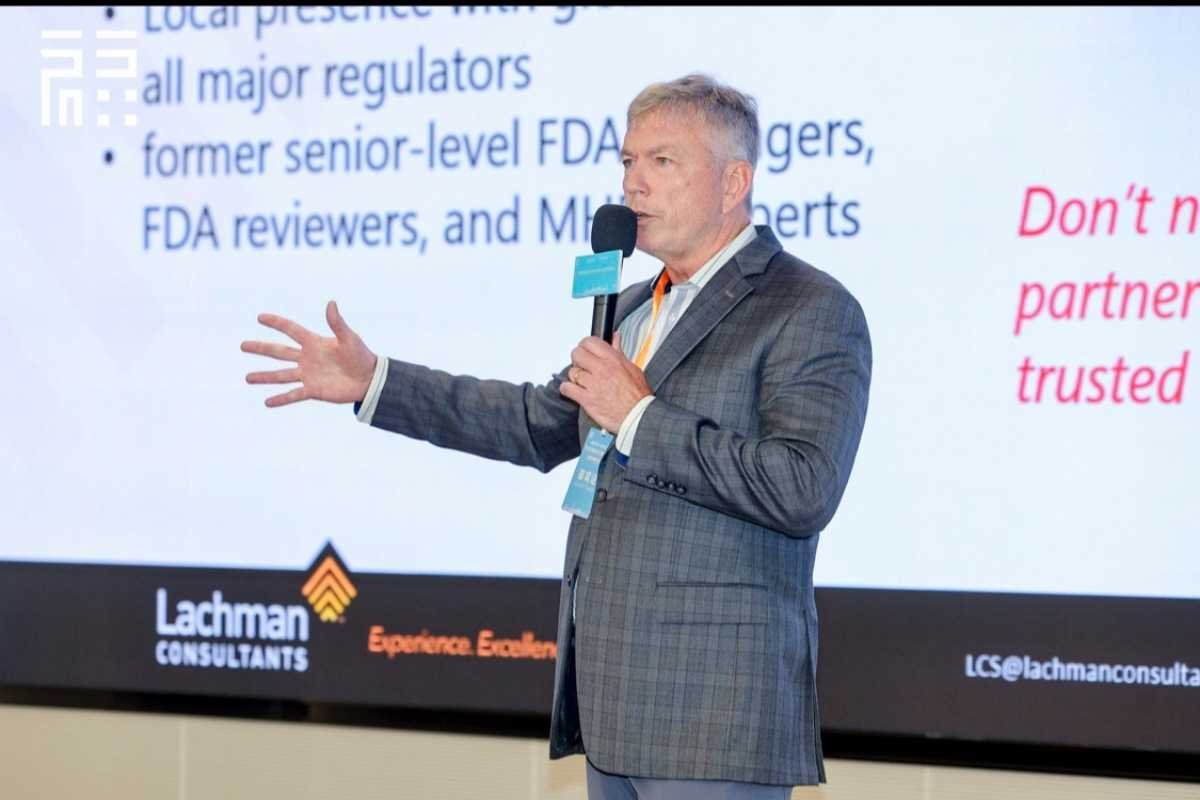
Founded in 1978, Lachman has become a global authority in global compliance, regulatory affairs, and technical services. The firm’s mission is clear and unwavering: to deliver the highest quality regulatory and compliance consulting services across the pharmaceutical, biopharmaceutical, and medical device industries.
Lachman has cultivated a culture that prioritizes excellence, integrity, and patient-centric outcomes. Its consultants include former FDA, MHRA, and HPRA regulators, as well as senior industry experts with decades of hands-on experience.
For Day, Lachman represents more than a consulting firm; it is an institution of collective institutional knowledge, capable of solving problems that span geographies, modalities, and regulatory regimes.
Enterprise Risk in Life Sciences: Lachman’s Distinctive Approach
In an environment where risk tolerance is low and consequences are profound, Lachman Consultants differentiates itself through experience-driven, proactive risk management. Rather than reacting to regulatory crises, the firm emphasizes preparation, prevention, and strategic foresight.
Key differentiators of Lachman’s methodology include:
- Depth of Expertise: Consultants with first-hand regulatory enforcement experience.
- Proactive Engagement: Identifying risks before they materialize into findings.
- Customized Solutions: Tailored strategies aligned to each client’s operational maturity.
- Global Perspective: Integrated U.S. and international regulatory insight.
Patrick Day’s work particularly centers on data integrity and data governance, disciplines that cut across all life-science sectors from startups to multinational manufacturers. His team’s Data Integrity Risk Assessments are widely regarded as best-in-class, scaling rigor based on regional risk, organizational maturity, and product complexity.
Patrick Day’s Core Areas of Impact
1. Data Integrity as an Enterprise Risk Pillar: Day views data integrity not as a technical checkbox, but as a foundational element of organizational trust, patient safety, and regulatory credibility.
2. Culture as the Hidden Risk Multiplier: Through global engagements, he has consistently demonstrated that cultural awareness is essential to successful compliance and transformation initiatives.
3. Risk-to-Value Transformation: Day advocates for shifting from risk avoidance to risk-informed value creation, aligning with modern quality and business objectives.
4. Knowledge Management and ICH Q10: He emphasizes integrating Risk Management and Knowledge Management as interdependent pillars of an effective Pharmaceutical Quality System.
5. Readiness for AI and Emerging Technologies: Recognizing the growing influence of AI, Day supports structured adoption frameworks that match technological ambition with organizational readiness.
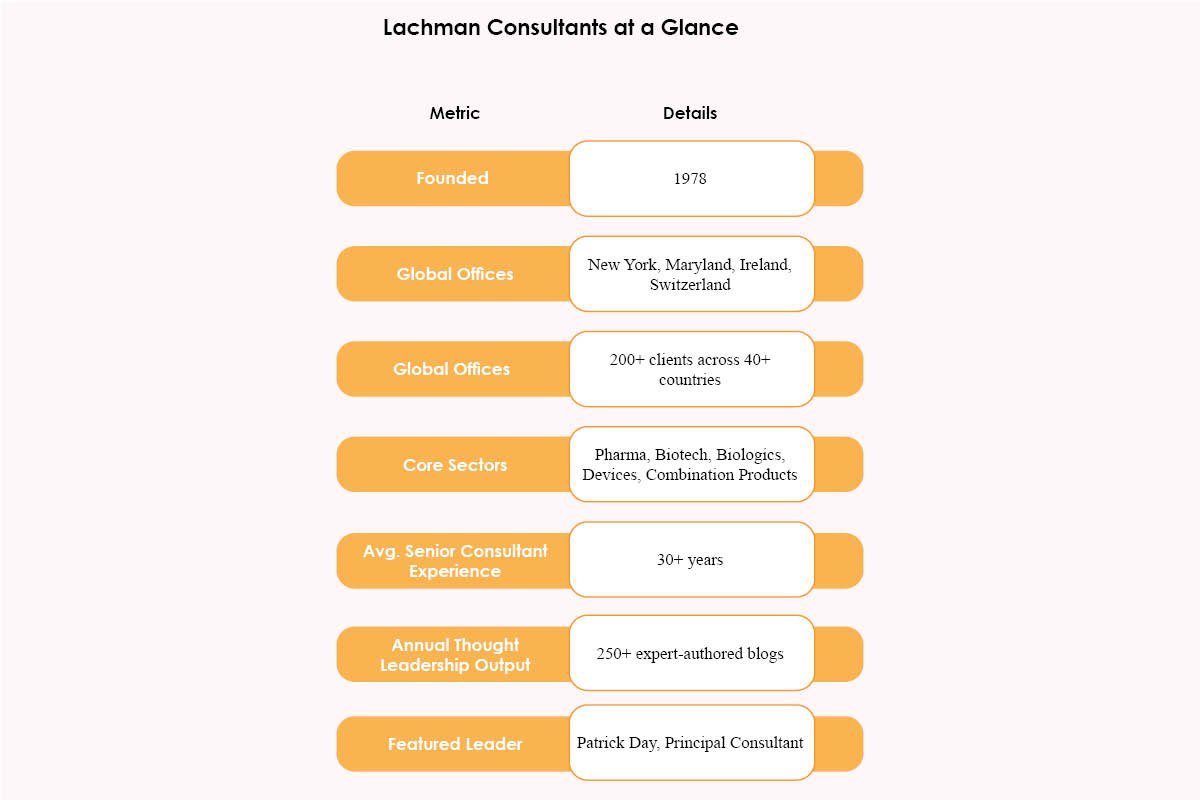
| Lachman Consultants at a Glance | |
|---|---|
| Metric | Details |
| Founded | 1978 |
| Global Offices | New York, Maryland, Ireland, Switzerland |
| Clients Served | 200+ clients across 40+ countries |
| Core Sectors | Pharma, Biotech, Biologics, Devices, Combination Products |
| Avg. Senior Consultant Experience | 30+ years |
| Annual Thought Leadership Output | 250+ expert-authored blogs |
| Featured Leader | Patrick Day, Principal Consultant |
Navigating Emerging Risks and Regulatory Shifts
Day is particularly focused on the slow maturation of enterprise risk management within the pharmaceutical sector. Despite formal guidance under ICH Q10, many organizations still treat risk and knowledge management as siloed activities.
Another growing concern is the rapid adoption of Artificial Intelligence. While AI holds immense promise, Day cautions against unstructured implementation. Lachman’s frameworks assess both technical readiness and leadership maturity, ensuring adoption occurs at a sustainable pace.
He is also a strong advocate of Quality Management Maturity (QMM)a model that aligns quality excellence with competitive advantage. Although adoption has been gradual, Day believes QMM represents the future of regulatory trust and operational resilience.
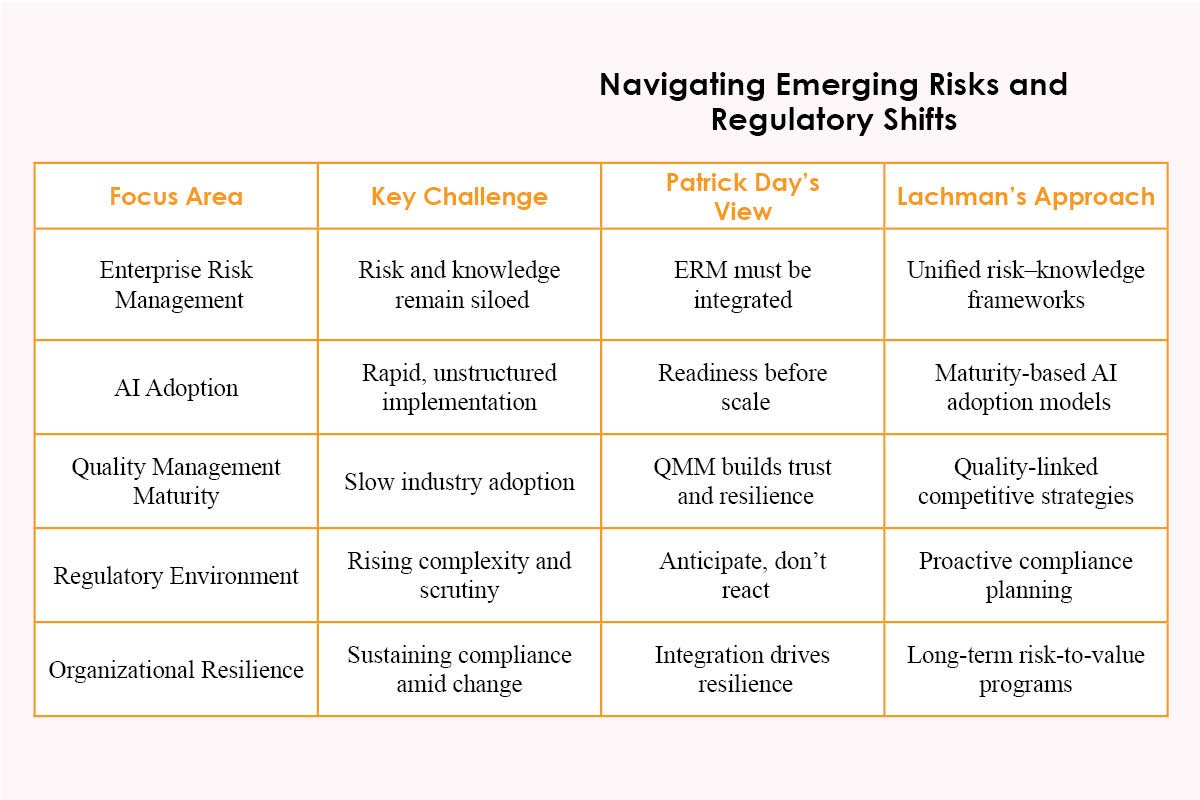
| Navigating Emerging Risks and Regulatory Shifts | |||
|---|---|---|---|
| Focus Area | Key Challenge | Patrick Day’s View | Lachman’s Approach |
| Enterprise Risk Management | Risk and knowledge remain siloed | ERM must be integrated | Unified risk–knowledge frameworks |
| AI Adoption | Rapid, unstructuredimplementation | Readiness before scale | Maturity-based AI adoption models |
| Quality ManagementMaturity | Slow industry adoption | QMM builds trust and resilience | Quality-linked competitive strategies |
| Regulatory Environment | Rising complexity andscrutiny | Anticipate, don’t react | Proactive compliance planning |
| Organizational Resilience | Sustaining complianceamid change | Integration drives resilience | Long-term risk-to-value programs |
Thought Leadership and Global Influence
Lachman Consultants is widely recognized for its robust thought leadership ecosystem, publishing over 250 blogs annually, authored by experienced practitioners and cited across industry platforms. These insights have positioned the firm as a go-to authority for regulators, manufacturers, and policymakers alike.
Patrick Day’s personal contributions include speaking engagements at:
- Podcast with Brandwidth Solutions on AI in Pharma manufacturing, quality, and supply chain management viewable here: Podcast – Brandwidth Solutions
- International GMP Conference, University of Georgia
- PDA Antwerp, Belgium
- BIOHK 2025 (Hong Kong Biotechnology Conference & Exhibition)
- Duke Margolis Supply Chain Consortium
He is also scheduled to speak at CPHI Americas 2026 on Global Risk Management and Risk-to-Value Transformation. Notably, Day has trained over 200 FDA inspectors in facility management inspection techniques, an uncommon distinction that underscores his credibility on both sides of the regulatory table.
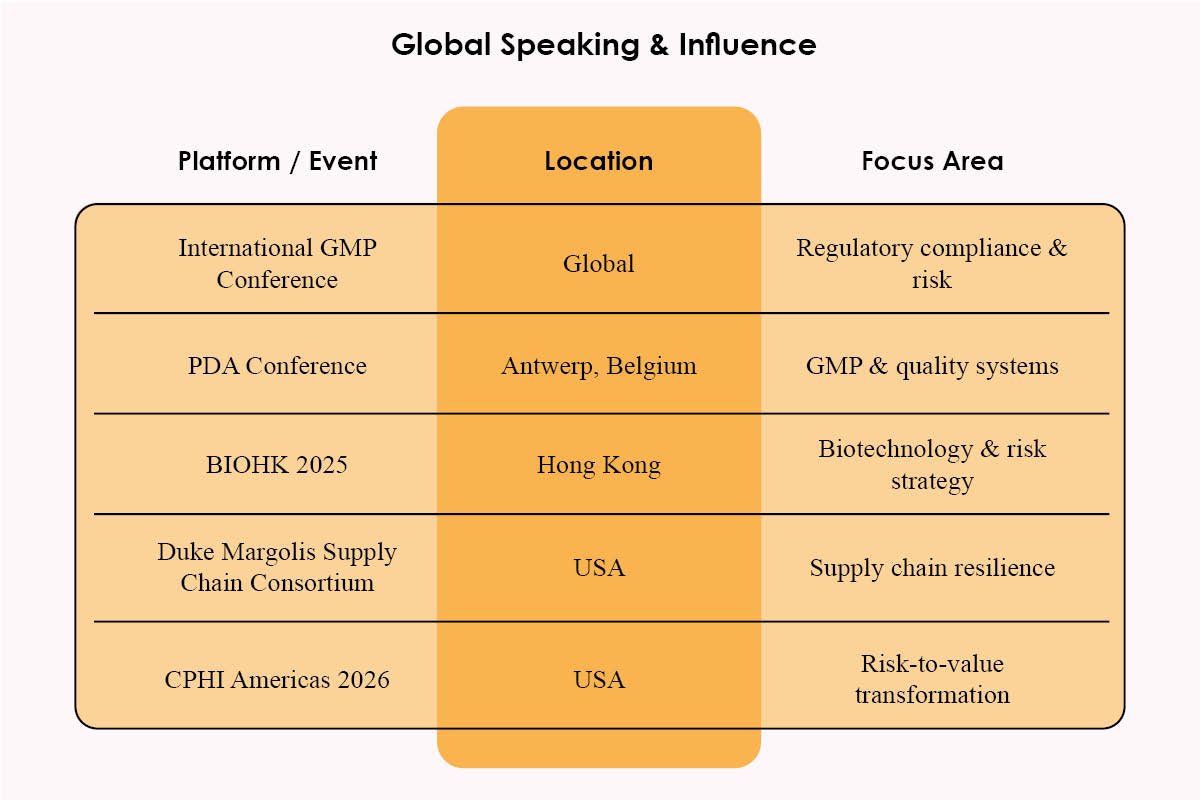
| Global Speaking & Influence | ||
|---|---|---|
| Platform / Event | Location | Focus Area |
| International GMP Conference | Global | Regulatory compliance & risk |
| PDA Conference | Antwerp, Belgium | GMP & quality systems |
| BIOHK 2025 | Hong Kong | Biotechnology & risk strategy |
| Duke Margolis Supply Chain Consortium | USA | Supply chain resilience |
| CPHI Americas 2026 | USA | Risk-to-value transformation |
Trust, Ethics, and the Patient at the Center
At Lachman Consultants, trust is never taken for granted it is deliberately built through consistent actions, transparent decision-making, and unwavering ethical standards. Patrick Day places strong emphasis on the responsible stewardship of client data, strict vigilance against conflicts of interest, and a culture of mutual respect that spans every level of an organization, from C-suite leadership to production teams and CDMOs. For him, ethical conduct is not a regulatory obligation alone, but a professional duty that underpins long-term credibility and partnership.
Day also underscores that the true beneficiary of compliance efforts is often unseen. As both a consultant and a potential patient himself, he approaches his work with a heightened sense of personal accountability. In this light, compliance transcends checklists and inspections—it becomes an organizational compass, guiding decisions with integrity even in the absence of oversight, and ensuring that patient safety remains central when no one is watching.
Dear Future Leaders,
- Patients are always the true end customers keep them at the center of every decision.
- Science and disease are impartial; leadership must rise above politics and circumstance.
- Stay current in cGMPs capability and relevance are continuous responsibilities.
- Lead with curiosity, enable creativity within boundaries, and prioritize culture.
- Seek great coaches early, and become a great coach as you lead others.
Patrick Day
Principal Consultant, Lachman Consultants
Five Key Takeaways
- Enterprise risk in life sciences extends beyond regulation it is rooted in culture, knowledge, and trust.
- Data integrity is not a technical function alone; it is an organizational responsibility.
- Proactive risk management creates a competitive advantage in highly regulated environments.
- Sustainable compliance requires integrating risk management with knowledge management.
- Patient-centric leadership remains the ultimate measure of success in global healthcare systems.