When complex systems are not coherently aligned, organizations rarely fail all at once. Instead, strain accumulates quietly through delays, miscommunication, and compensating effort that masks deeper structural issues. Over time, these conditions erode readiness, efficiency, and trust. Addressing this kind of fragility requires more than reactive fixes. It requires a disciplined systems approach that aligns people, processes, and technology in a way that can be sustained under real operating conditions.
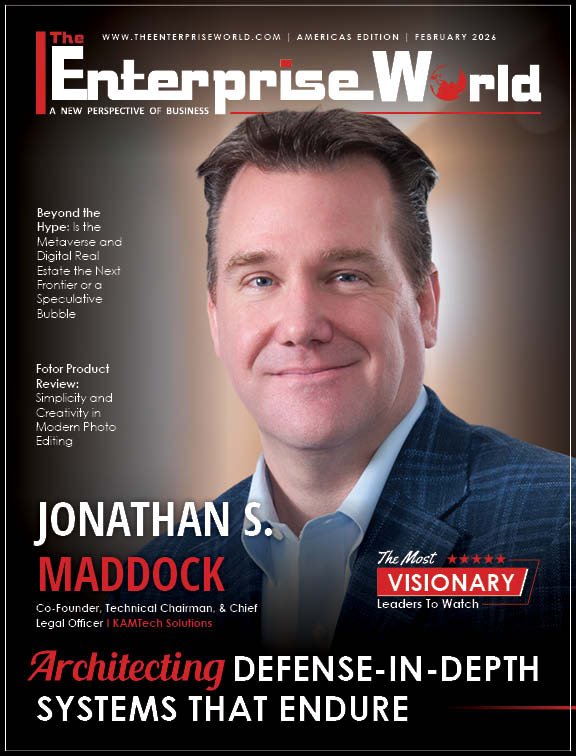
Jonathan S. Maddock, Co-Founder, Technical Chairman, and Chief Legal Officer of KAMTech Solutions, has spent his career confronting these challenges at their source. He guides KAMTech’s growth by designing resilient operational structures that connect engineering, logistics, compliance, and mission execution into a unified whole. His work emphasizes durability over speed and clarity over heroics, ensuring that complex systems remain reliable long after initial deployment.
Under his leadership, KAMTech has expanded its global footprint while strengthening the internal disciplines that support long-term performance. This includes the development of the Sustainment Maturity Model, a framework that helps organizations assess and improve their ability to operate, adapt, and endure. A defining example of this approach is KAMTech’s role in the Jordan Armed Forces Border Security Program, where sustainment was transformed from a contractual requirement into an embedded operational capability. Through mentorship and structured system design, the program delivered lasting readiness, enhanced local ownership, and mission outcomes that continue well beyond initial execution.
Foundation of KAMTech Solutions
When Jonathan S. Maddock and his business partner, John B. Allen, first established KAMTech, the earliest challenges were not related to technical capability or intent, but to focus. While the founding team possessed deep experience and a clear vision, the company initially operated without an established client base and with limited resources. During this period, Jonathan S. Maddock was still operating within another organization while supporting the Jordan program office, requiring careful management of obligations, boundaries, and continuity.
The pivotal moment came with the recognition that sustainable growth could not be achieved through divided attention. Fully committing to KAMTech required consolidating effort, transitioning services responsibly, and establishing a structure that could scale without compromising integrity. This shift was executed while maintaining continuity for a mission critical client, reinforcing trust even as organizational responsibilities changed.
By prioritizing disciplined transition over rapid expansion, KAMTech established its foundation as a firm built on clarity, accountability, and long-term stewardship. The balance between operational integrity and entrepreneurial risk during this period became a defining characteristic of the company and continues to shape how it approaches growth, partnerships, and execution today.
Building Trust and Credibility

As KAMTech began to take shape, one of the most complex challenges facing its leadership was establishing trust while navigating perception. During the transition of services from another organization to KAMTech, Jonathan S. Maddock was already serving as Technical Country Portfolio Manager for the Jordan program office, a role that required discretion, integrity, and sustained transparency. At the same time, he and John were intent on ensuring that the company’s growth was grounded in ethical clarity rather than expediency.
Together, they emphasized clear separation of responsibilities and deliberately structured the company around well-defined areas of expertise. Personnel were aligned to distinct functional roles, creating internal clarity while reinforcing appropriate boundaries with partner organizations. This approach promoted mutual respect among sister subcontractors and ensured that collaboration remained principled, focused, and effective.
By prioritizing ethical discipline and structural clarity over rapid expansion, KAMTech established credibility early and sustained it as the organization grew. This foundation demonstrated that integrity and restraint are not constraints on progress, but essential conditions for building trust that endures across partnerships, missions, and operating environments.
A Philosophy Inspired by the Teachings of Marcus Aurelius
Jonathan S. Maddock’s leadership philosophy draws inspiration from the writings of Marcus Aurelius, particularly the idea that leadership is an act of stewardship rather than control. This perspective emphasizes responsibility, proportion, and alignment within a larger system. He is guided by principles that include supporting others according to their capacity, acting in harmony with the broader environment, and understanding one’s role within an interconnected whole.
At KAMTech, this philosophy is expressed through how work is structured and how teams engage with one another. Individuals are encouraged to understand not only their specific responsibilities, but also how their decisions affect adjacent functions and long-term outcomes. The company places strong value on clarity of purpose, disciplined empathy, and technical precision, with these principles reinforced through everyday practices rather than abstract statements.
Jonathan S. Maddock believes effective leadership aligns talent with intent so that effort is neither wasted nor misdirected. When people understand both their role and its relationship to the larger mission, coordination improves and unnecessary friction is reduced. In this way, KAMTech operates as a cohesive system of systems, where each component contributes to the reliability, integrity, and sustained success of the whole.
The Sustainment Maturity Model
At KAMTech Solutions, innovation is measured by whether a system can be trusted to perform over time, not just whether it can be delivered. One of the company’s most significant contributions to this problem space is the Sustainment Maturity Model (SMM), a proprietary framework developed to assess and strengthen an organization’s ability to operate and maintain complex systems throughout their intended service life.
The SMM is intentionally focused on the organizations responsible for owning and sustaining a system after it has been fielded. While many established maturity models are applied earlier in the system lifecycle and emphasize development and integration activities, this model evaluates the operational entity itself. Its purpose is to determine whether the people, processes, and supporting structures in place are capable of preserving system performance under real world conditions.
Through this lens, the model examines how well an organization can absorb disruption, including workforce turnover, funding variability, regulatory constraints, and shifting geopolitical realities. As organizational maturity increases, so does stakeholder confidence that the system will remain viable, supportable, and mission effective over its full lifespan. By making sustainment capability visible, measurable, and improvable, KAMTech helps clients and partners justify long term investment decisions and ensure that operational value endures long after initial deployment.
Comprehensive Services for Complex Needs
KAMTech Solutions delivers integrated, expert-driven services:
KAMTech Solutions addresses complex security and operational challenges through the discipline of defense-in-depth system architecture. Physical security, cybersecurity, and organizational performance are treated as interconnected layers rather than isolated functions. By designing these layers to reinforce one another, KAMTech reduces single points of failure and enables systems to detect disruption, absorb stress, and sustain performance over time.
Within this architectural framework, KAMTech delivers integrated capabilities across key defense layers:
1. Perimeter and Border Security Architecture
Designing layered physical security environments that integrate sensing, monitoring, and response to maintain control, reduce blind spots, and sustain operations as conditions change.
2. Cybersecurity and Digital Defense Layers
Embedding cybersecurity as a core system layer that protects data and networks while preserving visibility, verification, and accountability across evolving digital environments.
3. Organizational and Governance Transformation
Aligning decision authority, workflows, and accountability so people and processes reinforce system integrity rather than compensate for structural gaps.
4. Integrated Command and Operational Coordination
Connecting physical, digital, and organizational layers to enable early detection, informed decision making, and coordinated response without cascading failure.
5. Sustainment and Lifecycle Confidence
Structuring systems to endure personnel turnover, funding variability, and regulatory constraints while maintaining performance throughout their intended life.
Mission and Vision
KAMTech Solutions takes a systems-focused approach to designing and sustaining layered architectures that protect operations, preserve trust, and enable long term mission success:
| Mission | Vision |
| KAMTech Solutions is committed to designing and sustaining resilient physical, digital, and organizational systems that enable organizations to operate securely, confidently, and effectively in complex and evolving environments. | To be a trusted global leader in defense-in-depth system architecture, shaping how critical physical, digital, and organizational systems are designed, governed, and sustained so they remain secure, resilient, and mission effective throughout their intended life. |
Real Impact

A notable example of KAMTech’s impact can be seen in its work with the Jordan Armed Forces (JAF) under the Border Security Program. Applying the Sustainment Maturity Model (SMM), KAMTech partnered with JAF to develop and implement a comprehensive Life Cycle Sustainment Plan (LCSP) that strengthened long term readiness and operational self-sufficiency. The focus was not simply on documenting sustainment activities, but on assessing and improving the organization responsible for operating and maintaining the system.
Rather than delivering a static plan, KAMTech employed a mentorship driven approach that included targeted training across logistics, maintenance, supply chain management, systems engineering, and performance analysis. This collaboration enabled JAF personnel to construct and own the sustainment framework themselves, building technical capability while reinforcing accountability at every level.
Through this engagement, sustainment evolved from a contractual requirement into an integrated operational discipline. The result was a defense-in-depth architecture supported not only by technology, but by mature organizational practices capable of absorbing change, sustaining performance, and evolving the system over time. This approach ensured that JAF could independently maintain and adapt its border security capabilities well beyond initial fielding
Preparing for the Future of Technology and Security
Artificial intelligence is reshaping how organizations analyze information, automate decisions, and adapt to changing conditions. In mission critical systems, however, these capabilities introduce new risks alongside new efficiencies. Increased autonomy can challenge core cybersecurity principles such as control, verification, and accountability, making it essential to govern how and where AI is applied.
KAMTech approaches emerging technologies with the same discipline it applies to system architecture. Rather than treating AI as a standalone solution, the company integrates it as a controlled layer within a broader defense-in-depth framework. This includes preserving human oversight, ensuring decisions remain traceable and auditable, and designing cyber defenses that prevent automation from becoming a source of fragility.
By balancing innovation with governance, KAMTech enables organizations to benefit from advanced technologies without compromising operational integrity or ethical standards. This measured approach ensures that modernization strengthens system resilience, supports long term confidence, and sustains mission performance as technology continues to evolve.
Achievements That Highlight Kamtech’s Evolution
Key milestones in KAMTech’s growth reflect a consistent focus on disciplined system design and longterm resilience:
- Integration of Advisory and Sustainment Leadership: Established a unified operating model that aligns strategic guidance with execution and long-term system stewardship.
- Development of the Sustainment Maturity Model: Created a measurable framework that enables organizations to assess readiness, build confidence, and sustain complex systems throughout their operational life.
- Recognition for Mentorship Driven Capability Building: Earned recognition for approaches that strengthened partner nation readiness by transferring knowledge, accountability, and ownership rather than dependence.
Together, these milestones illustrate KAMTech’s evolution into a firm known for delivering system level solutions that endure beyond individual programs, contracts, or leadership transitions.
Ethics and Accountability at the Core
At KAMTech Solutions, ethics and accountability are embedded into the design and operation of every system the company supports. In environments that involve international collaboration, defense integration, and sensitive information, credibility is sustained not through intent alone but through disciplined structure. Ethical boundaries and compliance requirements are treated as foundational system elements rather than administrative overlays.
Governance is built into daily operations so that processes ranging from contracting to configuration management remain transparent, traceable, and auditable. This structural approach ensures accountability is maintained even as systems scale, partners change, or operating conditions become more complex. Rather than relying on individual discretion, KAMTech designs controls that reinforce ethical behavior through clarity of responsibility and decision authority.
Equally important, the company cultivates a culture where ethics are understood and practiced in context. Team members are trained not only on what requirements exist, but why they matter, reinforcing shared responsibility for protecting information, maintaining transparency, and honoring commitments. In high stakes operating environments, this integration of ethics, governance, and execution preserves trust and underpins KAMTech’s reputation for integrity over the long term.
Using Feedback to Improve and Evolve
At KAMTech, feedback is treated as a structured system input rather than a reactive response to isolated events. The team looks for recurring patterns that reveal how systems behave under real operating conditions, focusing on underlying causes rather than surface level symptoms. This approach allows insight to be integrated into system design, governance, and sustainment practices in a deliberate and repeatable way.
When partners share feedback, it is evaluated within the broader operational context to identify opportunities to strengthen workflows, communication, and accountability. In one international engagement, early discussions revealed a need for greater clarity in transferring sustainment responsibility. In response, KAMTech refined its mentorship model to include clearer sustainment roadmaps, staged responsibility transitions, and shared progress checkpoints.
By incorporating feedback through structured analysis rather than ad hoc adjustment, KAMTech continuously improves how systems are supported and governed. These refinements enhance alignment, increase transparency, and have become standard practice across the company’s engagements, reinforcing long term performance and resilience.
Advice for Emerging Leaders and Entrepreneurs
Jonathan S. Maddock encourages emerging leaders to develop the discipline to see beyond isolated decisions and immediate outcomes. In complex environments, success rarely comes from depth in a single domain. It comes from understanding how people, decisions, resources, and constraints interact to shape system behavior over time. Leaders who recognize these relationships are better equipped to move from reacting to problems toward designing structures that prevent them.
He emphasizes the importance of building systems that support sustainable growth rather than relying on constant intervention. This includes establishing clear purpose, maintaining disciplined communication, and reinforcing ethical boundaries that remain stable under pressure. When structure carries responsibility, organizations reduce dependence on heroics and improve consistency in execution.
For Jonathan S. Maddock, leadership is not a performance or a moment of influence. It is a long-term obligation to the systems entrusted to one’s care. The structures leaders create or inherit will persist beyond their tenure, shaping outcomes long after they depart. When leaders focus on stewardship rather than visibility, growth becomes steadier, resilience strengthens, and success endures.
Jonathan S. Maddock’s 5 Impactful Business Mantras
- See the Whole System: Understand how people, decisions, resources, and constraints interact to influence outcomes.
- Build Sustainable Structures: Design clarity, discipline, and governance into systems so performance does not depend on constant intervention.
- Lead with Integrity: Maintain ethical boundaries and accountability as foundational elements of trust and credibility.
- Mentor and Empower: Develop capability and ownership so knowledge and responsibility are distributed rather than centralized.
- Growth Follows Responsibility: When leaders treat stewardship as their primary role, systems become stronger and success lasts.