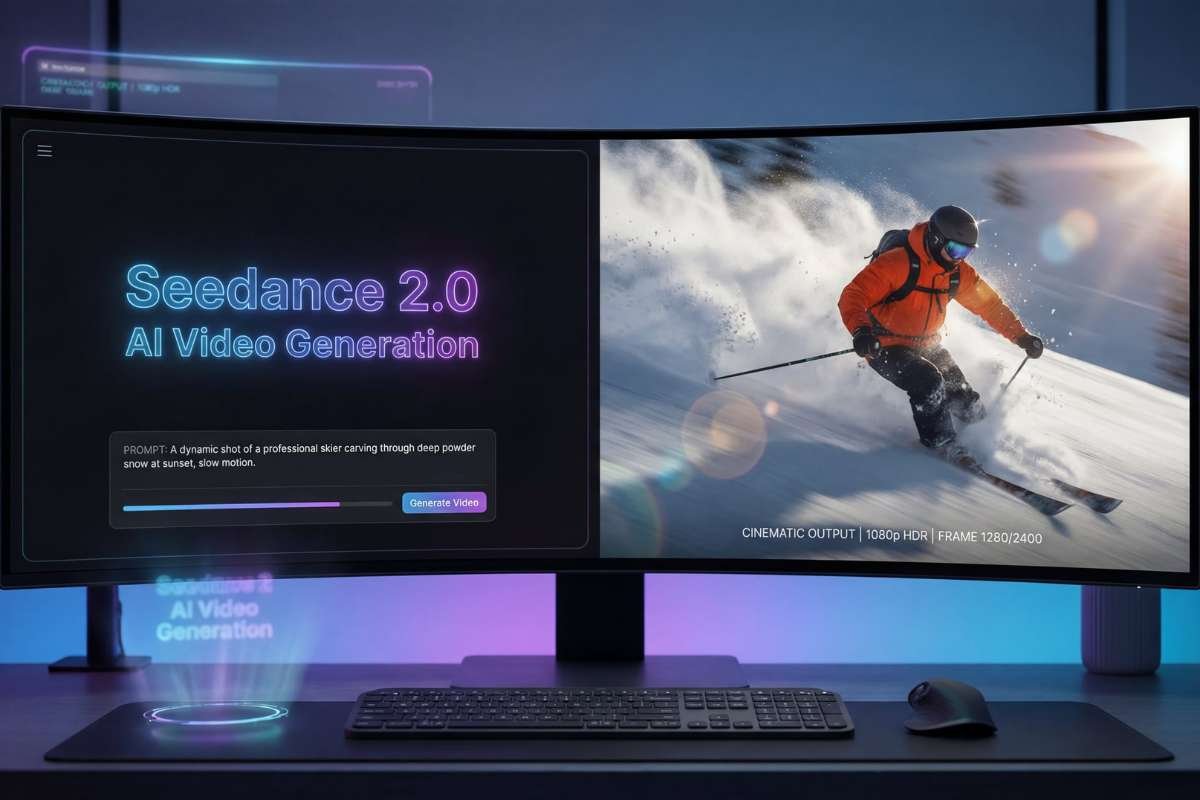
The artificial intelligence landscape has witnessed remarkable progress in content generation over the past few years, yet video synthesis has remained one of the most challenging frontiers. While text-to-image models achieved photorealistic quality relatively early, creating coherent, physics-accurate video with synchronized audio has proven far more complex. Enter Seedance 2.0, a multimodal AI system that’s rewriting the rules of what’s possible in automated video creation.
What sets this platform apart isn’t just incremental improvement over its predecessors. It represents a fundamental architectural shift in how AI systems approach the problem of audio-video generation. By adopting a unified multimodal framework that processes text, images, audio, and video inputs simultaneously, Seedance 2.0 has achieved something that fragmented, single-modal approaches consistently struggled with: true coherence across every dimension of the generated content.
Seven Core Pillars of Seedance 2.0’s Multimodal Architecture
1. The Architecture That Changes Everything
Traditional AI video generators typically operate in silos. A text-to-video model might excel at interpreting prompts but struggle with visual consistency. An image-to-video system could maintain appearance but fail at complex motion. Audio generation, if included at all, often feels like an afterthought, poorly synchronized with the visual content. The industry has essentially been stitching together separate models and hoping the seams don’t show.
Seedance 2.0 demolishes this fragmented approach with its unified multimodal architecture. The system processes all input modalities through a shared framework, allowing it to understand and maintain relationships between text descriptions, visual references, motion dynamics, and audio characteristics throughout the generation process. This isn’t just about accepting multiple input types; it’s about the model fundamentally understanding how these modalities relate to and influence each other.
The practical implications are staggering. Users can now input up to nine reference images, three video clips, three audio samples, and natural language instructions simultaneously. The model doesn’t just consider these inputs separately but understands how they should interact. When you provide an image of a specific character, a video demonstrating a particular movement style, and audio setting the emotional tone, Seedance 2.0 synthesizes these elements into a cohesive output that respects all constraints simultaneously.
2. Physics Accuracy: Where Previous Models Stumbled
One of the most persistent problems in AI video generation has been physical plausibility. Models would generate people walking through walls, objects defying gravity, or movements that violated basic physics. These failures weren’t just aesthetic issues; they represented a fundamental gap in the model’s understanding of how the real world operates.
Seedance 2.0 has made remarkable strides in this area, particularly evident in its handling of complex human interactions. The platform can now generate scenarios that previous systems couldn’t approach, such as competitive figure skating pairs performing synchronized jumps and spins. These aren’t simple motions; they require precise timing, weight distribution, momentum conservation, and coordination between multiple subjects.
The technical achievement here goes deeper than just “better training data.” The unified architecture allows the model to maintain consistent physical rules across the temporal dimension. When a character jumps, the model understands that their ascent must be followed by descent, that their center of gravity affects their balance, and that their clothing and hair should respond appropriately to movement and gravity. This physical consistency extends to interactions between objects and subjects, creating video that passes the crucial “reality check” that so much AI-generated content fails.
Consider a scenario where the model generates a character catching and throwing an object. Earlier systems might show the object appearing in the character’s hand or passing through their fingers. Seedance 2.0 maintains physical continuity: the object follows a ballistic trajectory, the character’s hand moves to intercept, fingers close around it at the right moment, and the throw imparts visible momentum. These details might seem minor individually, but collectively they determine whether the generated video feels authentic or uncanny.
3. Audio That Finally Matches the Picture
Perhaps the most underappreciated aspect of professional video content is audio design. A stunning visual sequence loses its impact if accompanied by generic, poorly synchronized sound. Yet audio has traditionally been the weakest link in AI video generation, often limited to basic background music that bears little relationship to on-screen action.
Seedance 2.0 integrates dual-channel stereo audio generation directly into its core architecture. This isn’t a separate audio model bolted onto a video generator; it’s a genuine multimodal synthesis where audio and visual elements emerge from the same underlying process. The result is audio that doesn’t just accompany the video but complements and enhances it with remarkable specificity.
The system can generate layered soundscapes with multiple concurrent audio tracks: background music, environmental ambiance, specific sound effects, and even human speech. These elements maintain appropriate timing relationships with visual events. When a character’s foot strikes the ground, the impact sound occurs at precisely the right moment. When a door swings closed, you hear the creak of hinges followed by the latch clicking shut. This level of audio-visual synchronization requires the model to understand causality in both modalities simultaneously.
The audio quality itself represents a significant leap forward. The system generates detailed, nuanced sounds that capture material properties. The scratch of glass differs from that of plastic, which differs from metal. Fabric rustling has an appropriate texture. Water sounds genuinely fluid. These aren’t pulled from a sound effects library; they’re synthesized to match the specific context of the generated video, creating an integrated audio-visual experience that earlier systems couldn’t approach.
4. Controllability: From Generation to Direction
Raw generation capability, while impressive, isn’t sufficient for professional content creation. Creators need control over the output, the ability to refine and adjust until the result matches their vision. This has been another persistent weakness in AI video systems, which often operate as black boxes producing unpredictable results.
Seedance 2.0 addresses this through multiple layers of controllability. The model demonstrates strong instruction following, accurately interpreting complex prompts with detailed specifications about subjects, actions, camera movements, and pacing. More importantly, it maintains consistency across these elements. If you specify that a character should wear specific clothing and perform a particular action sequence, the model won’t suddenly change their appearance or deviate from the described motion.
The platform also introduces video editing capabilities that let creators modify specific portions of generated content. This addresses a common frustration with earlier systems: if 90% of a generated video was perfect but one element was wrong, you’d need to regenerate the entire clip and hope for better luck. Seedance 2.0 allows targeted edits, changing specific subjects, actions, or narrative elements while preserving the rest of the scene.
The video extension feature represents another dimension of control. Rather than limiting creators to whatever length the model initially generates, they can extend sequences by providing continuation prompts. The model maintains visual and narrative continuity, effectively “continuing the shot” in a way that respects the established context. This transforms the generation process from a single-shot gamble into an iterative creative process.
5. Multimodal Reference: The Creative Multiplier
The ability to provide multimodal references fundamentally changes the creative workflow. Instead of struggling to describe everything in text, creators can now show the model examples of what they want. This reference capability operates across multiple dimensions simultaneously, allowing unprecedented creative control.
A creator might provide images establishing a specific visual style, video clips demonstrating desired camera movements or action choreography, and audio samples indicating the intended sonic atmosphere. The model processes these references holistically, understanding how to synthesize elements from each into a coherent output. This isn’t simple template matching; the system extracts higher-level concepts like composition principles, motion characteristics, and aesthetic qualities, then applies these to new contexts.
The storyboard reference capability is particularly powerful for structured content creation. Users can provide a visual storyboard with scene descriptions, and the model will interpret both the visual composition of each frame and the narrative flow between them. Combined with character and environment references, this enables highly specific content generation that would require enormous amounts of descriptive text to achieve through prompts alone.
6. Real-World Applications and Industry Impact

The technical capabilities of Seedance 2.0 translate into practical value across numerous industries. Commercial advertising can now generate high-quality product videos without expensive shoots. Film and television production can visualize scenes and test creative concepts before committing to physical production. Game developers can create cinematic sequences that dynamically adapt to gameplay variables. Educational content creators can illustrate complex concepts with custom animated explanations.
The economic implications are substantial. Professional video production typically requires significant investment in equipment, locations, talent, and post-production. While AI generation won’t entirely replace traditional production for all applications, it dramatically lowers the barrier to entry for high-quality video content. Small businesses can now create advertising that rivals major brand campaigns. Independent filmmakers can visualize ambitious scenes beyond their budget. Educators can produce polished explanatory content without video production expertise.
The platform’s 15-second high-quality output capability with multi-shot compositions addresses real production needs. Many commercial applications, from social media advertising to product demonstrations, operate within this timeframe. The ability to generate complete, polished videos at this length, with proper audio and visual flow, makes the system immediately practical for commercial deployment.
7. The Road Ahead
Despite its impressive capabilities, the development team acknowledges that Seedance 2.0 isn’t perfect. Generated content still exhibits occasional artifacts, consistency challenges, and areas where physical accuracy falters. Fine details can become unstable across frames. Complex multi-subject interactions sometimes break down. Audio synchronization, while vastly improved, isn’t flawless.
What’s significant is that these limitations are increasingly edge cases rather than fundamental flaws. The core architecture has proven capable of addressing previously intractable problems. Future iterations will likely refine reliability and extend capabilities rather than requiring fundamental redesigns.
The unified multimodal approach that Seedance 2.0 pioneered represents a template for future development in AI content generation. By training models to understand relationships between modalities from the ground up rather than trying to bridge between separate systems, we achieve more coherent, controllable, and contextually appropriate outputs. This architectural insight extends beyond video generation to any task requiring coordination across multiple types of information.
As the technology continues to evolve, the gap between AI-generated and professionally produced content continues to narrow. Seedance 2.0 represents a significant step in that journey, demonstrating that many of the fundamental challenges in AI video generation have viable solutions. The future of content creation isn’t about AI replacing human creativity but about providing creators with powerful new tools that multiply their capabilities and bring ambitious visions to life.