


In today’s world, where global supply chains shape the pace of business, agility and reliability in logistics are essential for success. Behind every smooth delivery and efficient warehouse operation is a careful combination of clear vision, accuracy, and strong leadership, qualities that set outstanding organizations apart. The logistics sector in Saudi Arabia has grown into a vibrant and innovative environment focused on efficiency and a deep understanding of customer needs. Leading this change is a new generation of leaders who are transforming how goods and value move within the Kingdom and beyond.
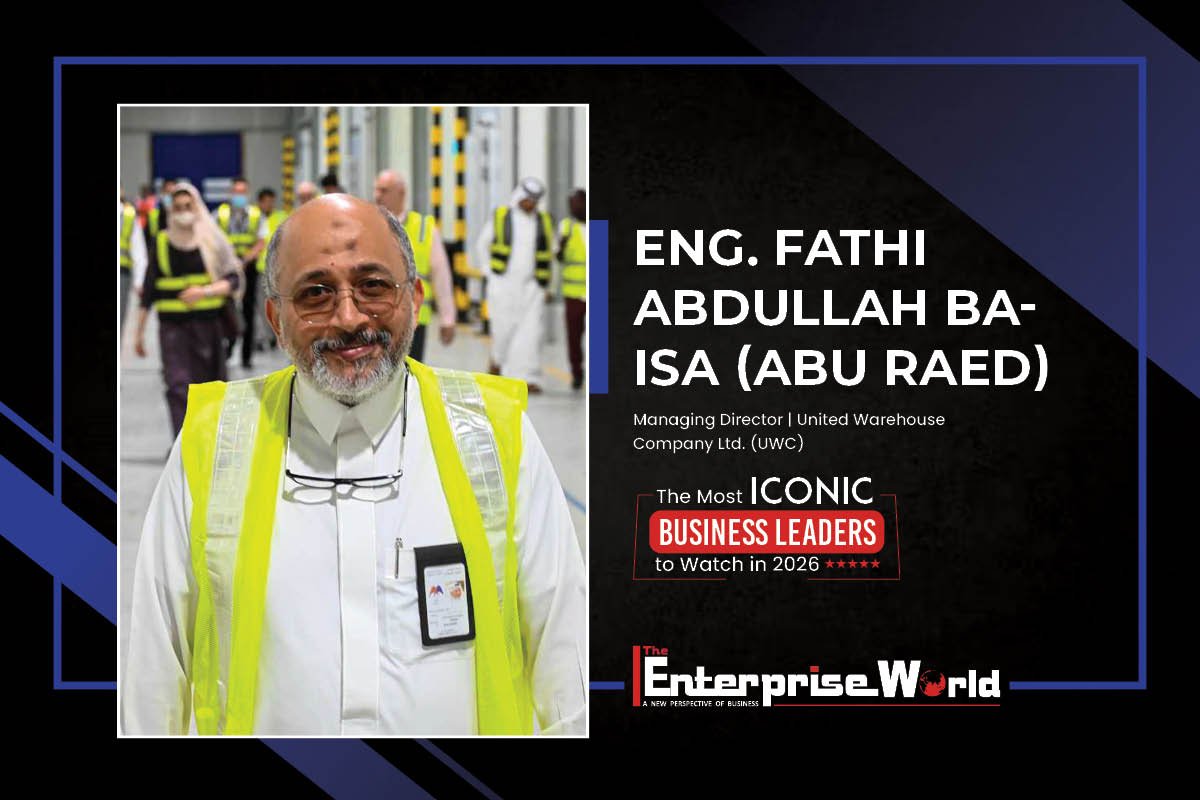
One key figure in this transformation is Eng. Fathi Abdullah Ba‑Isa (Abu Raed), the Managing Director of United Warehouse Company Ltd. (UWC). Since UWC was founded in 2007, his leadership has played a vital role in establishing the company as a trusted provider of third‑party logistics (3PL) services. Abu Raed’s approach, based on reliability, quick response, and thorough customer insight, has created a culture of operational excellence. This enables UWC to manage hundreds of trucks every day and serve some of the region’s leading brands. His forward-thinking leadership continues to enhance UWC’s reputation as a dependable logistics partner focused on quality service and long-term value.
A Lifetime of Learning That Built a Modern Logistics Vision
Abu Raed’s path to becoming the Managing Director of United Warehouse Company is the result of nearly forty years of practical leadership experience in manufacturing, engineering, and logistics. He started his career as a Project Engineer in food production and packaging, where he developed strong skills in operational discipline and process improvement. Over time, he managed large new factory projects, major expansions, and complete plant overhauls in industries such as corrugated cartons, plastics, and food manufacturing.
His move into logistics leadership began during his early work at United Warehouse and continued when he served as assistant general manager at Al Taufiq Plastic. In these roles, he focused on improving efficiency through lean operations, optimizing supply chains, and driving business growth. Since 2019, as Managing Director of UWC, Abu Raed has guided the company through a major transformation into a fully integrated logistics provider. Under his leadership, UWC now offers services including freight forwarding, customs clearance, transportation, and e-commerce fulfillment. His efforts in automation, team development, and strategic market growth have established UWC as a leading logistics company in Saudi Arabia.
A Turning Point in the Journey to Become a Diverse Logistics Provider
Before Abu Raed joined, the company mainly operated as a second-party logistics (2PL) business with limited involvement in third-party logistics (3PL) warehousing. At that time, its infrastructure was mostly focused on dry storage. A key turning point during his leadership was the strategic decision to transform United Warehouse Company into a fully integrated 3PL and contract logistics provider.
Under his guidance, the company added new capabilities such as temperature-controlled, chilled, frozen, and dangerous goods (DG) warehousing. This expansion significantly broadened UWC’s services to support sectors including fast-moving consumer goods (FMCG), food, chemicals, and e-commerce. Achieving this transformation required considerable capital investment, compliance with regulatory requirements, operational changes, and focused talent development.
This shift from a traditional dry warehouse operator to a multi-sector logistics solutions provider marked a defining moment in the company’s growth. It accelerated expansion, improved customer loyalty, and established UWC as one of the most diverse warehousing and logistics platforms in the region.
Flexible, Scalable, and Fully Connected Logistics Services
United Warehouse Company addresses the common challenge of fragmented logistics by providing a complete, fully integrated logistics solution on a single platform. This means customers do not have to manage multiple service providers for warehousing, transportation, customs clearance, freight forwarding, handling dangerous goods, temperature-controlled storage, and e-commerce fulfillment. Instead, UWC manages the entire supply chain with one point of accountability.
What sets UWC apart is the combination of extensive infrastructure and operational flexibility. The company operates in dry, air-conditioned, chilled, frozen, and dangerous goods environments, allowing customers to expand across different temperature and regulatory requirements without needing to change partners. UWC’s approach focuses on tailored solutions rather than standard pricing, designing storage, handling, value-added services, and distribution models to fit each customer’s specific business needs.

Additionally, UWC’s strengths include:
- Fast market entry through available infrastructure and quick onboarding
- Strong compliance with regulations from authorities such as SFDA, Civil Defense, and municipal bodies
- Technology-driven operations using warehouse management systems (WMS) for visibility and performance tracking
- A partnership approach, acting as a strategic extension of customers’ supply chains rather than just a service provider
This blend of scalable infrastructure, regulatory expertise, technological support, and a partnership mindset makes United Warehouse Company a leading and distinctive 3PL and contract logistics provider in Saudi Arabia, far beyond a traditional warehouse operator.
United Warehouse Company Ltd. – End‑to‑End Logistics Solutions at a Glance

1. Warehousing Solutions
- One of the largest warehousing facilities in the Kingdom with in Jeddah, approximately 450,000 sqm of land with around 200,000 sqm of covered warehousing space and a total capacity of about 200,000 pallet positions across multiple logistics villages. In Riyadh, UWC has an operational facility in the 2nd Industrial City with over 6,000 pallet positions
- Designed for high-volume storage, efficient inventory handling, and year‑round operations. These facilities support dry, air-conditioned, chilled, frozen, and open-yard storage, with 24/7 operations and the capability to handle over 300 trucks per day
2. Cross-Docking
- Dedicated docking terminals for quick receiving and transfer of products.
- Minimizes storage time, speeds up order fulfillment, and optimizes distribution flows.
3. Value‑Added Services
- Kitting, packaging, and repacking tailored to customer and product requirements.
- Supports product customization, promotional bundling, and compliance-ready preparation.
4. Freight Transport Solutions
- Tailored transport services within Jeddah and across all parts of the Kingdom, along with cross boarder transportation services.
- Integrated with warehousing and cross-docking to provide end‑to‑end logistics coverage.
Strong Processes That Ensure Reliable and Ethical Operations
At United Warehouse Company, trust and transparency are not just ideas but are built into the company’s governance, processes, and leadership culture. Trust is developed through clear accountability, with every department working under well-defined key performance indicators (KPIs), regular audits, and clear procedures for addressing issues. Transparency is ensured by providing real-time visibility into operations, maintaining detailed standard operating procedures (SOPs), and using data-driven performance reports so that decisions are always based on facts and can be tracked at every level.
Regarding compliance and ethics, the company follows a “compliance-by-design” approach. This means that regulatory requirements, such as those from the Saudi Food and Drug Authority (SFDA), Civil Defense, dangerous goods handling, quality management, and environmental standards, are integrated into the design of facilities, processes, and training programs from the beginning, rather than being fixed after audits. Ethical standards are maintained through strict policies that allow no tolerance for violations, separation of responsibilities, and close management oversight across both commercial and operational teams.
Quality control is maintained through consistent inspection routines, traceability managed by warehouse management systems (WMS), ongoing internal audits, and structured processes for correcting issues. Customer feedback is systematically gathered and reviewed through regular business reviews, service scorecards, clear procedures for handling concerns, and continuous improvement efforts.
Ultimately, United Warehouse Company achieves consistent high standards by aligning disciplined personnel, strong processes, and system-based controls. This approach ensures the company maintains excellence in compliance, service quality, and customer trust year after year.
A Unified System That Improves Speed, Quality, and Compliance
While United Warehouse Company’s strength is rooted in adopting best-in-class global logistics practices, its true strategic advantage lies in how these practices have been adapted, integrated, and implemented through proprietary frameworks specifically designed for the Saudi market. Over time, the team has developed standardized models for onboarding new customers, aligning with compliance requirements, and quickly scaling operations from pilot phases to full commercial activity, all without sacrificing service quality.
UWC operates under a single-window governance framework that unifies warehouse management system (WMS) controls, key performance indicator (KPI) dashboards, quality assurance and control, safety, and commercial performance into one cohesive layer. This approach provides real-time visibility, enables faster decision-making, and allows the company to anticipate and resolve issues proactively rather than reacting after problems arise.
From an operational perspective, UWC’s edge also comes from several key strategies:
- Zoned warehouse designs that allow flexible conversion of space between dry, air-conditioned, chilled, frozen, and dangerous goods storage based on market needs
- Manpower planning frameworks that align labor costs directly with activity volumes to optimize efficiency
- Regulatory compliance built into the design phase, ensuring adherence to Civil Defense, SFDA, and dangerous goods regulations from the start, rather than correcting issues after audits
- Scalable integration playbooks that enable smooth coordination with transporters, freight forwarders, customs brokers, and last-mile delivery partners within a unified execution system
Together, these internal frameworks give United Warehouse Company a strong operational advantage. They enable faster scaling, maintain high compliance standards even at large volumes, control costs effectively, and consistently deliver more reliable service compared to traditional warehouse operators.
Key Trends Shaping the Next Generation of Logistics
The warehousing and supply chain industry is experiencing a significant transformation driven by digitization, stricter regulations, higher customer expectations for speed, and growing demand for temperature-controlled storage. Traditional warehouses are growing into advanced fulfillment and distribution centers powered by technology.
Key trends shaping the industry include strong growth in temperature-controlled logistics driven by food security, pharmaceuticals, biotechnology, and fresh e-commerce. Automation and artificial intelligence are enhancing warehouse and transportation management, demand forecasting, and labor efficiency. Regulatory standards are becoming stricter, especially regarding the Saudi Food and Drug Authority (SFDA), dangerous goods, environmental and social governance (ESG), carbon tracking, and traceability. Omni-channel fulfillment requires warehouses to serve retail, wholesale, B2B, B2C, and dark-store models all in one place. There is also a shift from fixed assets to flexible, scalable warehousing solutions that quickly adapt to customer needs.
Looking toward 2026 and beyond, leaders should watch for AI-driven autonomous operations, mandatory carbon-neutral warehouses, city-based micro-fulfillment centers, optimized cross-border logistics in the GCC, Africa, and South Asia, and increased financial services integrated into 3PL systems.
Abu Raed states, “The companies that will lead this next cycle are those that treat logistics as a strategic growth enabler, not a back-end cost center, investing early in technology, compliance depth, multi-temperature infrastructure, and data-driven execution.” He believes this will define future market leaders.
Expanding Capacity to Support Vision 2030 Goals
At this stage, United Warehouse Company is actively advancing a multi-city expansion plan focused on Riyadh, Dammam, Makkah, and Madina, with particular attention to food-grade and pharmaceutical logistics facilities. The expansion in Riyadh is already under construction and represents an important step in strengthening the company’s presence in the central region. Simultaneously, detailed planning is in progress for developments in Dammam and the western holy cities, with these phases expected to begin soon as part of the company’s nationwide growth strategy.
These expansions are designed to meet long-term market demand, comply with regulatory requirements, and support Saudi Arabia’s Vision 2030 goals. They will further solidify United Warehouse Company’s position as a leading national provider of multi-temperature and pharmaceutical-grade logistics services.
A Leadership Lesson Rooted in Partnership and Progress
The most important lesson Abu Raed has learned as a leader in warehousing and logistics is that lasting success comes from collaboration, not competition. The industry is highly interconnected, making it impossible to grow in isolation. Long-term value is created through strong partnerships with customers, suppliers, and other stakeholders, where trust, transparency, and shared growth are prioritized over short-term profits.
Equally crucial is the commitment to continuously improve services by upgrading infrastructure, systems, and operational standards to meet and exceed customer expectations. This combined focus on partnership-driven growth and ongoing service enhancement is what ultimately ensures customer loyalty and sustained market leadership.

Open Letter to the Next Generation of Logistics Leaders
Dear Upcoming Professionals and Future Leaders in Warehousing and Logistics,
This industry will test your patience, character, and resilience long before it rewards your ambition. My first advice is simple that master the fundamentals before chasing titles. Spend time on the warehouse floor, understand operations at ground level, learn compliance, safety, inventory discipline, and customer expectations in real conditions and not from reports alone.
Build your career on credibility, not shortcuts. In logistics, reputations travel faster than CVs.
Your ethics, commitment to quality, and reliability will define your long-term value far more than short-term achievements. Every delayed shipment, every compliance failure, and every customer promise kept or broken shapes who you become as a leader.
Embrace technology, but never abandon people. Automation, AI, and digital platforms will reshape this industry, but leadership will always remain human. Invest equally in systems and in team development because a motivated, trained, and respected workforce will outperform any machine.
Think long term and work with humility. Logistics is not an overnight success story. True leadership is built through consistency, learning from failure, adapting to change, and staying disciplined when growth is slow. If you remain curious, committed, and principled, this industry will reward you with opportunities that go far beyond titles; it will give you the chance to build real infrastructure, real impact, and real legacy.
The future of logistics belongs to leaders who combine operational depth, ethical strength, and strategic vision. Aim to be one of them.
Eng Fathi Abdullah Ba-Isa ( Abu Raed )
Managing Director, United Warehouse Company Ltd.
5 Key Takeaways from Eng Fathi Abdullah Ba-Isa ( Abu Raed )’s Impact on the Logistics Industry
- Transformational Leadership – Abu Raed led the shift from a basic dry-storage operator to a fully integrated 3PL provider offering multi-temperature, DG, and value-added logistics services.
- Strong Operational Systems – UWC’s success is built on clear KPIs, strict compliance, real-time visibility, and standardized frameworks that ensure consistency, quality, and speed.
- Customer-Centric, Scalable Solutions – The company provides end-to-end logistics from warehousing to transport to e-commerce, eliminating the need for multiple vendors and enabling faster market entry.
- Future-Focused Strategy – Abu Raed emphasizes technology, automation, regulatory depth, and flexible infrastructure as the pillars that will shape the next generation of logistics.
- Leadership Rooted in Ethics and Partnership – Abu Raed believes long-term success comes from collaboration, strong ethics, continuous improvement, and building trust across the supply chain ecosystem.














