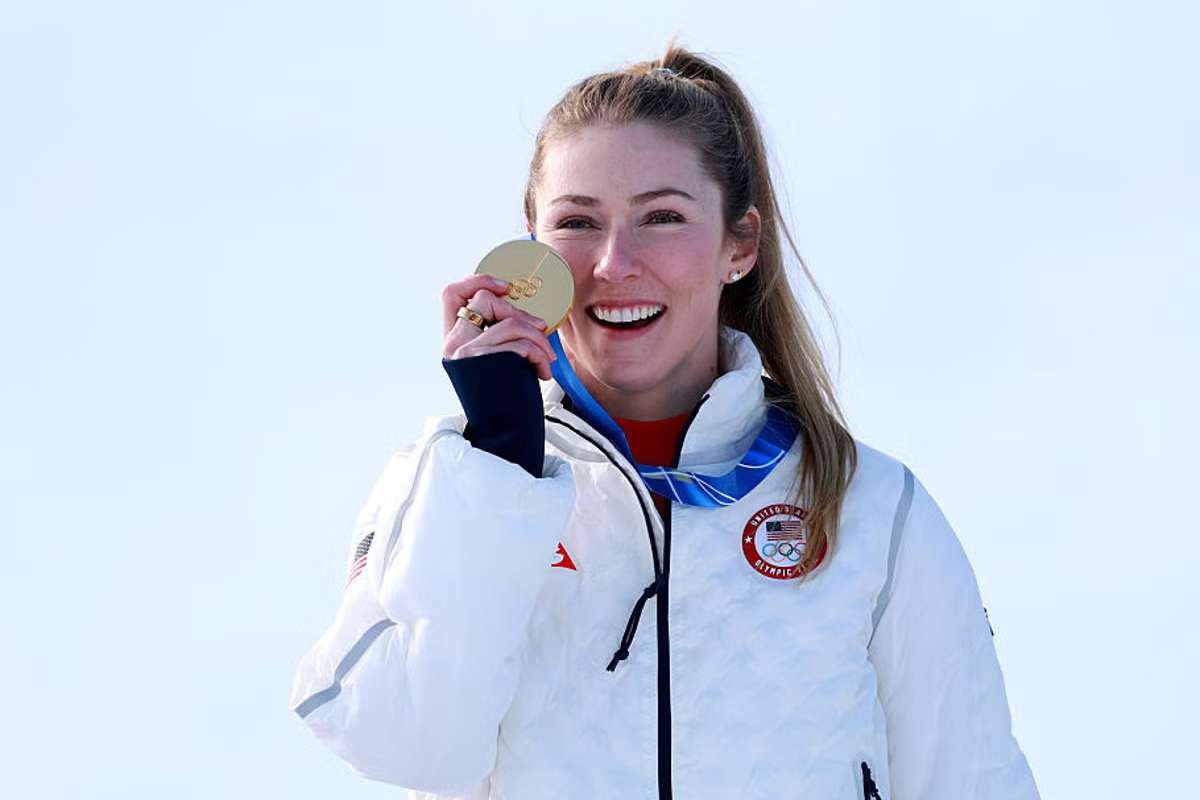
In a defining moment at the 2026 Winter Olympics in Cortina d’Ampezzo, American alpine skiing icon Mikaela Shiffrin delivered a performance that will be etched into Olympic history. The 30-year-old secured gold in the women’s slalom, marking her first Olympic medal in eight years and reaffirming her status as one of the greatest technical skiers of her generation.
Racing on the storied Olimpia delle Tofane course, Shiffrin clocked a combined time of 1:39.10 across two runs, finishing a commanding 1.50 seconds ahead of Switzerland’s Camille Rast, who took silver. Sweden’s Anna Swenn-Larsson claimed bronze. The margin of victory was among the most dominant seen in Olympic slalom competition in decades.
Mikaela Shiffrin had built a strong foundation in the opening run, carrying a significant lead despite a brief moment of imbalance mid-course. In the decisive second run, she skied with composure and precision, navigating the technical turns with fluid control. As she crossed the finish line, her calm demeanor reflected not just victory, but relief.
The gold medal marks her third Olympic title, making her the first American alpine skier to achieve that milestone. She previously won slalom gold in 2014 and giant slalom gold in 2018. This triumph also ended a long wait for an Olympic podium finish after missing out in Beijing four years earlier.
From Setbacks to Redemption
Mikaela Shiffrin’s path to Olympic redemption was anything but straightforward. Entering the Milan-Cortina Games, expectations were high, yet early results raised doubts. She finished outside the medals in the giant slalom and narrowly missed the podium in the team combined event. The scrutiny that followed echoed memories of the 2022 Winter Olympics, where she left without a medal despite being a heavy favorite.
Beyond competitive pressures, Shiffrin has faced profound personal challenges in recent years. The loss of her father in 2020 deeply affected her both personally and professionally, reshaping her perspective on competition and life. She has spoken candidly about grief, anxiety, and the mental demands of elite sport conversations that have resonated far beyond the skiing community.
Her slalom victory in Cortina symbolized more than technical mastery; it represented resilience. Observers noted the quiet moment she took at the finish area, a pause that seemed to carry the weight of eight years of heartbreak, criticism, and self-doubt. Rather than an exuberant celebration, there was a sense of calm fulfillment.
A Legacy Strengthened
With this victory, Mikaela Shiffrin achieved a rare Olympic distinction: she became both the youngest and the oldest American woman to win Olympic gold in slalom. The 12-year span between her first and most recent slalom titles underscores her longevity in a sport that demands precision, adaptability, and mental toughness.
Already the most decorated alpine skier in World Cup history, Shiffrin’s Olympic comeback adds a powerful chapter to her legacy. It reaffirms her ability to evolve, endure, and perform under immense pressure. More importantly, it highlights a broader narrative that success in elite sport is often intertwined with vulnerability, growth, and perseverance.
In Cortina, Mikaela Shiffrin did more than win a race. She reclaimed her place atop the Olympic podium, transforming years of pressure into what she described as a sense of peace, a golden moment forged through resilience.