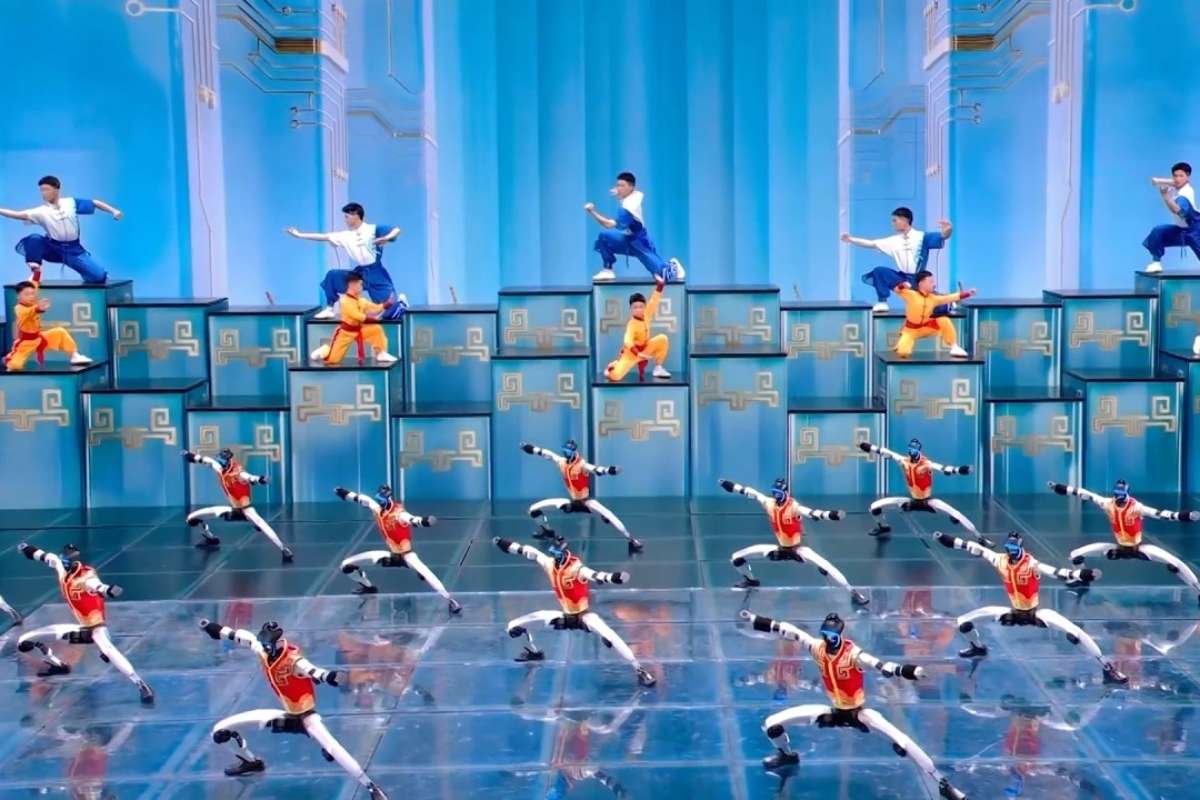
China’s most-watched annual television broadcast, the CCTV Spring Festival Gala, transformed into a global technology showcase this year as humanoid robots performed live before hundreds of millions of viewers. The Lunar New Year celebration, traditionally known for music, dance, and cultural performances, featured advanced humanoid machines executing synchronized martial arts routines, acrobatics, and theatrical skits.
Robots developed by leading Chinese firms such as Unitree Robotics, Galbot, Noetix, and MagicLab shared the stage with human performers. One standout act featured dozens of robots moving in near-perfect unison, performing kung fu sequences and coordinated formations that demonstrated remarkable balance, agility, and spatial awareness. Compared with earlier demonstrations in previous years, the machines appeared significantly more refined, displaying improved motor control and stability.
The spectacle quickly went viral across digital platforms, amassing billions of online views and sparking widespread discussion about China’s growing strength in artificial intelligence and robotics. For many viewers, the performance symbolized not just entertainment innovation but a bold statement of technological ambition.
From Performance to Practical Application
Beyond the choreography, the Spring Festival Gala also highlighted the commercial potential of humanoid robotics. Several companies used the broadcast to demonstrate how these machines could transition from stage performers to real-world assistants.
Galbot showcased robots capable of sorting household items and folding clothes, while MagicLab displayed humanoids serving food in controlled environments. Noetix introduced lifelike androids designed for interactive service roles, hinting at applications in hospitality and customer engagement. Meanwhile, Unitree’s robots demonstrated advanced obstacle navigation and coordinated group movement, signaling potential for logistics, inspection, and industrial tasks.
Following the broadcast, public interest in humanoid robots surged dramatically. Online searches, product inquiries, and investor attention reportedly spiked, reflecting a growing perception that humanoid robots are moving closer to commercial viability.
China’s broader industrial strategy has played a key role in this acceleration. Government support, integrated manufacturing supply chains, and heavy investment in AI research have allowed domestic firms to iterate rapidly and reduce development costs. Analysts suggest that this ecosystem advantage has positioned Chinese companies to scale production faster than many international competitors.
A Symbol of Intensifying Global Competition
The gala performance also carried geopolitical undertones. As competition in artificial intelligence intensifies globally, humanoid robotics has emerged as a new frontier in the technological rivalry between China and the United States.
Chinese companies have ramped up production of humanoid units at a pace that rivals Western initiatives, including Tesla’s Optimus program. Industry leaders have acknowledged that Chinese robotics firms are likely to become formidable competitors in the global humanoid market.
However, experts caution that while the gala performance demonstrated impressive coordination and control, most of the showcased tasks were pre-programmed and executed in controlled environments. Significant technical challenges remain before humanoid robots can reliably operate in unpredictable, real-world conditions.
Still, the message from Beijing was unmistakable. By integrating cutting-edge robotics into one of the world’s largest cultural broadcasts, China signaled its intent to lead not only in manufacturing and AI research but also in shaping the global narrative around the future of intelligent machines.
The Spring Festival Gala may have been a celebration of the Lunar New Year, but this year it also served as a stage for a much larger announcement: the race for humanoid AI dominance is accelerating, and China intends to be at the forefront.