
Ancient Greece has intrigued every archaeologist. It was the birthplace of democracy, philosophy, geometry, astronomy, and the Olympics. It was also one of the earliest civilizations.
When we think of the Greeks, we imagine Socrates and Plato debating, Diogenes committing acts of ridicule, and Herodotus recording it all. But how did these guys live? What do ancient Greek houses look like? It is a question that might come to mind, but you may not consider.
In today’s blog, we will answer a simple question: What were houses like in Ancient Greece?
A Walk Through an Ancient Greek House During Its Golden Age
Now, when we think of ancient Greek architecture, we think of the stone temples and monuments that have stood the test of time. And while they are a great reminder of their skills, it is not how an average Greek family would live.
So what were the houses like in Ancient Greece? Let’s find out.
Most Greeks lived in simple, practical homes made of sun-dried mud bricks and wood. Here’s what you would see when you entered a Greek’s house during their golden age. Let’s take a tour, shall we?
Now, before we enter, we must understand this is a classical Greek house, not an archaic one. We will talk about their differences later.
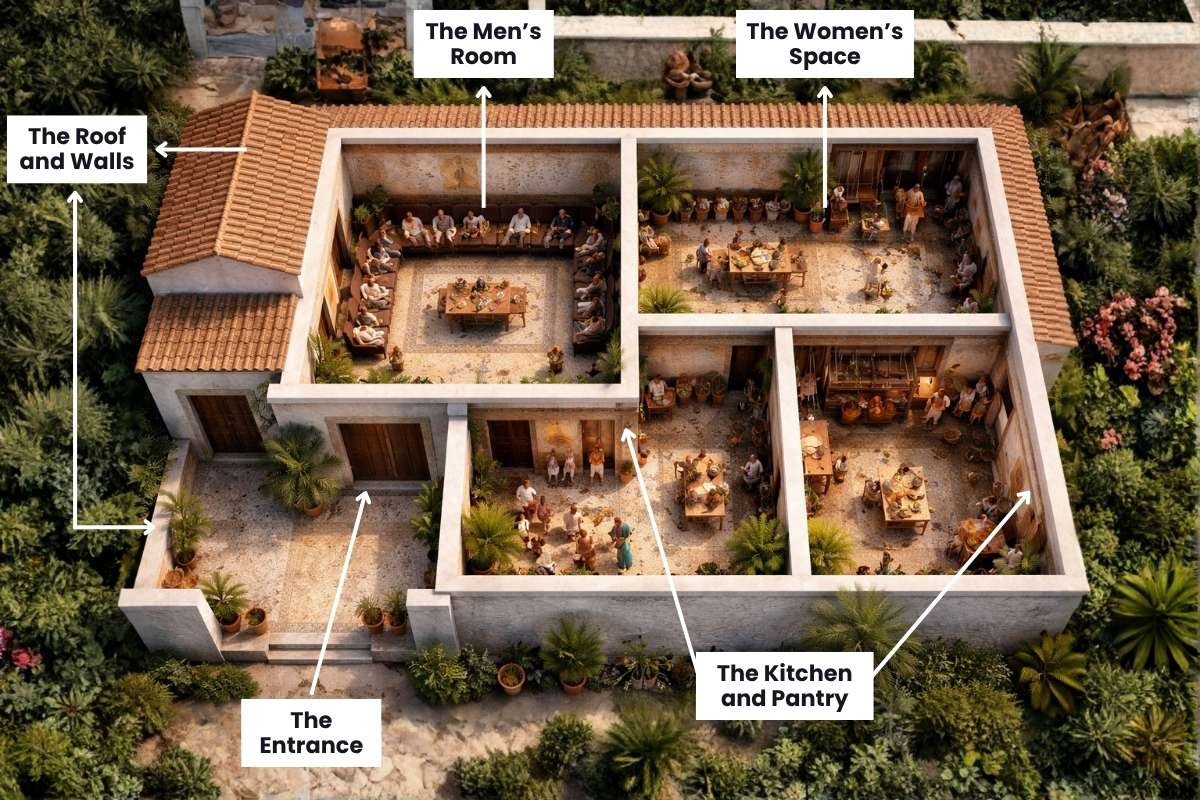
The Entrance
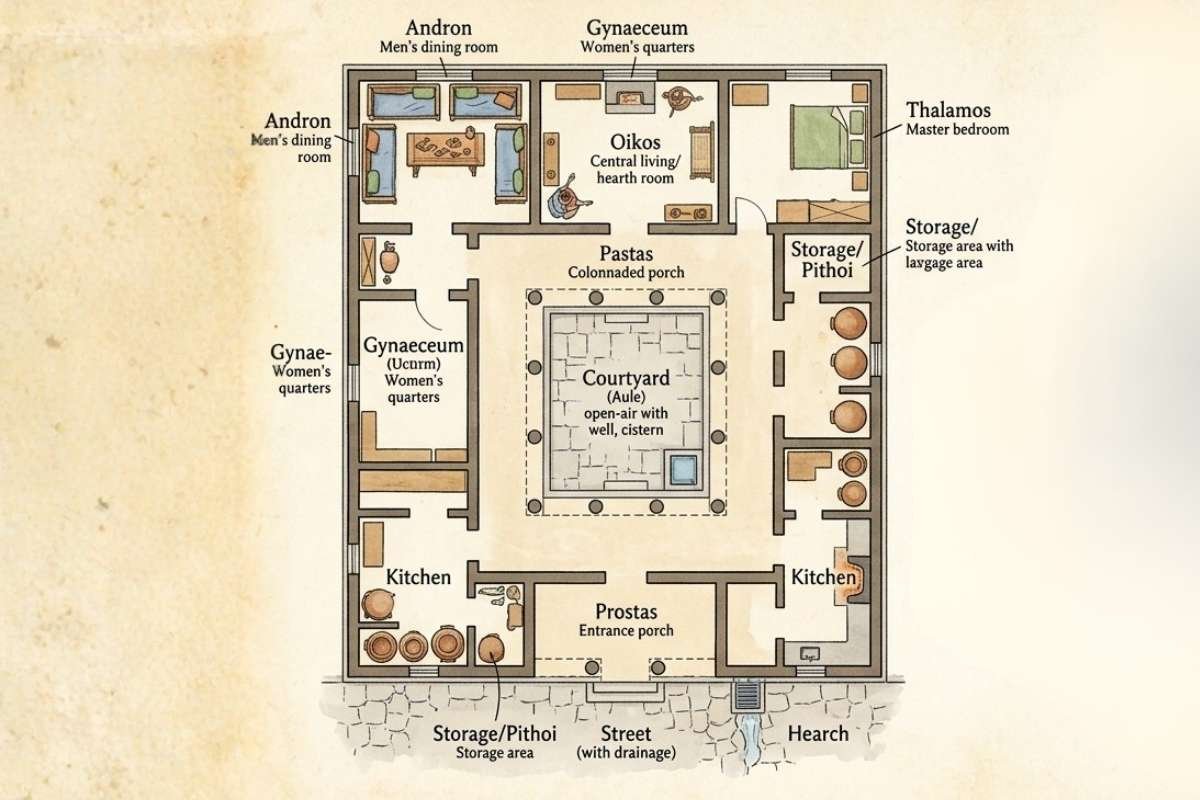
In ancient Greek houses, we step through the single wooden door. We are in a short hall. This leads to the Aule, or the open court. This is the heart of the home. All other rooms face this space. It lets in light and fresh air. In the center sits a stone altar, hearth of Hestia. The family meets here to pray each day.
The Men’s Room
To our left is the Andron. This is the room for the master and his friends. It sits near the front door. This keeps guests away from the rest of the house.
Look at the floor. It has a pattern made of small stones. Low wooden couches line the walls. Men recline here to eat and talk. They drink wine and discuss the city. This is the most decorated room in the house.
The Women’s Space
Now we move to the Gynaikon. This is the space for the women and children. It is often on the second floor. It is the most private part of ancient Greek houses.
You can see large wooden looms here. The women spend the day spinning wool. They make all the clothes for the family. Large chests hold their fine linens and robes. This room is quiet and away from the street noise.
The Kitchen and Pantry
Next, we see small rooms for food. Huge clay jars line the walls. They hold golden olive oil, dark wine, and grain.
The kitchen is very simple. There is no large stove. Instead, the cook uses a small clay pot. It holds hot coals to heat the food. They cook simple meals like flat bread, salty cheese, and olives. The smoke from the fire drifts up and out through the open court.
The Roof and Walls
Look up at the roof. It is made of heavy red clay tiles. These tiles are baked in the sun. They are very heavy and keep the house dry when it rains.
The walls are thick but soft. A thief can sometimes dig right through the mud bricks. This is why the house has few doors to the outside. Everything is built to keep the family safe and cool.
Archaic vs Classical Greek Houses: Key Differences Explained
Now, ancient Greece had five periods: the Dark Age, Archaic Period, Classical Period, Hellenistic Period, and Roman Greece. Each period had a different architecture, due to the technology available.
But when we talk about ancient Greece today, the one with philosophy and democracy, we are discussing the Archaic and classical periods.
Alexander the Great lived in the Hellenistic period, which is a completely different story. But when we think about that era of Greece, we don’t think about Ancient Greek houses, but rather the conquest.
So, let’s discuss the difference between the Archaic and Classical period houses of Ancient Greece.
| Archaic Greek Houses (c. 800–480 BC) | Feature | Classical Greek Houses (c. 480–323 BC) |
|---|---|---|
| Simple layouts, often one or two rooms; sometimes oval or apsidal structures | Overall Layout | Organized around a central courtyard (aule) with rooms surrounding it |
| Generally small and basic | Size | Larger and more structured, with multiple rooms |
| Mud bricks, wood, thatch roofs; early use of clay tiles | Building Materials | Mud-brick walls on stone foundations with terracotta roof tiles |
| Little or no specialized rooms | Room Organization | Clear room functions (dining room, storage, women’s quarters) |
| Rare or not clearly defined | Men’s Room (Andron) | Andron used for male gatherings and symposia |
| No strong separation of spaces | Women’s Quarters (Gynaikonitis) | Separate gynaikonitis for women and children, often upstairs |
| Not always present or fully developed | Courtyard | The central courtyard is the main feature of the house |
| Minimal decoration | Decoration | Decorative floors such as pebble mosaics, especially in the andron |
| Less emphasis on privacy | Privacy Design | Houses designed with few street-facing windows and doors for privacy |
| Irregular house layouts in early settlements | Urban Planning | More structured houses in planned cities such as Athens |
Archaeological Discoveries That Revealed the Layout of Greek Houses
We know about these ancient Greek Houses because of the hard work of experts. These teams dig deep into the ground. They find the walls and floors that have been buried for years. Their work shows us how both poor and rich people lived.
Early Discoveries at Thorikos
South of Athens, a team led by Dr. Johannes Bergemann found a very old house from the Iron Age. This is the oldest Greek house we know of. It has many rooms and a paved yard. Inside, the team found heavy grinding stones. These stones show that the family spent a lot of time making their own flour.
The Big Finds at Olynthus and Halieis
Years ago, David M. Robinson led a big dig at a place called Olynthus. He found over 100 houses! One is called the “House of Many Colors.” It is famous because it has pretty floor art and even early plumbing.
At a site called Halieis, another team found a house with 11 rooms. They found the Andron and the hearth where the family cooked. They also found small items like pots. These items tell us exactly what people did every day.
Digging in the Heart of Athens
The American School of Classical Studies has worked in the center of Athens for a long time. They found many ancient Greek houses in the old market area. One of these is the Vari House. It was built near a cave.
These digs show us how the streets were laid out. We can see where the large storage jars sat. We can also see how the rooms were split for men and women. Each stone and pot they find helps us tell the story of the past.
Read More:
- 7 Ancient Wonders of the World: Stories, Secrets, and the Legacy They Left Behind
- 21 Tombs Around the World: Tales of Power, Belief, and Architecture
Conclusion
So, what were houses like in Ancient Greece? They were private, simple, and built around the sun. Most homes faced inward to a central yard. This Aule brought light and air into every room. The walls were made of thick mud bricks to keep the heat out.
Inside, the home was split into areas for men and women. The Andron was for guests and talk. The Gynaikon was for family and work. While the outside looked plain, the inside was the heart of family life.
Today, teams of experts dig up these old floors. They find pots and stones that tell us how people lived long ago. From the small homes in Athens to the big villas with art, each of the ancient Greek houses shows us a piece of history.
FAQs
1. What did people eat in Ancient Greece?
Most Greeks ate a simple diet of bread, olives, and cheese. They also enjoyed fresh grapes, figs, and honey for sweetness. Meat was rare and usually saved for special feast days.
2. What did Ancient Greeks wear?
Men and women both wore light tunics made of linen or wool. These garments were called a chiton or a peplos. They also wore leather sandals or went barefoot inside the home.
3. Did children go to school in Ancient Greece?
Boys in cities such as Athens went to school to learn reading and music. They also practiced sports such as wrestling. Most girls stayed at home to learn how to run a household and weave cloth.