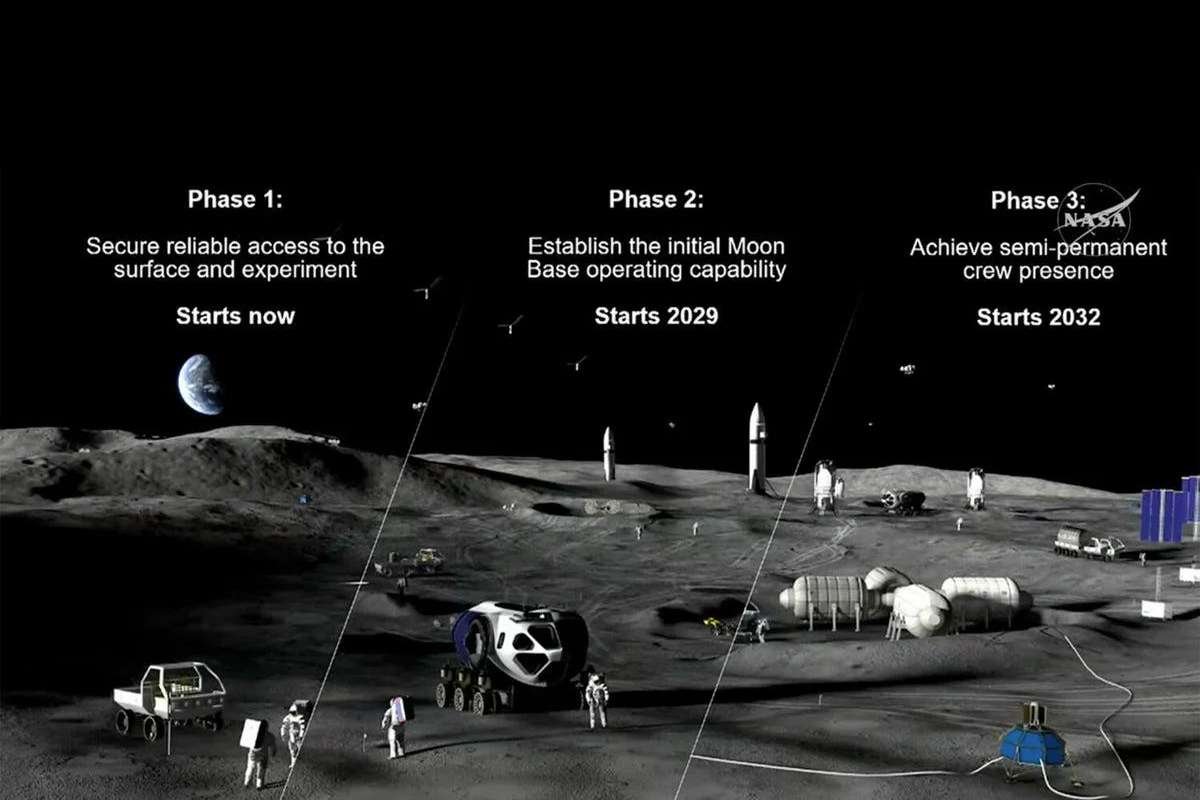
NASA has announced a bold plan to establish a permanent human presence on the Moon, with a base targeted near the lunar south pole. The initiative, projected to cost around $20 billion over the next seven years, signals a significant shift from brief, symbolic landings to long-term habitation and continuous scientific operations.
The lunar south pole is a strategic choice. Its permanently shadowed craters are believed to contain ice and other volatile resources, which could supply water, fuel, and life-support essentials for astronauts. By harnessing these resources, NASA hopes to create a self-sustaining lunar outpost capable of supporting repeated missions and extended stays.
Officials describe this venture as a phased approach starting with exploratory missions, moving to semi-permanent surface occupation, and ultimately establishing a fully equipped lunar base. Unlike the sporadic Apollo-era landings, the new roadmap emphasizes frequent missions, ongoing research, and infrastructure development, laying the foundation for a continuous human presence on the Moon.
Shifting Focus from Orbit to the Lunar Surface
A major change in NASA’s strategy is the pivot away from the Lunar Gateway, a planned orbiting station initially conceived as a staging hub for lunar landings near the lunar south pole. While Gateway will still contribute to broader exploration plans, the agency now aims to directly invest in surface infrastructure, such as habitats, power systems, rovers, and communication networks.
This decision reflects the agency’s goal of making the Moon a viable long-term platform for both human and robotic missions. By focusing on surface operations, NASA plans to accelerate technology development and ensure that key infrastructure is ready within the next two to four years.
The renewed emphasis on lunar surface construction aligns with broader exploration priorities, including the eventual retirement of the International Space Station and preparation for Mars missions. Establishing robust infrastructure on the Moon also allows NASA to test technologies, life-support systems, and operational procedures that will be critical for deep space exploration, bridging the gap between low-Earth orbit operations and future interplanetary travel.
Energy, Technology, and Global Implications
Reliable power is essential for sustained lunar activity, and NASA intends to deploy nuclear energy systems capable of supplying continuous electricity to habitats, scientific instruments, and life-support modules. Such power sources are particularly critical at the lunar south pole, where sunlight is inconsistent due to extended periods of darkness in certain craters.
In addition to energy infrastructure, NASA is investing in advanced propulsion and construction technologies. Nuclear-electric propulsion systems, among other innovations, are designed to support both lunar operations and future missions to Mars, demonstrating a forward-looking approach that integrates immediate lunar goals with long-term interplanetary exploration.
NASA’s plan underscores the strategic importance of maintaining leadership in space, particularly through sustained missions to the lunar south pole. By prioritizing frequent crewed missions, robust surface infrastructure, and sustainable operations, the agency aims to transform the Moon from a historic landing site into humanity’s first long-term outpost beyond Earth. The successful execution of this roadmap could redefine space exploration, providing the foundation for future settlement and scientific discovery in the solar system.
As the project moves forward, the coming years will see astronauts, robots, and advanced technologies working in tandem to incrementally build a self-sufficient lunar base, setting the stage for an era of continuous human presence in space. If realized, NASA’s vision promises to make the Moon not just a destination, but a stepping-stone to the broader cosmos.