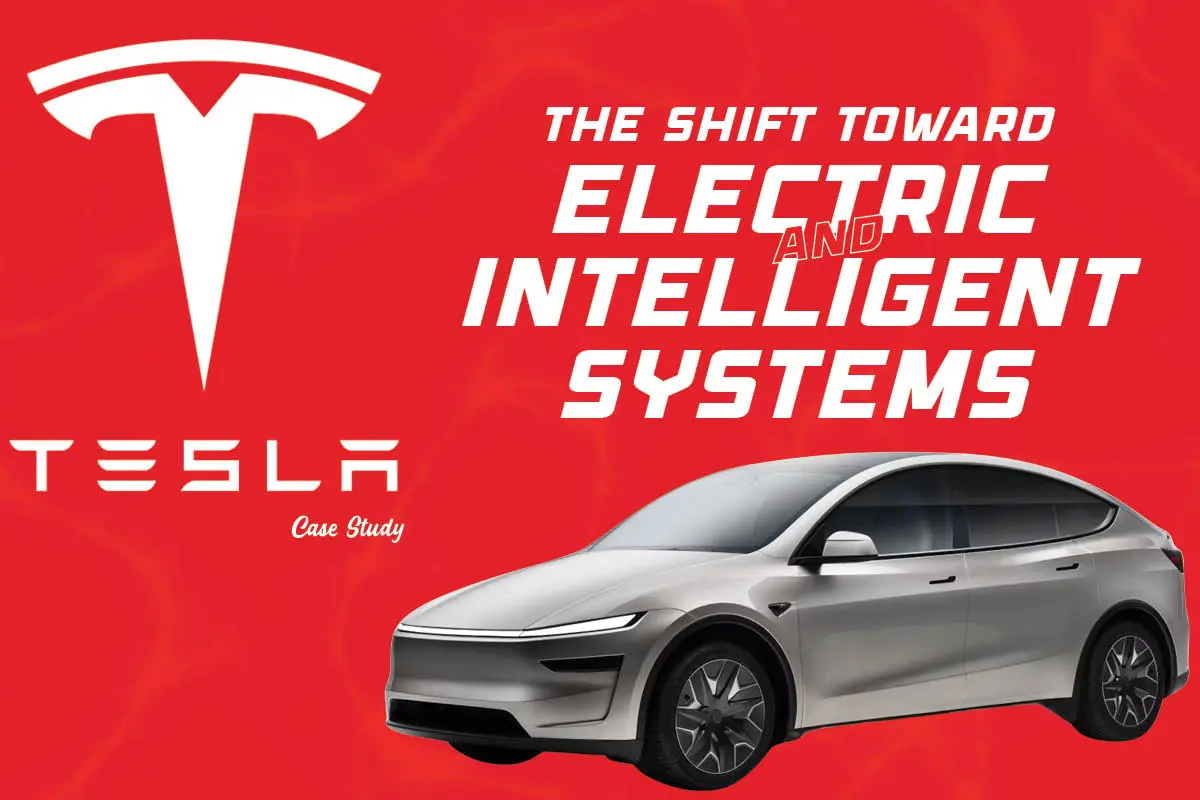
For years, electric vehicles were seen as slow, costly, and impractical for daily use. Tesla challenged this belief by showing that electric cars could deliver high performance and real convenience. It also pushed new ideas about how energy can be stored and used. This Tesla case study explains why the company matters in the modern industry.
It reviews the company’s product journey, key decisions, and long-term impact on the automotive and energy sectors. The study follows a clear timeline, starting with Tesla’s first product and ending with its latest technological efforts. Expert insights are included to deepen understanding and provide a clear context for each stage.
Early vision and first steps:
- Early 2000s: Tesla aims to prove electric cars can match gasoline performance.
- Elon Musk joins as a key investor and guides the direction.
- The goal is a high-performance electric sports car.
- 2006: The Roadster prototype gains attention and shows clear intent.
- Early challenges include limited funding, high battery costs, and production delays.
- Engineers face hurdles in range, safety, and reliability.
These early steps show how Tesla set a clear path despite strong doubts and early challenges.
Roadster as proof of concept
The Tesla Roadster marked Tesla’s first breakthrough and served as clear proof of concept. It showed that an electric car could offer strong acceleration and a competitive driving range. The use of advanced lithium-ion battery packs sets it apart in the market.
Early reception brought attention and curiosity from both the media and buyers. However, the car carried a high price and faced production delays. These issues limited its reach. Despite this, the Roadster gave Tesla credibility and helped shape its identity in the automotive industry, according to product experts.
Expansion into mass market segments
Tesla moved beyond its early stage with two models that focused on scale, design, and wider appeal.
| Aspect | Tesla Model S | Tesla Model X |
| Role | Marked a shift toward larger-scale production | Expanded lineup into the SUV segment |
| Key Features | Long range, fast acceleration, software updates | Falcon wing doors, advanced safety focus |
| Design | Sleek sedan with premium interior | Larger body with family-focused space |
| Challenges | High production pressure and cost control | Complex design led to delays and assembly issues |
| Impact | Attracted a wider audience and built strong demand | Added versatility and broadened market reach |
Industry analysts view this phase as Tesla’s entry into serious automotive competition with growing influence.
Scaling for mass adoption
Tesla’s push toward a wider market brought both pressure and learning at scale.
Challenge:
The Tesla Model 3 aimed to offer affordability with strong performance. Early production faced bottlenecks, slow assembly, and supply issues. These problems tested Tesla’s manufacturing approach and exposed limits in execution.
Progress:
Tesla improved efficiency by simplifying processes and refining factory operations. The Tesla Model Y is built on this progress with a practical design. It reached high volume sales and supported steady growth.
This phase shows Tesla’s strategy of solving production issues to make electric vehicles accessible at scale.
How Tesla makes and delivers value?

Tesla built a distinct business model that supports control, efficiency, and long-term value creation.
Sales Approach: Tesla sells cars directly to customers without using traditional dealerships. This gives the company control over pricing and customer experience.
Revenue Streams: Income comes from vehicle sales, software features, regulatory credits, and energy products like the Tesla Powerwall. Each stream supports steady business growth.
Vertical Integration: Tesla manages battery production, software systems, and distribution within the company. This reduces reliance on external suppliers and keeps operations aligned.
Software Value: Regular software updates add new features and improve performance after purchase. This keeps vehicles relevant over time.
A business strategist notes that Tesla combines a tech-focused approach with automotive manufacturing discipline.
Connected energy and future technology
Tesla connects energy systems with advanced technology through a structured ecosystem.
Ecosystem map
Solar panels generate power that feeds into storage systems like the Tesla Powerwall. Stored energy supports homes and charges Tesla vehicles when needed. Vehicles connect to the Tesla Supercharger network, which enables fast and reliable charging across locations. Each element supports the other, forming a unified system focused on efficiency and convenience. Energy experts often see this setup as a long-term advantage in clean energy markets.
Future lens
Tesla develops artificial intelligence systems such as Autopilot and Full Self Driving. Real-world driving data improves system accuracy over time. Some experts view this data strategy as a strong advantage, while others highlight safety concerns and regulatory limits that may affect future progress.
This combination shows how Tesla links energy use with technology to shape its long-term direction.
SWOT analysis of Tesla
Tesla’s position in the market can be better understood through a clear view of its internal strengths and external factors.
- Strengths
Strong brand recognition and a loyal customer base support Tesla’s market position. The company leads in electric vehicle technology and develops advanced self-driving systems. Its clean energy products create an integrated offering. Tesla also attracts skilled talent across engineering and software fields.
- Weaknesses
Tesla depends on regulatory credits for part of its income. Production capacity remains lower than that of traditional automakers. High valuation creates pressure to meet expectations. The company also relies heavily on Elon Musk for leadership and public image.
- Opportunities
Future growth includes autonomous ride services and energy storage expansion. Affordable models and entry into emerging markets can increase reach.
- Threats
Competition in electric vehicles continues to rise. Policy changes, supply chain risks, and economic conditions may affect demand. Analysts note strong innovation with market risks.
This analysis shows that Tesla’s future depends on balancing its strong innovation with careful management of risks and expectations.
Expert voice panel
Different expert views help explain how Tesla’s strategy is seen across leadership, industry, and investment perspectives.
- Elon Musk: He sees Tesla as a force for shifting the world toward sustainable energy. His focus remains on long-term technology progress and replacing traditional transport systems.
- Mary Barra: She represents a measured approach to electric vehicles. Her view stresses steady production, manufacturing stability, and building customer trust over time. This stands in contrast to Tesla’s faster expansion strategy.
- Cathie Wood: She views Tesla as a technology-focused company. Her outlook highlights future value in autonomous systems and energy solutions beyond vehicle sales.
These perspectives show how Tesla’s strategy invites both confidence in its vision and caution about its pace.
Looking ahead: Progress and pressure

New developments include vehicles like the Tesla Cybertruck and steady improvements in battery efficiency. Tesla also explores robotics and artificial intelligence for future use. Current focus areas include automation and expanded energy solutions. Experts continue to debate whether the company should focus more on software or on manufacturing scale.
Tesla faces production delays, quality concerns, and rising competition. Regulatory pressure and public scrutiny add further challenges. These issues affect its reputation and daily operations. Market analysts suggest that clear responses to criticism remain important for long-term credibility.
Conclusion
The Tesla case study shows how a clear vision, bold product choices, and control over technology can reshape an industry. The company proved that electric vehicles can compete with traditional cars while building a connected energy system. At the same time, it faces pressure from competition, execution challenges, and public scrutiny. Tesla’s future will depend on how well it balances innovation with consistent performance and trust.