Key Takeaway:
- Blue Origin faces a major setback after the New Glenn explosion.
- NASA moon missions could see delays linked to Artemis plans.
- Rocket failures remain common in modern space development.
Blue Origin suffered a major setback after its massive New Glenn rocket exploded during a critical ground test in Florida, raising fresh uncertainty around upcoming lunar missions and intensifying pressure on Jeff Bezos’s long-term space ambitions.
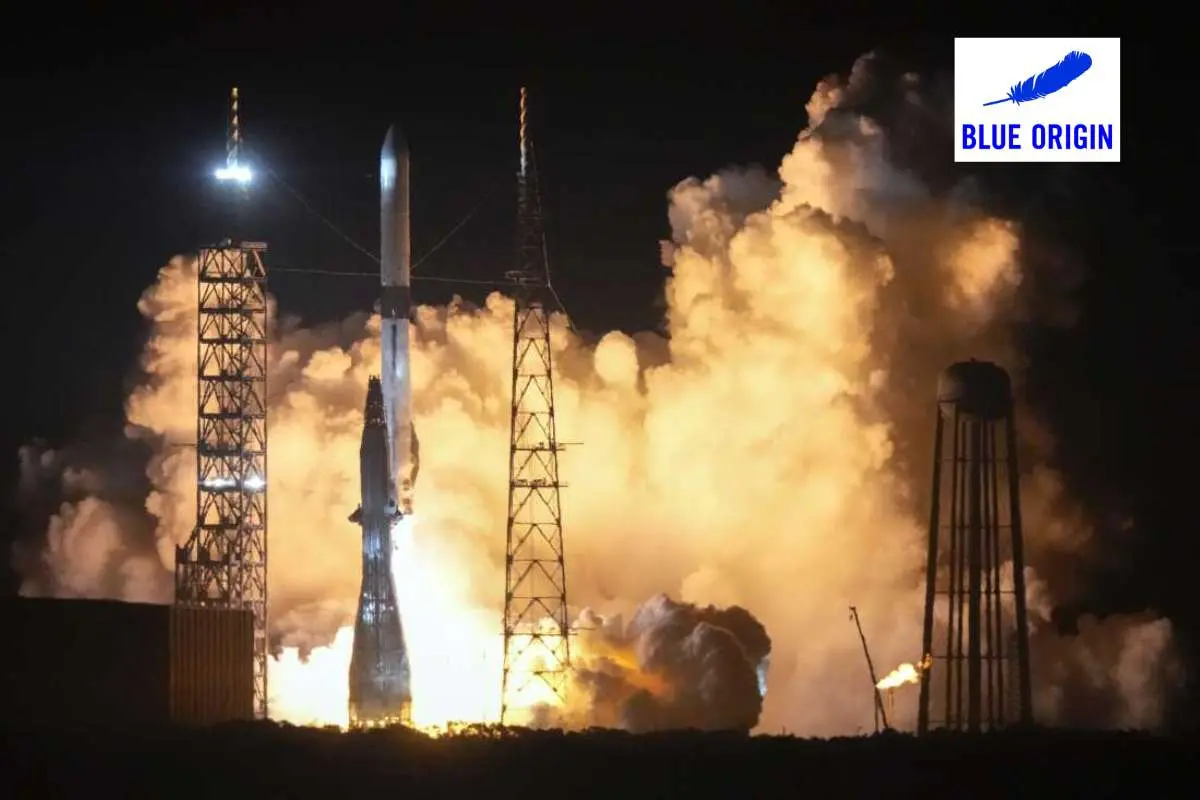
The dramatic incident took place at Cape Canaveral during a late-night “hot-fire” test, a crucial phase in rocket development where engines are ignited while the vehicle remains secured to the launch pad. Moments after ignition, the rocket erupted into a giant fireball, sending flames and thick smoke across the launch complex as emergency crews rushed to contain the blaze.
Videos captured from nearby areas quickly spread online, showing the night sky illuminated by the explosion. Despite the scale of the blast, Blue Origin confirmed that all personnel had been evacuated before the test began and that no injuries were reported.
The destroyed rocket belonged to the company’s highly anticipated New Glenn program, a heavy-lift launch vehicle developed to compete directly with SpaceX in the rapidly evolving commercial space industry. The rocket was expected to support major satellite deployments, national security launches, and future lunar cargo missions connected to NASA’s Artemis program.
NASA moon plans and commercial missions face fresh questions
The explosion represents one of the most serious incidents in Blue Origin’s history and comes at a particularly sensitive moment for the company. Founded by Bezos in 2000, Blue Origin spent years building its reputation through suborbital tourism missions before shifting focus toward larger orbital rockets and deep-space exploration systems.
New Glenn was considered central to that transformation. Designed as a partially reusable rocket, the system was built to lower launch costs and expand Blue Origin’s role in government and commercial missions. Industry analysts viewed the rocket as Bezos’s strongest attempt yet to challenge SpaceX’s dominance in reusable launch technology.
The timing of the failure has intensified concerns across the aerospace sector because NASA has increasingly depended on private companies to power its future Moon missions. Blue Origin had positioned itself as a key partner in America’s lunar ambitions, with New Glenn expected to transport equipment and cargo required for future Artemis operations.
Experts now believe the incident could trigger delays in planned launches while engineers investigate the cause of the explosion and inspect potential structural damage at the launch facility. Aerospace regulators are also expected to examine engine systems, launch-pad infrastructure, and safety procedures as part of the investigation.
Beyond lunar missions, New Glenn also carries major commercial importance for Bezos’s wider business ecosystem. The rocket is expected to launch satellites for Amazon’s Project Kuiper initiative, a global broadband network designed to compete with SpaceX’s Starlink satellite internet system. Delays to the rocket program could therefore impact both space and telecommunications plans tied to Amazon’s future growth strategy.
Blue Origin pushes forward despite a major setback
Comparisons with SpaceX emerged almost immediately after the incident. Elon Musk’s Starship rocket program has experienced multiple high-profile explosions during testing phases, yet the company continued refining the system through rapid development cycles. Many analysts now believe Blue Origin may adopt a more aggressive testing strategy moving forward to remain competitive in the increasingly crowded private space race.
Following the explosion, Bezos reportedly addressed the incident internally, describing it as a difficult moment while encouraging employees to continue pushing forward with development efforts. Company officials later referred to the incident as a “major anomaly” and confirmed that technical teams had already begun reviewing data from the failed test.
Local authorities stated that the blast posed no immediate danger to surrounding communities, though fires reportedly continued burning around sections of the launch complex for hours after the explosion. Safety inspections and environmental assessments are expected to continue as cleanup operations move ahead.
The incident arrives during an increasingly competitive era for the global space industry. Governments and private firms are investing billions into reusable rockets, lunar infrastructure, satellite networks, and future Mars exploration programs. The competition between Blue Origin and SpaceX, in particular, has become symbolic of a larger race to dominate the next generation of space technology.
For Blue Origin, the coming weeks may prove critical. The company must now determine what caused the catastrophic failure while reassuring NASA, commercial partners, and investors that the New Glenn program remains viable.
While the explosion represents a costly and highly visible setback, many industry observers believe it is unlikely to derail Blue Origin’s broader ambitions. In modern aerospace development, failures are often viewed not as endings, but as part of the difficult path toward building the future of space exploration.