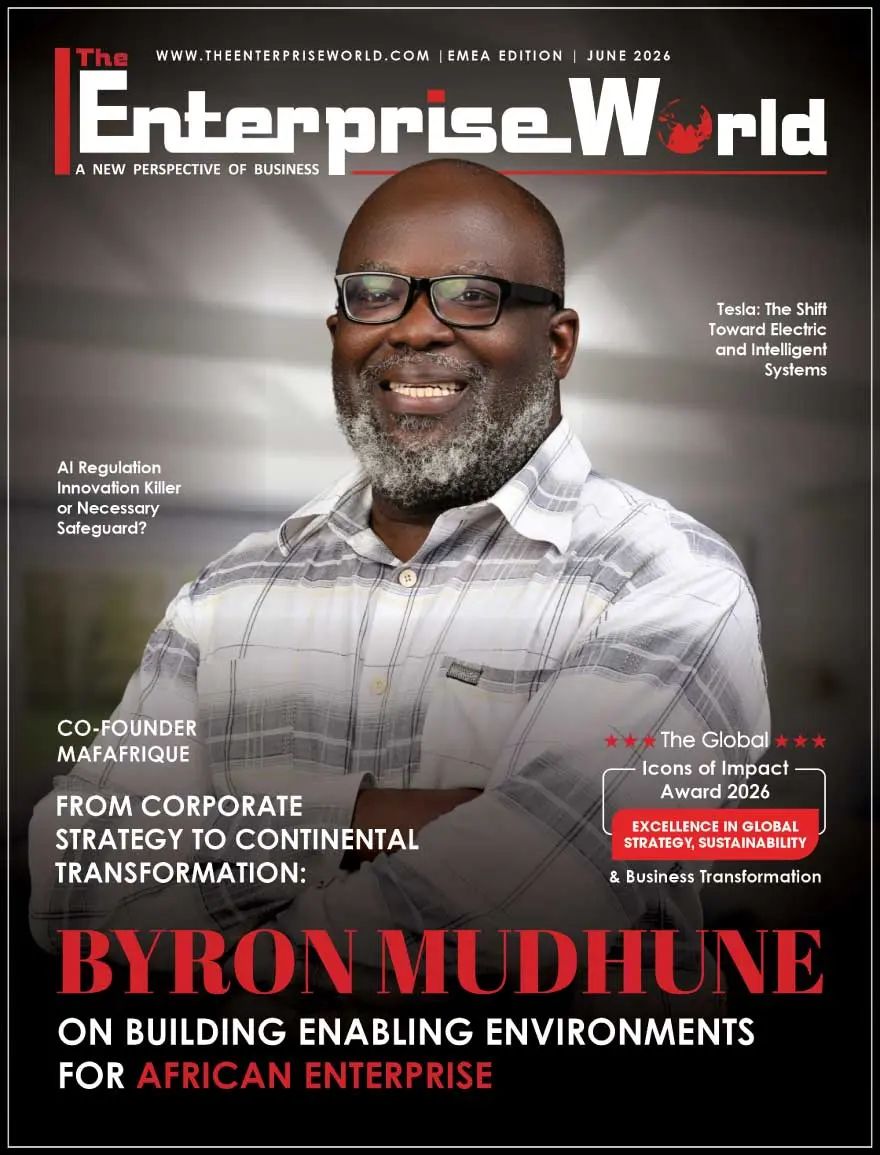
Every market has its myths, and few are as persistently damaging as the belief that Africa’s path to prosperity begins and ends with financing a misconception that Byron Mudhune, Co-Founder of MafAfrique, knows is not just inaccurate but a barrier obscuring the continent’s true potential for decades. With over twenty-five years of experience spanning corporate strategy, innovation, governance, enterprise risk management, and project development across Africa, Europe, the Middle East, and Asia, Mudhune has built his career on a different premise: what African enterprises truly need are sustainable business solutions and an enabling environment to thrive.
Recognized by Corporate Livewire (United Kingdom) as the 2023 Business Strategy Consulting Firm of the Year and winner of the Innovation and Excellence Awards, Mudhune brings a rare combination of cross-continental strategic insight, deep operational experience, and an unwavering commitment to social responsibility. His journey from corporate strategist to co-founder of a purpose-driven consulting firm reflects a leadership philosophy defined by resilience, adaptability, and a steadfast belief that environmental conservation, market expansion, and community impact, especially for women and youth, are not only compatible but mutually reinforcing.
The shift from corporate strategy to MafAfrique
The first defining moment in Byron Mudhune’s career did not arrive with a promotion or a public accolade but came from sustained exposure to the recurring challenges faced by African enterprises attempting to grow sustainably and serve wider markets. Across his extensive professional journey working at the intersection of corporate strategy, international trade, development, and sustainability, Mudhune repeatedly observed the same pattern: promising ventures hindered not by a lack of capital alone but by the absence of durable business solutions and supportive ecosystems. “
“A prevalent misconception is that the solution to Africa’s issues lies in financing and more financing,” Mudhune explains, “but that is not accurate. What enterprises truly need are sustainable business solutions and an enabling environment to thrive.” This realization became the catalyst for co-founding MafAfrique, a consultancy designed not to dispense quick fixes but to work alongside enterprises, governments, and advocacy groups in designing market-driven, scalable, and sustainable solutions.
Strategy, trade, and sustainability at MafAfrique
MafAfrique is a pan-African strategy, trade, and sustainability advisory firm headquartered in South Africa, with a presence across East, Central, and Southern Africa. The firm specializes in enterprise development, market entry strategy, trade facilitation, and project management, working at the intersection of public policy and private sector growth. MafAfrique’s core differentiator lies in its ability to design market-driven, scalable solutions that address the root causes of business stagnation, not just the symptoms.
By collaborating closely with industry advocacy groups, government agencies, and policymakers, the firm helps enterprises navigate complex regulatory environments, access new markets, and build resilient operations that balance profitability with social and environmental responsibility. This integrated approach reflects Mudhune’s conviction that sustainable business solutions, supported by an enabling environment, are the true drivers of long-term African prosperity.
Choosing resilience and teams over quick wins
Byron Mudhune does not point to a specific product launch or high-profile contract when reflecting on the single decision or initiative that created the biggest impact in his organization or sector. Instead, he describes a disciplined way of operating that has become foundational to MafAfrique’s culture: “Cultivating resilience, quickly learning from mistakes and disappointments, taking measured risks when necessary, and celebrating small wins,” he says.
“Building a solid team around you is also essential since people have a tendency to assist one another and accomplish incredible things when they see each other as colleagues.” That emphasis on collegiality and shared purpose has shaped everything from internal decision-making to client engagements, as Mudhune believes that the most sustainable impact emerges not from heroic individual effort but from environments where mutual respect enables extraordinary collective achievement.
Overcoming unconscious bias and regional nuances
Every market has its own business culture and nuances, and across East, Central, and Southern Africa, MafAfrique’s primary region of operation, Mudhune, has encountered not only differences in regulatory frameworks and market practices but also the more subtle challenge of unconscious bias. “Such environments can only sharpen your creativity and expand your thinking horizon,” he observes. “It can be very challenging if you are new to this environment.”
The solution has not been to seek uniformity but to develop genuine adaptability, as operating across diverse African markets has forced Mudhune and his team to become more creative, thoughtful, and rigorous in their approach. Rather than viewing regional complexity as a liability, MafAfrique has turned it into a competitive advantage that enables the firm to design solutions that are genuinely context-aware rather than generically applied.
The long view and adaptive engagement
As his responsibilities and influence have grown, Mudhune’s leadership style has evolved in two significant ways, starting with a longer-term perspective on shaping policies and creating business opportunities. “I have always believed in shaping policies and creating business opportunities in every market,” he admits, “but dispelling myths regarding markets in Africa is one aspect that is continuously challenging that belief.”
“One has to take a long-term view.” Second, he has learned to become highly adaptive, a necessity when working with African governments to establish enabling environments for enterprises to thrive. This adaptability is not about abandoning principles but about finding multiple pathways to the same goal: creating conditions where businesses can grow, communities can benefit, and economies can diversify.
Influence, trust, and the future of leadership
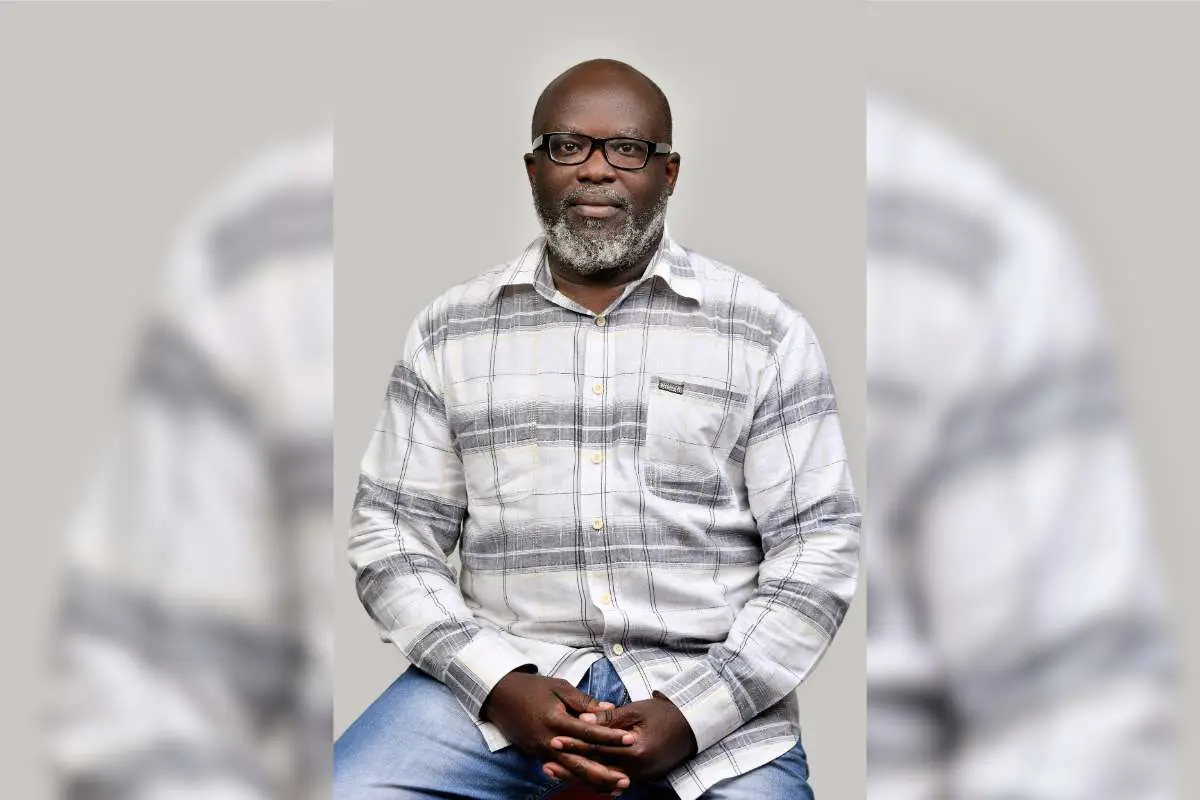
Working at the intersection of public policy, sustainability, enterprise development, investments, and international trade, Byron Mudhune defines “power” in distinctly relational terms. “Power means influence and trust, shaping policies and creating business opportunities.”
This definition reflects a fundamental shift from hierarchical authority to earned credibility, where true leadership power is not the ability to command but the capacity to convene, persuade, and build durable partnerships across sectors. It is trust that enables policy dialogue, influence that opens doors for enterprise development, and both must be cultivated over time through consistent, principled action.
Balancing people, planet, and performance
What drives Byron Mudhune beyond conventional metrics of growth and profits is rooted in MafAfrique’s people-and-planet agenda, as he demonstrates daily that environmental conservation, expanding ventures beyond their initial market, and having a beneficial influence on communities, especially women and youth, are all achievable.
That demonstration is not merely rhetorical, as external recognition has followed. Being named the 2023 Business Strategy Consulting Firm of the Year by Corporate Livewire (United Kingdom) and winning the Innovation and Excellence Awards serves, in Mudhune’s view, as validation that a strong commitment to sustainability and social responsibility is not just ethical but eminently worthwhile.
Ensuring progress benefits people and performance
An African proverb guides Mudhune’s approach to balancing human impact with organizational performance: “If there is no enemy within, the enemy outside can do us no harm.” For him, this means cultivating a strong thirst for knowledge, data, and information to spot emerging opportunities, training the mind to always see opportunities rather than obstacles, and putting that mindset into practice through constant market scanning and collaboration.
At MafAfrique, that translates into active partnerships with industry advocacy groups, government agencies, and even policymakers to design market-driven, scalable, sustainable solutions that place more emphasis on the interests of the most vulnerable youth and women.
Why technology matter for African enterprises?
Africa’s economic growth continues to be driven by multiple forces: production and export of hydrocarbons, revival of agriculture, growth of private and infrastructure projects, continuous development of mining industries, political and governance reforms aimed at improving the general business environment, and, most recently, growth in digital infrastructure, which has propelled the continent to account for 70% of the global mobile money market.
At MafAfrique, this insight is not abstract, as the firm constantly collaborates with industry advocacy groups, government agencies, and policymakers to deep-dive on these trends and design market-driven innovation and transformative technologies that emphasize the interests of youth and women. Trust in technology, Byron Mudhune believes, is strengthened precisely because it can be deployed transparently and scalably, putting control in the hands of users rather than distant intermediaries.
Receiving the Global Icons of Impact 2026 award
Some moments arrive not with fanfare but with quiet certainty, and this was one of them. When Byron Mudhune learned he would receive the Global Icons of Impact 2026 award, his reaction was measured yet deeply felt. “Privileged, but also honored,” he says, “as the award highlights my transformative contribution over the years.” For him, this recognition is not an endpoint but a milestone that validates the work MafAfrique has been doing and fuels the motivation to accomplish incredible things in the future.
Defining impact-driven leadership in his own words
Currently, Byron Mudhune is focused on enhancing trade and regional integration in Africa, and that focus has shaped his personal leadership development priorities. “To achieve that, I have to work on increasing my emotional intelligence, fortify my support system, get better at listening, take on new challenges outside of my comfort zone, and invest more time in coaching, mentoring, and inspiring others, especially young people.”
His definition of impact-driven leadership is therefore intensely practical: if he can deliver on those areas, then that is impact-driven leadership, not a slogan or a framework, but a daily discipline of growth, service, and intentional action.
The MafAfrique approach: from misconception to solution
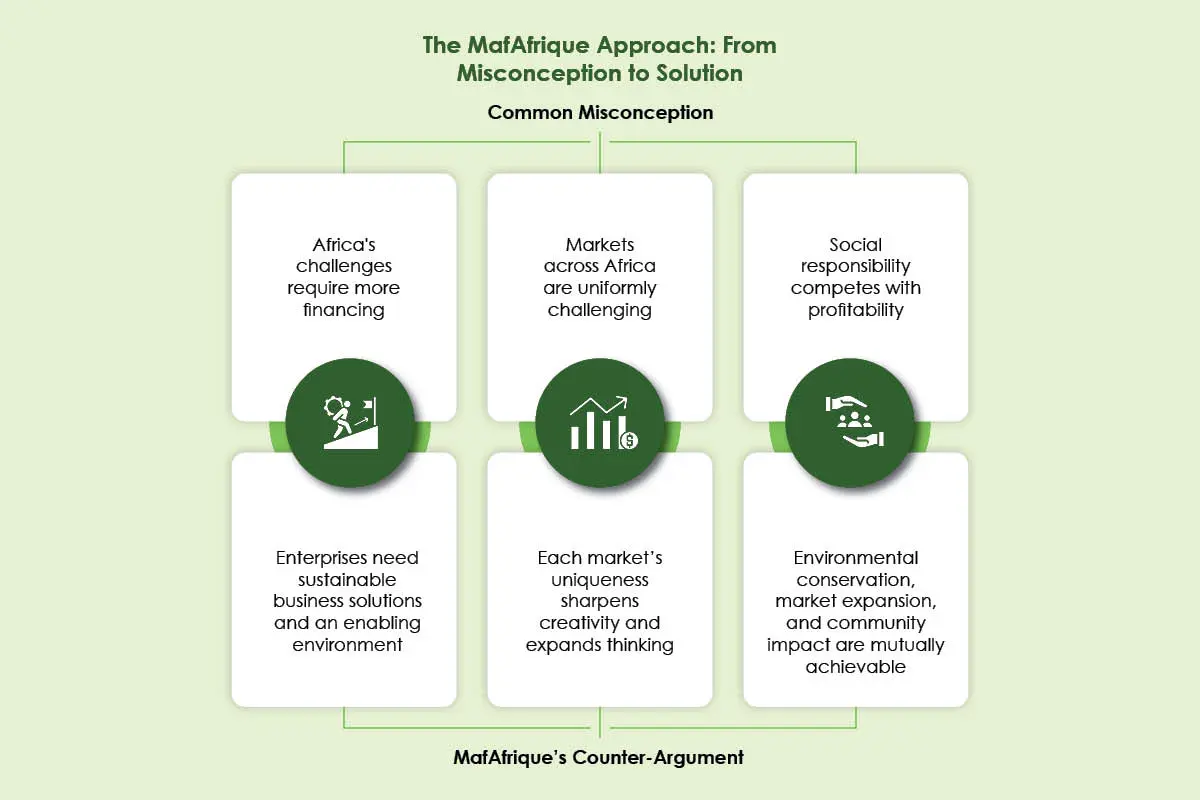
| Common Misconception | MafAfrique’s Counter-Argument |
| Africa’s challenges require more financing | Enterprises need sustainable business solutions and an enabling environment |
| Markets across Africa are uniformly challenging | Each market’s uniqueness sharpens creativity and expands thinking |
| Social responsibility competes with profitability | Environmental conservation, market expansion, and community impact are mutually achievable |
Key drivers of Africa’s economic growth (MafAfrique market scan)
- Local and regional energy value chains
- Revival of agricultural transformation
- Channeling private capital and pension funds into large-scale infrastructure projects
- Investment in strengthening the mining industry value chain
- Political and governance reforms
- Growth in digital infrastructure (Africa accounts for 70% of the global mobile money market)

Strategic partnerships and a collaborative approach
Byron Mudhune’s leadership at MafAfrique is characterized by active, ongoing collaboration rather than isolated intervention, as the firm constantly engages with industry advocacy groups, government agencies, and policymakers to design market-driven, scalable, sustainable solutions.
This collaborative approach ensures that solutions are not imposed from outside but developed in context with genuine ownership from local stakeholders, and the emphasis on the most vulnerable youth and women is not an add-on to MafAfrique’s work but integrated into every stage of solution design from initial market scanning to implementation and evaluation. For Mudhune, social responsibility is not a department but an operating principle.
Building credibility across challenging markets
One of the biggest challenges Byron Mudhune has overcome is building credibility, trust, and confidence in markets that require continuous innovation and high levels of professionalism, and this is not a one-time achievement but an ongoing discipline. “Every country does, in fact, have a unique business culture and nuances,” he notes, adding that even across East, Central, and Southern Africa, differences exist, more often accompanied by unconscious bias. Operating effectively in such environments requires not only technical competence but also emotional intelligence, patience, and a genuine willingness to learn.
Rapid fire: the core of Byron Mudhune’s leadership philosophy
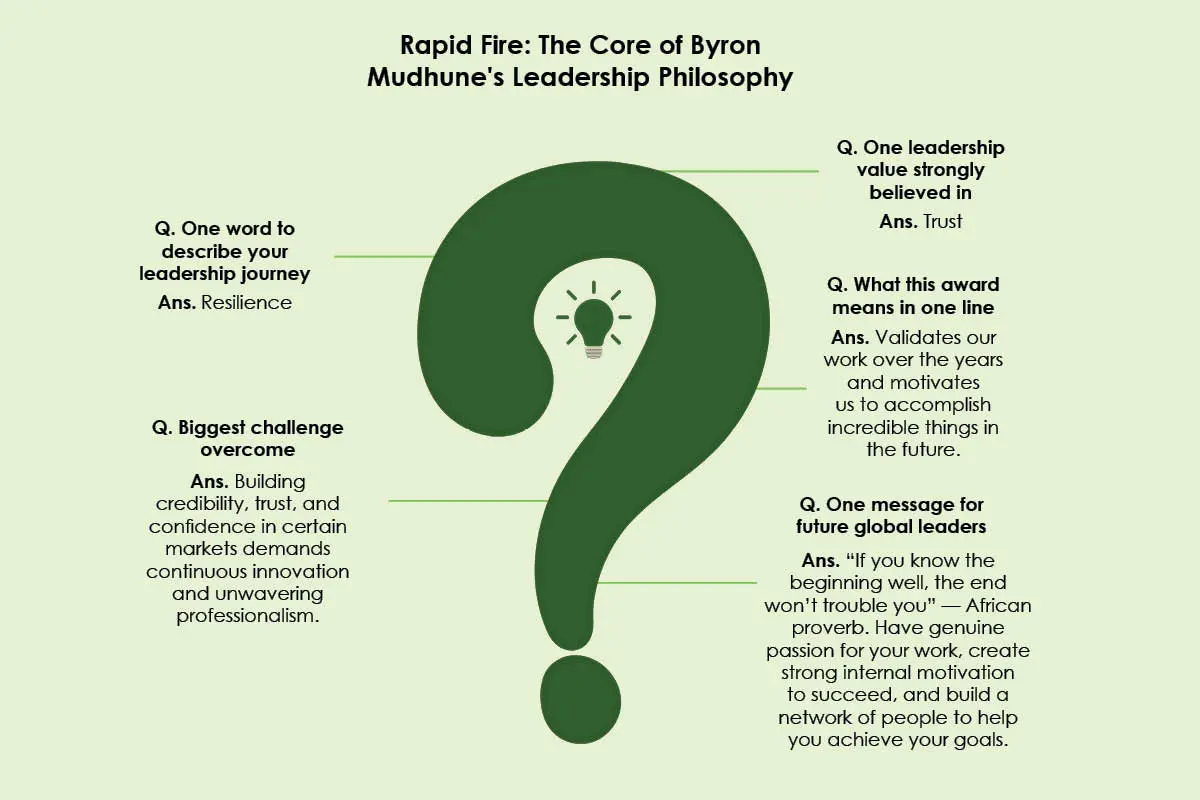
| Question | Answer |
| One word to describe your leadership journey | Resilience |
| Biggest challenge overcome | Building credibility, trust, and confidence in certain markets demands continuous innovation and unwavering professionalism. |
| One leadership value strongly believed in | Trust |
| What this award means in one line | Validates our work over the years and motivates us to accomplish incredible things in the future. |
| One message for future global leaders | “If you know the beginning well, the end won’t trouble you” — African proverb. Have genuine passion for your work, create strong internal motivation to succeed, and build a network of people to help you achieve your goals. |
A message for future global leaders
Byron Mudhune ‘s advice to the next generation of leaders across Africa and beyond is rooted in an African proverb: “If you know the beginning well, the end won’t trouble you.” For him, this means starting with genuine passion for your work, as that passion, rather than external validation or financial reward, becomes the foundation for sustainable motivation.
From there, future leaders must create a strong internal drive to succeed that can withstand setbacks, skepticism, and slow progress, while equally important is building a network of people around you to help achieve your goals. That network is not merely transactional but built on mutual respect, shared purpose, and the recognition that people accomplish incredible things when they see each other as genuine colleagues.
Looking ahead with trade regional integration and its impact
As he accepts the Global Icons of Impact 2026 award, Byron remains focused on the work ahead, as enhancing trade and regional integration in Africa is not a short-term project but requires sustained effort, adaptive leadership, and an unwavering commitment to the people-and-planet agenda that has defined MafAfrique from its founding.
His personal development priorities reflect that commitment: increasing emotional intelligence, fortifying his support system, becoming a better listener, taking on new challenges outside his comfort zone, and investing more time in coaching, mentoring, and inspiring others, especially young people. If he can deliver on those areas, Mudhune believes that is impact-driven leadership, and by that measure, his journey is far from complete.
Key takeaways from Byron Mudhune’s leadership journey
- Sustainable business solutions matter more than financing alone, and an enabling environment is essential for African enterprises to thrive.
- Resilience, adaptability, and team-building are foundational leadership practices
- Power in leadership means influence and trust, not authority.
- Environmental conservation, market expansion, and community impact are mutually achievable.
- Africa’s digital infrastructure growth (70% of the global mobile money market) presents transformative opportunities.
- Impact-driven leadership requires emotional intelligence, listening, and investing in others.
- Knowing your beginning well ensures the end will not trouble you.