Key takeaways
- Google’s Suncatcher test puts 4 AI processors into orbit.
- Data centers could consume 3% of global electricity by 2030.
- Scaling orbital computing faces major power, cooling, launch, and bandwidth challenges.
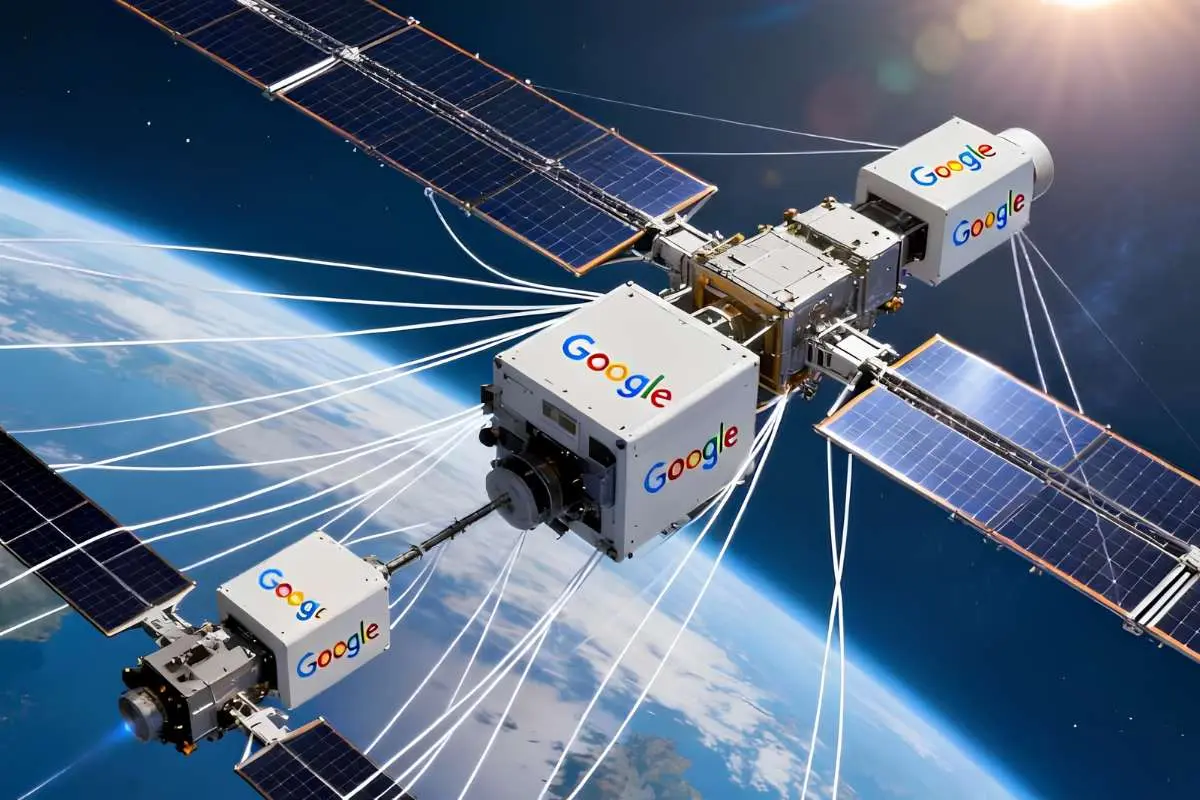
Google is testing whether artificial intelligence computing can move beyond Earth’s power constraints through Project Suncatcher, a satellite system designed to run AI processors in orbit. The initial test will carry 4 processors aboard a SpaceX rocket and run Google’s Gemini AI models for 15 minutes at a time.
Google tests AI computing in orbit
Project Suncatcher is designed as an early test for a much larger orbital computing system. Google’s long term concept involves thousands of satellites working together as an AI data center, with processors running models in space and transmitting results back to Earth.
The project is linked to the growing electricity needs of AI infrastructure. Data centers are projected to account for about 3% of global electricity consumption by 2030, roughly twice their current share.
Google says solar panels in orbit can generate up to 8 times more power than similar panels on Earth because they receive more consistent sunlight. This could provide an energy source for AI computing without requiring the same land based electricity infrastructure used by conventional data centers.
However, the initial Suncatcher satellite is far smaller than the systems needed to compete with large data centers on Earth. Current AI facilities can contain hundreds of thousands of chips and require up to 1 gigawatt of electricity.
By comparison, the International Space Station’s solar arrays generate only a small fraction of that amount. Building an orbital AI facility at comparable computing scale would require a significant number of solar panels and processors to be launched into space.
Google has been testing the hardware against some of these conditions before launch. Engineers have subjected spacecraft prototypes to vibration tests that simulate launch conditions and exposed processors to proton beams to examine their response to radiation.
Power, cooling and data transfer remain challenges
Operating computing hardware in space creates several technical problems beyond generating electricity. The vacuum of space makes heat removal difficult, requiring specialized radiators to keep processors within operating temperatures.
The Suncatcher processors will therefore operate for limited periods before shutting down to cool. Future systems would need much larger thermal management equipment if they are to support sustained AI workloads.
Radiation also creates another challenge. Earth’s atmosphere blocks much of the radiation found in space, while processors in orbit can experience conditions that may cause calculation errors. Space-based computers need systems that can detect and correct those errors.
Data transfer presents another major constraint. An orbital data center would need to send AI results to Earth while also receiving information required for computing tasks. Although satellites can communicate through radio and laser systems, moving large volumes of data between orbit and ground remains more difficult than transferring information between facilities on Earth.
The economics of the model will also depend on launch and replacement costs. Every processor, solar panel, cooling system, and communications component must first be transported into orbit. Satellites would also eventually need to be replaced as equipment ages.
That creates a business question around whether savings from abundant solar energy can offset launch, maintenance, replacement, and data transmission costs.
Project Suncatcher is therefore an early test rather than a commercial orbital data center. Its results will provide Google with information on computing performance, thermal management, radiation effects, power generation, and communications.
The technology is being developed as AI companies face rising demand for computing infrastructure. Whether orbital systems can eventually operate at the scale required by modern AI workloads will depend on improvements across each of these areas.