
What happens when a company fails to provide training for higher-level work?
Capable employees leave their jobs when they do not see a clear path to advance beyond entry-level duties. Putting targeted workforce development programs in place solves this problem by linking everyday job training directly to internal promotion paths.
Read on for eight distinct program types, a complete build framework, and clear methods to track long-term performance.
What are workforce development programs?
A workforce development program is a structured, employer-run initiative. They help employees build skills for their current jobs and future roles. They may include training, mentoring, job rotations, coaching, or career development plans. These plans are usually based on business and employee needs.
Unlike one-off training, these programs connect learning to a specific role, skill gap, or career path and continue over time.
What are the main types of workforce development programs?
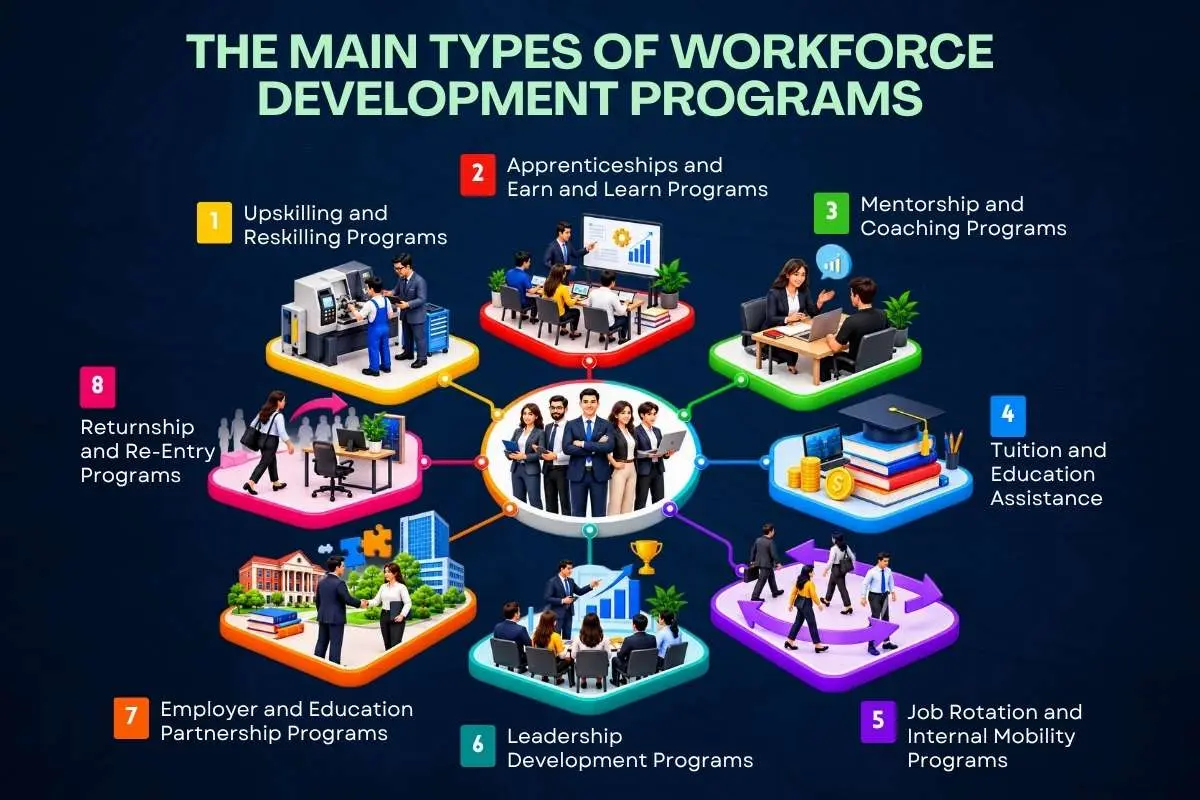
Organizations can use different programs based on the skills they need, the roles they want to fill, and the career paths they want to support.
1. Upskilling and reskilling programs
Upskilling helps employees build new skills for their current roles. Reskilling prepares them for different roles. For example, a company may train its sales team to use new customer data tools or help warehouse staff learn skills needed for automated systems. The difference between reskilling and upskilling also affects how employers plan training, career paths, and future workforce needs.
- Effort: Moderate to high, based on the skills and tools involved.
- Best for: Roles being influenced by technology.
2. Apprenticeships and earn and learn programs
These programs combine paid work with structured instruction. An apprentice can work alongside experienced staff while learning the technical skills needed for a specific job. This model works well when employers need workers to meet clear skill standards.
- Effort: High during setup, with ongoing costs for wages and training.
- Best for: Trades, manufacturing, and technical roles with clear skill standards.
3. Mentorship and coaching programs
Mentorship pairs employees with experienced colleagues who can offer guidance, feedback, and career advice. Coaching can focus on a specific skill, role, or work challenge. For example, a new hire might meet a senior employee each month to discuss goals and progress.
- Effort: Low to moderate, depending on program size.
- Best for: New hires and employees moving into a different function.
4. Tuition and education assistance
These programs help employees pay for courses, certificates, or degrees that support their career goals. Amazon’s Career Choice Program, for example, provides eligible employees with access to education and training opportunities.
- Effort: Moderate to high because employers must manage funding, eligibility, and approved programs.
- Best for: Employers that need credentials or degrees they cannot build in-house.
5. Job rotation and internal mobility programs
Job rotation lets employees work in different teams or functions for a set period. Internal mobility programs also help employees move into open roles within the company. For example, an employee in operations might spend several months with the sales team before moving into a new role.
- Effort: Moderate, with planning needed across teams.
- Best for: Building cross-functional skills and clearer career paths.
6. Leadership development programs
Leadership programs prepare employees for roles with greater responsibility. These workforce development programs may include workshops, coaching, mentoring, project work, and exposure to senior leaders. A company might select high-potential employees and prepare them for future manager or director roles.
- Effort: Moderate to high, especially when programs include senior leaders and long-term coaching.
- Best for: Building the management pipeline and preparing future leaders.
7. Employer and education partnership programs
Employers can work with community colleges, universities, or training providers. They can help build courses around real job needs. For example, a manufacturer may help design a technician certificate that teaches the skills its local facilities need. This creates a direct path from education to employment.
- Effort: High at setup, then lower once the program runs smoothly.
- Best for: Employers hiring in volume or facing a limited local talent supply.
8. Returnship and re-entry programs
Returnships offer paid, structured work for experienced professionals returning after a career break. For example, Mercedes-Benz partnered with Shelton State Community College to create a pathway from automotive training to jobs at its factory. This approach gives returning professionals time to rebuild recent skills while helping employers assess their fit.
- Effort: Moderate, since employers need a cohort, mentors, and a clear hiring plan.
- Best for: Filling mid-career roles while widening the candidate pool.
The right workforce development programs depend on the skills a business needs. Some programs build technical skills. Others support career growth, leadership, or internal mobility. Companies can choose one approach or combine several to build skills that match their workforce needs.
How to build a workforce development program?
A strong workforce development program starts with a clear business need. Companies should first identify the skills they need, then choose the right way to build those skills. A clear plan also helps teams track progress and improve the program over time.
- Start from the business need: List the roles the program must support in the next 12 to 18 months. Set clear goals for each role. Goals may include filling open roles, closing skill gaps, or preparing staff for new work.
- Run a skills gap analysis: List the skills each role will need. Then compare them with the skills your team has now. For example, 20 employees may need data skills, but only 8 may have them. The program then needs to close the skills gap for the other 12.
- Match the program type to the gap: Choose a program that fits the skill needed. A technical gap may need reskilling or an apprenticeship. A gap in management readiness may need a leadership program.
- Give it an owner, a budget, and protected time: Choose a person or team to run the program. Set a clear budget for training and support. Give employees work time for learning and practice. This helps the program stay active over time.
- Pilot with one group, then expand: Start with one team or employee group. Set the pilot length and choose a starting measure. Compare the results with that starting point before you expand the program.
Workforce development programs work best when the business gives them clear goals, resources, and time. Start small, measure the results, and use what you learn to improve the program as it grows.
How to evaluate a workforce development program?

Use four levels to judge a program. The Kirkpatrick model covers reaction, learning, behavior, and results. Set a baseline before the first group starts.
- Level 1: Participation. Track who joins and who finishes. Enrollment rate = enrolled ÷ eligible × 100. Completion rate = completers ÷ enrolled × 100. Low completion may signal timing or relevance issues.
- Level 2: Learning. Check what employees learned during the program. Compare scores from tests taken before and after training. You can also track the certification pass rate.
- Level 3: On-the-job behavior. Check progress after 60 to 90 days. Ask managers if employees use their new skills at work. Track how many completers move into new roles or take on more duties.
- Level 4: Results and cost. Measure the cost of each completion. For example, a hypothetical $36,000 program with 12 enrolled costs $3,000 per enrollee. If only 9 finish, the cost rises to $4,000 per completion. Compare this cost with business gains, such as faster time to productivity or fewer external hires.
Change one thing between groups and compare the results. This can show a link between the change and the outcome, but it does not prove the cause.
A strong evaluation looks beyond how many employees complete a program. It shows what they learned, how they use those skills, and what the business gains from the effort. By tracking these results across each group, employers can improve workforce development and make better decisions about future investment.
What do workforce development programs cost and how are they funded?

The cost of a workforce development program depends on its design, size, and delivery method. A clear budget should cover both direct costs and the time employees spend learning.
Cost drivers: Four costs shape most program budgets: content or curriculum, an instructor or learning platform, administration, and participant time. Participant time means the wages paid while employees train. Companies often leave this cost out of the first budget.
Funding routes: Employers can fund these programs through their own training budgets. Government grants and tax incentives may also help, based on local rules. Industry groups and vendors may offer another funding or training option.
For example: A 12-person cohort has a total budget of $36,000. The budget could include $18,000 for content and instruction, $4,000 for a platform, $12,000 for participant time, and $2,000 for administration.
A well-planned budget helps a workforce development program stay on track. Employers can also look at government-funded workforce development programs, grants, and training incentives to lower some costs. The right funding mix can make it easier to give employees time, training, and support without placing the full cost on the business.
Conclusion:
A complete workforce development program connects everyday skill-building to broader organizational performance through structured planning and precise tracking. By balancing core program types, following a disciplined rollout model, and regularly evaluating clear output metrics, companies create a dependable internal talent pipeline that reduces reliance on external hiring. Launching a targeted pilot program in a single department offers the best environment to test training materials and adjust workflows before expanding the complete framework across the rest of the business.
FAQs
1. What is a workforce development program?
It is an organized internal training initiative designed to build specific job skills, prepare employees for new responsibilities, and meet business demands.
2. How do you measure the success of a workforce development program?
Key metrics include skill assessment scores, internal promotion rates, time-to-productivity for upskilled employees, and staff retention.
3. Who manages workforce development programs within a company?
HR teams, department managers, and learning leaders partner to design, run, and track these training efforts.
4. How long does it take to see results from a workforce development program?
Initial progress shows within 30 to 60 days through skill assessments, while larger impacts on promotion rates appear over six to twelve months.
5. What is the best way to start a workforce development program?
Start with a targeted skills audit to identify clear gaps, then run a small pilot program in a single department to test your framework.