
Measuring workforce development ROI gives finance the concrete dollar value they actually need, moving the conversation past vanity participation metrics. It answers the question that follows every training budget and is usually aimed at someone holding a spreadsheet of completion rates.
This guide breaks down the core calculation models, the practical data inputs required, and how to accurately isolate training impact from general business growth.
What is workforce development ROI?
Workforce development ROI shows the financial return a company gets from money spent on employee training and development. It compares the net financial benefit of a program with its cost. It then expresses the result as a percentage. A positive ROI means the program returned more value than the company spent on it.
Measuring this return can be difficult. This is because the benefits may appear in different areas.
They can be:
- lower hiring costs
- better employee retention
- higher productivity
- stronger job performance.
But these results may take months to appear. The challenge is widespread. According to ATD’s 2026 State of the Industry report:
Less than a quarter of organizations measure whether their training programs achieve organizational goals, while an even smaller share measures ROI.
Because of this, companies often track several measures before calculating the full training ROI. These measures can include changes in performance, retention, productivity, and internal mobility.
How to calculate workforce development ROI?
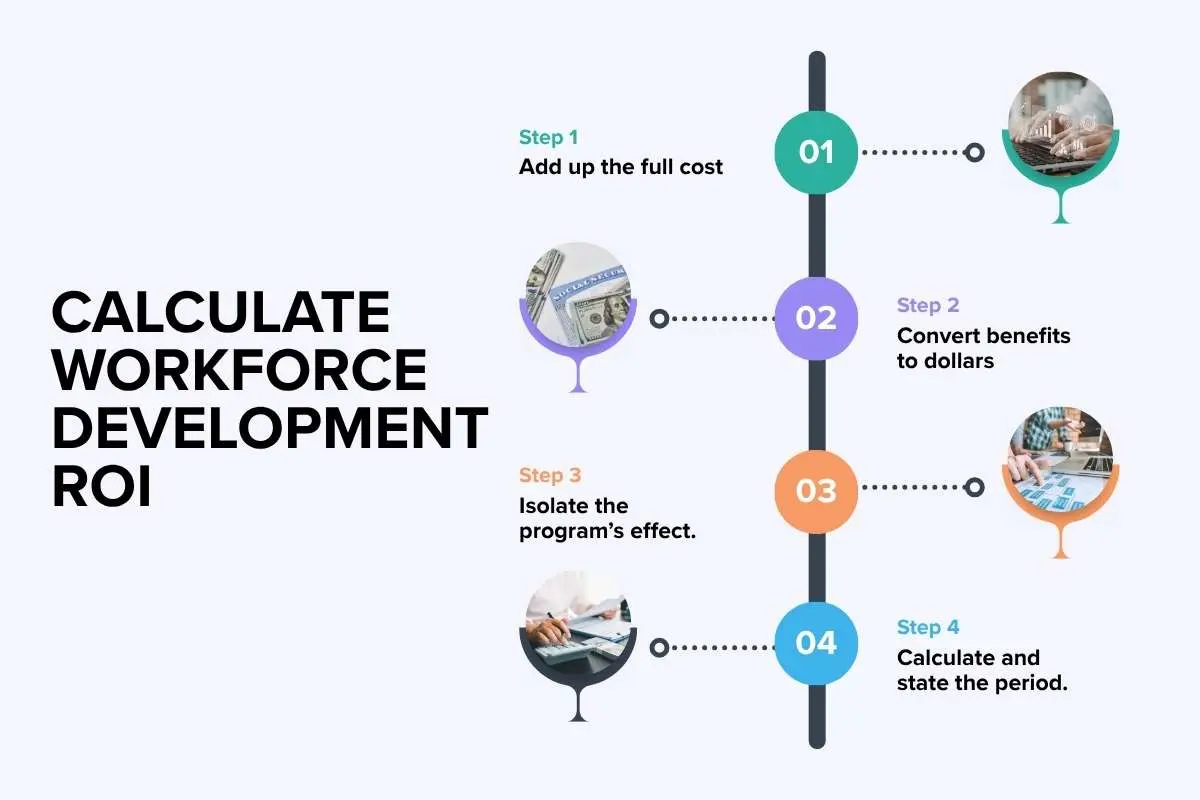
The formula: Workforce development ROI measures the financial return from a program against what the company spent on it. Use this formula: ROI (%) = (total benefits − total costs) ÷ total costs × 100.
- Step 1: Add up the full cost. Include direct costs such as content, instructors, learning platforms, and administration. Also include the wages employees earn for the hours they spend learning. This participant time often gets left out, even though it forms a real part of the program cost.
- Step 2: Convert benefits to dollars. Choose two or three outcomes that you can measure, such as fewer resignations, fewer external hires, or faster time to productivity. Then assign a dollar value to each outcome. Use actual company data where possible to make the estimate more reliable.
- Step 3: Isolate the program’s effect. Compare employees who completed the program with a similar group that did not take part. If that data is not available, ask managers to estimate how much of the change came from the program and how confident they are in that estimate.
- Step 4: Calculate and state the period. Calculate the return over a fixed period, such as 12 months. This gives the result a clear time frame and makes future comparisons easier. You can also calculate the payback period with this formula: Payback period = total cost ÷ monthly benefit.
Let us take an example:
A 20-person cohort costs $60,000. This includes $20,000 for content, $5,000 for the platform, $5,000 for administration, and $30,000 for participant time. Over 12 months, the program is credited with five fewer resignations, saving $75,000 in replacement costs at $15,000 per resignation. It also helps fill three roles internally, saving $24,000 in recruiting costs at $8,000 per role.
The total benefit comes to $99,000. The workforce development ROI is 65%, calculated as: ($99,000 − $60,000) ÷ $60,000 × 100 = 65%. The payback period is about 7 months, assuming the benefits build at an even rate.
What is a good workforce development ROI?
There is no single ROI benchmark that works for every workforce development program or industry. A good return depends on the program’s cost, goal, and expected results. A program that delivers a strong return in one company may deliver a different return in another.
Use three comparison points to judge whether the program return makes sense:
- The cost of the alternative: Compare the program cost with what the company would spend on external hiring. You can also compare it with replacement costs or other ways to solve the same workforce need.
- Earlier cohorts: Compare the results with past groups that completed similar programs. This shows whether the company is getting better results from its workforce development spend over time.
- Finance’s return threshold: Compare the program’s return with the return that the finance team expects from other company investments. This gives leaders a familiar point of reference when they review the results.
Timing also matters. Some programs can show results within a few months. For example, technical upskilling may improve job performance soon after employees learn and use new skills. Leadership development often takes longer. Changes in leadership behavior, team performance, retention, and promotions may take one to two years to become clear.
A good ROI should match the program’s goal, cost, and time frame. Instead of looking for one “good” percentage, companies should compare the return with these factors and with results from similar investments.
How to present workforce development ROI to leadership?

A strong ROI calculation can lose its value if leaders cannot see how it affects the business. Present the result in a simple format that connects workforce development to a business outcome, shows how you reached the figure, and makes the next decision clear.
- Step 1: Lead with the business outcome. Start with what changed for the business, such as lower turnover costs, faster hiring, or higher output. Then show the ROI figure that supports the result.
- Step 2: State your assumptions. Explain how you calculated the costs and benefits. Show both a conservative case and an expected case, such as 40% and 65% ROI. This gives leaders a clearer view of how the result may change.
- Step 3: Show the payback period. Include how long the program takes to recover its cost. Executives often want this figure because it shows when the investment starts to return value.
- Step 4: Explain what you would change next. End by showing what the next cycle could do better. You might change the target group, adjust the program length, or focus on a different skill.
A clear presentation helps leaders judge the result without digging through complex calculations. It also turns the ROI review into a useful decision about whether to repeat, change, or expand your workforce development strategy.
Which benefits count toward workforce development ROI?
Workforce development programs can create value in several areas. But not every benefit fits neatly into an ROI calculation. Focus on outcomes that the company can measure and connect to a clear financial value. This helps keep the calculation practical and easier to defend.
| Benefit | How to value it | Data source |
|---|---|---|
| Lower turnover | Exits avoided × replacement cost | HR data |
| Fewer external hires | Roles filled internally × cost per external hire | Recruiting records |
| Faster ramp-up | Days saved × daily value of the role | Performance data and manager input |
| Higher output or quality | Change in measurable output, such as fewer errors, less rework, or higher sales per employee | Operations data |
These benefits give companies a stronger basis for measuring workforce development ROI. This is because each one connects a workforce change to a measurable business result. Engagement and employer brand also matter. But report them alongside the ROI figure rather than converting them into dollars without a defensible basis.
Conclusion:
Measuring the financial yield of training gives business leaders the hard data required to justify ongoing talent investments. By systematically tracking total expenses alongside core financial gains turn learning initiatives into measurable profit drivers. Consistently auditing these metrics establishes a clear baseline for future learning programs, ensuring every dollar spent directly supports long-term business strategy and workforce development ROI.
FAQs
1. How soon after a training program should you begin measuring workforce development ROI?
Wait 60 to 90 days post-completion before running your first assessment. This gives employees enough time to apply new workflows.
2. Why must employee hourly wages be factored into total costs?
Hours spent away from regular duties carry a direct payroll cost, and excluding them creates an inflated assessment of overall efficiency.
3. How do you isolate training impact from external market factors?
Comparing outcomes between a trained group and an untrained control cohort provides the cleanest comparison.
4. What represents a realistic payback period for workforce learning investments?
Six to twelve months for technical upskilling, whereas executive development may require eighteen to twenty-four months.
5. Should qualitative markers like team engagement be included in financial return figures?
Soft metrics are best reported alongside financial figures rather than assigned speculative dollar values that dilute the credibility of the analysis.