Every growing business eventually hits the same wall: the work is changing faster than people can keep up. Traditional HR is great for handling open roles, benefits, and everyday onboarding, but is it built to solve massive, industry-wide skill shortages on its own?
So, what can be done?
How do you develop your employees and workforce to handle such situations?
According to The National Association of Workforce Development Professionals (NAWDP):
“Workforce development is a comprehensive approach to preparing individuals for success in the labor market while ensuring that businesses have access to the talent they need to grow and thrive.”
Think of it as looking past your immediate headcount needs to make sure your entire region has the talent required to thrive down the road.
Picture a local factory adding automated assembly lines to stay competitive. If the current crew only knows manual machinery and nearby schools aren’t teaching automation, the whole operation grinds to a halt.
Joining forces with local educators and regional workforce initiatives turns that scary skill gap into a massive growth opportunity. You upgrade your existing team’s capabilities, keep great people around, and build a resilient business that can weather any technological shift.
In this article, we will take a look at:
Why does workforce development matter now?
Work is changing fast. New tools are changing how people do their jobs. Automation can now handle many routine tasks. AI also changes how teams work and solve problems. In fact, adoption of AI technologies is accelerating at a 209% annual rate.
At the same time, many companies face another issue. Their workers are getting older, while some new roles lack skilled workers. Industries such as AI, clean energy, and advanced technology need skills that many teams still need to build.
This creates a growing need for workforce development. Companies must help their people learn new skills. They also need to prepare workers for jobs that may change in the years ahead.
Imagine two companies facing the same market change. Both need to adopt new technology within a year. The first company already has a workforce development system. It tracks skill needs and helps workers build those skills.
The second company has no such system. Its leaders must first find the skills they lack. Then, they must decide how workers can gain those skills. They also need to find time for training while keeping work on track.
Both companies face the same change. Yet, their starting points are very different.
This example shows why workforce development matters now. Hiring alone may not fill every skill gap. Companies also need to build skills within their current teams.
That work needs more than training courses. Leaders must link employee growth with business needs. As President and Publisher of AY Media Group, Heather Baker says:
“Any organization that has achieved lasting success has empowered their people to think creatively, challenge assumptions, and pursue excellence together.”
Workforce development vs. employee training
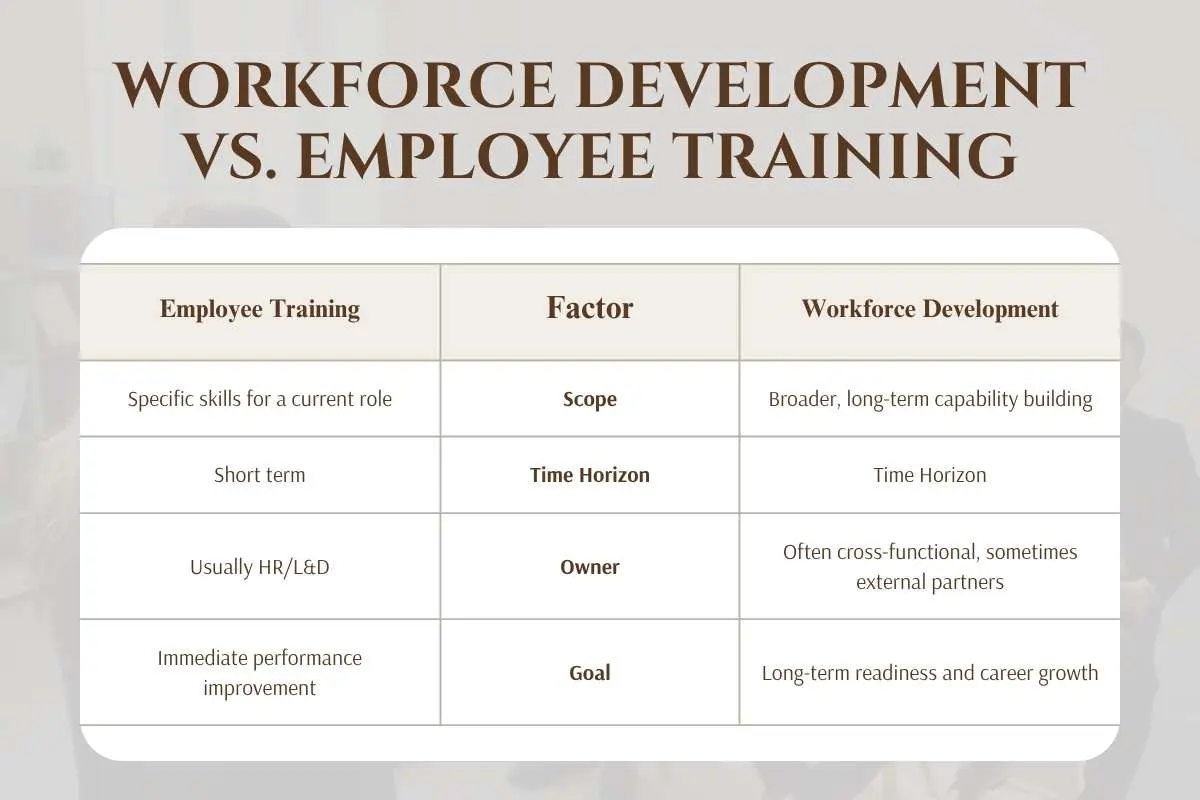
The terms workforce development and employee training often get used interchangeably. However, they cover different areas of employee growth. Employee training usually targets specific skills for a current role, while workforce development takes a wider and longer view of skills, careers, and future business needs.
| Factor | Employee Training | Workforce Development |
|---|---|---|
| Scope | Specific skills for a current role | Broader, long-term capability building |
| Time Horizon | Short term | Long term |
| Owner | Usually HR/L&D | Often cross-functional, sometimes external partners |
| Goal | Immediate performance improvement | Long-term readiness and career growth |
The distinction matters when companies plan budgets and assign ownership. Training may sit within one team, while workforce development can involve several business functions. A clear understanding helps leaders decide where each effort belongs. For the full comparison, see Workforce Development vs. Employee Training.
Workforce development vs. talent management
Workforce development and talent management both focus on people and their growth. However, they start with different goals and often have different owners. Talent management tends to focus on finding, developing, and keeping key talent, while workforce development looks at building skills across a wider group of workers.
| Factor | Talent Management | Workforce Development |
|---|---|---|
| Primary Focus | Identifying and retaining high-potential talent | Building capability across the broader workforce |
| Scope | Often individual or succession focused | Often organization-wide or industry-wide |
| Typical Owner | HR/People teams | HR, L&D, sometimes external or government partners |
Knowing which lens applies can help companies decide where an initiative should sit. It can also clarify who should manage it, fund it, and measure its results. For a deeper comparison, see Workforce Development vs. Talent Management.
Workforce development programs
A workforce development program helps employees build skills for their current and future roles. It gives companies a clear way to support learning and career growth.
These programs can take many forms. Some focus on job skills and training. Others help employees plan their careers or learn through mentors. Many companies use a mix of these methods.
Workforce development programs usually include 4 basic components
- Training: Training helps employees build skills for their current roles and future work. Companies may cover technical skills, leadership, new tools, or job-specific knowledge. They can deliver training through classes, online courses, workshops, or hands-on practice.
- Mentorship: Mentorship connects employees with more experienced workers. Mentors can help employees understand new roles, solve work problems, and plan their next career step. They can also share practical knowledge that formal training may not cover.
- Career Pathing: Career pathing shows employees how they can grow within a company. It can outline possible roles, required skills, and steps for career growth. This gives employees a clearer view of their future at the organization.
- Partnerships: Partnerships give companies access to skills, knowledge, and talent outside the organization. Companies may work with colleges, training providers, or industry groups. These partnerships can support learning and help companies prepare workers for changing skill needs.
The value becomes clearer with a simple example.
Imagine a retail chain that trains employees only when a new need appears. A store may get product training one month, while another team receives customer service training later. The company responds to each issue as it comes up. Learning stays scattered across teams.
Now consider another retail chain with an ongoing workforce development program. Its employees receive regular training, access mentors, and have clear paths for career growth. Store leaders also know which skills their teams need to build.
The two companies may spend similar amounts on learning. Their approach, however, differs greatly. One reacts to each new need. The other treats employee development as an ongoing effort.
A workforce development program brings these efforts together. It gives learning a clear place within the wider business strategy. The exact structure will vary by company, workforce, and goals.
Workforce development does not happen only within companies. Government-funded programs and public partnerships can also support employee learning and skill building. These programs can give smaller employers access to training, funding, and other resources that may be harder to provide on their own. They can also help businesses respond to wider skill needs in their local or regional workforce.
Workforce development strategies
Workforce development programs show what a company offers employees. Workforce development strategies focus on how the company approaches employee growth.
Consider a company that needs more workers with advanced technology skills. Its leaders have two broad options. They can build those skills within the current workforce. Or, they can hire people who already have them.
Each choice can lead to a different workforce plan.
If the company chooses internal development, it may invest more in employee training. It could create learning programs for current workers and give them time to practice new skills. Mentorship and career paths may also become part of the plan.
If the company chooses external hiring, its focus may look different. It may spend more effort on finding skilled candidates and improving its hiring process. Existing employees may still receive training, but the company may use hiring to fill some key gaps.
Neither approach works the same way for every company. Business goals, available talent, budgets, and skill needs can shape the decision.
Workforce development strategies can also change over time. A company may build skills internally for one role while hiring externally for another. It may also shift its approach as technology, business needs, and workforce needs change.
The right strategy connects workforce needs with business plans. It helps companies make clearer choices about where to invest their development efforts.
For a deeper look at the different approaches companies can use, see our guide on workforce development strategies.
Workforce development for small businesses

Small businesses face many of the same skill needs as larger companies. Their approach, however, often looks different. A small business may not have a dedicated HR or learning team. It may also have less money and time for employee development.
Consider a 20-person business where the owner leads most employee development. The owner may train new hires, answer questions, and guide workers through new tasks. Employees can learn a lot through this close support.
But this approach can create limits. The owner has many other duties to manage. If the owner gets busy, employee development may slow down.
Now consider a franchise with several locations. Each location may have a smaller team, but the franchise can share learning resources across its network. It may provide common training materials, role guides, and learning sessions for employees at different locations.
The two businesses show how size can influence workforce development for small businesses. A small company does not need to copy the systems used by a large corporation. It can focus on a few clear needs and use resources that fit its team.
The key is to match the approach with the business. Small teams can build development into daily work rather than creating a large formal system.
Closing the skills gap
A hiring manager receives 200 applications for one technical role. The job still stays open. Many applicants meet some basic requirements. Yet, few have the exact skills the company needs. Some lack experience with key tools. Others have the right background but need more training before they can take on the role.
This situation can create a skills gap. The term often describes a difference between the skills employers need and the skills available in their workforce or talent pool. Companies may use the term in different ways, so it can describe several workforce problems.
Workforce development can help companies respond to these gaps. Companies can use several approaches based on the skills they lack:
- Skills mapping: Companies can compare the skills they have with the skills they need. This helps leaders identify specific gaps instead of treating the whole workforce as under-skilled.
- Internal mobility: Companies can move employees into roles that match their existing skills while helping them build missing ones. This can help fill open roles without relying only on external hiring.
- Job redesign: Some roles can be changed when the required skills shift. Companies can divide tasks differently, add new tools, or combine responsibilities to match the skills available within the workforce.
- Skills-based hiring: Companies can focus on skills rather than relying only on degrees, job titles, or years of experience. This can widen the talent pool and help employers find candidates with relevant abilities.
Closing the skills gap does not always mean finding people who already have every required skill. Companies can also hire people with strong core skills and help them build the rest. The right approach depends on the type of gap. A company may need stronger technical skills, better digital knowledge, or workers prepared for new roles.
The first step is to identify the skills the business needs. Companies can then decide where they need to build, hire, or develop those skills.
Workforce development metrics
Let us take an example:
A company spent two years running an employee training program. Workers attended courses, completed lessons, and joined skill sessions. The company kept adding new sessions each year. Then leaders checked employee turnover.
The rate had barely changed.
The company had spent time and money on workforce development, but it had not tracked whether the program changed employee outcomes. Leaders knew how many people joined the training. They did not know if employees gained useful skills, moved into new roles, stayed longer, or improved their work.
This happens more often than expected. Companies often track activity instead of results, so they know what employees completed but not what changed afterward.
Workforce development metrics help close that gap. They give companies a way to track whether development efforts support business and employee goals.
Useful metrics can include:
- Training completion: Shows how many employees finished required learning.
- Skill growth: Measures whether employees gained or improved specific skills.
- Internal mobility: Tracks moves into new roles or higher positions.
- Employee retention: Shows whether employees stay with the company after development efforts.
- Performance changes: Looks for changes in work quality, output, or other role-based results.
- Employee feedback: Shows how workers view the training and development support they receive.
Companies do not need to track every possible metric. The right measures depend on the goals of each program. A leadership program may focus on promotions and team results. A technical program may focus more on skill growth and job performance.
The goal is simple. Companies should know what their development efforts change. Tracking the right workforce development metrics can help leaders improve programs, direct resources, and connect workforce development with business needs.
Workforce development ROI
Workforce development needs more than good intentions. Leaders also need to understand its business value. When budgets come under review, they may ask what the company gains from its investment.
This question can shape whether a program continues. A strong employee experience may support development, but leaders often need clear business results before they renew funding.
Consider an executive team reviewing its workforce development budget. The company has funded a training program for the past year. Employees report that they found the program useful. Managers also say that workers gained new skills.
However, the finance team cannot see a clear financial return.
The executives now face a choice. They can renew the budget and continue the program. They can reduce its funding. Or, they can pause the program until the company can show stronger results.
The problem does not always mean the program failed. The company may simply lack the right data. Leaders may know how many employees completed training, but they may not know whether the program reduced hiring costs, improved productivity, increased retention, or helped employees move into higher-value roles.
This is where workforce development ROI becomes useful. ROI helps companies compare the value gained from a development effort with the cost of running it.
Companies can look at several business measures. These may include lower turnover costs, fewer external hires, faster employee growth, better productivity, or stronger performance. The right measures depend on what the program aims to change.
ROI also gives leaders a common way to discuss workforce development. HR teams can connect development results with financial and business goals. Finance teams can then review those results using data that supports budget decisions.
Not every benefit will show up as a direct financial gain. Some programs may support long-term skill growth or prepare workers for future roles. Even then, companies can track clear measures that show progress.
For a deeper look, read more here: Workforce Development ROI.
Workforce development mistakes

Workforce development programs can look strong at launch. The real test comes later. Small gaps in planning and support can weaken employee participation over time.
Common warning signs include:
- Enthusiasm fades: Enthusiasm runs high in month one, but attendance becomes thin by month six.
- Managers support it in words: Managers say development matters, yet they rarely give employees time away from daily tasks to learn.
- The program looks better on slides: Reports show strong goals, polished materials, and high enrollment. Exit interviews, however, reveal that employees saw little value in the program.
- Learning stays separate from work: Employees complete courses, but they rarely get chances to use their new skills on the job.
- The same program reaches everyone: Teams have different roles and skill needs, yet the company gives everyone the same learning plan.
- Leaders stop checking results: The company launches the program and moves on. Without regular reviews, leaders may miss falling participation or weak results.
These signs can point to deeper problems. Employees may lack time, managers may face competing demands, or the program may not match real work needs. A workforce development plan needs regular attention to stay useful.
Reskilling vs. upskilling
Reskilling and upskilling are both part of workforce development. Yet, they serve different needs. Reskilling prepares an employee for a different role, while upskilling helps an employee build stronger skills for their current role. The main difference lies in the goal of the learning effort.
| Factor | Reskilling | Upskilling |
|---|---|---|
| Definition | Training for a different role | Advancing skills within a current role |
| Trigger | A role or skill becomes less relevant | Growth within an existing role |
| Goal | Prepares employees for new work | Improves performance in current work |
Reskilling and upskilling are tactics within a wider workforce development strategy. Companies may use either approach based on their skill needs and business goals. For a deeper comparison, see Reskilling vs. Upskilling.
What are some companies with strong workforce development programs?
Real company examples often explain workforce development better than definitions alone. Large employers use different approaches based on their industries, workforce needs, and business goals. The following examples show how workforce development can take different forms.
1. AT&T
AT&T has invested heavily in employee training as its business has become more technology-focused. Its AT&T University provides technical and career training, while its skills transformation efforts have helped employees prepare for changing roles. In its 2018/2019 corporate responsibility report, AT&T said it invested each year in its internal training organization.
2. Walmart
Walmart combines education, career growth, and skills-based development through programs such as Live Better U and Walmart Academies. Its Live Better U program covers college tuition and books for eligible associates, while its broader skills-first approach focuses on recognizing skills and creating paths to career growth.
3. JPMorgan Chase
JPMorgan Chase launched New Skills at Work with a $250 million, five-year commitment in 2019. The initiative supports education and training programs while also helping the company forecast emerging skills and create training pathways for its own workforce. It also supports community colleges and nontraditional career routes.
4. Microsoft
Microsoft launched Microsoft Elevate to expand access to AI and digital skills. The company announced plans to invest more than $4 billion over five years in cash, AI, and cloud technology for schools, colleges, and nonprofits. Its Elevate Academy also aims to provide AI credentials to 20 million people within two years.
5. Amazon
Amazon’s workforce development approach has made employee upskilling a major part of its workforce strategy. Its Upskilling 2025 initiative committed more than $1.2 billion to training 300,000 employees by 2025. Programs included Career Choice, Amazon Technical Academy, and technical apprenticeships that helped employees prepare for roles in areas such as cloud computing, machine learning, and robotics.
These examples span telecom, retail, finance, technology, and e-commerce. They also show that strong workforce development programs can take different forms.
Conclusion:
Relying on traditional hiring channels is no longer enough to keep pace with rapid industry shifts and evolving tech stacks. In fact, in 2025, nearly 7 in 10 organizations (69%) are still reporting difficulties recruiting for full-time regular positions.
When organizations look beyond immediate headcount needs and actively invest in the broader learning ecosystem, they turn potential skill shortages into powerful engines for continuous innovation.
Building a resilient company requires aligning internal growth pathways with community resources, educational partnerships, and public initiatives. Committing to a strong workforce development strategy ensures your business stays agile, your employees see clear career progression, and your entire operation remains built for long-term growth.
FAQs
1. How does workforce development differ from standard human resources?
Standard HR manages internal functions while workforce development builds broader, ecosystem-level pipelines.
2. Why are public-private partnerships essential for successful workforce development?
Partnering with local colleges, trade programs, and government initiatives ensures educational curricula match real-world business needs.
3. How does workforce development improve employee retention rates?
Offering clear career pathways and continuous upskilling makes employees feel valued, significantly reducing voluntary turnover.
4. What role does technology play in modern workforce development programs?
Digital learning platforms and simulator tools allow workers to quickly master advanced tech and automation without interrupting daily operations.
5. How can small businesses participate in workforce development with limited budgets?
Small companies can partner with local community colleges and industry associations to access shared apprenticeship programs and regional training grants.