
Executives now spend close to 23 hours a week in meetings, according to Harvard Business Review — more time than most of them spend on the work those meetings are supposed to enable. And by their own account, more than two-thirds of those meetings aren’t even productive. That’s not a scheduling problem. It’s a design problem.
Most executives respond by trying to have fewer leadership team meetings, or shorter ones. Both are reasonable instincts, and both usually fail, because the issue was never length. It’s structure. And the clearest evidence for that is sitting in a room most leaders never think to look at for management advice: the boardroom.
The 23-hour problem — why meetings fail
Walk into almost any unproductive meeting and the failure points are the same. There’s no fixed agenda, so the group drifts to whatever’s loudest that day. No one owns the decision, so the discussion ends with “let’s circle back” instead of a resolution. Topics that were supposedly settled last month resurface, because nothing was actually recorded as decided. And because there’s no formal endpoint to a topic, conversations expand to fill whatever time is available — a version of Parkinson’s Law that shows up in almost every recurring leadership meeting.
The result is a familiar pattern: the same strategic question gets discussed at three consecutive meetings without ever being resolved, while the people in the room walk out each time with a different understanding of what was actually agreed. Multiply that across a leadership team meeting weekly for a year, and the 23 hours a week stops looking like an exaggeration.
None of that is a people problem. It’s the predictable result of running a meeting with no process for turning talk into decisions. And it’s exactly the problem formal governance bodies solved more than a century ago.
What boardrooms get right that most companies don’t
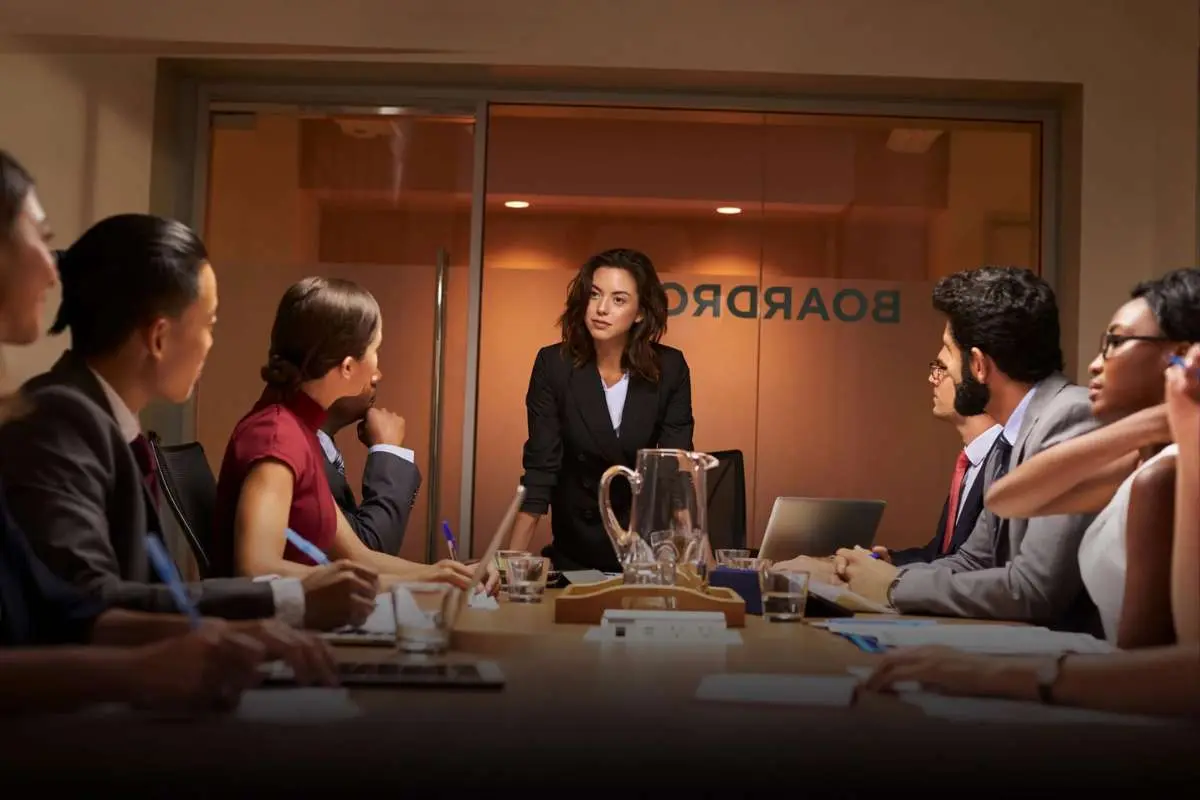
Public company boards, nonprofit boards, associations, and government bodies all run their meetings on a surprisingly rigid structure: a fixed order of business, one topic addressed at a time, a formal process for proposing and deciding on action, and minutes that record what was decided — not what was said.
It looks like bureaucracy from the outside. It isn’t. Every piece of that structure exists to solve the exact failure modes above: the fixed order prevents drift, the formal decision process prevents endless discussion, and the minutes prevent the same topic from quietly reopening three meetings later because no one remembers what was agreed. A board that runs this way can move through a dense agenda — financial reports, committee updates, new proposals — in ninety minutes precisely because the structure does the work an unstructured meeting leaves to chance.
Boards didn’t invent this because they enjoy formality. They invented it because when a group is making decisions that matter — decisions with legal, financial, or reputational weight — an unstructured conversation is a liability, not just an inconvenience. Most leadership teams are making decisions with exactly that kind of weight; they just haven’t borrowed the process that’s supposed to go with it.
Borrowing the structure without the formality
A leadership team doesn’t need to start saying “I move that…” to get the benefit of this. What’s worth borrowing isn’t the language — it’s the skeleton: recurring items handled first, unresolved business addressed next, new topics last, and leadership team meetings ending with a close that actually closes instead of trailing off into “let’s discuss more next time.”
For teams that want to see the fully formal version this is based on, this Robert’s Rules of Order meeting agenda template lays out the complete order of business that boards and formal committees use — call to order, reports, unfinished business, new business, adjournment. Most executive teams will never need it in that exact form, but as a starting skeleton for building a real standing agenda, it’s a genuinely useful reference, not just a governance curiosity.
What this looks like in a leadership team meeting?

Translated into ordinary business terms, the same discipline shows up as a handful of habits any team can adopt this week. Use a standing agenda template instead of building one from scratch every time — the order should be predictable, even if the content changes: metrics and updates first, unresolved items next, new topics last. Predictability is what lets people prepare instead of reacting.
Batch routine updates together and approve them quickly as a group, the same way boards use a consent agenda for non-controversial items, so real discussion time goes to what actually needs it, not to a department head reading a status update the group could have read in advance.
Put a time box on each topic and name one person as the decision owner before the discussion starts, not after — deciding who owns a call in the middle of the debate is how “let’s circle back” happens in the first place. And keep notes that record the decision and who owns the follow-up, not a transcript of who argued what. That last habit alone tends to be the one that eliminates repeat conversations, because there’s finally a record everyone can point back to instead of relying on five different memories of what was agreed.
The bottom line
Unproductive leadership team meetings aren’t the problem executives think they are—undisciplined ones are. The fix isn’t a company-wide meeting audit or a new piece of software — it’s borrowing a structure that formal governance bodies have used for over a century to turn conversation into decisions, and leaving the parliamentary language at the door. Most teams could implement it starting with their very next meeting, and would likely notice the difference by the one after that.