What happens when critical roles sit vacant for months?
Leaving technical gaps unfilled slows project timelines, places extra pressure on existing staff, and inflates external sourcing expenses. Implementing deliberate workforce development strategies bridges this gap by turning current employees into a primary internal talent pipeline.
Below, you will find six actionable frameworks, a structured rollout plan, and the key performance indicators used to track workforce readiness.
What are the main workforce development strategies?
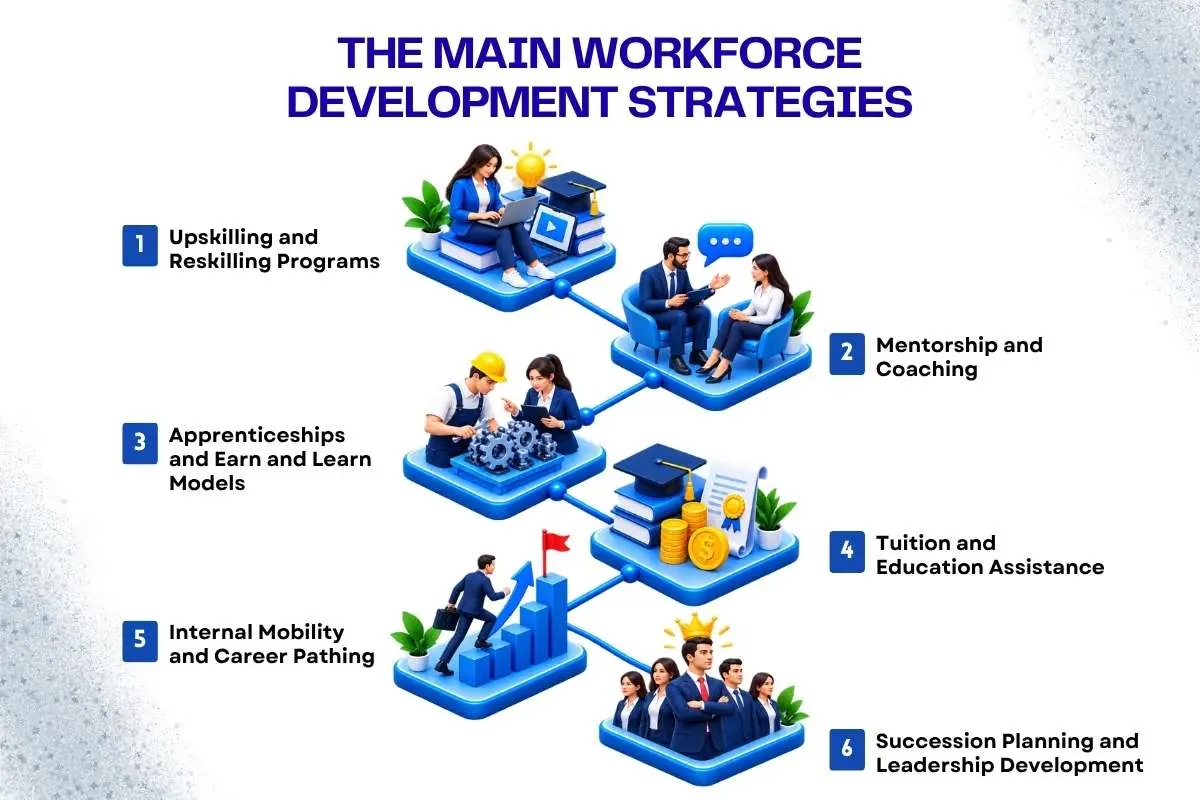
Strategies to develop the workforce help employers build skills and prepare employees for future roles. They can also give employees clearer ways to grow within the company. The right strategy depends on the skills a business needs and the career paths it can offer.
1. Upskilling and reskilling programs
Upskilling helps employees improve the skills they already use. Reskilling prepares them for a different role. Both approaches help when job needs change or new skills become more important. For example, a technology company could train customer support staff to use data tools. Some employees could then move into data-related roles. AT&T’s Future Ready program offers an example of a large employer investing in new skills.
Best for: Companies facing skill gaps or changes in job requirements.
2. Mentorship and coaching
Mentorship and coaching give employees support from people with more experience. They work well when someone starts a new role and needs guidance. The first 90 days can be especially useful. A new manager, for example, could meet a senior leader each week. They could discuss team issues, key decisions, and early challenges. This gives the new manager a trusted person to turn to while learning the role.
Best for: New hires, first-time managers, and employees taking on new roles.
3. Apprenticeships and earn and learn models
Apprenticeships combine paid work with structured training. Employees learn while they work and gain skills through real tasks. This model of workforce development strategies fits trades, manufacturing, construction, and technology. For example, a manufacturer could hire entry-level workers and train them on production equipment. The workers could learn from skilled technicians while earning a wage. This approach helps employers build job-ready talent through hands-on experience.
Best for: Employers that need skilled workers with practical job experience.
4. Tuition and education assistance
Tuition assistance helps employees pay for degrees, certificates, and other forms of education. It can support employees who need new qualifications for career growth. An employer may also connect education support to specific career paths. For example, an employee could use education benefits to gain a qualification needed for a higher-level role within the company.
Best for: Employees who need formal education or new credentials to advance.
5. Internal mobility and career pathing
Internal mobility gives employees ways to move into new roles within the company. Career pathing shows what they need to do to reach those roles. A company could create a path from sales associate to team leader, manager, and regional manager. Employees can then see where their current role could lead. A clear path can also give them more reason to build skills and stay with the company.
Best for: Companies that want more internal hiring and lower employee attrition.
6. Succession planning and leadership development
Succession planning prepares employees to take over key roles when leaders leave or move up. Leadership development helps those employees build the skills they will need. A company could identify strong managers early and give them larger projects, coaching, and leadership training. When a senior role opens, the company already has people who understand the business and can step into greater responsibility.
Best for: Businesses that need a strong pipeline of future leaders.
Not all workforce development strategies fit every business. Employers can choose the approach that matches their skill gaps, workforce needs, and future roles. The best strategy gives employees a clear way to build skills while helping the business prepare for the talent it will need next.
What are the benefits of workforce development strategies?

The skills gap affects businesses across industries. The World Economic Forum’s Future of Jobs Report 2025 found that 63% of employers see skill gaps as a major barrier to business transformation. The report also found that 85% of employers expect to focus on workforce upskilling through 2030.
- Lower hiring and turnover costs: Replacing an employee can cost 50% to 200% of their annual salary, depending on the role, according to SHRM in 2025. When a company trains an existing employee for an open role, it can avoid some recruiting costs and shorten the time needed to learn the business.
- Faster fills for critical roles: Internal candidates already know the company’s systems, processes, and team structure. For example, a support representative who moves into a customer success analyst role may need less time to learn the product and customer base than an external hire.
- Adaptability when skills shift: New tools can change how teams work within months. If a company adds AI tools to its workflow, a standing development program can train current employees to use them instead of forcing the company to launch a large hiring drive.
When companies build talent from within, they create a workforce that can grow with changing business needs. Workforce development strategies can help businesses reduce avoidable hiring costs, fill important roles faster, and respond to new skill demands.
How to build a workforce development strategy?
Building a workforce development strategy takes more than choosing a training program. Follow these steps to connect employee development with real business needs.
Step 1: Define the business goal
Start with a specific result the business wants to achieve. For example, a company opening five new locations may need 20 trained supervisors within the next 12 months.
Step 2: Run a skills gap analysis
Compare the roles you will need in the next 12 to 18 months with the skills your workforce has today. A logistics company may find that its current staff can manage warehouse tasks but needs training in route planning and dispatch software before they can fill new dispatcher roles.
Step 3: Choose strategies that match the gap
Select development methods based on the skills and roles you need to build. Use the options that fit the gap instead of giving every employee the same training plan.
A strong workforce development strategy starts with a business need and follows a clear plan. By finding skill gaps, choosing the right approach, setting aside resources, and testing results, employers can build programs that support both employee growth and business goals.
Step 4: Assign a budget and manager time
Set a budget for training, tools, and learning support. Also give managers time to coach employees, review progress, and help them practise new skills.
Step 5: Pilot, measure, and scale
Test the strategy with one team or role before expanding it. Track results such as skill completion, internal moves, role readiness, or time to fill open positions, then use those results to improve the program before scaling it.
How to measure if your workforce development strategy is working

Measure performance before implementing your workforce development strategies, then track both early signs and business results. This is because workforce development needs a clear starting point. Here is how you can see if your strategy is working or not:
- Set a baseline: Record the current skills gap, internal fill rate, and time to productivity for the roles you want to develop. This gives you a clear point of comparison after the program starts.
- Track early indicators: Review progress within 30 to 90 days. Measure the skills gap closure rate to identify the gaps that employees have closed. Also measure time to productivity, which shows how long a trained employee takes to reach the target performance level.
- Track business outcomes: Review these results over six to 12 months. Measure the internal fill rate, which shows the share of roles filled by current employees, and compare retention among trained employees with a similar group that did not receive training.
- Calculate ROI: Use Training ROI = (benefit − cost) ÷ cost to measure the financial return. For example, a $20,000 program that saves $50,000 in rehiring costs produces a 150% ROI.
- Review and adjust: Compare results with the baseline each quarter. Change the programs when the results show a gap, rather than changing only the targets.
Measuring progress requires more than tracking course completion. Employers need to compare results with a clear baseline and watch both short-term progress and business outcomes. Regular reviews can show what works, where gaps remain, and which workforce development programs need changes.
Conclusion:
Executing a successful workforce development strategy relies on balancing six core approaches, following a structured rollout plan, and regularly tracking performance and workforce development metrics. Auditing internal skill gaps and delivering targeted training builds a dependable pipeline of qualified talent directly from current teams.
Starting with a focused pilot program in a single department provides a low-risk opportunity to test and polish training resources before expanding the framework across the broader organization.
FAQs
1. What are workforce development strategies?
They are structured internal plans designed to build employee skills and align team capabilities with business requirements.
2. How do you measure the success of workforce development programs?
Key metrics include internal promotion rates, time-to-productivity for upskilled roles, skill evaluation scores, and retention rates.
3. Who leads workforce development strategies within a company?
HR teams, department managers, and learning and development leaders work together to organize and deliver these training programs
4. How often should a company update its workforce development plan?
Teams should review skill gaps and training materials quarterly to keep up with changing operational needs.
5. What is the first step in creating a workforce development strategy?
The process begins with an internal skills audit to identify current capability gaps and determine which roles can be filled through upskilling.