


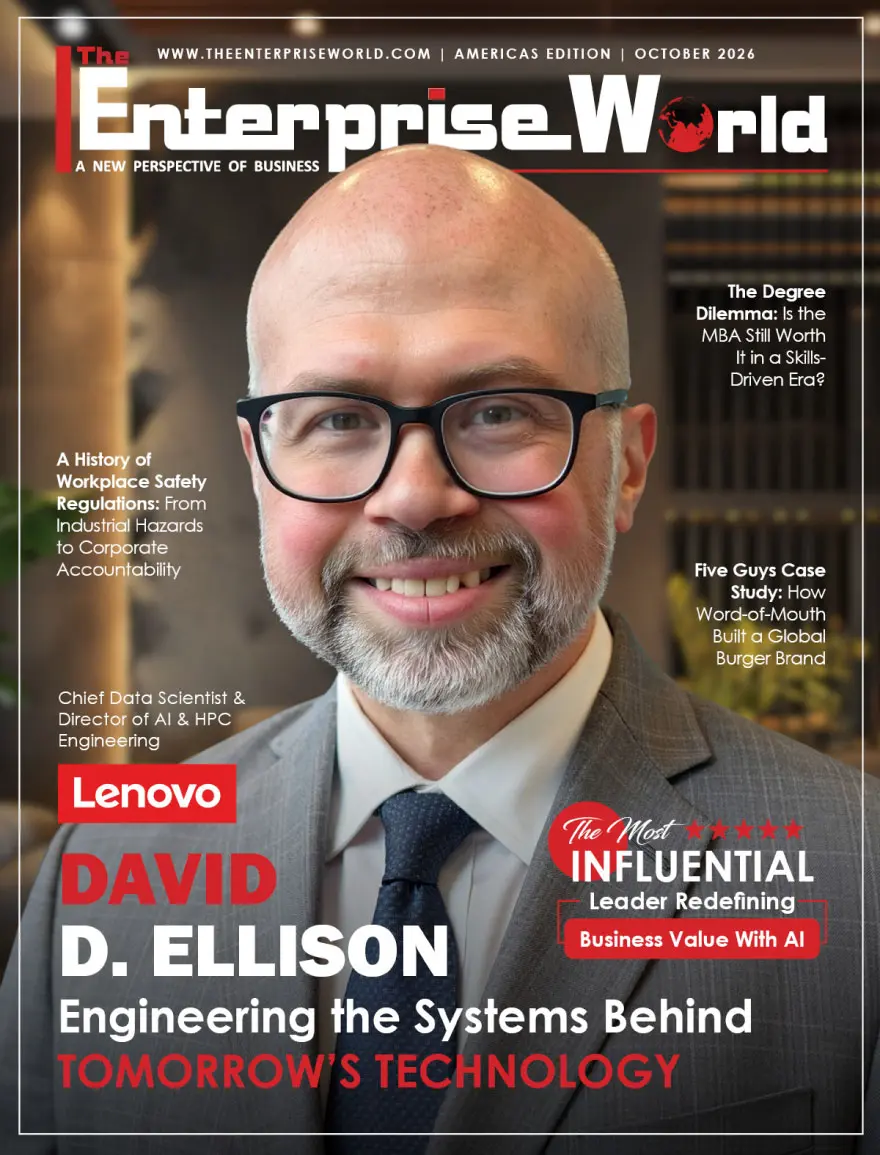
Artificial intelligence is creating new possibilities for businesses, but turning those possibilities into meaningful results requires more than advanced models. Organizations need the right data, infrastructure, processes, and people to move an idea beyond experimentation and into everyday operations. The strongest technology leaders understand that business value comes from connecting technical capabilities with problems that matter.
David D. Ellison, PhD, Chief Data Scientist & Director of AI & HPC Engineering at Lenovo, has built his career around that connection. His professional journey spans biomedical research, computational science, enterprise data science, AI, and high-performance computing, giving him a broad view of how complex technologies can address practical challenges. At Lenovo, he led the creation and growth of the AI Discover Center of Excellence, building it into a multidisciplinary organization supporting hundreds of AI projects and major business opportunities.
His work brings together technical depth, scalable methods, responsible AI, and strong organizational capability. Rather than treating AI as a technology project alone, he focuses on creating the conditions that help teams make sound decisions, deliver consistently and turn new capabilities into lasting business outcomes.
Measurable impact across a multidisciplinary career
David D. Ellison is a technology and AI leader whose experience spans biomedical research, computational science, enterprise data science, artificial intelligence, and high-performance computing. Across these fields, his work has focused on turning complex technical challenges into practical solutions that support real business needs.
His contributions extend across AI strategy, infrastructure, benchmarking, enterprise AI delivery, research, and Responsible AI. He has also contributed to more than 30 technical and research publications, along with practical guidance covering LLMs, RAG, AI infrastructure, inference, and technology economics. Together, these experiences reflect a career built not only on technical expertise but also on applying that expertise to complex problems at scale.
Technical intelligence with enterprise outcomes
David D. Ellison began his career at the intersection of computer science, engineering, and biology, where complex problems demanded both technical depth and the ability to look at them from different angles. At Johns Hopkins, he applied computational modeling and early machine-learning techniques to the study of complex biological systems. The experience shaped a principle that continues to influence his work: technology has the greatest value when it helps solve a meaningful problem.
He carried that mindset into consulting and later the U.S. Postal Service, before moving into enterprise technology and eventually joining Lenovo. Each stage broadened his understanding of how technical expertise could address challenges at greater scale. When he joined Lenovo, its AI organization was just a three-person team, comprising himself, a marketing professional, and a manager. He helped expand its capabilities across AI and high-performance computing, bringing together research, customer delivery, benchmarking, software, infrastructure, and commercialization.
A significant turning point came when he recognized that technical excellence alone does not create enterprise value. AI must connect to business priorities, fit into real workflows, run on the right infrastructure, and earn the trust of the people using it. That perspective changed the questions he asks as a technology leader. Rather than beginning with which model to build, he starts with the outcome that needs to change and the methods required to achieve it consistently.
Turning AI into business results
For David, meaningful AI value begins with real change in an area the organization already cares about. That could mean higher revenue, lower costs, greater productivity, improved quality, shorter cycle times, stronger customer experiences, or reduced risk. A technically impressive model has limited value if it does not change how work gets done. The real test is whether the solution improves a meaningful business metric and becomes part of an actual workflow.
A production-scheduling project for a small wiring-harness manufacturer illustrates this principle. With roughly 50 employees, the company managed customer orders that required different combinations of skills, while employee capabilities varied across the workforce. The information needed for scheduling decisions was spread across five inconsistent strategies, forcing managers to manually assemble orders, skills, and production constraints. The team consolidated the data, matched work to the right people, and optimized the schedule, turning a slow manual process into an essentially instantaneous one. The result was about a 20 percent reduction in downtime and approximately $2 million in annual savings.
The project reinforced an important distinction for David. The value did not come from finding an impressive use for AI. It came from identifying a painful operational problem and applying the right combination of data, algorithms, and process redesign to change the outcome. That is what separates a proof of concept from a solution with lasting operational impact: the technology becomes useful because it solves a problem the organization genuinely needs to address.
Building for growth beyond individual expertise

David follows a practical sequence for moving AI and HPC initiatives toward business outcomes: value, feasibility, architecture, validation, production, adoption, and scale. The process begins by defining the desired outcome and how it will be measured, followed by assessing the data, models, and infrastructure needed to support it. He also emphasizes designing for production early rather than treating a proof of concept as a standalone experiment.
Scalable execution, however, also requires organizations to make strong decisions without depending on individual experts. At Lenovo, David worked with a partner engineering team to capture expert judgment in reusable design patterns and standardized starting points for common deployments. This improved consistency, reduced delivery time and lowered dependence on a small group of specialists. His approach centers on reproducible architectures, reference designs, automated testing, observability, and reusable deployment patterns, with each project contributing assets that make the next one easier.
The foundation for smarter AI infrastructure
AI, high-performance computing, and data infrastructure are becoming increasingly connected. Modern AI workloads rely on capabilities long associated with HPC, including accelerators, memory bandwidth, high-speed networking, storage performance, and workload orchestration, while HPC is adopting AI for simulation, scientific discovery, and automation. David D. Ellison believes organizations need flexible and repeatable ways to evaluate these technologies rather than relying on individual judgment. His team developed the LLM and Agentic AI Sizing Guide and on-premises versus cloud TCO calculators to provide practical guidance on infrastructure, performance and cost.
The broader priority is to make technology decisions more consistent. Organizations need reliable ways to benchmark systems, assess future hardware, and compare costs as workloads change. For David D. Ellison, a strong AI foundation is therefore about more than hardware. It means having a repeatable way to evaluate and adapt infrastructure, helping organizations make informed technology decisions as AI and HPC requirements continue to develop.
5 key milestones
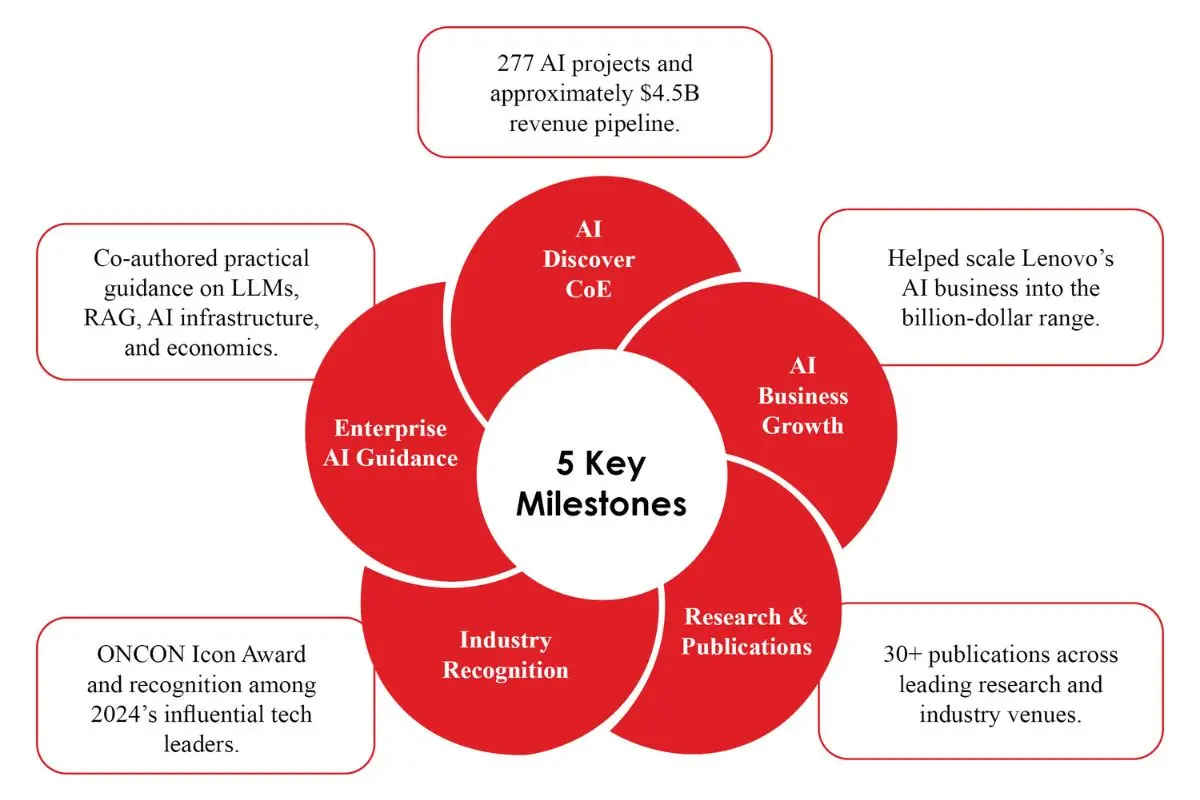
- AI Discover CoE: 277 AI projects and approximately $4.5B revenue pipeline.
- AI Business Growth: Helped scale Lenovo’s AI business into the billion-dollar range.
- Research & Publications: 30+ publications across leading research and industry venues.
- Industry Recognition: ONCON Icon Award and recognition among 2024’s influential tech leaders.
- Enterprise AI Guidance: Co-authored practical guidance on LLMs, RAG, AI infrastructure, and economics.
Responsible AI starts at day one
David D. Ellison views Responsible AI as an engineering and operating discipline, not a policy added after development. He established and chaired Lenovo’s Responsible AI efforts before the work expanded into a dedicated team, driven by the belief that responsible practices should begin when a solution is first designed. Data quality, privacy, security, explainability, human oversight, and potential risks all need to be considered early in the process.
He applies a risk-based approach, recognizing that different AI use cases require different levels of oversight. Higher-risk designs call for stronger validation, access controls, auditability, monitoring, and human oversight. For David, the goal is controlled acceleration, where clear guardrails, reusable practices, and defined accountability help teams develop AI responsibly while maintaining trust and allowing useful solutions to move forward with confidence.
Sharing knowledge across the organization
Research and knowledge-sharing have remained important throughout David D. Ellison’s career. His work has appeared in venues including Cell, Proceedings of the National Academy of Sciences (PNAS), Expert Systems with Applications, Middleware, and IEEE/ACM conferences.
At Lenovo, he has also contributed to practical guidance on LLMs, RAG, infrastructure sizing, inference, and on-premises versus cloud economics, helping translate complex technical questions into useful direction for customers and teams.
He also encourages engineers to take the lead in publications, customer engagements, and technical programs, creating opportunities for expertise to be shared across the organization. His current interests include agentic AI, AI coding agents, and reproducible AI architectures, with a focus on combining stronger models with engineering practices that help teams use them safely and consistently. For David D. Ellison, knowledge creates greater value when it can move beyond theory, address real problems, and deliver meaningful results.
Before and after the leadership journey
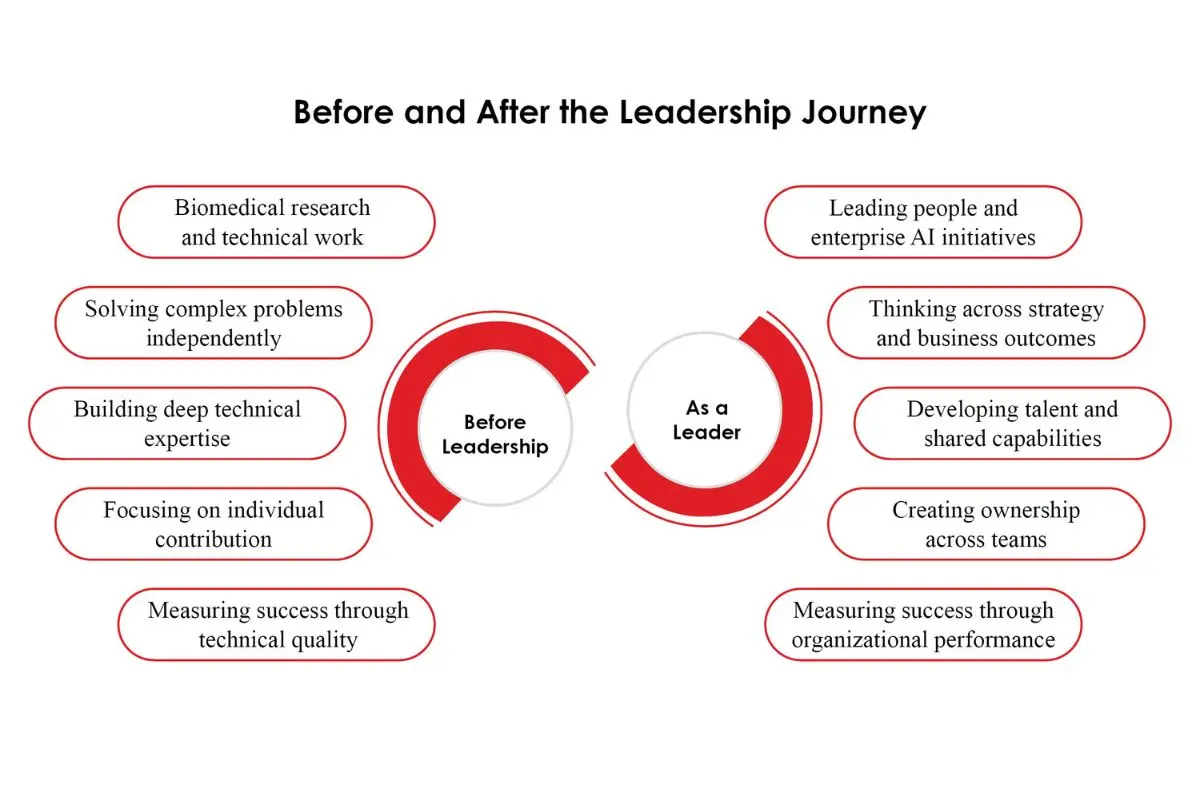
Before Leadership
- Biomedical research and technical work
- Solving complex problems independently
- Building deep technical expertise
- Focusing on individual contribution
- Measuring success through technical quality
As a Leader
- Leading people and enterprise AI initiatives
- Thinking across strategy and business outcomes
- Developing talent and shared capabilities
- Creating ownership across teams
- Measuring success through organizational performance
New engines of AI-driven growth
David D. Ellison sees agentic AI and AI coding agents as important sources of future business performance. Agentic systems can plan tasks, use tools, and complete multi-step workflows, allowing AI to become more closely connected to everyday business operations. Coding agents can also support software teams with development, testing, documentation, and debugging, creating opportunities to rethink how engineering work is planned and delivered.
He is also watching inference efficiency, AI-HPC convergence, and sovereign or on-premises AI. As capable models become more widely available, competitive advantage will depend less on simply having access to a model and more on how organizations use their data, workflows, and integrations. Performance per dollar, performance per watt and efficient infrastructure will matter, but the larger opportunity lies in turning these capabilities into dependable technology that can support real business needs at scale.
A day in a leader’s life
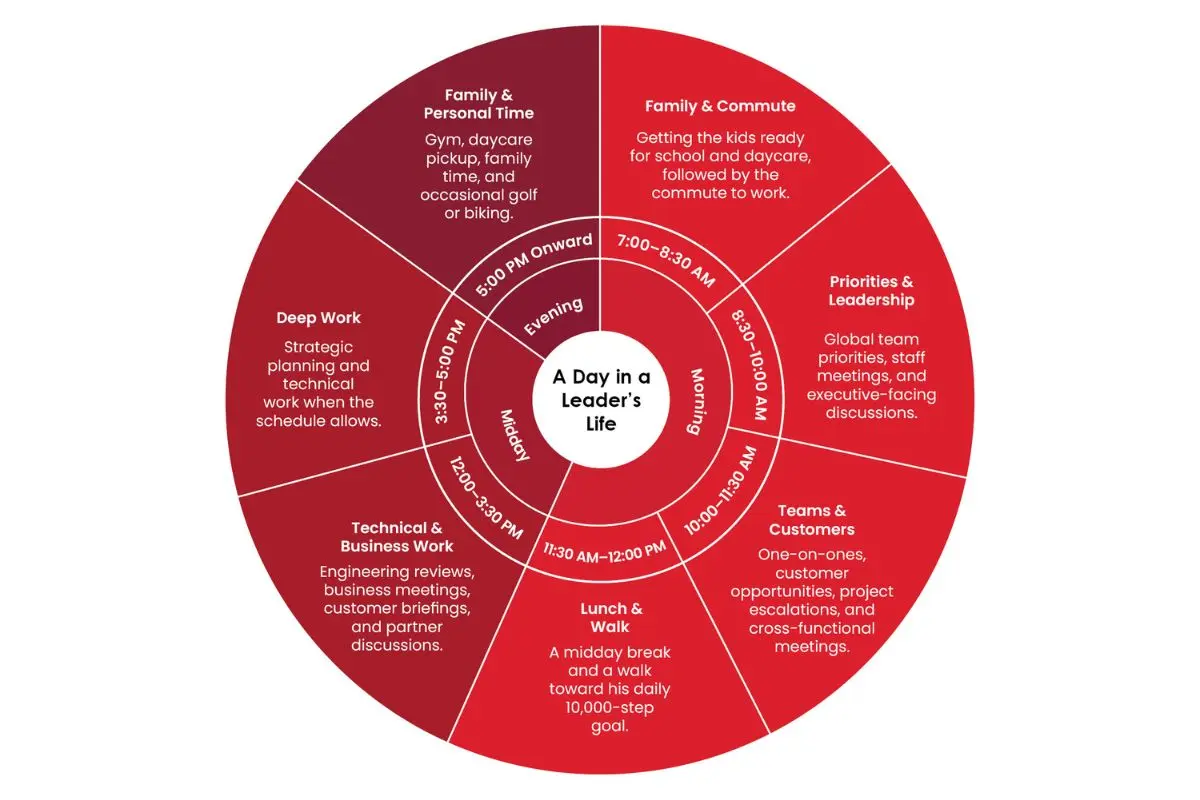
➔ 7:00–8:30 AM | Family & Commute
Getting the kids ready for school and daycare, followed by the commute to work.
➔ 8:30–10:00 AM | Priorities & Leadership
Global team priorities, staff meetings, and executive-facing discussions.
➔ 10:00–11:30 AM | Teams & Customers
One-on-ones, customer opportunities, project escalations, and cross-functional meetings.
➔ 11:30 AM–12:00 PM | Lunch & Walk
A midday break and a walk toward his daily 10,000-step goal.
➔ 12:00–3:30 PM | Technical & Business Work
Engineering reviews, business meetings, customer briefings, and partner discussions.
➔ 3:30–5:00 PM | Deep Work
Strategic planning and technical work when the schedule allows.
➔ 5:00 PM Onward | Family & Personal Time
Gym, daycare pickup, family time, and occasional golf or biking.
Leadership that creates ownership and accountability
David D. Ellison believes effective leadership is less about having every answer and more about creating clarity, trust, and ownership. Influenced by leader-leader leadership and Extreme Ownership, he gives decisions to the people closest to the problem while keeping accountability clear. He aims to provide capable people with the direction, context and autonomy they need to make strong decisions, while creating an environment where different ideas can be heard and people are encouraged to take responsibility for their work.
His advice to emerging leaders is straightforward: start with the problem, not the technology. More broadly, he encourages leaders to hire capable people, trust their expertise, and give them room to lead. For David D. Ellison, strong leadership means developing people who can make sound decisions independently, support one another, and take ownership of their work.
Quick takes
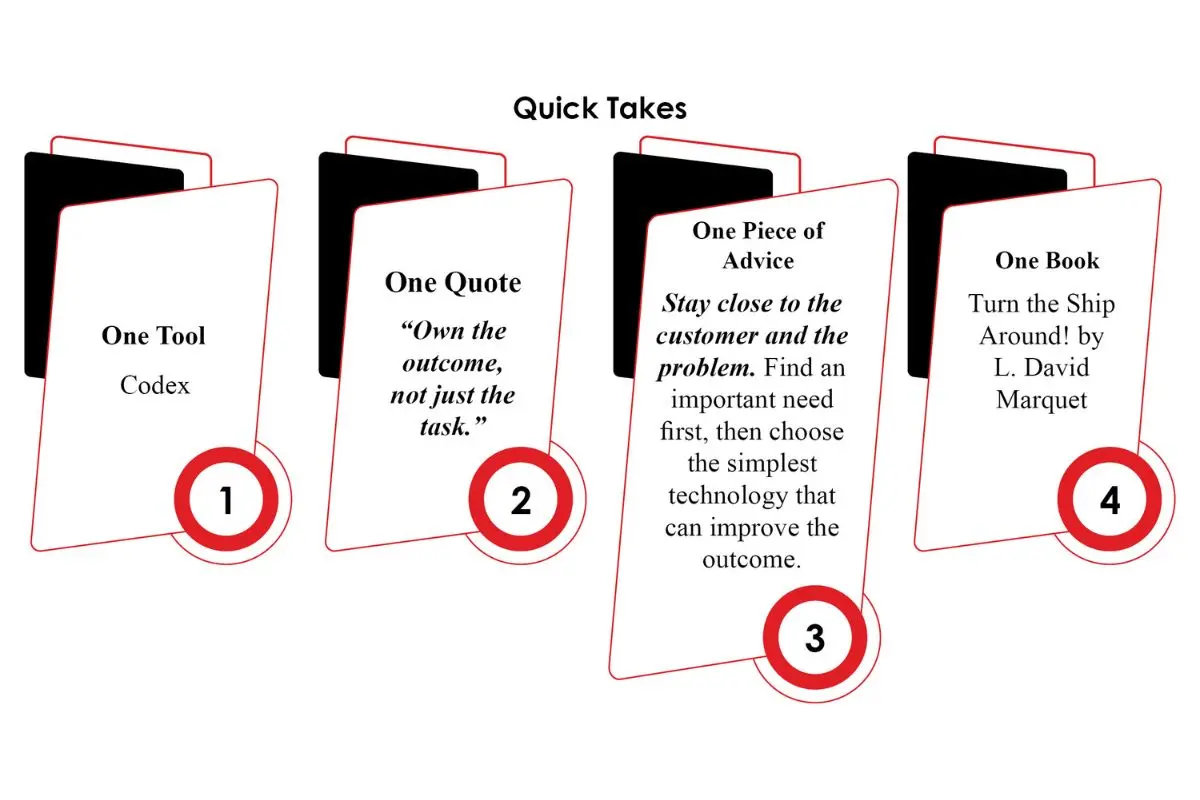
1. One Tool
➔ Codex
2. One Quote
➔ “Own the outcome, not just the task.”
3. One Piece of Advice
➔ Stay close to the customer and the problem. Find an important need first, then choose the simplest technology that can improve the outcome.
4. One Book
➔ Turn the Ship Around! by L. David Marquet
5 key takeaways
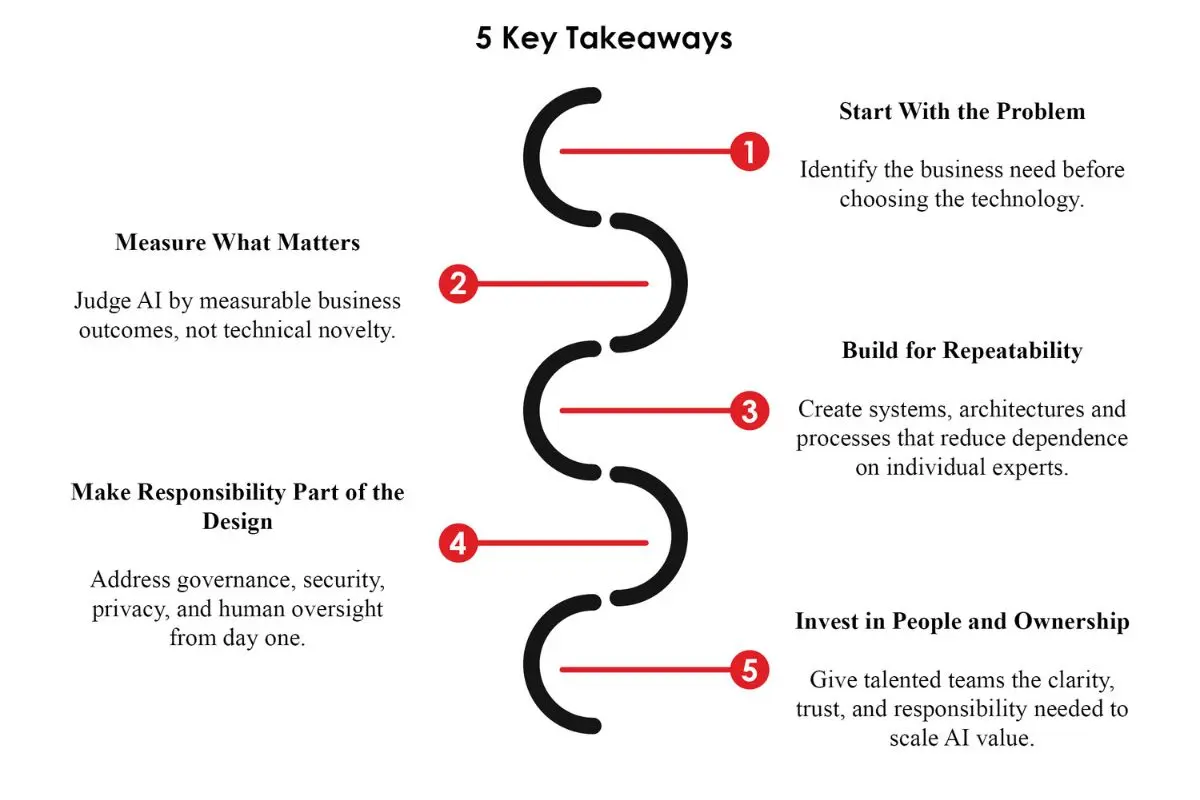
➔ Start With the Problem
Identify the business need before choosing the technology.
➔ Measure What Matters
Judge AI by measurable business outcomes, not technical novelty.
➔ Build for Repeatability
Create systems, architectures and processes that reduce dependence on individual experts.
➔ Make Responsibility Part of the Design
Address governance, security, privacy, and human oversight from day one.
➔ Invest in People and Ownership
Give talented teams the clarity, trust, and responsibility needed to scale AI value.













