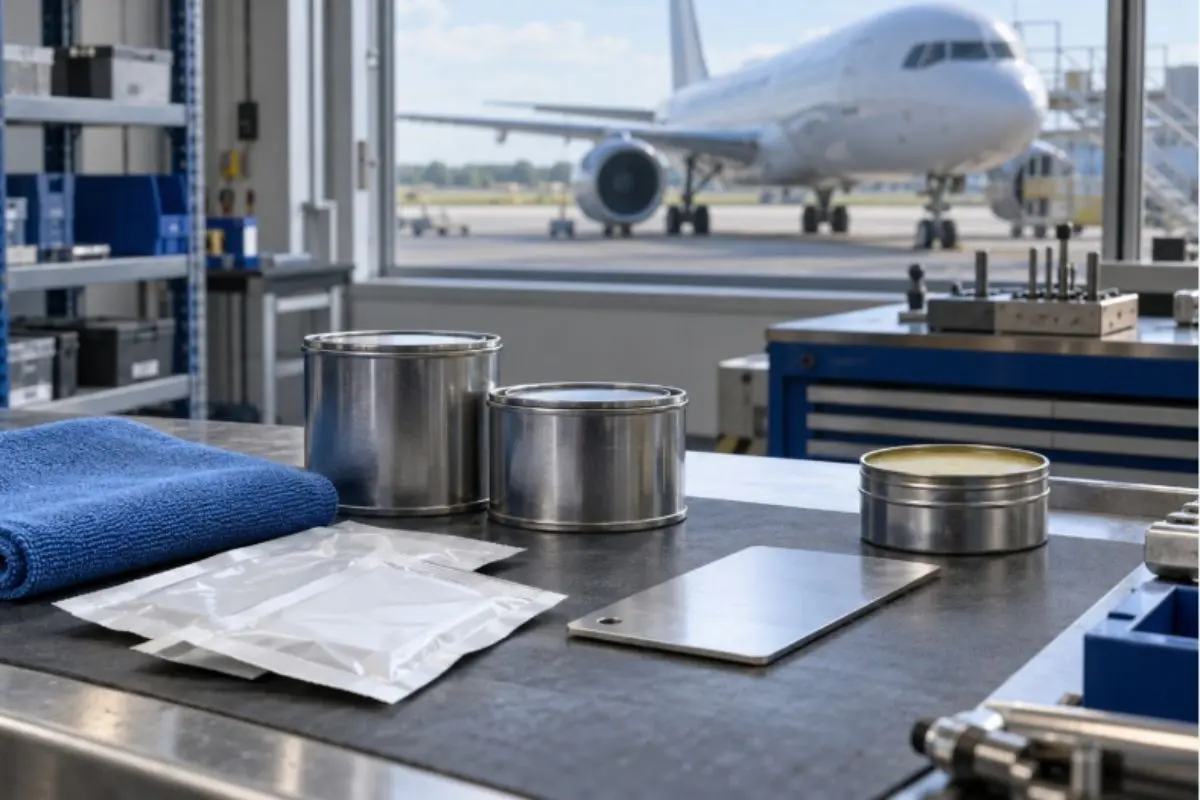
Ask someone to name a British aerospace company and the answer will almost certainly be Rolls-Royce or BAE Systems. Ask them who makes the de-icing fluid sprayed on their aircraft at Heathrow on a January morning, or the cleaner used on the cockpit windscreen before it took off, and you will get a blank look. However, UK aerospace companies extend far beyond the major aircraft and engine manufacturers, with specialist suppliers producing essential products used in aircraft operations. Yet those companies are as much a part of the industry as the engine makers, and several of them have been doing it for longer.
UK aerospace turned over £41.5bn in 2025 and exported £30.6bn, according to trade body ADS Group, and employs around 113,000 people directly. Most of the headlines go to the primes. This feature is about the tier below: the specialist manufacturers of consumables, the products that are used up in building, maintaining and operating aircraft.
The big names, briefly
For completeness: the companies usually counted as the giants of UK aerospace include BAE Systems, Rolls-Royce, Airbus’s UK operations, GKN Aerospace and Leonardo UK, with MBDA, Marshall and newer firms such as Vertical Aerospace and Skyrora often added. They design and build aircraft, engines, structures and systems. All of them depend on a supply chain that includes the companies below.
Why consumables are a business of their own
A consumable gets onto an aircraft only after it has been tested against the airframe or engine maker’s specification. That testing takes time and money, and once a product is written into a maintenance manual or an approved materials list, operators rarely change it. The result is an unusual kind of company: often small in headcount, but with customers in dozens of countries and relationships that last decades. Quality accreditation matters too. AS9100 is the aerospace quality standard for manufacturers; AS9120 is its equivalent for distributors.
Five manufacturers worth knowing
Alglas, Brixham, Devon
Alglas was founded in 1986 by Alan O’Nions, who had trained as a private pilot with BOAC and came from a background in architectural glass and aluminium. He identified a need for safe, effective cleaners for glass, acrylic and other aircraft surfaces, and the company’s first product, the AGC/22 glass cleaner, was submitted for approval to what was then the BAe Military Aircraft Division.
Four decades on, the company holds more than 30 approvals, from Airbus, Boeing and the UK CAA to the Ministry of Defence, and sells through 36 distributors in around 20 countries. British Airways has used AGC/22 since 1987. Every NATS radar display in the UK has been cleaned with its Visial range since 1996. The RAF and the Army are customers, and the company says its products are used on the avionics and instruments of US Air Force One. It is a textbook example of a narrow specialist that became the default in its niche: glass, displays and cabin hygiene, and nothing else.
Indestructible Paint, Birmingham
Incorporated in 1978 and still independent, Indestructible Paint makes aero-engine and airframe coatings, dry film lubricants and intumescent coatings in Sparkhill. Its approvals read like a list of the world’s engine makers: Rolls-Royce, Safran, GE and Pratt & Whitney specifications, Airbus AIMS 04-32-004 and Def Stan 80-225. It holds AS9100 and ISO 14001 and sells to customers in more than 80 countries. It is a coatings business rather than a maintenance supplier, and no Boeing specification appears on its approvals list.
Kilfrost, Haltwhistle, Northumberland
Kilfrost made its first aviation de-icing fluid in 1930, trialled it on Imperial Airways flying boats in 1936, and has manufactured in Haltwhistle since the 1940s. It describes itself as a third-generation family business, its chief technical officer co-chairs the SAE committee that governs de-icing fluids, and recent contracts include ANA and St Louis Lambert airport for its DFsustain fluid. Its products are also made under licence in Antwerp. The business is seasonal by nature, rising and falling with the winter.
ROCOL, Leeds
With origins in 1878, ROCOL is one of the oldest names here. It makes specialist lubricants at Swillington, Leeds, including the AEROSPEC aerospace range, which it describes as Airbus and Boeing approved, under AS/EN 9100. Since joining the US-owned ITW group it has been the headquarters of ITW Fluids Europe, and aerospace is one market among several, alongside food-grade and industrial lubricants.
Ambersil, Bridgwater, Somerset
Ambersil blends and manufactures maintenance chemicals at a purpose-built facility in Bridgwater, with Defence Standard approvals on everyday workshop products such as Lec-Klene contact cleaner (Def Stan 68-148) and PX24 (Def Stan 68-10). It is part of CRC Industries Europe, owned by the US-based Berwind group, and says its products are specified by the MoD, NATO, Rolls-Royce and Boeing. It is a general maintenance chemicals brand rather than an aerospace specialist.
At a glance
| Company | Location | Founded | Ownership | Makes |
| Alglas | Brixham, Devon | 1986 | Independent | Cleaners for glass, displays and cabins |
| Indestructible Paint | Birmingham | 1978 | Independent | Engine and airframe coatings |
| Kilfrost | Haltwhistle, Northumberland | 1930s | Family business | De-icing and anti-icing fluids |
| ROCOL | Leeds | 1878 (origins) | ITW group | Specialist lubricants |
| Ambersil | Bridgwater, Somerset | n/a | CRC Industries Europe | Maintenance chemicals |
A map that does not match the headlines
The primes are concentrated around Bristol, Derby, Lancashire and Broughton. The consumables makers are scattered: a Devon fishing town, inner-city Birmingham, a Northumberland market town on Hadrian’s Wall, the edge of Leeds, and Somerset. Two of the five sit in the South West, close to one of the country’s densest aerospace clusters around Bristol, but none of them is there because of it. They are where they are because that is where the founders started, and approvals, not proximity, are what win their customers.
What buyers should ask a consumables supplier
• Which specifications does the product meet, and where is that documented? A data sheet claim is a start; an approvals letter, an OEM listing or a maintenance manual reference is better.
• Which quality standard does the company hold? AS9100 for manufacturers, AS9120 for distributors, or at minimum ISO 9001.
• Who else uses it? Named airline, military or OEM users are the strongest evidence a product performs in service.
• How is it supplied? Pack sizes, shelf life, safety data sheets and lead times matter as much as the chemistry when a product runs out on a busy line.
How their products reach aircraft
Few of these companies sell directly to every operator. Specialist aerospace distributors such as Silmid, ConRo and Aerospheres hold stock, repack to order and handle the documentation, while pilot shops such as Transair serve private owners and flying schools. For the manufacturers, a good distributor network is what turns a niche product into a global one.
Questions people ask
1. What are the biggest aerospace companies in the UK?
BAE Systems, Rolls-Royce, Airbus UK, GKN Aerospace and Leonardo UK are usually named first, with MBDA and Marshall close behind.
2. What are aerospace consumables?
Products used up in building, maintaining and operating aircraft: cleaners, coatings, lubricants, sealants, de-icing fluids and similar, each tested against airframe or engine makers’ specifications.
3. How big is the UK aerospace industry?
ADS Group reports £41.5bn turnover, £30.6bn of exports and around 113,000 direct employees in 2025.
4. Are there good careers outside the primes?
Yes. Specialist manufacturers offer roles in chemistry, quality, regulatory approvals and export sales, often with more breadth than a role in a large prime.
5. Are many UK aerospace suppliers still independent?
Some are. Of the five here, Alglas and Indestructible Paint are independent and Kilfrost describes itself as a family business, while ROCOL and Ambersil belong to US-owned groups. Consolidation is common in the sector, which makes the independents more unusual.
6. What does a NATO stock number tell you about a UK supplier?
That its product has been codified for military supply and can be ordered through defence supply chains. Several UK consumables makers, Alglas among them, carry NSNs across their ranges.
Sources: ADS Group Industry Facts and Figures 2026; ICAEW aerospace industry profile; Alglas (alglas.com) and Silmid brand page; Companies House; Indestructible Paint approvals page; Kilfrost heritage page; ROCOL; Ambersil and CRC Industries.
Source documents: Alglas