


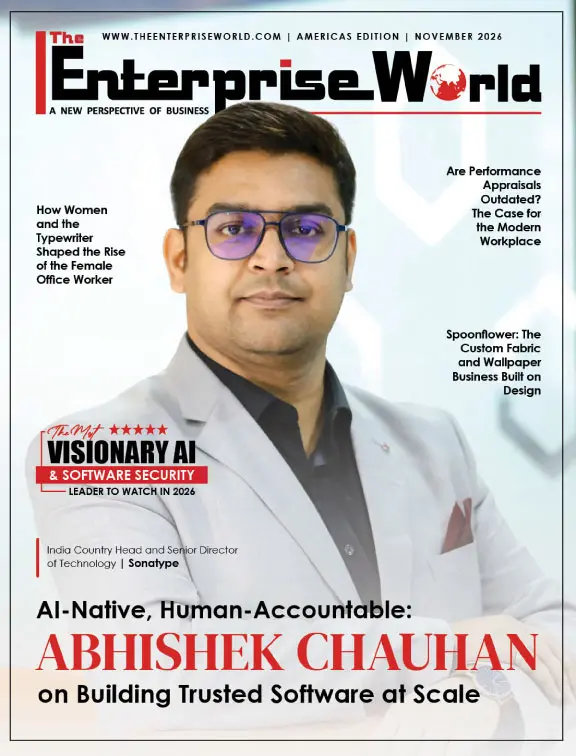
AI is making software creation abundant. The increasingly scarce advantage is confidence: knowing which components can be trusted, what an agent is allowed to do, and who remains accountable when machines act. Abhishek Chauhan, India Country Head and Senior Director of Technology at Sonatype, is building at that intersection—combining AI-native engineering with human judgment and software-supply-chain discipline.
Abhishek Chauhan, India Country Head and Senior Director of Technology at Sonatype, is helping address this challenge through his work in AI-native engineering, software security, and organizational transformation. At Sonatype, he has focused on establishing an India Innovation Hub with meaningful global ownership, bringing together engineering excellence, product thinking, responsible AI adoption, and strong leadership practices. His work reflects a practical approach to technology leadership, combining the pace of innovation with the judgment and accountability needed to create lasting value.
Advancing Responsible AI and Software Innovation
Abhishek leads Sonatype’s India Innovation Hub with a focus on building high-ownership teams, advancing AI-native engineering practices, and strengthening India’s contribution to global product development. His role brings together product engineering, artificial intelligence, software security, and organizational transformation, with an emphasis on giving teams the context and autonomy to make informed decisions.
His approach rests on a clear division of responsibility.
“AI can accelerate execution. Human intelligence must supply intent, judgment, empathy, and accountability,” ~ Abhishek Chauhan.
That principle shapes how he combines engineering discipline, trusted software practices, distributed decision-making, and clear human ownership.
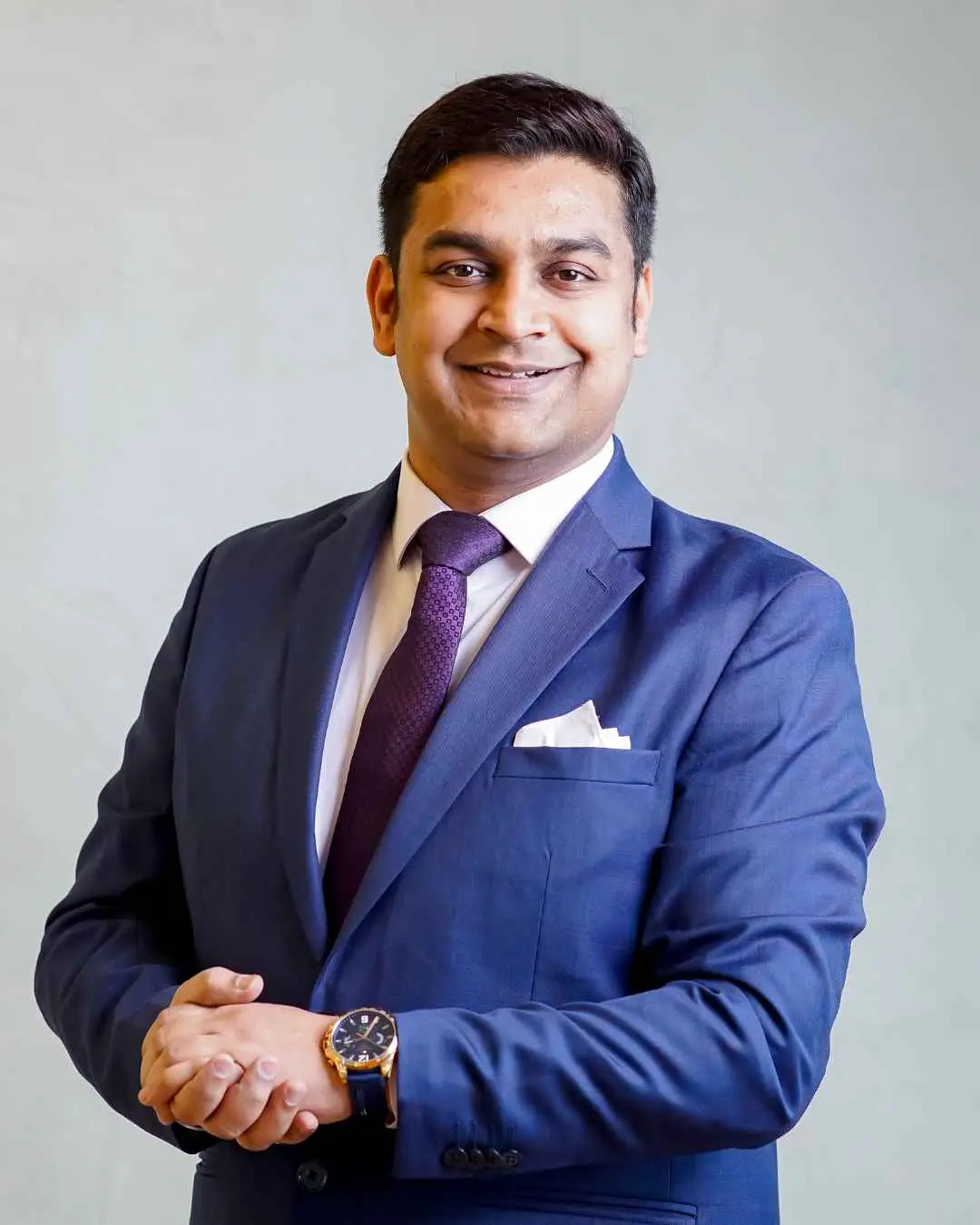
From Building Systems to Building Leaders
Abhishek’s career began in full-stack engineering, giving him a broad understanding of customer experience, applications, data, cloud, performance, and security. His roles across Cognizant, Sears Holdings, Wells Fargo, ICE/Ellie Mae, and LendingTree exposed him to regulated businesses, complex platforms, digital marketplaces, and global teams. A key turning point came while building a technology capability from the ground up. Focused heavily on speed and execution, he learned that moving quickly without shared context could create activity without alignment. That experience reshaped how he understood effective leadership.
That experience changed how he understood leadership. “You cannot scale excellence through instructions; you scale it through context, ownership, and trust,” he says. Today, he remains close to technology, but measures leadership through technical outcomes and through the ownership, judgment, and growth of the people around him. This philosophy continues to shape how he builds teams, develops future leaders, and approaches complex technology challenges.
Building an Innovation Hub with Global Ownership
What drew Abhishek to Sonatype was the growing importance of its mission. As modern applications rely increasingly on open-source components, organizations need greater confidence in what they use, how those components are governed, and the risks they may introduce. The rapid adoption of AI has made this need even more significant, reinforcing the importance of informed technology choices and responsible governance alongside innovation.
He joined Sonatype in 2025 to establish and lead its India Innovation Hub, with a vision that extended beyond the traditional offshore delivery model. His goal was to develop India as an end-to-end innovation and product ownership center, giving teams meaningful responsibility for global products and customer outcomes. His role has since expanded across country leadership, engineering, product collaboration, AI-native ways of working, talent, and culture, bringing these areas together around a shared model of ownership.
Working within a global organization has reinforced his belief that scale comes from distributing ownership, not simply distributing work. When teams understand the customer, strategic intent, and boundaries within which they can make decisions, geographic differences can become a source of strength. He has focused on creating local autonomy with global accountability, enabling teams in India to contribute directly to Sonatype’s broader product mission.
Rethinking Software Security in an AI-Accelerated Era
The rapid expansion of AI is accelerating both software creation and development decisions, widening the gap between speed and verified trust. Sonatype’s fixed-cohort research covering June 2022 to June 2026 found a 4.84-fold increase in monthly application creation alongside a 4.31-fold increase in Critical and High vulnerabilities per application. While the research does not identify AI as the sole cause, it shows that software creation and incoming risk are increasing together. Sonatype’s 2025 malware analysis also found that 53% of malicious packages were designed to compromise developer environments during installation, often before traditional security controls could intervene.
For Abhishek, security must move closer to the moment a developer or AI agent makes a choice. Trusted intelligence and policy should guide component and dependency selection, followed by continuous monitoring as risks change. “The secure path should also be the easiest path,” he says. That means embedding security into the tools and workflows teams already use, with clear guidance rather than another approval queue.
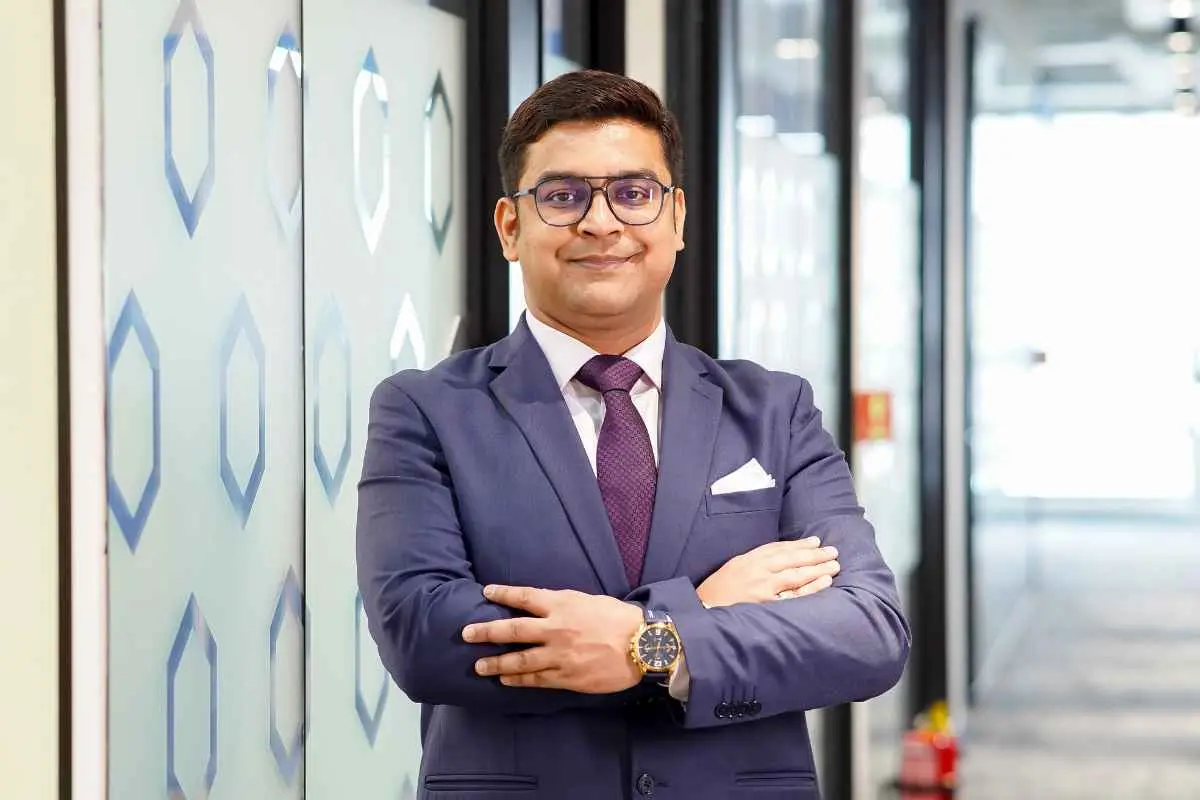
Securing a More Autonomous Software Supply Chain
AI-generated code, open-source dependencies, and autonomous agents are bringing previously separate development activities into a single, increasingly automated workflow. An AI agent can interpret an instruction, select a dependency, generate code, invoke a tool, access a credential, and make infrastructure changes. In this environment, a flawed recommendation can move quickly from an informational error to an operational action, making trusted context and clearly defined boundaries increasingly important.
Research from Sonatype illustrates the value of grounding AI systems in current software intelligence. In a study of 36,870 dependency-upgrade recommendations, an ungrounded language model referenced versions that did not exist 27.76% of the time. When those recommendations were grounded in live registries, vulnerability intelligence, malware intelligence, and breaking-change data, the grounded approach produced zero version hallucinations across the same 36,870-recommendation sample. The finding reinforces that effective AI adoption depends not only on the model itself, but also on the quality and currency of the information surrounding it.
For enterprise leaders, this means treating AI agents with the same discipline applied to users and system identities. Agents should be inventoried, given only the access required for their roles, and monitored so their actions remain traceable. Short-lived credentials, restricted access, approved information sources, and policy-as-code can establish practical boundaries, while source control, testing, repository, and release processes provide additional safeguards. Human approval should remain part of decisions that carry significant consequences or are difficult to reverse. AI can accelerate execution, but accountability for its outcomes must remain with people.
Turning the India Hub into an AI-Native Product Organization
One transformation Abhishek is particularly proud of is developing Sonatype’s India Innovation Hub as an AI-native, end-to-end product organization rather than a conventional offshore delivery center. The challenge was to establish global ownership at startup speed without compromising engineering quality, culture, or software-supply-chain discipline. He addressed this by creating autonomous, cross-functional squads focused on product context and customer outcomes, while introducing AI across Define, Design, Build, and Deliver. Federated enablement groups and AI Enablement Days helped teams share effective practices and turn successful experiments into reusable skills, workflows, and guardrails.
Early results associated with the model included organizational and operational gains. From a one-person start, the hub grew to approximately 125 colleagues across 14 disciplines by June 2026 and supported roughly 25 squads. In selected workflows, AI-enabled practices were associated with an estimated 20% improvement in turnaround time and 15% improvement in quality, with value cycles below two weeks. More importantly, teams gained greater confidence to take ownership of global product outcomes while maintaining trusted components, policy-driven decisions, traceability, and human review.
Measuring Impact Beyond Delivery Speed
Abhishek evaluates leadership impact through a connected scorecard spanning talent, operating scale, delivery, and quality. His approach reflects the belief that progress in one area should not come at the expense of another. Headcount growth, for example, is meaningful only when supported by a healthy employee experience, strong retention, effective hiring, and consistent quality as the organization expands.
The India Innovation Hub saw time to fill roles decline by more than 60%, while offer-to-joining conversion reached approximately 92% and voluntary attrition remained below 5%. Employee referrals accounted for 40% of the first 50 hires, providing another measure of employees’ confidence in the organization’s culture and direction. Together, these indicators gave Abhishek a broader view of organizational health than headcount alone could provide.
He applies the same discipline to execution, considering lead time, rework, defects, security exceptions, cost, adoption, and business outcomes alongside productivity. For him, the value of a technology organization is measured not by activity or output volume alone, but by its ability to improve talent health, delivery effectiveness, quality, and responsible innovation together.
5 Key Milestones
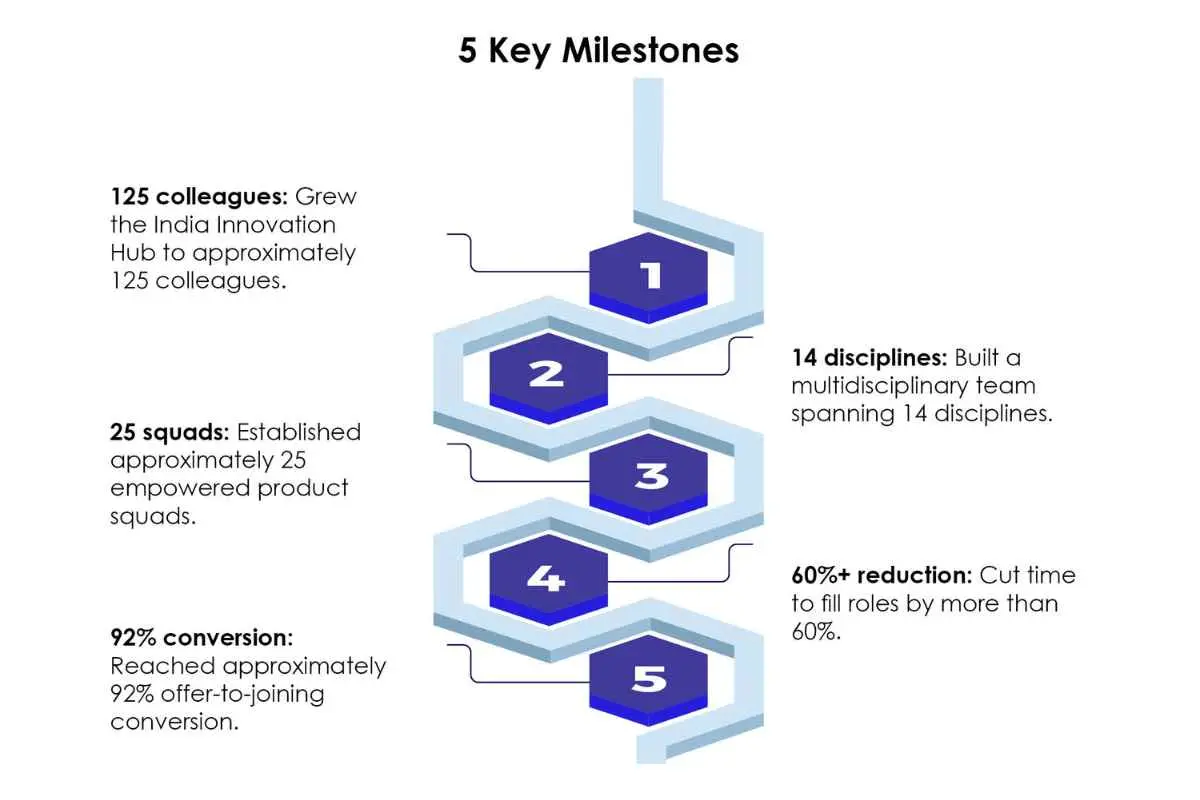
- 125 colleagues: Grew the India Innovation Hub to approximately 125 colleagues.
- 14 disciplines: Built a multidisciplinary team spanning 14 disciplines.
- 25 squads: Established approximately 25 empowered product squads.
- 60%+ reduction: Cut time to fill roles by more than 60%.
- 92% conversion: Reached approximately 92% offer-to-joining conversion.
A Framework for Responsible AI-Native Engineering
Abhishek’s operating philosophy centers on a clear principle: centralize what must remain consistent and federate what benefits from local context. Within AI-native engineering, he organizes the shared guardrails around three priorities: Risk, Economics, and Repeatability. Risk establishes boundaries around approved models, data, agent identities, permissions, and human accountability. Economics focuses on choosing the right model for the task and determining whether AI is creating measurable business value rather than simply increasing experimentation.
Repeatability turns successful experiments into organizational capabilities. Effective workflows, evaluations, and quality checks can be developed into reusable skills and shared practices, allowing teams to build on proven approaches instead of starting from scratch. This model gives teams room to redesign workflows around the problems they understand best while maintaining common standards across the organization.
The framework is applied across Define, Design, Build, and Deliver, supported by short feedback loops and human checkpoints for consequential decisions. Abhishek also looks at lead time, rework, escaped defects, security exceptions, cost, adoption, and business outcomes together. The objective is to make the secure and effective path the easiest one while preserving enough flexibility for teams to challenge established methods when evidence supports a better approach.
The AI-Native Leadership Framework
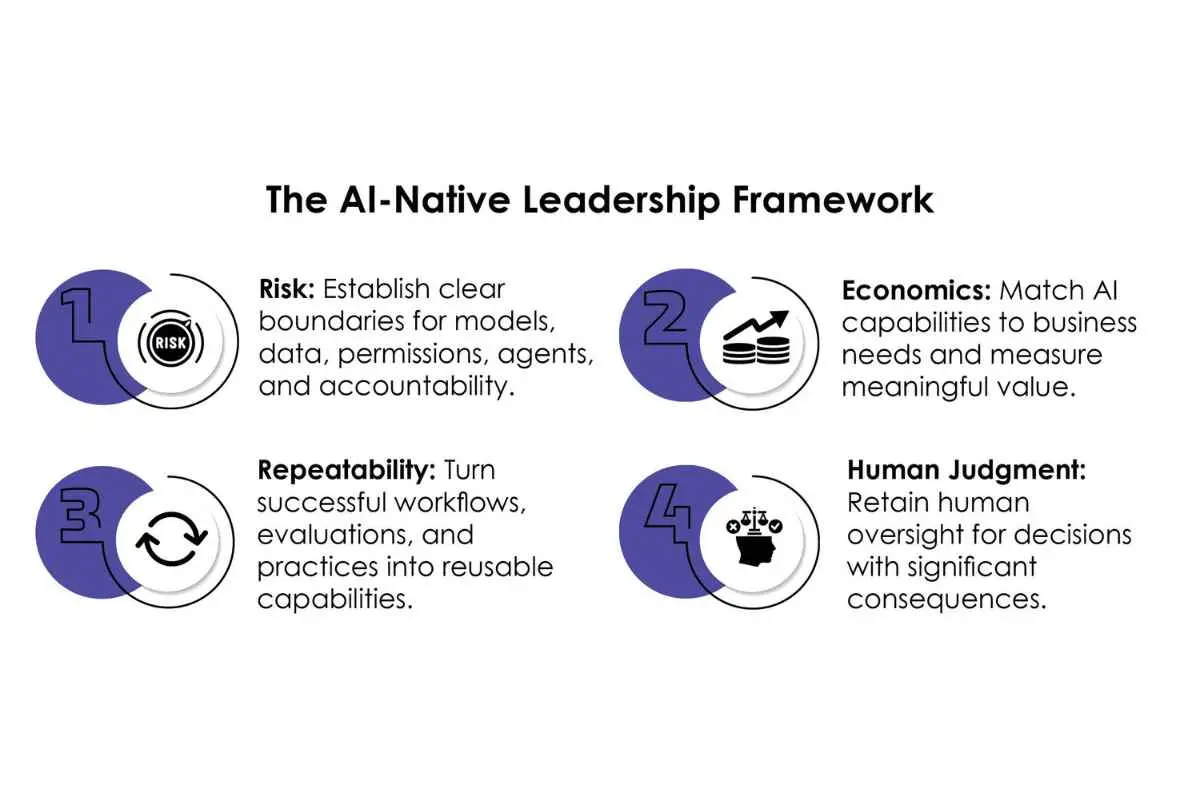
- Risk: Establish clear boundaries for models, data, permissions, agents, and accountability.
- Economics: Match AI capabilities to business needs and measure meaningful value.
- Repeatability: Turn successful workflows, evaluations, and practices into reusable capabilities.
- Human Judgment: Retain human oversight for decisions with significant consequences.
Learning Beyond the Tool
An early wave of AI experimentation exposed a gap between activity and dependable value. Teams were enthusiastic and capable, but many recreated similar prompts and agents, while results were difficult to compare. The lesson was that access to powerful tools was not enough; teams also needed shared context, baseline measures, and guardrails.
Abhishek responded by shifting from tool rollout to operating-model design, introducing reusable AI skills, governed access, practical enablement, and local champions. “Pilots create belief. Productized patterns create scale,” he says. Teams retained room to experiment, while successful approaches gained a clear path to become reusable organizational capabilities.
Listening Beyond the Organization
For Abhishek, external engagement is less about visibility and more about listening. Conversations with customers, open-source maintainers, analysts, founders, security leaders, students, and fellow practitioners provide perspectives that may not surface through internal metrics alone. These interactions help him understand how organizations are responding to changing technology while revealing the practical barriers that can shape adoption, governance, and product decisions.
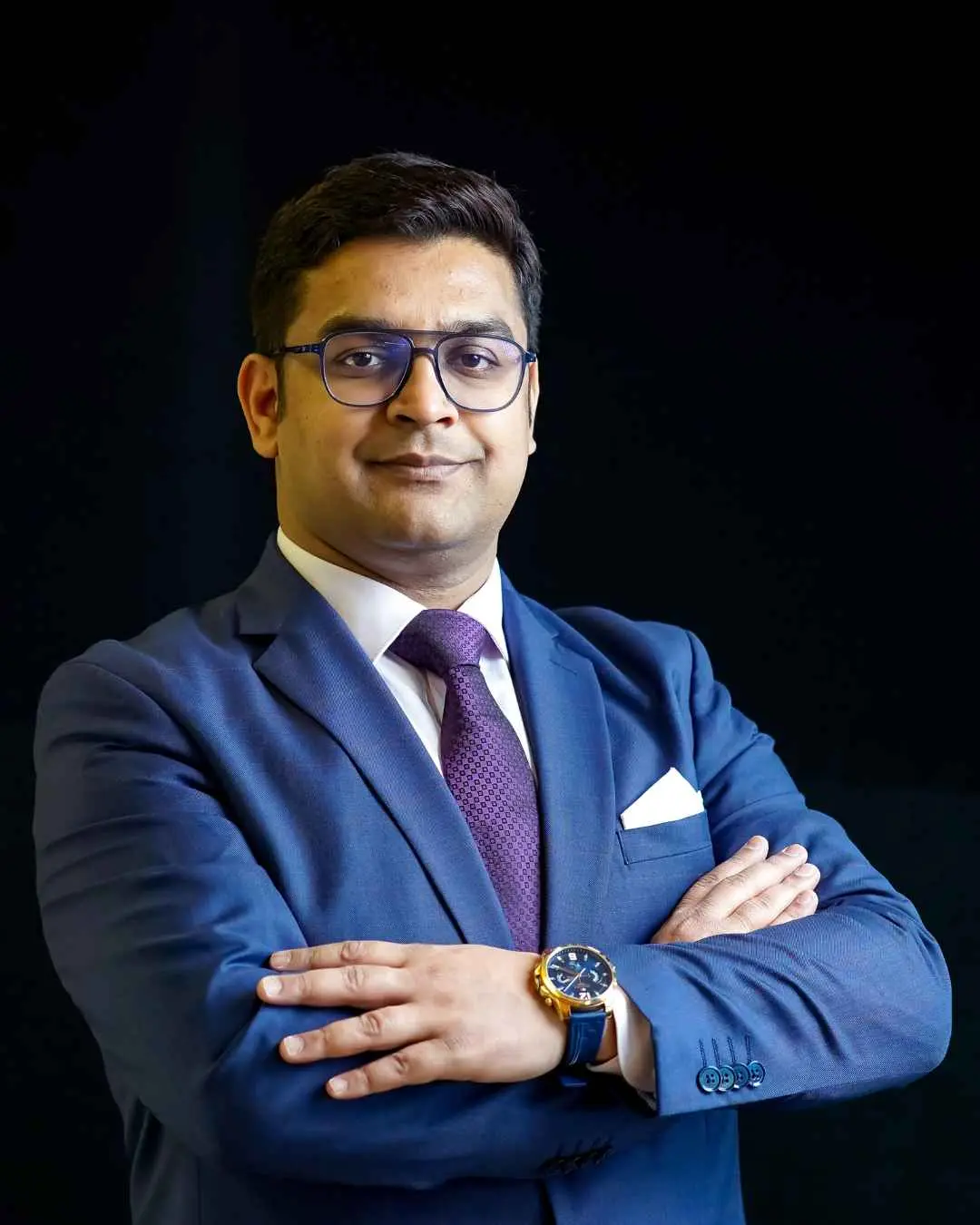
Discussions surrounding Sonatype’s 2026 forum with Forrester highlighted one recurring concern: AI adoption was expanding across teams while governance often remained centralized and slower to adapt. That insight reinforced the value of a model that centralizes risk, economics, and repeatability while allowing teams closest to individual workflows to determine how those principles are implemented. It also strengthened his view that software confidence should contribute to business value rather than function solely as a compliance exercise.
He carries the same listening mindset into industry forums, mentoring, speaking engagements, and his work with the DevNetwork AI/ML Advisory Board. Public speaking also challenges him to communicate complex ideas clearly across technical and nontechnical audiences. For Abhishek, meaningful thought leadership begins with listening, then becomes valuable when those insights are translated into practical ideas that can benefit teams and the wider technology community.
Creating Confidence for the Agentic Future
“Code will become abundant; confidence will become scarce,” ~ Abhishek Chahuan.
Over the next three to five years, he expects AI agents to move beyond assisting developers and take active roles across the software supply chain—selecting packages, invoking tools, changing infrastructure, and supporting delivery. As autonomy increases, identity, permissions, provenance, observability, and safe reversibility will become as important as vulnerability detection.
He also expects the Software Bill of Materials to evolve beyond a static inventory. As software ecosystems become more interconnected, it will need to provide a living view of trust across code, components, models, datasets, tools, agents, and the decisions connecting them. Security will increasingly shift from periodic inspection toward continuous governance, with controls embedded as software is selected, generated, assembled, and changed. Abhishek identifies governance debt as an important risk, as AI can accelerate decisions faster than organizations can establish accountability and mature their governance practices.
For leaders, the starting point is to understand what AI assets and agents are operating, what systems and information they can access, and how their decisions are being made. Trusted sources, least-privilege access, provenance, policy-driven development workflows, and human accountability should become part of the operating model. Organizations should also measure business outcomes rather than focusing only on code volume or activity. The long-term challenge will be building systems that can understand, explain, govern, and safely change the software they create.
For Abhishek, the decisive question is not simply how capable AI becomes, but whether organizations develop the judgment and governance to use it responsibly. “Artificial intelligence can amplify our abilities; it cannot inherit our purpose, ethics, empathy, or accountability,” he says. That is the Tech + Human principle at the center of his leadership: use AI boldly, but never delegate responsibility to it.
5 Key Takeaways
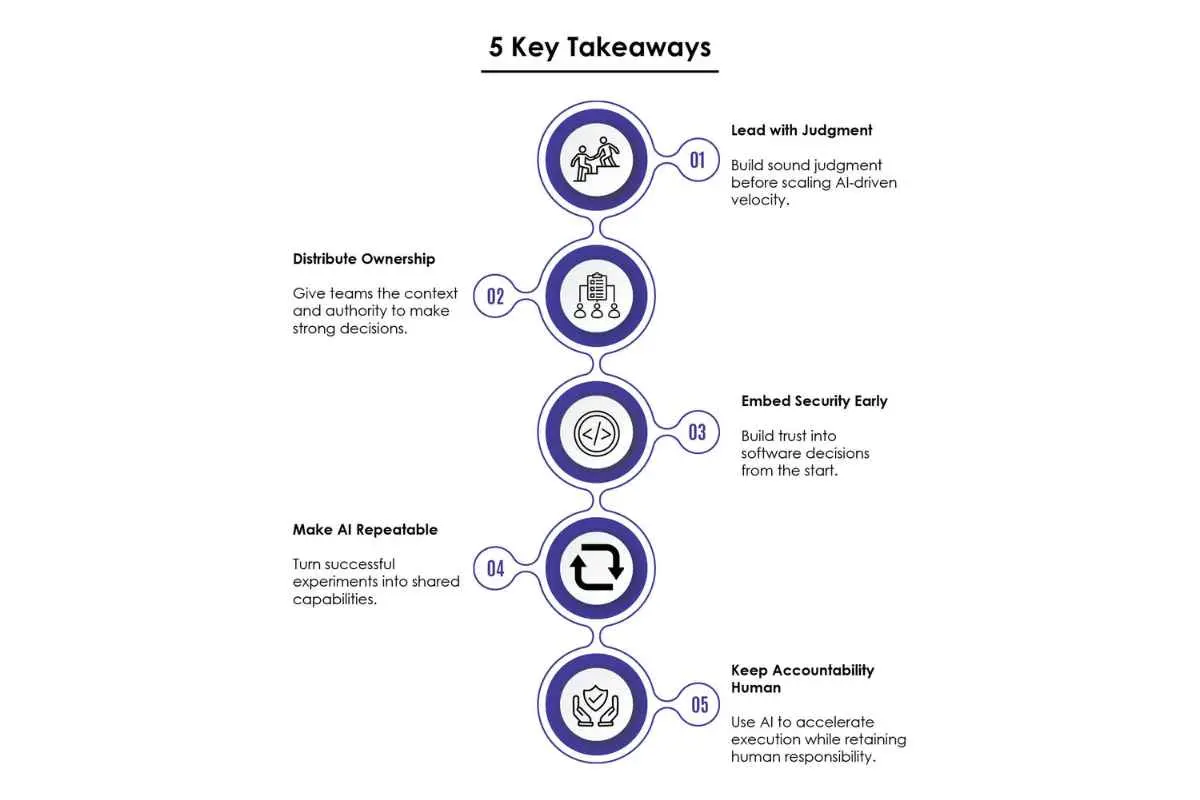
- Lead with Judgment
- Build sound judgment before scaling AI-driven velocity.
- Distribute Ownership
- Give teams the context and authority to make strong decisions.
- Embed Security Early
- Build trust into software decisions from the start.
- Make AI Repeatable
- Turn successful experiments into shared capabilities.
- Keep Accountability Human
- Use AI to accelerate execution while retaining human responsibility.













