

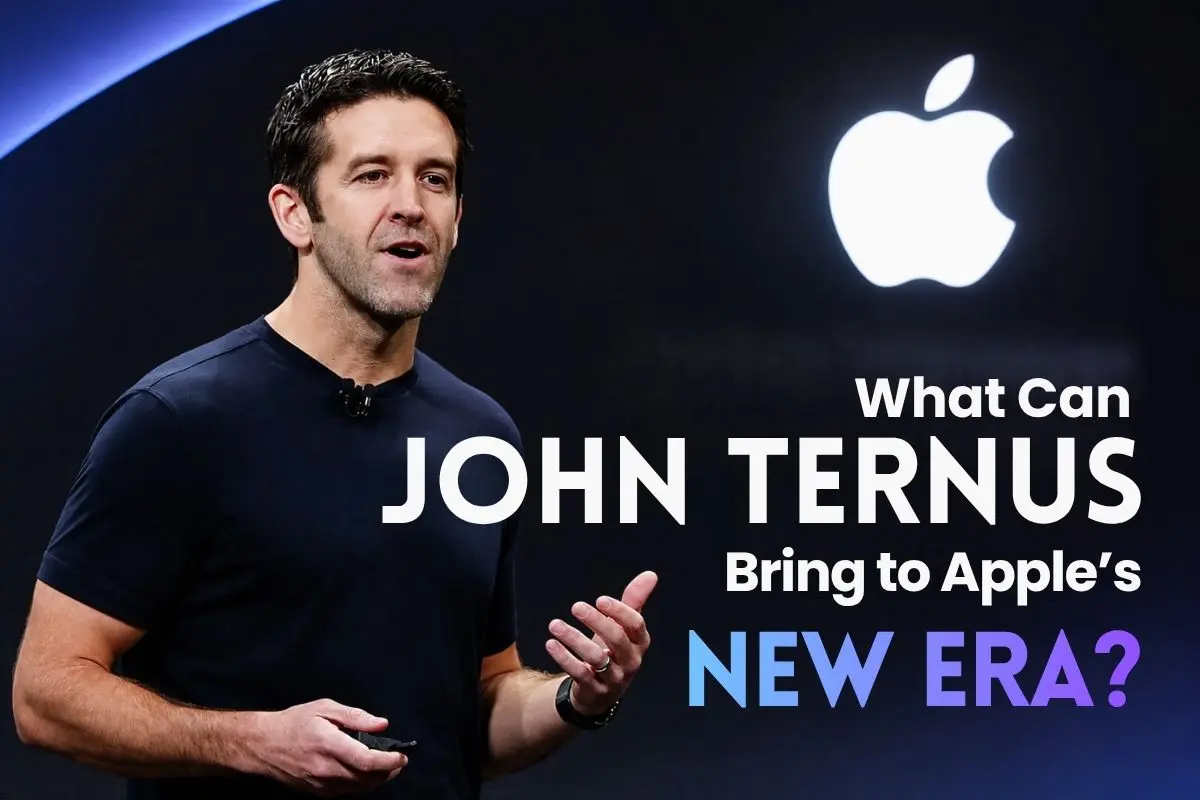
Apple’s leadership is entering a new chapter with John Ternus taking over as chief executive after Tim Cook’s nearly 15-year tenure. The appointment marks a significant change for one of the world’s most valuable technology companies. Ternus, who spent more than two decades working on Apple’s hardware, now has the responsibility of guiding its next phase of growth.
His rise reflects Apple’s preference for leaders who understand its products, engineering standards, and company culture. The board also expressed confidence in the appointment. Arthur Levinson, Apple’s chairman, called Ternus “the best possible leader to succeed Tim,” pointing to his leadership, technical knowledge, and focus on product development.
However, leading Apple’s hardware division and running the entire business are two very different responsibilities. Ternus must now prove that his technical experience can translate into long-term business success.
Mechanical Engineer to Apple’s Top Leadership Role
John Ternus joined Apple in 2001 as part of its product design team. He entered the company during a period of major change, when Steve Jobs was rebuilding Apple’s product portfolio and strengthening its position in the technology market.
Over the next two decades, Ternus moved through the company’s engineering leadership ranks. He became vice president of Hardware Engineering in 2013 and later took charge of the entire division as senior vice president.
His work covered several major product categories, including the iPhone, iPad, Mac, and AirPods. This gave him a broad understanding of how Apple develops products and brings them to market.
One of his most significant contributions came through Apple’s transition to its own processors. The introduction of Apple silicon, particularly the M-series chips, changed the Mac lineup. As Yale experts Jeffrey Sonnenfeld and Steven Tian say:
“Ternus has been a driving force behind the transition from Intel processors to Apple’s proprietary custom silicon chips—the foundation of Apple’s AI efforts.”
Before joining Apple, Ternus worked as a mechanical engineer at Virtual Research Systems. He also holds a degree in Mechanical Engineering from the University of Pennsylvania. His technical background has remained central to his career, setting him apart from many business leaders who reach the Apple CEO position through finance, operations, or sales.
Ternus has also developed a reputation for a measured leadership style. He is known for his attention to detail and collaborative approach. His public appearances at product launches have given customers and investors a closer look at the executive who will now lead Apple.
Tim Cook vs John Ternus Leadership Comparison
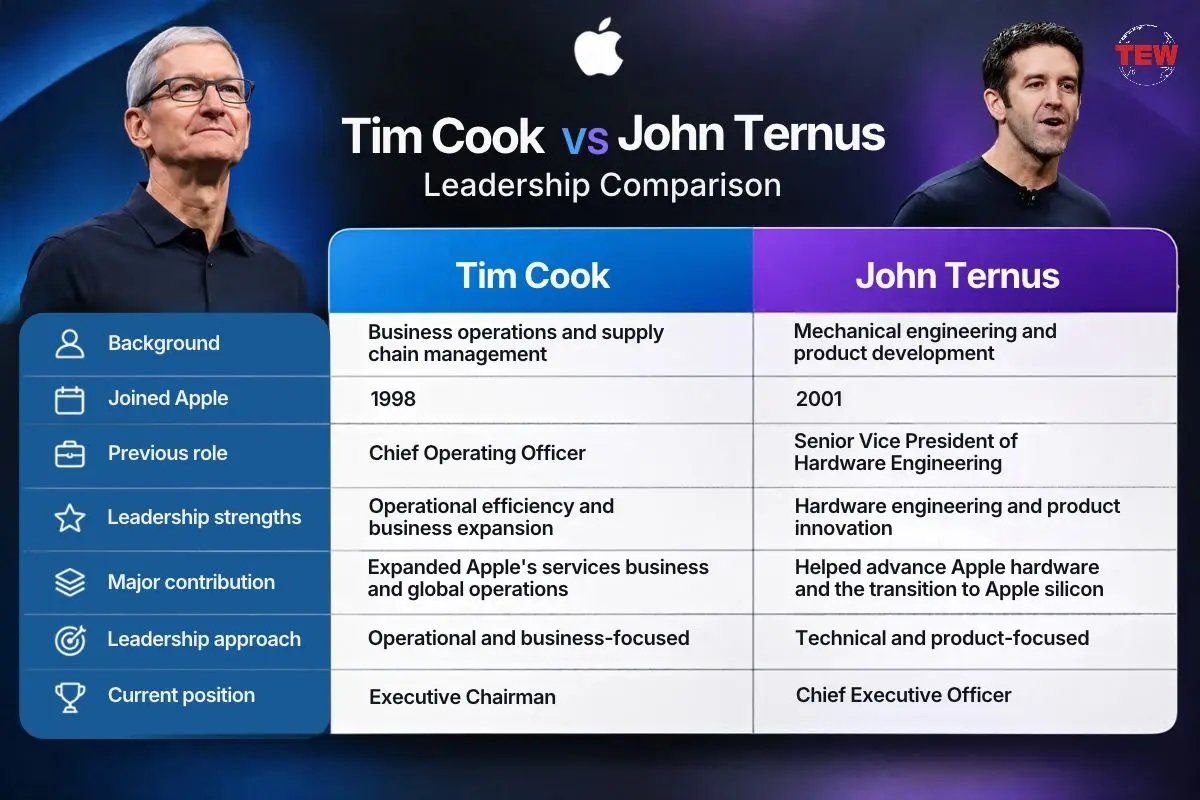
The leadership change brings two different professional backgrounds to the forefront. Cook built his career around business operations and supply chain management, while Ternus developed his expertise through product engineering.
| Comparison | Tim Cook | John Ternus |
| Background | Business operations and supply chain management | Mechanical engineering and product development |
| Joined Apple | 1998 | 2001 |
| Previous role | Chief Operating Officer | Senior Vice President of Hardware Engineering |
| Leadership strengths | Operational efficiency and business expansion | Hardware engineering and product innovation |
| Major contribution | Expanded Apple’s services business and global operations | Helped advance Apple hardware and the transition to Apple silicon |
| Leadership approach | Operational and business-focused | Technical and product-focused |
| Current position | Executive Chairman | Chief Executive Officer |
Cook’s leadership helped Apple expand beyond its core hardware business. He strengthened its global supply chain, developed its services segment, and supported the growth of its product ecosystem.
Ternus enters the Apple CEO position with a different set of strengths. His engineering experience gives him a close understanding of Apple’s products, but he must now manage the company’s wider business interests, investor expectations, and global operations.
The Biggest Challenges Facing John Ternus
Ternus takes charge at a time when the technology industry is going through another major shift. He will have to address several challenges while protecting Apple’s existing business strengths.
1. Keeping Pace With Artificial Intelligence:
AI is one of Ternus’s most important tests. Apple has introduced Apple Intelligence, but it faces pressure to make these features more capable and competitive. Apple’s next-generation Siri became available on September 14, 2026. It introduced personal context understanding, broader knowledge, onscreen awareness, and more actions across apps.
The new system uses Apple’s foundation models developed in collaboration with Google’s Gemini models. Apple says these models run on devices and through Private Cloud Compute, which is designed to protect user data. Ternus must help the company strengthen its AI offerings while maintaining its focus on privacy and user experience.
2. Reducing Dependence on the iPhone:
The iPhone remains central to Apple’s business, but relying heavily on one product category creates long-term growth challenges. Ternus will need to identify new opportunities through wearable technology, spatial computing, and other hardware categories. Turning these products into major revenue sources will be a key test of his leadership.
Ternus will have to manage these issues while protecting Apple’s business model. This includes working with regulators, adapting services to local requirements, and maintaining relationships with developers.
3. Managing Supply-Chain Costs and Global Competition
Apple’s product strategy depends on a complex global supply chain. Its FY2026 Form 10-K states that a significant majority of its manufacturing is carried out by outsourcing partners, mainly in China, India, Japan, South Korea, Taiwan, and Vietnam.
This is an important test for Ternus because new products often require custom components and complex manufacturing processes. His engineering experience may help the company improve product design and manufacturing efficiency, but he must also balance innovation with supply availability and cost control.
4. Retaining Engineering Talent and Protecting Apple’s Innovation Culture
Ternus also needs to make sure that Apple’s focus on reliability and product quality does not slow its response to new technology. The launch of iPhone Duo and HomeView shows that the company is entering new hardware categories. The next test is whether it can keep producing useful products at a pace that matches changes in the technology market.
Apple’s ability to develop new products depends on engineers who can work across hardware, software, silicon, materials, and services. Ternus has spent much of his career in this environment, but the CEO role gives him responsibility for keeping these teams focused on long-term innovation.
5. Leadership Changes in November Add Another Challenge
Apple recently appointed a new head of Apple Pay and Wallet, marking another leadership change within the company. These shifts could affect how Apple manages its services, product strategy, and internal priorities during a period of major industry change.
Ternus will need to maintain stability while these executives settle into their new roles. He must also ensure that different teams remain aligned on Apple’s broader strategy.
The November changes also include the appointment of Corey Fugman as head of Apple Pay and Wallet, replacing Jennifer Bailey, who retired after more than 25 years at Apple. Fugman previously served as senior director of Apple Pay and Wallet and has also overseen Apple Card and Apple Cash.
Can John Ternus Build on Tim Cook’s Legacy?
Ternus inherits a company with $478.8 billion in total net sales, a growing Services business, and a broad hardware portfolio. Cook helped build this foundation through global operations, business expansion, and a stronger services ecosystem.
Ternus brings a different advantage. His experience covers product engineering, materials, durability, and the development of major Apple devices. The introduction of iPhone Duo and HomeView also gives him early opportunities to show how his technical background can shape Apple’s next product cycle.
His first year as Apple CEO will offer an early indication of how he balances these priorities. If he can connect engineering innovation with strong commercial decisions, he has the opportunity to build on Cook’s achievements while giving Apple a clearer product direction. If he cannot, Apple’s dependence on the iPhone and its AI execution gap could become harder to address.
Ternus has the technical experience to understand Apple’s products. Whether he can turn that experience into the next stage of business growth will define his leadership.
Conclusion:
John Ternus brings a valuable mix of engineering experience, product knowledge, and a deep understanding of Apple’s culture. His work across the iPhone, Mac, iPad, and Apple Watch gives him a strong base for leading an innovation-driven company. However, technical expertise alone will not define his success as CEO. He must prove that he can make difficult business decisions, build a competitive AI strategy, and create new sources of growth without weakening Apple’s existing strengths.
For business leaders, Ternus’s appointment offers a useful lesson in leadership succession. A company can benefit from promoting someone who understands its products and people, but the next leader must also challenge established thinking. At The Enterprise World, this transition raises a broader question for technology businesses: can deep product knowledge become a lasting competitive advantage when markets, customer expectations, and business models keep changing?
FAQs
1. What are John Ternus’s biggest achievements at Apple?
He has led hardware engineering for major products, including the iPhone, iPad, Mac, and AirPods, and helped advance Apple silicon.
2. What is John Ternus’s leadership style?
His leadership reflects a strong engineering background, deep product knowledge, and experience working within Apple’s culture.
3. What could John Ternus change in Apple’s AI strategy?
He could strengthen the integration of AI across Apple’s hardware and software, while improving Apple Intelligence and Siri.