More than 80% of world trade still moves by sea. Cargo values keep going up every year. One storm, one fire at a busy port, or one crash can wipe out a shipment worth millions. That’s why the benefits of marine insurance matter more today than ever.
Global shipping faces new pressures now. War risk costs have jumped in some regions due to ongoing conflicts. Port fires have caused most storage-related cargo losses in recent years. Ships’ GPS signals are being blocked or faked in risky waters. Because of this, marine insurance has become a tool that protects your money and keeps your goods moving.
This article breaks down what marine insurance covers. It explains why it matters now and also shows how to pick a policy that fits your risk. Read on to see the real benefits of marine insurance and how the market has changed.
What Does Marine Insurance Actually Cover?
Marine insurance is a contract. It protects ships, cargo, and other property from loss or damage while goods travel by sea, air, or land. It pays out when accidents, bad weather, theft, or other listed risks cause a loss during shipping.
The coverage is broader than most people think. It can cover a container ship crossing the ocean. It can also cover a truck carrying goods to a port before loading. This is one of the quiet benefits of marine insurance. Protection often starts the moment goods leave the warehouse, not just when they hit open water.
Main Types of Marine Insurance Policies
Different businesses need different protection. Here’s a quick breakdown:
| Policy Type | What It Covers | Who Needs It |
| Cargo Insurance | Loss or damage to goods in transit | Importers, exporters, traders |
| Hull Insurance | Physical damage to the ship itself | Shipowners, operators |
| Freight Insurance | Lost freight money if cargo can’t be delivered | Shipping companies |
| Protection & Indemnity (P&I) | Injury, death, or environmental harm claims | Vessel operators |
| War Risk Insurance | Losses from conflict, piracy, or blockades | Carriers on risky routes |
Each policy fills a different gap. A business that ships goods overseas usually needs cargo insurance at minimum. A shipowner needs hull and P&I cover to stay protected and legal.
What are the 5 Key Benefits of Marine Insurance?
Once you know what marine insurance covers, the real question is what it does for your business day-to-day. Here are the five benefits that matter most to shippers right now.
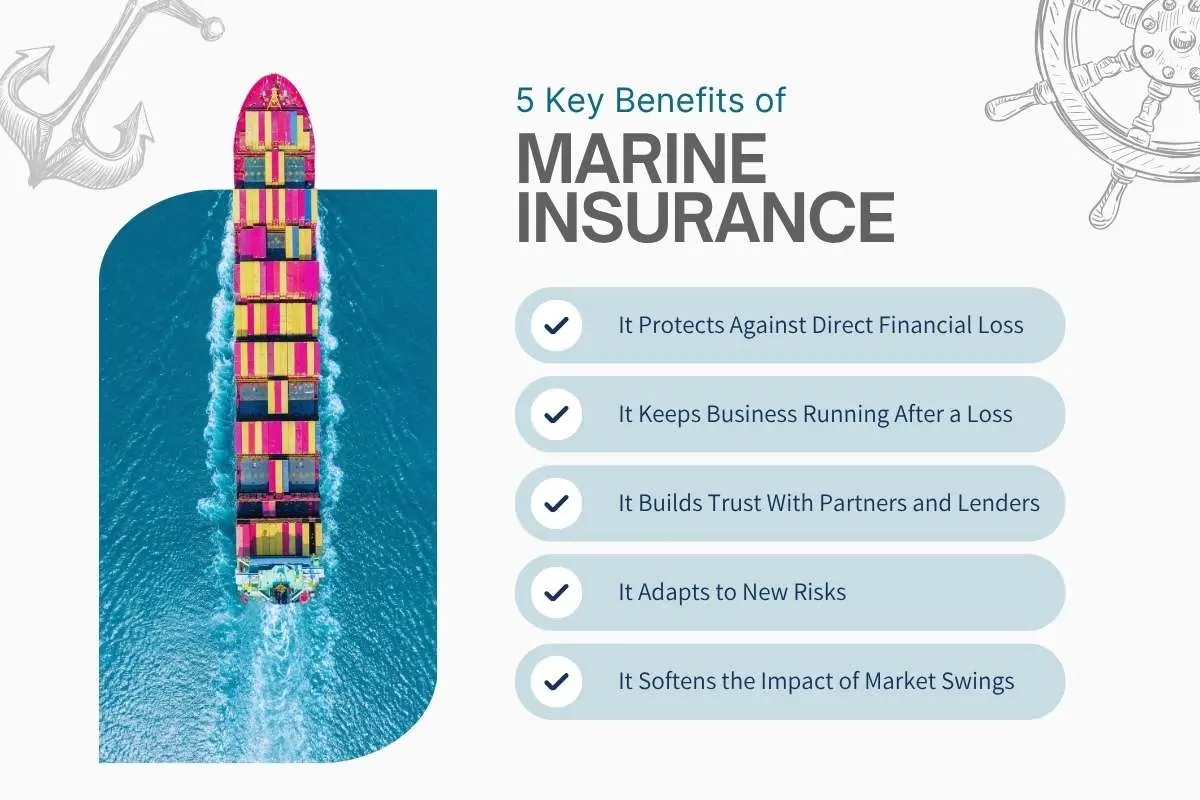
1. It Protects Against Direct Financial Loss
The clearest benefit is money back. If cargo is damaged, stolen, or lost, the policy pays out based on its insured value. Allianz reviewed 240,000 marine cargo claims worth a combined €9.2 billion and found these causes were the top reasons for all claims. That scale shows why having a payout ready matters, so one bad shipment doesn’t turn into a company-wide crisis.
2. It Keeps Business Running After a Loss
Speed matters after a loss. A business with marine insurance can repair, replace, or reroute goods fast because funds are ready. Without coverage, one bad incident can delay work for months while a company tries to cover the loss on its own.
3. It Builds Trust With Partners and Lenders
Buyers, banks, and shipping partners often want proof of insurance before they sign a deal. Solid marine coverage shows that a business handles risk well. This can open the door to better trade terms and financing.
4. It Adapts to New Risks
Insurers now factor in cyber threats, GPS spoofing, and climate-related delays when pricing policies. International Union of Marine Insurance (IUMI) has flagged new risks like lithium-ion battery cargo and rising cyber exposure as key reasons underwriters are rethinking their models. These risks are built into modern coverage, one of the newer benefits of marine insurance.
5. It Softens the Impact of Market Swings
The marine insurance market is shifting too. Property rates are easing after several tough years. More capacity and sharper competition among insurers are driving this. This means many businesses can now negotiate broader coverage without paying more. They can put the savings toward better protection instead of cheaper premiums.
How Do You Choose the Right Marine Insurance Policy?
Picking a policy is not one-size-fits-all. Think about these factors before you sign anything:
- Type of Goods Shipped: Perishables, electronics, and bulk goods carry different risks. Each needs different coverage limits.
- Shipping Routes: Routes through conflict zones or piracy-prone waters may need extra war risk coverage.
- Insurer Track Record: Check how fast a company pays claims. Look at how long it has worked in marine coverage.
- Policy Exclusions: Read the fine print. Many disputes happen because a business assumed something was covered when it wasn’t.
- Digital Claims Tools: Newer insurers offer fast, chat-based quote and claims systems. These can cut processing time significantly.
Customizing Coverage for Real Protection
A generic policy rarely fits a specific supply chain. Businesses get the most value by adjusting coverage limits. They can also add route-specific clauses and review exclusions with an experienced broker. This is where the benefits of marine insurance really show up. Tailored coverage closes the gaps that standard policies leave open.
Why Has Marine Insurance Become More Important Today?
Trade routes are more complex than they were ten years ago. Tariff changes are reshaping shipping paths across Asia, adding routing complexity and raising cargo risk questions for freight forwarders.
Regional conflicts have pushed war risk costs higher and changed coverage limits on some routes. Port fires have also become a bigger worry, causing most storage-related cargo losses in recent years. This makes coverage for goods sitting at ports, not just goods at sea, a real priority.
The market itself is shifting too. Valued at about $34.2 billion in 2025, it’s expected to grow past $48.8 billion by 2030 as global trade grows. Digital underwriting is speeding up quotes, with chat-based tools cutting the time between document upload and a first quote.
Insurers are also more willing to cover ships using newer, lower-emission fuels, though claims data on these fuels is still thin. Liability coverage remains tight even as property rates soften, so don’t assume every part of a policy will get cheaper.
The legal side is one of the overlooked benefits of marine insurance; it keeps businesses out of regulatory trouble. Many countries also require a set level of marine coverage before a ship can dock or cargo can clear customs.
Final Thoughts
Marine insurance is a tool that protects your money, keeps your business running, and adapts as shipping changes. From port fires to shifting trade routes to new fuel types, the risks businesses face today look different than they did a few years ago.
The benefits of marine insurance, including financial protection, legal compliance, and faster recovery, make it one of the smartest choices a shipping or trading business can make. Check your policy often and adjust it to match your current risks. That’s the best way to make sure your protection holds up when you need it most.
FAQs
1. What does marine insurance typically not cover?
Most policies skip losses from poor packaging, normal wear and tear, and misconduct by the shipper. Always check the exclusions before you assume you have full coverage
2. Is marine insurance mandatory for international shipping?
It depends on the country and the cargo type. Many ports and trade deals require proof of coverage before goods can clear or a ship can dock.
3. How is a marine insurance premium calculated?
Premiums depend on the value of goods, route risk, vessel condition, and claims history. Routes through conflict zones or piracy-prone waters usually cost more to insure.
4. Can small businesses afford marine insurance?
Yes. Many insurers now offer scaled cargo policies for smaller shipments. Rising competition has made coverage more affordable and easier to get.
5. What is the difference between marine cargo insurance and hull insurance?
Cargo insurance protects the goods being shipped. Hull insurance covers physical damage to the ship itself. Most businesses that ship goods only need cargo coverage, not hull coverage.