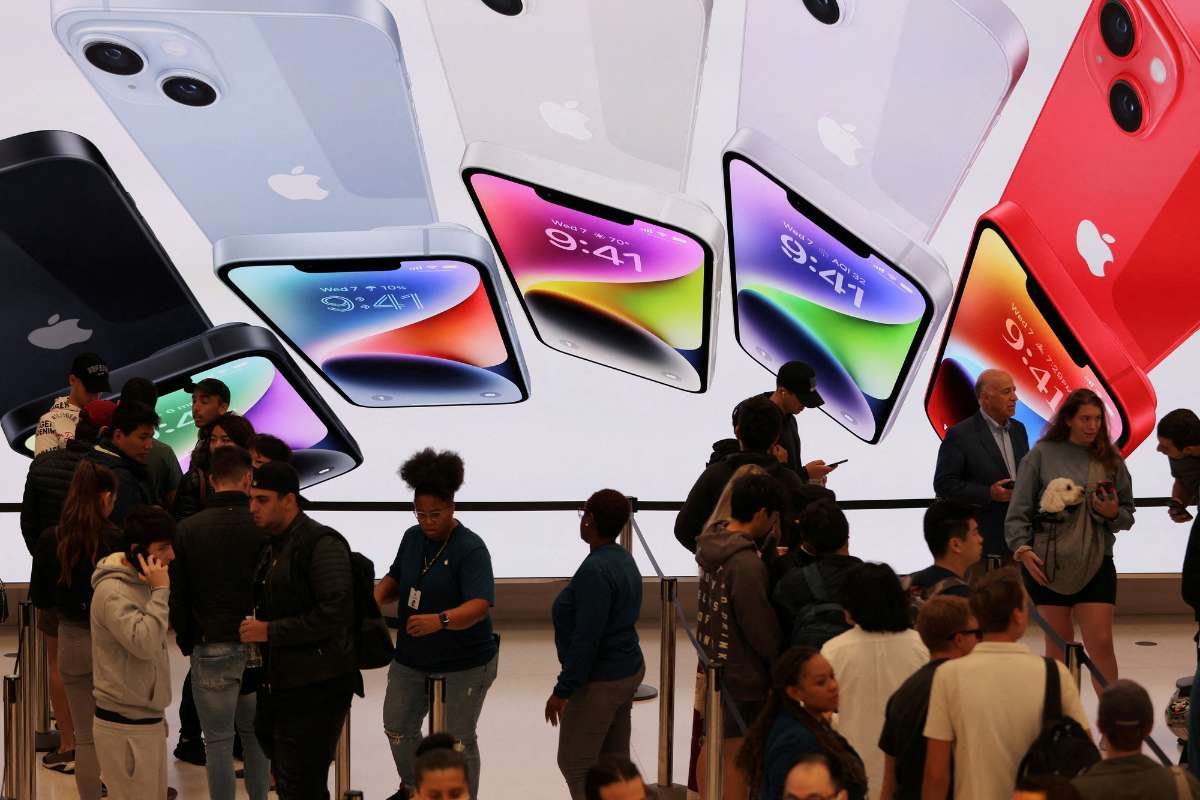
Apple Inc. on Thursday topped Wall Street’s first-quarter earnings estimates in Cupertino, California, driven by record iPhone sales, in its Apple Q1 Earnings report, while warning that a global memory chip crunch tied to AI data center demand could pressure margins in coming quarters.
Apple reported earnings per share of $2.84 on revenue of $143.8 billion, beating analysts’ expectations of $2.68 per share on $138.4 billion in revenue, according to Bloomberg consensus estimates. The results sent Apple shares up nearly one percent in early trading.
Record iPhone Revenue Powers Earnings Beat
The iPhone once again led Apple’s performance, generating a record $85.3 billion in revenue during the quarter. Analysts had expected $78.3 billion, and the figure marked a sharp increase from $69.1 billion in the same quarter a year earlier.
Services, Apple’s second-largest business after the iPhone, posted $30 billion in revenue, in line with expectations. Mac revenue totaled $8.4 billion, while iPad revenue reached $8.6 billion. Wearables, which include Apple Watch and AirPods, brought in $11.5 billion.
Overall gross margin for the quarter came in at 48 percent, reflecting Apple’s ability to maintain pricing power even as costs rise across the technology supply chain.
Memory Chip Crunch Clouds Outlook on Margins
Despite the strong results, Apple executives cautioned that margins may face headwinds in the months ahead. Chief Executive Officer Tim Cook said during the company’s earnings call that “the global memory crunch is going to hit the company’s margins going forward.”
Apple forecast gross margins of between 48 percent and 49 percent for the second quarter, roughly in line with the Apple Q1 Earnings but below what some investors had hoped for amid surging iPhone sales.
The strain on memory supplies stems largely from the rapid expansion of AI data centers, which has tightened availability of key components used in smartphones, laptops, and other devices. Manufacturers must either absorb higher costs or pass them on to consumers, a decision that could affect demand later this year.
China Rebound and AI Deals Shape Strategy
One of the quarter’s most notable turnarounds came in China, where Apple Q1 Earnings sales of $25.5 billion were up nearly 38 percent from a year earlier. The rebound follows declines in three of the previous four quarters and signals renewed momentum in one of Apple’s most critical markets.
Apple’s earnings also arrive amid a series of moves to strengthen its artificial intelligence capabilities. Earlier this month, Apple and Google issued a joint statement announcing that Apple will use Google’s Gemini models and cloud technology to power upcoming AI features, including a more personalized version of Siri expected later this year.
Separately, The Information reported that Apple is acquiring startup Q.AI for about $2 billion. The company’s technology can read facial skin micro-movements, which could be used to support what the report described as “non-verbal discussions” with an AI assistant.
Apple has acknowledged that its AI efforts trail some rivals, including Samsung, which also relies on Google’s models. The company has promised a fully revamped Siri since 2024, though quality issues delayed its launch until later this year.
For now, investors appear focused on Apple’s ability to sustain iPhone demand and manage costs in a tightening supply environment, even as the company bets heavily on AI and a recovery in China to fuel future growth.