Austin didn’t just weather the pandemic years; it expanded faster than any of the nation’s 50 largest metro areas, according to U.S. Census Bureau data. While other cities stalled, Austin continued to add people. The metro population rose from 2.3 million in 2020 to 2.55 million in 2024, a gain nearing 11%.
Nearly 60,000 residents arrived between 2023 and 2024 alone, with international migration playing a major role. Remote-work arrivals and global inflows reshaped the region, even as higher costs nudged many households toward surrounding suburbs. Austin’s demographic surge has become a national reference point.
A Central Point with Statewide Reach
Austin sits at the geographic center of Texas, giving it natural reach across the state’s largest markets. Dallas–Fort Worth, Houston, and San Antonio remain within efficient ground travel, creating daily business fluidity. Interstate highways, freight rail lines, and Austin-Bergstrom International Airport keep people and goods moving with speed. The airport’s expanding routes support national access and global connections.
This positioning makes Austin a practical gateway linking Texas’s economic power centers. A warm climate and scenic Hill Country setting sustain year-round activity, supporting tourism, events, and steady talent mobility. For businesses, geography translates into logistical clarity and regional scale advantages today.
The Economic Mix Tape
Austin’s economy stands on breadth, capital activity, and a company mix that supports performance across market cycles.
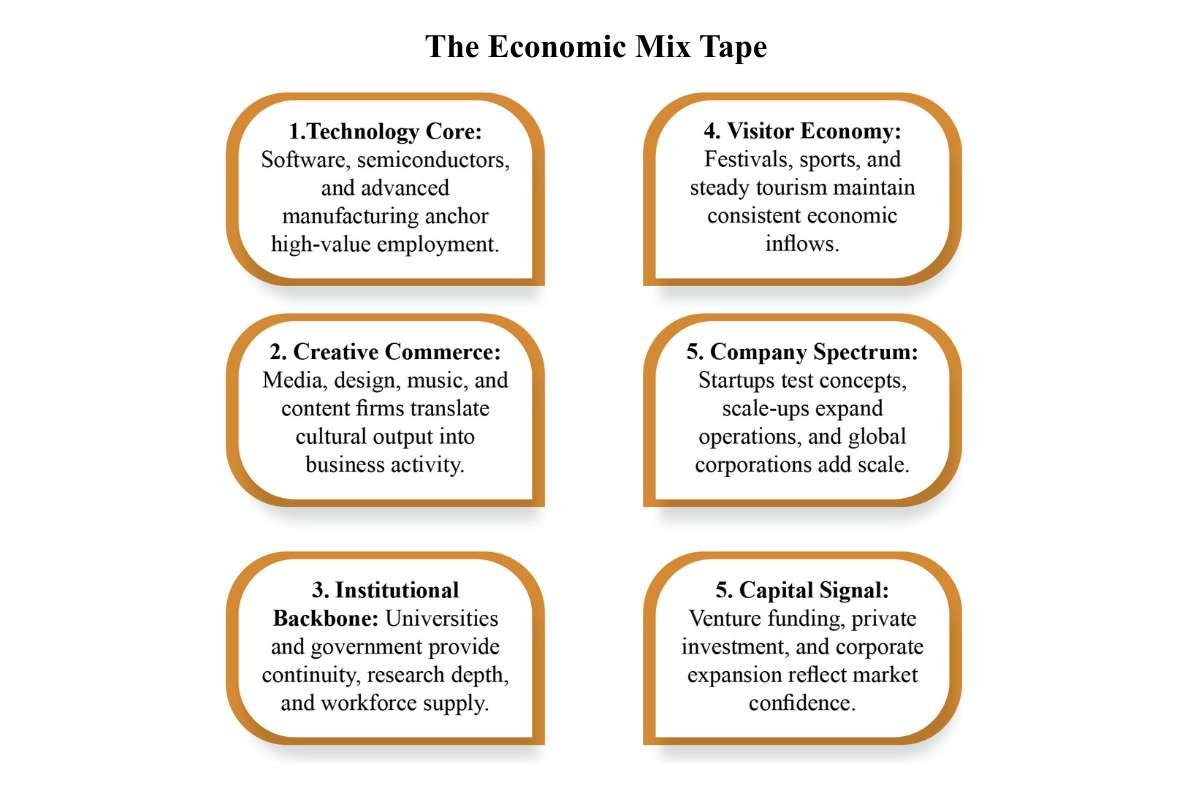
- Technology Core: Software, semiconductors, and advanced manufacturing anchor high-value employment.
- Creative Commerce: Media, design, music, and content firms translate cultural output into business activity.
- Institutional Backbone: Universities and government provide continuity, research depth, and workforce supply.
- Visitor Economy: Festivals, sports, and steady tourism maintain consistent economic inflows.
- Company Spectrum: Startups test concepts, scale-ups expand operations, and global corporations add scale.
- Capital Signal: Venture funding, private investment, and corporate expansion reflect market confidence.
These tracks form a balanced economy that supports long-term investment and sustained business presence.
A Market that Builds and Ships
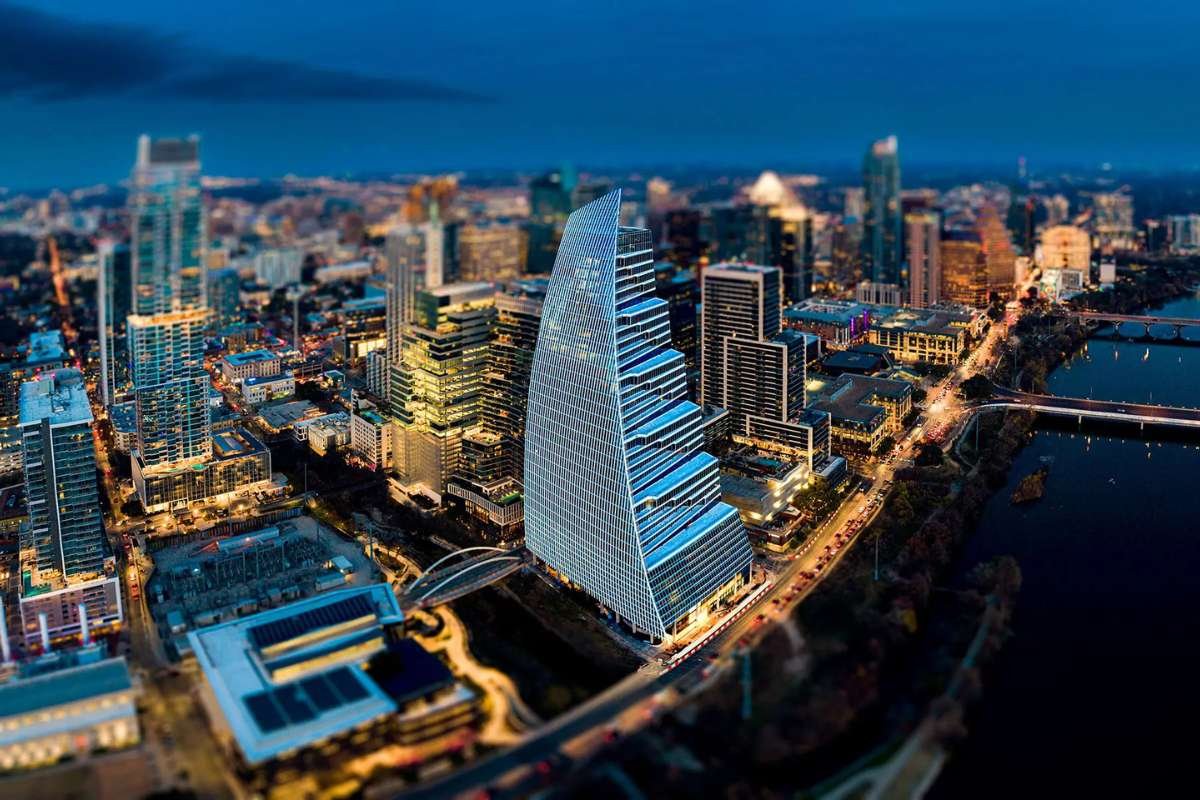
Austin stands as one of the nation’s most credible technology hubs, combining operational scale with practical experimentation. Established technology firms maintain major footprints, supporting research, production, and high-value employment. Alongside them, emerging companies build software, hardware, and digital platforms that reflect market needs rather than hype.
A dense network of accelerators, co-working spaces, and local investors supports early-stage activity with accessible capital and mentorship. Funding remains active across seed, growth, and later stages, giving companies room to mature.
Universities supply technical talent each year, while domestic and international arrivals add experience and leadership depth. Knowledge sharing occurs through formal networks and informal collaboration, reinforcing execution over noise.
For business leaders, Austin offers dependable innovation capacity grounded in people, infrastructure, and repeatable outcomes suitable for sustained technology investment. The market rewards disciplined builders seeking stability, scalability, and long-term operating confidence.
Staffing Reality in the Austin Metro
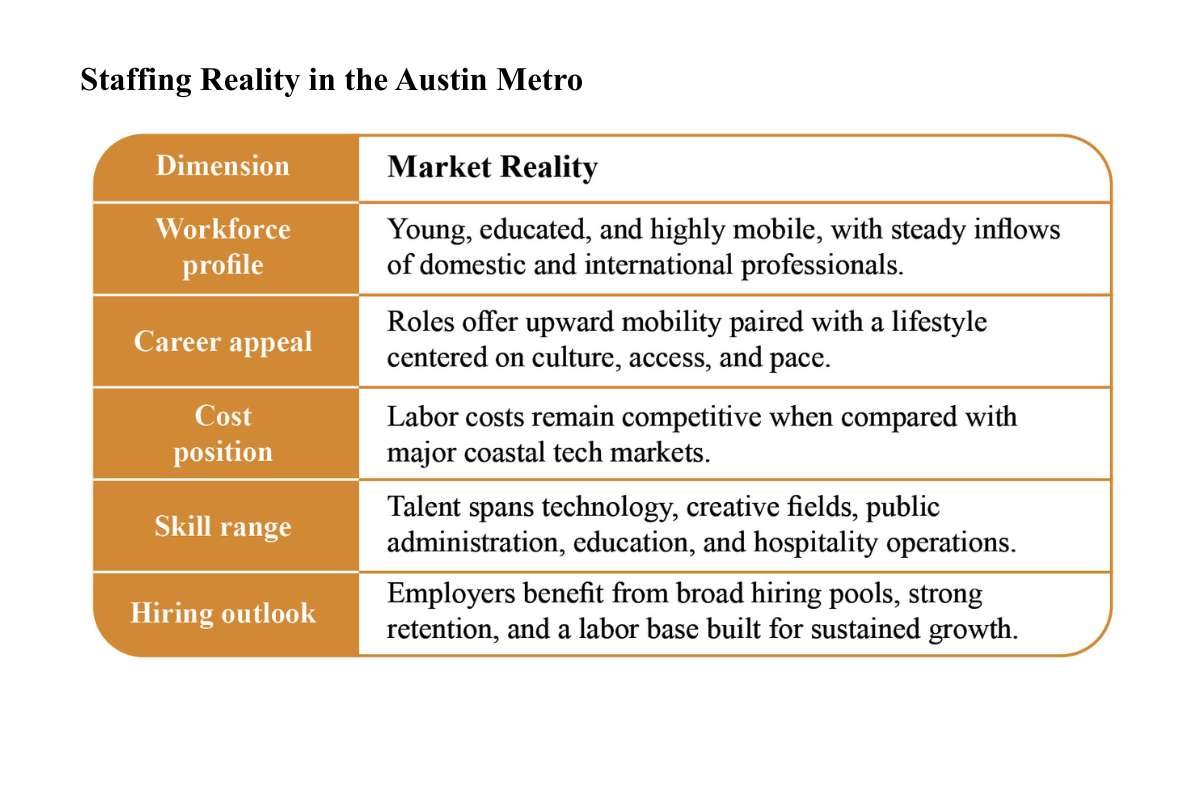
Austin’s workforce profile blends youth, education, and mobility in ways that continue to attract employers and talent alike.
| Dimension | Market Reality |
| Workforce profile | Young, educated, and highly mobile, with steady inflows of domestic and international professionals. |
| Career appeal | Roles offer upward mobility paired with a lifestyle centered on culture, access, and pace. |
| Cost position | Labor costs remain competitive when compared with major coastal tech markets. |
| Skill range | Talent spans technology, creative fields, public administration, education, and hospitality operations. |
| Hiring outlook | Employers benefit from broad hiring pools, strong retention, and a labor base built for sustained growth. |
Result: Employers gain access to a deep, renewable talent pool that supports sustained expansion.
Rules that Work for Business
Texas sets the tone with a tax structure and regulatory approach that lowers friction for companies. Austin adds local support through small business programs, startup assistance, and accessible permitting. Public and private leaders coordinate on workforce, infrastructure, and site readiness initiatives. Investors value the predictability embedded in state policy and the transparency shown at the local level.
Decision-making timelines remain readable, helping operators plan capital, staffing, and expansion with confidence. This combination explains why firms select Austin for headquarters placements and regional offices that require stability, speed, and long-term operating clarity across competitive domestic markets today.

Urban Expansion in Real Time

Austin’s built environment reflects rapid demand alongside deliberate planning. Commercial real estate continues to diversify, with office hubs adapting to hybrid work and specialized tenants. Residential supply expands through multifamily projects, townhomes, and infill housing, responding to sustained population growth. Mixed-use districts combine workplaces, retail, and housing, shortening daily routines and supporting street-level activity.
Public investment targets transportation, utilities, and digital infrastructure to keep pace with added density. Road upgrades, transit improvements, and airport expansion remain priorities. Despite growth, neighborhood character remains visible through zoning choices and preservation efforts.
This balance between scale and livability matters for developers, investors, and site-selection teams assessing timelines, costs, and long-term viability across Austin’s urban footprint for future projects and capital allocation decisions regionwide.
The Visitor Effect on the Local Economy
Austin’s visitor economy operates as a steady commercial channel that complements its core business sectors.
- Destination status: Austin attracts leisure travelers and business visitors throughout the year.
- Cultural draw: Music, food, and cultural events generate consistent visitor spending and repeat demand.
- Business travel: Conventions, meetings, and corporate trips sustain weekday hotel and venue usage.
- Hospitality supply: Premium hotels and expanded accommodations meet rising expectations and volume.
- Economic reach: Visitor spending supports retail, dining, transportation, and service employment.
- Business impact: Tourism circulates outside capital through local operations and public revenues.
This steady flow of visitors reinforces economic activity that connects directly with Austin’s broader growth priorities.
Visibility Built on Credibility
Austin’s cultural capital carries global recognition that few mid-sized metros command. Creativity shows up daily through music venues, film premieres, chef-led restaurants, and outdoor experiences woven into city life. The “Live Music Capital of the World” label functions as a working brand, attracting festivals, visitors, and sponsorships with measurable reach. Film, tech, and food scenes reinforce a reputation built on originality rather than spectacle.
This credibility matters in competitive talent markets, where identity influences relocation choices. Employers benefit as culture supports recruitment, retention, and city marketing efforts without heavy promotion. For investors and operators, Austin’s brand converts attention into foot traffic, spending, and long-term visibility. Cultural recognition amplifies the city’s profile, helping businesses gain exposure while operating within a market.

Hospitality Upside and Market Limits
Austin’s hospitality sector signals readiness for high-value visitors through the rise of luxury hotels and curated boutique stays. These properties cater to executives, conference delegates, and creative professionals who expect quality, access, and experience in one place. Premium hospitality plays a visible role in shaping how the city is perceived during major events and business gatherings. At the same time, market realities remain clear.
Housing costs continue to rise, infrastructure faces pressure from rapid population gains, and competition among U.S. metros has intensified. These constraints underscore the need for careful planning and coordinated investment. Acknowledging both strengths and limits preserves credibility and supports informed decisions for companies, investors, and event organizers assessing Austin’s long-term capacity for sustained success.
Looking Ahead: The Next Ten Years
Austin’s next chapter favors disciplined growth, informed choices, and long-term participation.
- Austin enters the next decade with momentum grounded in scale, talent, and capital presence.
- Technology remains central, supported by enterprise operations and steady startup formation.
- Cultural relevance continues to attract attention, visitors, and skilled professionals.
- Institutions, investors, and founders find room to build with patience and intent.
- Market maturity brings clearer signals around cost, capacity, and opportunity.
- Decision-makers benefit from a city that communicates its strengths plainly.
For Upshot readers, the city stands as a metro offering confidence, visibility, and clarity in an increasingly competitive national field. This outlook supports strategic planning decisions.