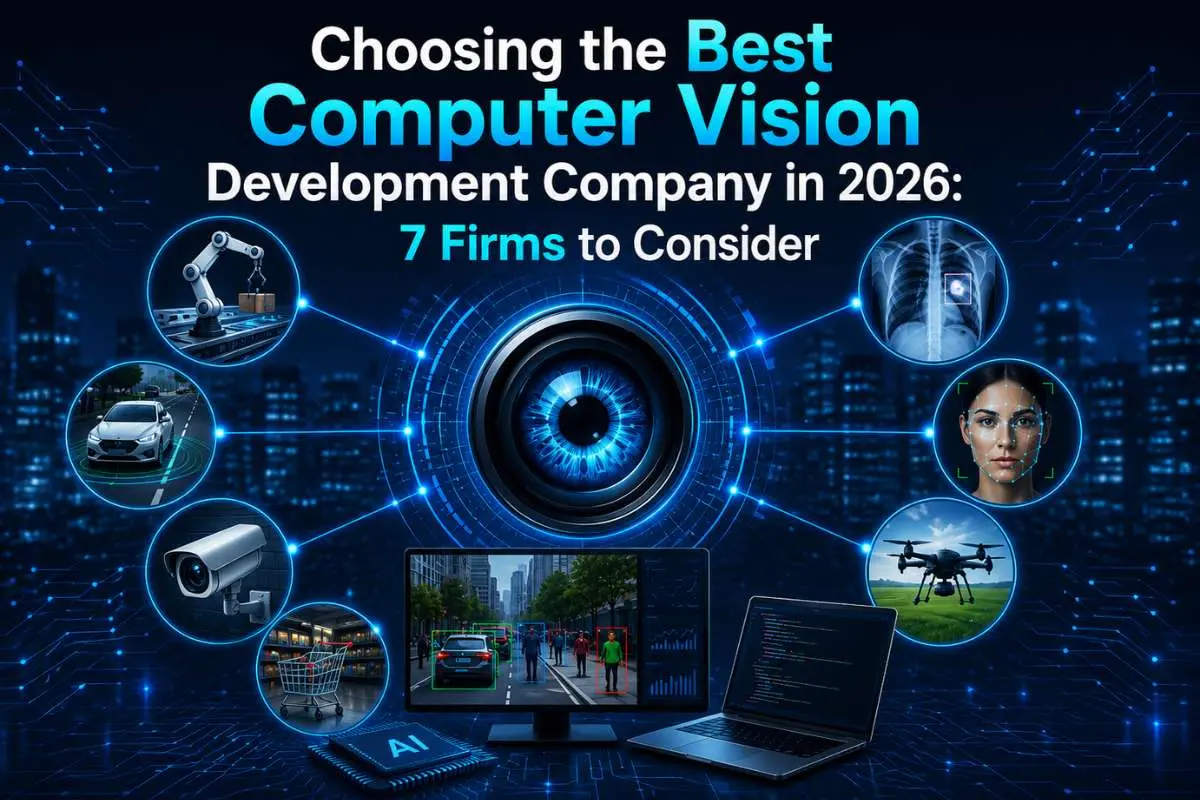
A model can look strong in a demo and still fail on a warehouse floor, inside a moving vehicle, or under shifting lighting. What separates a reliable computer vision development company is whether they can turn visual data into a stable production system that handles camera calibration, dataset preparation, annotation, model optimization, and integration into existing business systems, and keeps working after launch.
The global computer vision market is expected to grow from $24.14 billion in 2026 to $72.80 billion by 2034. This growth brings more vendors into the market, but not all of them can deliver production-grade systems. This list evaluates 7 companies based on public proof points, delivery scope, and verified industry experience, with more weight given to named case studies than broad capability claims.
How we selected the top computer vision development companies?
Each company in this list was evaluated against the following criteria. No vendor was included based solely on marketing claims.
- Dedicated CV offering. A clear computer vision service, methodology, or practice area.
- Public project evidence. At least one named case study, measurable outcome, or detailed technical example of completed CV work.
- Production engineering capability. Evidence that the company can handle the full delivery pipeline (data preparation, model training, testing, integration, deployment, and post-launch optimization or monitoring).
- Specialized delivery options. Documented experience in at least one area such as edge AI, embedded systems, on-premise deployment, cloud inference, or real-time video analytics.
- Relevant industry experience. Work in industries such as manufacturing, healthcare, logistics, automotive, retail, agriculture, sports, or security, supported by named examples.
- External credibility signals. Verified Clutch reviews, industry certifications, long market presence, or established client references where available.
Computer vision development companies comparison
The profiles below expand on each company in the table. Each one opens with a clear positioning statement, followed by the proof points behind its inclusion. You can read one in under two minutes, or read all seven for a clearer view of the market.
| Company | Strongest fit | Public proof point | Best for |
| SQUAD | Edge AI for hardware and camera products | 500+ shipped projects, 50+ physical devices, 6,500 m² validation lab | Hardware-dependent CV with full-cycle delivery |
| OpenCV.ai | Deep CV expertise and edge systems | Maintains OpenCV: 27M monthly downloads, integrations across 1B+ devices (company-reported) | Technically demanding CV products and embedded vision |
| deepsense.ai | Industrial inspection, edge optimization, and advanced R&D | 320% improvement in carbon-fiber defect detection at 96% precision | Industrial quality control, smart cameras, precision systems |
| DAC.digital | Manufacturing, robotics, LiDAR, physical-world CV | Furniture-production system with 90% defect detection; Komatsu forestry project with LiDAR + RGB | Hardware-connected industrial and embedded systems |
| CHI Software | Broad custom CV across automotive and enterprise | Connected car systems, vehicle health, building-plan approval (31 Clutch reviews) | Mid-sized companies needing a flexible development partner |
| AIMonk Labs | Edge AI, real-time video analytics, Jetson deployments | Deployments across 20+ countries; applications in luxury goods, vehicle damage, retail, and medical imaging | Edge manufacturing, logistics, and real-time monitoring |
| LeewayHertz | Applied CV for enterprise automation | Glass beading anomaly detection system; contactless attendance via CCTV and facial recognition | Companies that need an applied CV without a large internal AI team |
1. SQUAD — Full-cycle edge AI and smart camera engineering
Industries: Security cameras, smart home, ADAS, dashcams, industrial inspection, IoT.
SQUAD is a computer vision development company that engineers AI-powered camera systems from the hardware level up. Its team covers PCB design, firmware, embedded AI, ISP tuning, cloud streaming, and mobile integration within a single full-cycle delivery model.
The company reports 700+ engineers and a 6,500 m² Innovation Lab with setups for thermal testing, image quality benchmarking, connectivity validation, and automated model evaluation. Its delivery record includes 500+ projects, 50+ physical devices, 100+ app releases, and 20+ AI features shipped to production. SQUAD develops edge AI models for constrained processors, including Qualcomm, Ambarella, SigmaStar, OmniVision, and ARM Cortex-M, using model pruning, quantization-aware training, and hardware-aware optimization. Its deployed CV applications include person detection, vehicle and license plate recognition, event-based anomaly detection, and forensic video indexing. In one project, a Swiss industrial robot manufacturer hired SQUAD to build a CV system covering hardware, algorithms, and communications, and cited the team’s flexibility under difficult R&D-stage conditions.
SQUAD is the strongest fit for teams building physical camera or connected device products that need AI running on the chip, with a single team accountable from PCB design through over-the-air model updates.
2. OpenCV.ai — Deep computer vision expertise and edge systems

Industries: Agriculture, industrial monitoring, embedded vision, edge devices.
OpenCV.ai says its team built and now maintains OpenCV, the open-source computer vision library used across the industry. According to the company, OpenCV has 27 million monthly downloads and is integrated into more than 1 billion devices. That is a meaningful technical signal and sets OpenCV.ai apart from general AI vendors that treat OpenCV as just another tool.
Its public portfolio includes agriculture monitoring, weed detection, plant disease prevention, livestock surveillance, multi-camera calibration, RGB-D systems, and low-resolution thermal camera tracking. The common thread is advanced vision engineering, especially in calibration-heavy and embedded environments.
OpenCV.ai fits teams building technically demanding vision products, especially those involving multi-camera systems, calibration pipelines, or embedded hardware.
3. deepsense.ai — Industrial inspection and research-heavy CV systems
Industries: Industrial quality control, smart cameras, edge AI, 3D vision, research-grade systems.
deepsense.ai stands out because its case studies include specific performance results. One carbon-fiber quality control project reported a 320% improvement in defect detection at 96% precision. A wildlife recognition project using aerial imagery cut image analysis time by 98%. The company also documents a near-real-time tire defect-detection system across multiple product lines and a smart-camera quantization project. Named clients include Intel, Nvidia, Hitachi, L’Oréal, Nielsen, and the United Nations.
That level of detail is what makes deepsense.ai notable. Many vendors describe capabilities. deepsense.ai publishes measurable outcomes.
deepsense.ai is a strong fit for teams that need measurable performance on hard visual problems, especially in industrial inspection, defect detection, and optimized edge systems.
4. DAC.digital — Manufacturing, robotics, and physical-world CV

Industries: Manufacturing, robotics, forestry, agriculture, rehabilitation, embedded systems, and visual quality inspection.
DAC.digital has one of the most detailed public portfolios. Its documented projects include a wooden furniture production system with 90% defect detection, a Komatsu forestry system that combines LiDAR and RGB data to recognize trees and obstacles, an at-home rehabilitation app using pose detection, a manicure robot, automated fiber-optic installation validation, and eye-tracking systems for market research.
What stands out is the range of physical environments involved, from factory floors and forests to rehabilitation settings and lab conditions. That suggests strong experience in real operational settings where computer vision has to work, not just in controlled demos.
DAC.digital is a choice for projects that involve computer vision interacting with hardware, sensors, or physical workflows, especially when the system must operate reliably in outdoor or production environments.
5. CHI Software — Broad custom CV delivery for automotive and enterprise
Industries: Automotive, construction, enterprise software, and image-processing applications.
CHI Software’s public computer vision work spans connected cars, vehicle health systems, image recognition, building plan approval, and geosocial applications. Clutch lists the company with 31 verified reviews, a minimum project size of $50,000+, and average hourly rates of $50 to $99.
The pattern here is breadth rather than narrow specialization. CHI Software looks more like a flexible custom development partner than a deep computer vision research shop.
CHI Software is best suited to teams that need a broad engineering partner for custom CV work, especially in connected vehicle and enterprise software use cases.
6. AIMonk Labs — Edge AI and real-time video analytics

Industries: Manufacturing, retail, logistics, healthcare, security.
AIMonk Labs focuses on computer vision for edge devices, including deployments on Nvidia Jetson, Raspberry Pi, and Intel Neural Compute Stick hardware. The company says it operates across 20+ countries and lists use cases such as luxury handbag authentication, vehicle damage assessment, retail shelf monitoring, and medical imaging analysis.
Its stack includes object detection, OCR, visual recognition, semantic segmentation, and pose estimation using tools such as PyTorch, TensorFlow, OpenCV, YOLO, Mask R-CNN, and Vision Transformers. The emphasis is clear: real-time inference on constrained hardware.
AIMonk Labs is a good fit for teams that need real-time computer vision on edge hardware, especially when low-latency inference matters more than cloud-based flexibility.
7. LeewayHertz — Applied CV for enterprise automation
Industries: Manufacturing, enterprise automation, HR systems, logistics.
LeewayHertz is an AI development company with 9 verified Clutch reviews and a focus on applied computer vision for business and robotics use cases. Public examples include a system for detecting beading anomalies in glass production and a contactless attendance platform that uses CCTV and facial recognition.
Its delivery process covers data preparation, model design with OpenCV and TensorFlow, optimization, and deployment across AWS, Azure, and Google Cloud. The company is not positioned as a specialist CV lab. It is better understood as a practical engineering partner for operational automation.
LeewayHertz is a good fit for organizations that want applied computer vision delivered without building a large in-house AI team for defined workflow automation projects, such as inspection or access control.
What computer vision development companies deliver?
The scope of a computer vision engagement varies by vendor and project. Knowing what is included helps you set realistic expectations before scoping starts.
Data assessment and feasibility validation
A production-ready vendor should first assess the business process, available camera feeds or image data, annotation quality, operating conditions, target accuracy, and the cost of false positives and false negatives. Deployment requirements should also be clear at this stage, whether the system will run in the cloud, on edge devices, or on-premise. Without this step, it is difficult to set realistic performance targets or timelines.
Custom model development
Depending on the use case, model development may include image classification, object detection, segmentation, tracking, OCR, anomaly detection, pose estimation, medical imaging, 3D vision, or LiDAR and RGB sensor fusion. Each of these has different data needs, labeling methods, and evaluation metrics. A vendor should be clear about which of these it has actually shipped to production, not just which ones appear on a services page.
Deployment and systems integration
A trained model isn’t the same as a working product. Deployment includes camera and sensor integration, embedding the model into mobile apps or IoT devices, connecting it to manufacturing systems, warehouse platforms, or business dashboards, and setting up the reporting and alerting around it. Production-grade delivery should also include MLOps components such as experiment tracking, model versioning, deployment pipelines, and retraining workflows.
Monitoring after launch
Model accuracy shifts over time depending on conditions. Lighting changes, camera positions move, product variants change, and user behavior evolves. Without monitoring, performance can decline without anyone noticing right away. A vendor building a production system should define what will be monitored, what triggers retraining, and who owns that process after launch.
How to choose a computer vision development company?
1. Ask for a project similar to yours:
A defect-detection case for manufacturing tells you more about a factory project than a facial-recognition demo for fintech. Ask about the dataset, model metrics, deployment environment, and post-launch monitoring. If a vendor cannot explain those details, the case study is marketing, not proof.
2. Separate model accuracy from business value:
A vendor should be able to define the right metric for your project, whether that is precision, recall, F1 score, IoU, Dice score, or mean average precision. They should also be clear about acceptable false-positive and false-negative rates, latency requirements, how accuracy will be tested on unseen data, and how performance will be tracked after launch. Without those boundaries, “accuracy” is too vague to guide a project.
3. Clarify edge, cloud, and on-premise constraints early:
Edge deployment reduces latency and bandwidth use, but it also introduces hardware limitations that cloud systems do not. In manufacturing, connected vehicles, smart cameras, and other real-time environments, these constraints shape the architecture from the start. They affect model choice, optimization strategy, and the hardware experience the vendor needs.
4. Confirm who owns the data and trained models:
Before signing, make sure the contract clearly states who owns the dataset, annotations, source code, and trained model weights. It should also define any third-party licensing, who handles retraining if performance drops, and what monitoring and maintenance will cost after launch. These details often surface hidden assumptions on both sides.
5. Start with a PoC when uncertainty is high:
A proof of concept makes sense when you first need to confirm that the available visual data is good enough for the use case. It should answer a clear feasibility question, not act as a sales exercise. Define what success looks like before the PoC starts, and use the outcome to decide whether to move forward.
Frequently asked questions
1. Which industries use computer vision most often?
Computer vision is used most often in manufacturing, healthcare, automotive, logistics, retail, agriculture, construction, security, and sports technology. In logistics, common use cases include package dimensioning, automated picking, and driver safety monitoring. In healthcare, it is used for diagnostic imaging, surgical instrument tracking, and patient monitoring.
2. What is the difference between computer vision and machine vision?
Machine vision usually refers to fixed industrial inspection systems built for a specific task, often in manufacturing. Computer vision is broader. It uses AI and deep learning to analyze images and videos in more varied, less controlled environments. In practice, the line isn’t always clear because many modern industrial systems now use deep learning as well.
3. Should a computer vision system run in the cloud or on edge devices?
Cloud deployment gives you more computing power, easier updates, and centralized data management. Edge deployment reduces latency, lowers bandwidth usage, and relies less on a stable internet connection. This makes Edge a better fit for manufacturing lines, autonomous vehicles, and smart cameras that need real-time decisions. The right setup depends on your latency requirements, privacy needs, connectivity, and hardware limitations.
Conclusion
Choosing a computer vision development company starts with the problem you need to solve and the environment the system will run in. SQUAD is the strongest fit for physical camera and edge device products because it covers the full hardware-to-cloud stack. OpenCV.ai and deepsense.ai stand out for deep technical specialization. DAC.digital is a strong option for manufacturing, robotics, and LiDAR-based systems. AIMonk Labs brings edge-deployment experience with Jetson-class hardware. CHI Software and LeewayHertz are better suited to teams that need broader custom delivery for defined use cases.