When software starts handling objects
Most of the artificial intelligence that business leaders have adopted over the past few years lives entirely inside a screen. It reads contracts, drafts emails, forecasts demand, flags anomalies in a spreadsheet. Get one of those predictions wrong and the cost is a bad recommendation, a clumsy paragraph, a number that needs correcting before anyone acts on it.
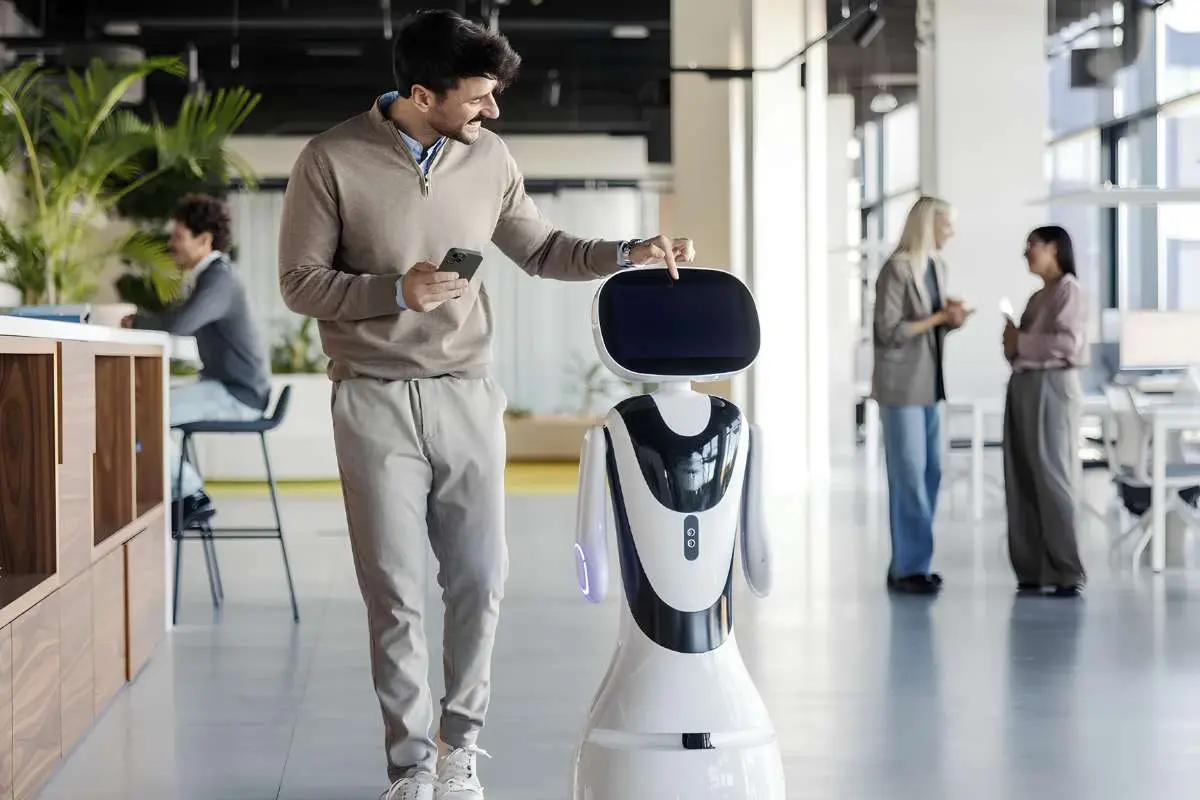
Physical AI is a different category of problem. It is the intelligence that sits inside machines that act in the physical world rather than simply describing it, and in a business setting, that almost always means robots. A model that only has to predict the next word never needs to know how heavy a box is, how a pallet shifts as a forklift turns, or what happens if a gripper closes a fraction of a second too early. A model that has to pick up that box, move it, and set it down without dropping it does.
It needs a working sense of mass, friction, momentum, and consequence, because the room it operates in does not pause to let it reconsider. Get it wrong and the result is not a flawed sentence to be edited. It is a dropped pallet, a damaged part, or a collision on a factory floor.
That distinction is why physical AI is treated as its own discipline rather than a subset of the AI most companies already use. It borrows the same underlying techniques, neural networks, reinforcement learning, large training runs, but it is judged by a much less forgiving standard: whether the machine can act correctly in a physical space it does not fully control.
Physical AI at work today
This is not a five-year-out promise. It is already running in operations that most companies recognise. In warehouses, fleets of mobile robots now handle stowing, picking, sorting, and moving goods between stations, working alongside human staff rather than replacing a whole facility overnight. Amazon alone has passed one million robots across its fulfilment network, and its newest robotics-enabled sites report processing times cut by as much as a quarter compared with earlier facilities.

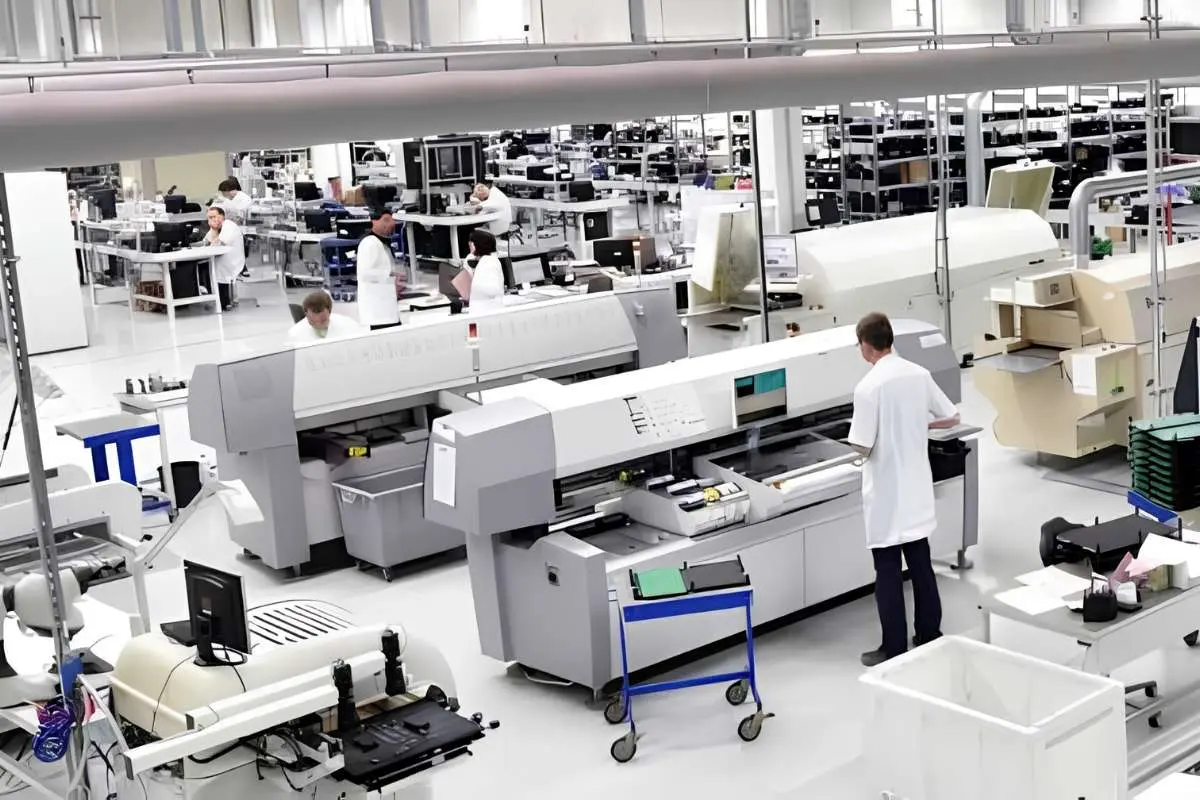
On production lines, robots fitted with computer vision now inspect parts as they move down the line, catching defects that are easy for a tired human eye to miss, and increasingly handling precision assembly steps that used to require a dedicated technician at every station. In hospitals, autonomous carts and delivery robots move supplies, medication, and linen between departments, freeing clinical staff from a logistics job that has nothing to do with patient care. None of these examples require a breakthrough still on the horizon. They are running today, and the number of sites adopting them is growing quarter over quarter.
Learning the job in simulation first
The obvious question a business leader should ask is how a robot becomes competent enough to do any of this before it is switched on at a real site, where mistakes are expensive and slow to fix. The answer is that it practises first, not on the warehouse floor, but inside a 3D simulation built to behave like the real one.
In these simulated environments, a robot can attempt a task thousands of times in the time it would take to attempt it once in reality. It can be dropped into scenarios engineers would never risk with real equipment, a stack that topples, a corridor blocked without warning, a part that arrives slightly out of position, and allowed to fail safely, over and over, until the underlying policy holds up. Platforms such as NVIDIA’s Isaac Sim and Isaac Lab run these training loops in parallel across hundreds or thousands of virtual robot instances simultaneously, compressing what would be months of physical trial and error into a training run measured in days.

None of that works without one thing: simulated environments and objects that behave like their real counterparts, not just look like them. Building that data is a specialist job in its own right. A 3D model that renders convincingly on screen is not automatically usable by a physics engine, it needs accurate mass, friction, and collision properties, cleaned geometry, and structure a simulator can actually reason about.
Companies such as Physical AI now focus specifically on producing this kind of sim-ready 3D asset and environment at scale, supplying the physics-accurate objects and scenes that robotics and world-model teams train against before any hardware reaches a site. That layer of infrastructure has quietly become as important to physical AI as the training algorithms themselves.
What changes for cost and operations
For a business, the practical effect of simulation-first training is that the slowest and most expensive part of a robotics rollout happens before installation, not after. A robot that arrives with most of its learning already done needs a shorter, less disruptive tuning period on site, rather than an extended live trial-and-error phase that ties up floor space and staff attention.
That shifts where the cost sits. Installation becomes faster and cheaper, because far less has to be discovered live. Rollouts carry less operational risk, because the failure modes that matter have already been surfaced and corrected in software. And because deployment timelines become more predictable, finance and operations teams can plan capital spending and hiring around robotics with more confidence than they could when every rollout was effectively its own experiment. Over the next few budget cycles, that predictability, not the robots themselves, may end up being the more consequential change.