

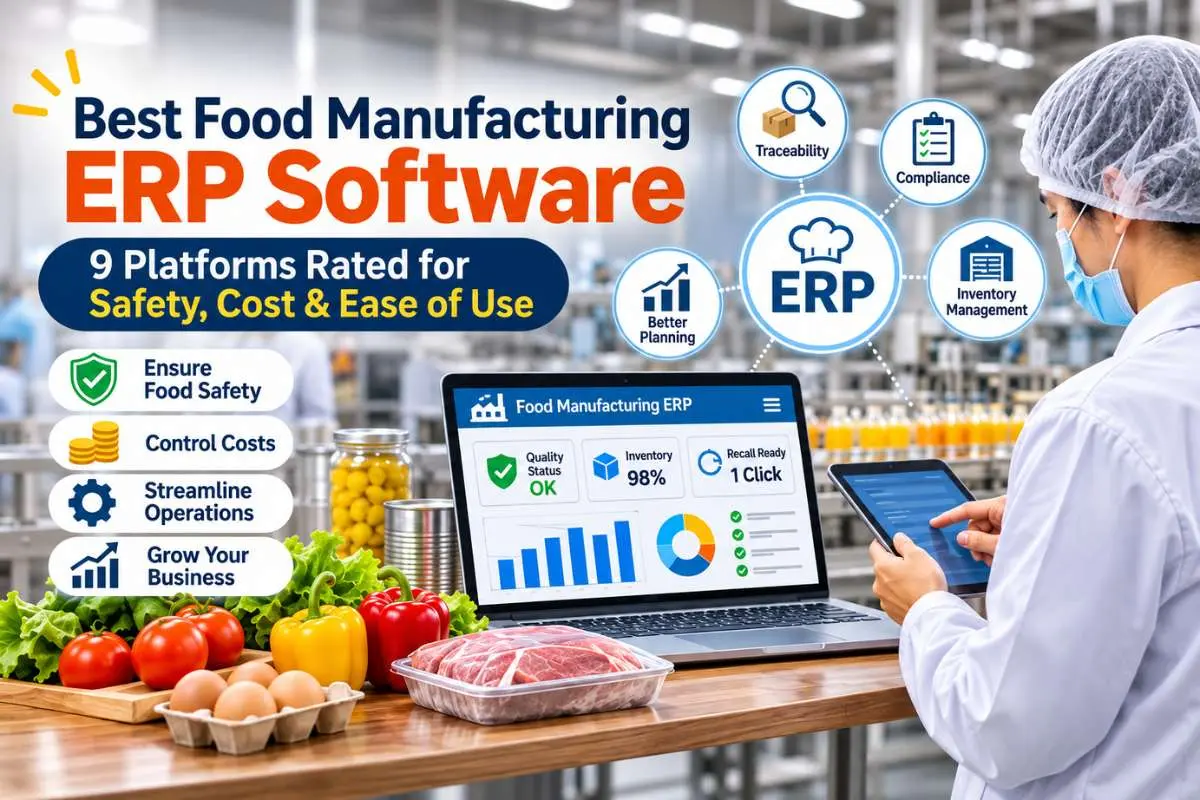
Consumers enjoying a meal rarely think about the complex backend systems driving the supply chain, but industry professionals know exactly what keeps operations running smoothly. In today’s highly regulated market, deploying the Best Food Manufacturing ERP Software provides the invisible operational foundation needed to guarantee food safety, allowing companies to track every single ingredient down to the individual almond.
Best Food Manufacturing ERP Software: 9 Platforms Rated for Safety, Cost & Ease of Use
Well, this ERP software is quite an important consideration for those who deal with perishable raw materials, complex product development processes, and rigorous food safety compliance.
Choose the wrong system and see your favorite food brand flounder in recall, inventory shortage, or razor-thin profit. Choose the right system, and the very same brand can grow successfully with little notice from consumers.
A review, or tour, through these nine popular food manufacturing ERPs will help you see, via a practical example, which platforms preserve products best, provide overall cost upfront, and remain straightforward enough for line-level users so that your food business selects an ERP system that helps with both compliance and expansion.
Why Food Makers Need a Specialized ERP
When it comes to the food industry, the products are perishable and directly affect the customers’ health, and can take down the brand reputation. Well, some of the regular or basic ERP systems may not be able to keep up with your unique operational and compliance challenges.
That is why specialized ERP systems come into the picture, which are designed to manage these complexities from the ground up.
Silver-bullet complexity
The food industry has the most perishable spoil, and one mislabeled spice batch can trigger international returns. Honestly, generic accounting systems simply can’t juggle expiration dates, catch-weights, and farm-level traceability. As a result, many manufacturers rely on spreadsheets and disconnected tools, increasing the likelihood of errors that can escalate rapidly.
A recall can vaporize cash
You may not know, but the financial impact of a food recall is severe and immediate. Having said that, Label errors caused 45.5% of all U.S. food recalls in 2024 and cost the industry an estimated $1.92 billion in direct expenses.
Recent headlines on Nationwide FSIS chicken-corn-dog recalls show how fast issues snowball when data lives in spreadsheets. Honestly, a single recall event can freeze distribution, strain retailer relationships, and wipe out months or even years of operating margin for growing food brands.
Adoption is exploding
With the risk getting intense, people are now making sure to get the ERP System for their business. Well, the global ERP market doubled from $48 billion in 2022 and is projected to hit $96 billion by 2032, which is huge. This is because the food manufacturer, especially small, fast-growing brands, now have cloud options sized (and priced) for them.
How We Scored Each Platform
- Safety & Compliance: The ERP System shall provide traceability with both backward and forward in the supply chain, i.e., full bi-directional lot traceability; manage allergen segregation, and be ready for FSMA 204, with one click recall reporting.
- Cost Transparency: The cost should be made transparent with clearly identifiable licensing rates. In addition, the realistic setup timelines should be explained, and the fact that additional functionalities like warehouse management, quality control options, or EDI integrations may incur additional costs should also be made prominent.
- Ease of Use & Support: The system shall be user friendly; it should allow mobile first UI, intuitive batch screens, and local integrators.
- Operational Impact: A good ERP should improve inventory accuracy, reduce waste and plan faster and more efficiently.
The 9 Best Food Manufacturing ERP Platforms
1. WhereFour: Traceability in Two Minutes
Wherefour is known for the Real-time lot tracking. This cloud system is primarily marketed for helping the food, beverage, nutraceutical, and cosmetics brands grow and thrive. With an inventory screen that showcases on-hand, committed, and aging stock at one glance. Moreover, FIFO, FEFO, LIFO, or manual lot picking keeps auditors happy.
The system also has a Work Orders Production, which captures catch-weights and can deduct ingredients automatically. On the same note, built-in MRP suggests purchase orders against lead times, and a customer B2B portal eliminates inbox chaos.
The best part is that it can generate recall reports with just one click. Because of this, businesses have seen up to 3x inventory savings and 70% revenue lift claimed by users. For this, you can get the pricing, which is subscription-based, where you can even tailor the features to your needs.
2. Aptean Food & Beverage ERP: Allergen Guardian
Aptean Food & Beverage ERP offers recipe management, allergen control points, and CFR-part-11 e-signatures on the Microsoft Dynamics NAV roots. Well, it has a live HACCP plan that follows each batch with built-in SQF workflows and a log verifier sign-off.
Moreover, the dashboard shows yield variances in real time. The best part is that implementation comes via Aptean’s own consultants, which can be a little costly but battle-tested.
This ERP system is perfect for mid-sized processors that ship to retailers demanding strict GFSI certification.
3. JustFood ERP: Recipe-Level QC for SMEs
JustFood ERP comes under Aptean, but for the small business, where the system lets QA teams attach COAs, lab results, and photos directly to ingredients. This system follows an R & D module to handle nutrition panel generation and “what-if” formula costing.
Other than this, the system also comes with pre-built EDI maps for speed onboarding with Costco, Whole Foods, and UNFI. So, if you are running a food business that involves Gluten-free, organic, or regular recipe tweaks to cater to different dietary needs, this is a perfect one to use.
4. Deacom: One Giant Database
With a single system solution, Deacom integrates everything from production and quality to supply chain and financials. Honestly, the software is known for strong real-time quality management and advanced recall capabilities, which also have automated compliance workflows.
Moreover, real-time operational dashboards mean faster reporting, and there are fewer integration bugs. This is ideal for enterprises prioritizing control, compliance, and data accuracy across large-scale operations.
5. BatchMaster ERP: Formula History Champion
Another ERP system that excels in R&D and is built on SAP Business One is BatchMaster. Well, this system covers batch processing, formulation accuracy, and quality control workflow. It can also integrate with accounting platforms like QuickBooks.
From theoretical cost to allergen status, regulatory statements, and nutrient values, BatchMaster makes a perfect system for manufacturers with complex formulations and quality-driven operations.
6. Plex Smart Manufacturing Platform: MES Meets ERP
Plex is a cloud-based system that was originally known as a cloud MES. It can handle traditional business processes like inventory and order management while offering real-time visibility into what’s happening on the factory floor.
It connects production data, quality checks, and business operations in one place, bringing shop floor control and ERP together. Plex is best suited for manufacturers looking for in-depth production insights, enhanced quality management, and for a system that can connect its operations on the floor with its business back office.
7. Microsoft Dynamics 365 Supply Chain + Food Extensions: Familiar UI, Infinite Scale
Dynamics 365 is a quite flexible cloud based ERP system that comes with the familiarity of the Microsoft interface, and there are food industry-related addons for the ability to trace lots, track catch weight, allergy management, and recipes. Well, many manufacturers use it for finance, inventory, and operations.
However, you need a food industry extension like Aptean to get the features for the food business. Moreover, the Power BI and Power Apps allow for easy reporting and mobile check handling and are scalable to multiple plants and geos.
8. SAP S/4HANA Consumer Products: Global Compliance Heavyweight
Just in case you have a multinational food business, the SAP S/4Hana is your safest choice to make. This system not only handles recipe management but also covers allergen changeovers, cold storage automation, and global compliance.
This whole system can be a little expensive and take longer to implement, but it is super powerful to take care of everything at a larger level. So if you need full digital control, predictive analytics, and operations across multiple countries, this is your ERP system.
9. Katana Manufacturing ERP: Visual Flow for Micro-Brands
Katana is a perfect system for small snack or functional-drink brands making sub-10,000 units per run. It uses a drag-and-drop visual board that helps in planning as well as tracking inventory in real time.
Moreover, sales from platforms like Shopify or WooCommerce are updated automatically, letting you do the lot tracing barcode WMS, and expiration alert. A perfect system for those who need real inventory control without any complex ERP.
Feature Snapshot: Who Wins What?
- Fastest Recall: In this area, Wherefour takes the prize as it can generate a full recall report in just 2 minutes, helping brands respond to food safety issues instantly.
- Deepest Allergen Control: Aptean Food & Beverage is the perfect system because it has advanced allergen management, which keeps products safe across every batch.
- Richest R&D Suite: The most valuable R&D suite involves BatchMaster for extensive formulation and recipe management, ensuring product innovation coupled with consistent quality.
- Best Shop-Floor Visibility: The real-time production tracking and dashboards of Plex let operators and managers see exactly what’s happening on the line.
- Most Scalable Cloud: Without any doubt, Dynamics 365 is the most scalable as it easily grows with your business, supporting multiple sites, channels, and high-volume production.
- Enterprise Global Compliance: SAP S/4HANA offers powerful tools for compliance and reporting at a multinational operation.
- Easiest UI: Well, Katana offers simple screens and a mobile-friendly design, which is very easy to adopt for shop-floor teams.
- One-Database Simplicity: All modules of Deacom run within one platform, reducing complications and headaches with integration.
- EDI Out of the Box: JustFood eliminates the time spent on setting up electronic data interchange with suppliers and retailers.
Common Buyer Questions, Answered
1. How long does the implementation of the ERP Software take
For a small or mid-sized business, the implementation may take around three to nine months, whereas large enterprises take around six to 18 months.
2. Do you need a consultant for implementing ERP Software?
Yes, you need a consultant because they will help you to take your success rate higher than 85% with their expertise. So, make a small budget for a consultant as well.
3. Are there any hidden fees in ERP Software/
If you want to check any hidden fees, then watch for EDI, advanced WMS, and percolation surcharges.
4. Which is better – Cloud or on-prem?
Over 53% of ERP users already run cloud (NetSuite stat), citing automatic updates and easier audits, which clearly states that cloud is a better option.
Final Thoughts
The food industry operates on a razor’s edge, where a single tracking or labeling failure can instantly destroy a brand’s reputation. To prevent this, companies rely on the Best Food Manufacturing ERP Software to guarantee product safety, minimize waste, and maintain total visibility over costs. While the nine platforms reviewed here offer distinct advantages, your final choice simply comes down to matching their specific capabilities with your operational needs.