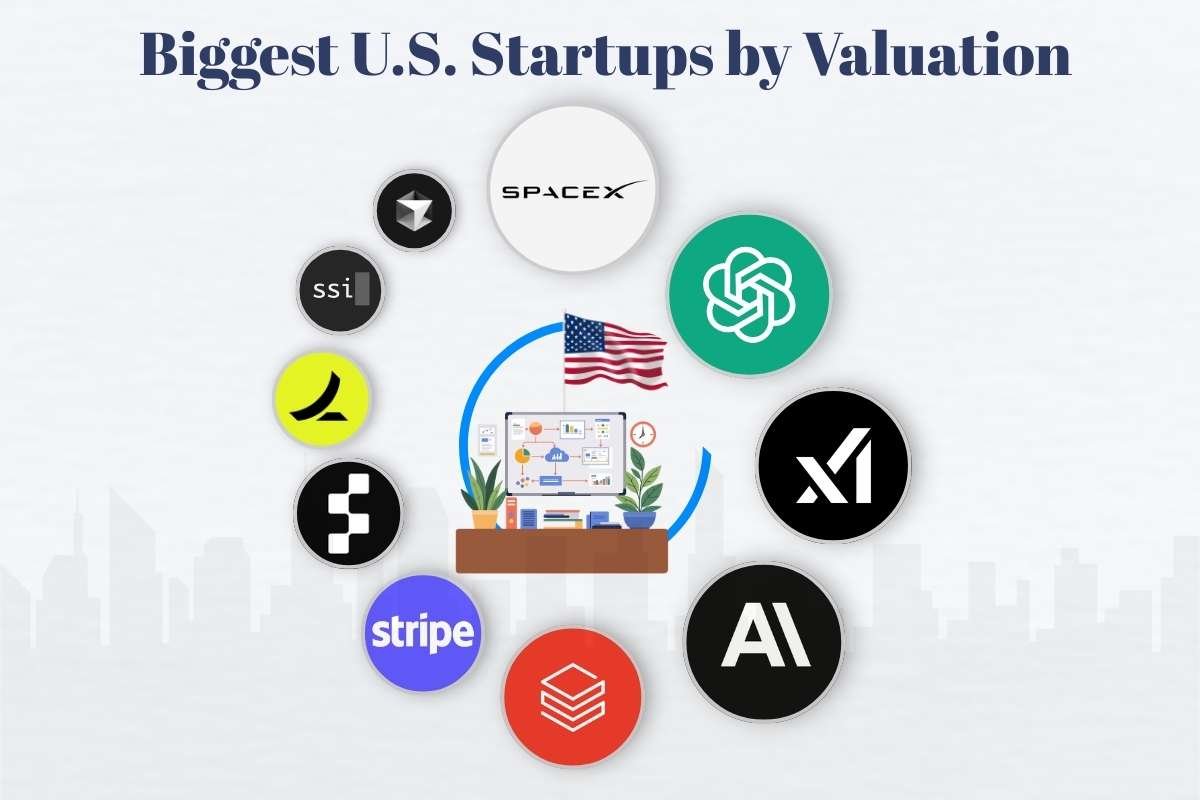
U.S. startups are setting new highs with staggering valuations, redefining what private companies can achieve. Companies like SpaceX and OpenAI stand at the center of this momentum, attracting billions of dollars and demonstrating how breakthroughs in AI and space technology can scale at remarkable speed. What started as bold experiments has evolved into some of the most valuable private enterprises in the world.
The biggest U.S. startups by valuation now reach levels that would have seemed unrealistic just a few years ago. Industry leaders such as SpaceX have moved beyond the $400 billion mark, while OpenAI trails closely, near $300 billion following major funding rounds. Others, including xAI and Anthropic, are capitalizing on the AI surge to reach similarly significant heights, pushing the combined value of top U.S. startups into the multi-trillion-dollar range.
Investors continue to back these companies because they address complex, high-stakes challenges. From advanced software platforms to next-generation rocket launches, each startup on this list expands the boundaries of what private businesses can accomplish. Their rise shapes hiring patterns, investment strategies, and the future direction of entire industries.
In this article, we rank the biggest U.S. startups by valuation, spotlight the top 25 market leaders, break down the sectors driving their growth, and explain why tracking these companies is crucial for investors, founders, and anyone following the direction of the global economy.
Era of Mega-Unicorns
Big startups are no longer stopping at unicorn status. Many now qualify as decacorns, meaning they are valued at $10 billion or more. SpaceX sits far above the rest at around $400 billion, built on steady government contracts, commercial launches, and long-term confidence in its space ambitions. OpenAI reached a valuation of roughly $300 billion after a massive funding round led by Microsoft and other strategic backers.
This shift began gaining real momentum last year. AI companies pulled in the most extensive checks, as investors chased platforms reshaping how people work and build products. Anthropic is a clear example, having doubled its valuation with significant backing from Amazon and Google amid surging demand for advanced AI models.
Non-AI players continue to hold their ground as well. Databricks is valued at $100 billion by helping enterprises manage and analyze complex data at Scale. Stripe maintains a valuation close to $70 billion, driven by its role in simplifying online payments for businesses worldwide. These figures reflect the most recent funding disclosures and market estimates.
25 Biggest U.S. Startups by Valuation Driving the Next Tech Cycle

| Startup | Valuation (2026) | Sector | Founded | Key Investors |
| SpaceX | $400B | Industrials/Aerospace | 2002 | Founders Fund, DFJ |
| OpenAI | $300B | Enterprise Tech/AI | 2015 | SoftBank, Microsoft, Thrive |
| xAI | $230B | Enterprise Tech/AI | 2023 | Sequoia, a16z, VY Capital |
| Anthropic | $183B | Enterprise Tech/AI | 2021 | Amazon, Google, Iconiq |
| Databricks | $100B | Enterprise Tech | 2013 | a16z, NEA, Battery |
| Stripe | $70B | Financial Services | 2010 | Sequoia, a16z, Thrive |
| Figure | $39B | Industrials/Robotics | 2022 | Intel, Parkway, Amazon |
| Ramp | $32B | Enterprise Tech | 2019 | D1, Stripe, Coatue |
| Safe Superintelligence | $30B | Enterprise Tech/AI | 2024 | Sequoia, DST, a16z |
| Anysphere (Cursor) | $29.3B | Enterprise Tech/AI | 2022 | a16z, Thrive, OpenAI |
| Chime | $25B | Financial Services | 2013 | Forerunner, Crosslink |
| Epic Games | $22.5B | Media & Entertainment | 1991 | Tencent, KKR |
| Perplexity | $20B | Enterprise Tech | 2022 | NEA, IVP, Nvidia |
| Deel | $17.5B | Enterprise Tech | 2019 | a16z, Spark, YC |
| Rippling | $16.8B | Enterprise Tech | 2016 | Initialized, YC, Kleiner |
| Skild AI | $14B | Industrials/AI | 2024 | CRV, General Catalyst |
| Anduril | $14B | Industrials/Defense | 2017 | a16z, Founders Fund |
| Scale AI | $13.8B | Enterprise Tech/AI | 2016 | Accel, YC, Index |
| Cognition AI | $10.2B | Enterprise Tech/AI | 2023 | Founders Fund, Khosla |
| Sierra | $10B | Enterprise Tech/AI | 2023 | Benchmark, Sequoia |
| Glean | $7.25B | Enterprise Tech | 2019 | Wellington, Sequoia |
| Groq | $6.9B | Enterprise Tech/AI | 2016 | Disruptive, TDK |
| OpenEvidence | $6B | Healthcare/AI | 2023 | Sequoia, Kleiner Perkins |
| Luma AI | $4B | Enterprise Tech/AI | 2021 | Humain, a16z, AMD |
| Fireworks AI | $4B | Enterprise Tech/AI | 2022 | Evantic, Index, Sequoia |
1. SpaceX

- Founded in 2002 by Elon Musk, with the mission to reduce spaceflight costs and enable human missions to Mars.
- Valuation Driver: Reached $400B on the back of reusable launch systems, Falcon 9 dominance, and advancing Starship tests.
- Revenue Engines: Long-term NASA contracts, Starlink satellite internet services, and commercial launch operations.
- Funding Snapshot: Raised over $9.7B from 68 investors, with the latest secondary transaction valuing the company at $350B in late 2024.
SpaceX fundamentally reshaped modern spaceflight by proving that rockets could launch, land, and fly again. Elon Musk started the company with a long-term vision of reducing launch costs and making human life multi-planetary. That vision moved from theory to execution as Falcon 9 became the most reliable orbital rocket in history, completing more than 300 missions and normalizing reusable launch systems.
Starlink has emerged as a powerful second engine for growth, delivering high-speed satellite internet to millions of users in rural and remote regions. The service now generates billions in annual revenue, funding SpaceX’s broader ambitions. On the government side, NASA contracts for ISS missions and upcoming Artemis lunar landings, providing steady, long-term cash flow.
Within the biggest U.S. startups by valuation, SpaceX continues to reinforce its status as the most valuable private startup ever built by consistently delivering where competitors struggle, supported by ongoing Starship testing and frequent secondary share sales.
2. OpenAI

- Founded in 2015 by Sam Altman and a group of researchers focused on building safe and broadly beneficial AI.
- Valuation Driver: $300B valuation following large-scale funding from Microsoft and SoftBank.
- Core Products: ChatGPT and enterprise AI models used globally for writing, coding, research, and automation.
- Operating Model: Capped-profit structure focused on long-term AGI development aligned with human benefit.
OpenAI began as a nonprofit research lab with a mission to ensure artificial intelligence benefits humanity. That mission quickly collided with explosive demand once ChatGPT launched, turning the company into one of the fastest-scaling technology platforms ever seen. Millions of users now rely on OpenAI tools for writing, coding, research, and customer support, while enterprises integrate its models directly into workflows.
Microsoft’s deep partnership placed OpenAI at the center of global cloud infrastructure, allowing rapid model deployment at Scale. Additional backing from SoftBank accelerated growth even further, pushing valuation into historic territory.
Despite its commercial success, OpenAI continues to operate under a capped-profit structure, balancing revenue growth with safety research and governance. Its pursuit of artificial general intelligence places it at the core of debates shaping the future of work, creativity, and human-machine collaboration.
3. xAI

- Founded in 2023 by Elon Musk to develop AI systems focused on understanding reality and the universe.
- Valuation Driver: $230B valuation following rapid model releases and backing from Sequoia and a16z.
- Flagship Product: Grok chatbot, positioned as a real-time, data-connected alternative to ChatGPT.
- Core Philosophy: Emphasis on truth-seeking AI with minimal censorship constraints.
xAI emerged as Elon Musk’s direct response to what he viewed as overly constrained AI development elsewhere, a move that quickly elevated it to the biggest U.S. startup in its valuation category. The company launched Grok at breakneck speed, positioning it as a real-time, fact-driven alternative powered by live data from X. This integration gave Grok immediate differentiation in an increasingly crowded AI chatbot market.
Backed by top-tier investors such as Sequoia and Andreessen Horowitz, xAI attracted elite talent from Tesla, OpenAI, and significant research labs.
Its Colossus supercomputer became one of the most powerful AI training systems in operation, allowing rapid iteration of increasingly large models. Valuation surged as enterprises showed interest in Grok’s real-time reasoning capabilities. xAI stands apart by tightly linking AI development with Musk’s broader ecosystem, spanning space exploration, autonomous systems, and large-scale infrastructure.
4. Anthropic

- Founded in 2021 by former OpenAI researchers focused on building safer, more controllable AI systems.
- Valuation Driver: $183B valuation following significant investments from Amazon and Google.
- Core Product: Claude AI models, known for long-context reasoning, coding, and reliability.
- AI Approach: “Constitutional AI” framework designed to align systems with human values.
Anthropic was founded by former OpenAI researchers who believed advanced AI required stronger safety foundations from the ground up. Their flagship model, Claude, quickly gained a reputation for handling long-form conversations, complex reasoning, and code generation with fewer harmful outputs. The company’s “constitutional AI” framework embeds ethical principles directly into model training rather than applying safety controls afterward.
Amazon’s multi-billion-dollar investment gave Anthropic massive cloud-scale reach, while Google’s backing strengthened infrastructure and distribution.
Claude now powers a growing number of enterprise tools and consumer applications. Revenue continues to rise through API access and strategic partnerships. Anthropic’s valuation reflects investor confidence in its measured, safety-first approach to scaling powerful AI without sacrificing reliability or trust.
5. Databricks

- Founded in 2013 by UC Berkeley researchers behind the open-source Apache Spark project.
- Valuation Driver: $100B valuation backed by a16z, NEA, and growing enterprise AI demand.
- Core Platform: Lakehouse architecture combining data warehouses and data lakes.
- Customer Base: Widely adopted by Fortune 500 companies for analytics and AI model training.
Databricks originated from the creators of Apache Spark, who sought to simplify large-scale data analytics. What began as open-source software evolved into a comprehensive enterprise platform used by some of the world’s largest companies. The Databricks Lakehouse architecture eliminated the divide between data warehouses and data lakes, allowing teams to analyze massive datasets without complexity.
As AI adoption surged, Databricks became a critical layer for training and deploying machine learning models. The acquisition of MosaicML strengthened its generative AI capabilities, while tools like Unity Catalog improved governance and security across cloud environments.
Fortune 500 customers rely on Databricks to accelerate insights and reduce infrastructure costs, placing it firmly among the biggest U.S. startups by valuation. Its valuation reflects the central role data platforms now play in enterprise AI strategies.
6. Stripe

- Founded in 2010 by Irish brothers Patrick and John Collison to simplify online payments for businesses and developers.
- Valuation Driver: Holds a $70B valuation backed by Sequoia and a16z through steady, fundamentals-driven growth.
- Core Business: Processes billions of dollars in transactions annually for platforms such as Amazon, Shopify, and millions of online merchants.
- Platform Expansion: Expanded into banking tools, billing, fraud prevention, global payouts, and crypto infrastructure.
Stripe was born from a simple frustration: accepting payments online was far harder than it needed to be. The Collison brothers built a clean, developer-first API that allowed businesses to start processing payments with minimal setup. That ease of use quickly made Stripe the default choice for startups, which later turned into large enterprises as those companies scaled. Stripe now quietly sits behind much of global e-commerce, handling transactions without being visible to end users.
Over time, Stripe expanded beyond payments into a broader financial operating system. Products like Stripe Billing, Atlas, and Treasury helped businesses manage subscriptions, form companies, and hold funds directly. Fraud detection and compliance tools enabled global expansion without complexity.
Investors continue to support Stripe because revenue growth remains consistent, margins are strong, and the company compounds value by becoming harder to replace. Its valuation reflects the strength of its infrastructure rather than hype cycles.
7. Figure

- Founded in 2022 by Brett Adcock to build general-purpose humanoid robots that can work alongside humans.
- Valuation Driver: Reached $39B following investments from Parkway and Amazon tied to real-world factory deployments.
- Technology Focus: AI-driven humanoid robots using vision systems, articulated arms, and rapid task learning.
- Target Markets: Warehouses, manufacturing facilities, and environments affected by persistent labor shortages.
Figure set out to solve one of robotics’ most complex challenges: building machines that can function in human environments without custom programming, placing it among the biggest U.S. startups by valuation. Founder Brett Adcock recruited engineers from Tesla and advanced robotics teams to focus on mobility, balance, and object manipulation. Early demonstrations showed robots lifting boxes, sorting items, and navigating physical spaces that traditional industrial robots struggle with.
Momentum increased when Amazon began piloting Figure’s robots inside active warehouse operations. These deployments validated that the robots could operate outside controlled labs. Investor interest surged as videos showcased consistent progress rather than one-off demos.
Instead of chasing novelty, Figure prioritizes reliability and fast learning. Backed by strong AI partnerships, the company is positioning humanoid robots as a practical answer to global labor constraints.
8. Ramp

- Founded in 2019 by Eric Glyman and Karim Atiyeh to modernize corporate spending and expense management.
- Valuation Driver: Achieved a $32B valuation after a major revenue-based funding round led by D1 and Stripe.
- Core Offering: Corporate cards paired with real-time spend controls, savings insights, and automated accounting.
- Growth Signal: User base doubled year over year as companies focused on cutting operational costs.
Ramp entered the fintech space by targeting inefficiencies rather than rewards. Traditional corporate cards offered points but little insight. Ramp built software that tracks spending in real time, flags unnecessary expenses, and actively recommends savings. This approach resonated with startups and large enterprises under pressure to manage burn rates more carefully.
As adoption grew, Ramp expanded its platform through acquisitions, adding travel booking, payroll support, and vendor management. Deep integrations with accounting software made it central to finance teams’ daily workflows.
Unlike many fintech peers, Ramp focused early on profitability, strengthening investor confidence. Its valuation reflects strong unit economics and the growing importance of software-driven financial control.
9. Safe Superintelligence

- Founded in 2024 by former OpenAI chief scientist Ilya Sutskever to pursue aligned superintelligent AI.
- Valuation Driver: Valued at $30B with backing from Sequoia and DST, driven by founder credibility and long-term potential.
- Research Focus: Building AI systems that remain aligned with human intent before scaling intelligence.
- Operating Model: Pure research organization with no commercial products or short-term revenue goals.
Safe Superintelligence emerged from a deliberate break with mainstream AI development. Ilya Sutskever left OpenAI to focus exclusively on the most challenging unsolved problem in the field: alignment. Rather than racing to ship consumer products, the company concentrates on foundational research that could determine whether future AI systems remain controllable.
Investors committed capital rapidly, betting on Sutskever’s track record and the belief that alignment breakthroughs could be enormously valuable.
The company hires selectively, prioritizing deep research over speed. Its valuation reflects optionality rather than output — if Safe Superintelligence succeeds, its work could influence every central AI system built afterward.
10. Anysphere (Cursor)

- Founded in 2022 by Michael Truong and team to build AI-native tools for software developers.
- Valuation Driver: Reached $29.3B following rapid adoption and backing from a16z and Thrive.
- Flagship Product: Cursor, an AI coding assistant that understands and edits entire codebases.
- User Base: Widely adopted by engineers across top technology firms and fast-growing startups.
Anysphere built Cursor to address a core limitation of earlier coding assistants: the lack of project-level understanding. Cursor reads full repositories, suggests complete functions, refactors files, and adapts to a team’s style. Developers quickly reported significant productivity gains, leading to organic adoption through engineering communities.
As usage spread, Cursor became embedded into daily development workflows rather than used as a side tool.
The team expanded features to include debugging assistance, test generation, and deeper contextual reasoning. Investor interest followed real usage rather than speculation. Anysphere’s valuation reflects how AI is reshaping software creation at a structural level, not just speeding up individual tasks.
Read More:
- Largest Companies in the United States in 2026: Revenue, Market Cap, Employees, and More
- 10 Startups You Need to Pay Attention to in 2025
11. Chime

- Founded in 2013 by Chris Britt and Ryan King to offer fee-free, consumer-friendly banking.
- Valuation Driver: Reached a $25B valuation with backing from Forerunner Ventures and Crosslink Capital.
- Core Offering: Digital banking with no overdraft fees, early paycheck access, and spending flexibility.
- Growth Engine: Expanded rapidly through word-of-mouth among younger users frustrated with traditional banks.
Chime was built to strip banking down to what everyday users actually need. Traditional banks relied heavily on overdraft fees and minimum balances, which alienated younger and lower-income customers. Chime removed those pain points entirely, offering no-fee accounts and features like SpotMe, which allows users to overdraw small amounts without penalties. Early direct deposit access became one of its most popular features, helping users manage cash flow more effectively.
The app keeps its interface simple, focusing on savings tools like automatic round-ups and balance alerts. Instead of charging customers, Chime earns revenue through interchange fees when users swipe their cards.
That model allowed it to scale quickly while maintaining user trust. Chime reached profitability earlier than many peers, proving that consumer neobanks can grow sustainably without physical branches or aggressive fee structures.
12. Epic Games

- Founded in 1991 by Tim Sweeney, known for Fortnite and the Unreal Engine.
- Valuation Driver: Holds a $22.5B valuation supported by Tencent and KKR.
- Core Technology: Unreal Engine, one of the most widely used real-time 3D graphics platforms.
- Revenue Stream: Fortnite generates billions through in-game purchases, events, and brand partnerships.
Epic Games built its reputation long before Fortnite through Unreal Engine, which powers a large share of modern video games, films, and simulations. The engine lowered development costs while delivering high-end visuals, making it a standard across studios of all sizes. Fortnite then turned Epic into a consumer powerhouse, combining gaming, live events, and social interaction into a single platform.
Epic has remained in the spotlight through its public fight with Apple over app store fees, positioning itself as a challenger to closed ecosystems and reinforcing its place among the biggest U.S. startups by valuation.
Beyond Fortnite, the company continues to invest in the Epic Games Store to compete with Steam and expand its control over distribution. Ongoing investments in virtual worlds, creator tools, and real-time graphics keep Epic relevant as gaming and digital experiences evolve. Its valuation reflects steady revenue and long-term platform influence.
13. Perplexity

- Founded in 2022 by Aravind Srinivas to rethink how people search for information.
- Valuation Driver: Reached $20B with backing from NEA, IVP, and Nvidia amid rapid user growth.
- Core Product: AI-powered search that delivers direct answers with cited sources.
- User Adoption: Used daily by millions seeking fast, ad-free information.
Perplexity was created as an alternative to traditional search engines, which are overloaded with ads and SEO-driven pages. Instead of listing links, it delivers clear answers while showing sources transparently. This approach resonated with users who wanted trustworthy information without having to dig through multiple websites.
Strategic partnerships and Nvidia-backed infrastructure enabled fast, reliable responses at Scale. Revenue comes from premium subscriptions and enterprise search offerings rather than advertising.
The team expanded quickly with talent from leading AI labs, strengthening model quality and reliability. Perplexity’s valuation reflects its challenge to legacy search models and its growing role as a daily research tool.
14. Deel

- Founded in 2019 by Alex Bouaziz to simplify global hiring and payroll.
- Valuation Driver: Achieved a $17.5B valuation with backing from a16z, Spark Capital, and Y Combinator.
- Core Offering: End-to-end global payroll, compliance, and contractor management.
- Customer Base: Serves over 100,000 companies hiring across borders.
Deel emerged as remote work went mainstream, addressing the complexity of hiring international talent. Companies could onboard workers anywhere in the world without setting up local entities or navigating tax laws. Deel handled contracts, payments, compliance, and even visa support, removing friction from global hiring.
Growth accelerated as distributed teams became permanent rather than temporary. Deel expanded through acquisitions, adding benefits administration and equity management to its platform.
Its valuation reflects the structural shift toward borderless workforces and the increasing need for compliant, scalable global operations. Deel positioned itself as essential infrastructure for modern companies.
15. Rippling

- Founded in 2016 by Parker Conrad, drawing on lessons from his previous startup experience.
- Valuation Driver: Reached a $16.8B valuation backed by Initialized Capital, Y Combinator, and Kleiner Perkins.
- Core Platform: Unified system for HR, payroll, IT, and device management.
- Key Advantage: Automates employee onboarding across departments from day one.
Rippling set out to unify fragmented workforce tools into a single platform. When a new employee joins, Rippling automatically sets up payroll, benefits, email accounts, software access, and even ships devices. This automation saves companies significant time while providing leadership with real-time visibility into workforce costs.
Founder Parker Conrad applied lessons from past compliance challenges to build stronger controls from the start. Rippling expanded its platform through acquisitions, adding financial and healthcare features.
Revenue growth accelerated as larger enterprises adopted the system. Rippling’s valuation reflects its dominance in workforce infrastructure and its ability to replace multiple tools with one integrated solution.
16. Skild AI

- Founded in 2024 to develop AI systems designed for real-world robotic tasks rather than controlled lab environments.
- Valuation Driver: Reached a $14B valuation with backing from CRV and General Catalyst.
- Technology Focus: AI models that allow robots to adapt quickly to factories, warehouses, and home settings.
- Talent Strategy: Recruits researchers and engineers from leading AI and robotics labs to focus on practical movement intelligence.
Skild AI focuses on one of robotics’ most difficult challenges: enabling machines to operate reliably in unpredictable environments. Instead of training robots solely in simulation, Skild emphasizes learning from real-world interactions. Its models are designed to handle irregular objects, uneven spaces, and constantly changing conditions such as those found in warehouses and homes. Early demonstrations have shown that robots can sort and handle items with greater consistency than many existing systems.
The company prioritizes software efficiency, allowing its AI to run on relatively low-cost hardware. This approach lowers deployment costs and speeds up adoption. Partnerships with logistics and warehouse operators allow Skild to test systems in live environments rather than pilot labs. Its valuation reflects investor confidence in fast commercialization and the belief that adaptable robotics will play a significant role in addressing global labor shortages.
17. Anduril

- Founded in 2017 by Palmer Luckey to modernize defense technology through software-first systems.
- Valuation Driver: Reached a $14B valuation with backing from a16z and Founders Fund.
- Core Products: AI-powered surveillance systems, autonomous drones, and battlefield intelligence platforms.
- Customer Base: Secured multi-billion-dollar contracts with the U.S. military and allied governments.
Anduril was created to challenge slow, outdated defense procurement systems. Palmer Luckey founded the company after leaving Oculus, believing that modern warfare required rapid software iteration rather than decades-long hardware cycles. Anduril’s systems combine sensors, AI, and autonomous drones to monitor borders, detect threats, and respond faster than traditional defense platforms.
The company gained traction through contracts for autonomous surveillance towers used in border security, followed by broader military deployments. Rising global tensions and increased defense spending accelerated demand for Anduril’s technology. Repeat government contracts and expanding product lines have driven strong revenue growth. Its valuation reflects confidence in its ability to deliver advanced defense systems faster than legacy contractors.
18. Scale AI

- Founded in 2016 by Alexandr Wang to provide high-quality data for AI training.
- Valuation Driver: Holds a $13.8B valuation backed by Accel, Y Combinator, and Index Ventures.
- Core Service: Data labeling and preparation for machine learning models across text, images, and video.
- Key Clients: Works with major AI developers and enterprises, including OpenAI and General Motors.
Scale AI became a backbone of the AI ecosystem by solving a fundamental problem: models are only as good as the data they’re trained on. The company built systems combining human reviewers and automation to label massive datasets accurately and at Scale. Founder Alexandr Wang left MIT to start Scale at a young age, betting that data quality would define AI performance.
As AI use expanded, Scale evolved beyond labeling into synthetic data generation and evaluation tools, reducing reliance on manual annotation. Enterprise demand surged as companies raced to train and deploy models faster. Scale’s valuation reflects the idea that high-quality data is critical infrastructure for AI development, positioning the company as a long-term enabler of advanced systems.
19. Cognition AI

- Founded in 2023 to build AI systems capable of reasoning like experienced software engineers.
- Valuation Driver: Reached a $10.2B valuation with backing from Founders Fund and Khosla Ventures.
- Flagship Product: Devin, an AI agent that can plan, write, debug, and deploy software autonomously.
- Target Market: Software development teams seeking end-to-end automation rather than simple code assistance.
Cognition AI set out to move beyond code completion toward autonomous problem solving. Devin, its flagship agent, can take high-level instructions and execute entire development workflows, from planning architecture to deployment, driving attention as one of the biggest U.S. startups by valuation. Early adopters reported building functional applications and prototypes in hours instead of days, highlighting the system’s potential to reshape engineering productivity.
The company trains its models on real-world codebases to improve the accuracy and reliability of their reasoning. Partnerships allow Devin to be tested in production environments rather than isolated demos. Investors see Cognition as a step toward AI agents that can replace large portions of routine engineering work. Its valuation reflects expectations that agent-based systems will become a core layer of future software development.
20. Sierra

- Founded: 2023 by Bret Taylora, former OpenAI board member and Salesforce executive.
- Valuation Driver: Achieved a $10B valuation with backing from Benchmark and Sequoia Capital.
- Core Product: AI agents designed to handle sales and customer support conversations with a human-like tone.
- Early Results: Pilot programs show improved sales close rates and customer engagement.
Sierra focuses on bringing AI directly into customer-facing roles where interaction quality matters most. Its agents are trained to handle natural conversations, adapt to customer responses, and learn from top-performing human representatives. Founder Bret Taylor applied deep enterprise experience to design systems that integrate smoothly into existing sales and support workflows.
Early pilots demonstrated measurable returns, including higher conversion rates and faster response times. Investors responded to this proof of impact rather than speculative use cases. Sierra’s revenue is beginning to scale through enterprise adoption, and its valuation reflects belief in the rise of AI agents across frontline business functions. The company is positioning itself at the center of the emerging agent-driven service economy.
21. Glean

- Founded in 2019 by Arvind Jain to help employees search enterprise data quickly and securely.
- Valuation Driver: Reached a $7.25B valuation with backing from Wellington Management and Sequoia Capital.
- Core Product: Enterprise search across Slack, documents, emails, and internal tools.
- Customer Base: Used by large organizations, including Shell and Databricks, for internal knowledge discovery.
Glean was built to solve a growing problem inside modern companies: critical information scattered across too many tools. Employees waste hours searching through documents, chats, and emails to find answers that already exist. Glean indexes all enterprise data sources without heavy setup, allowing workers to ask natural-language questions and receive instant, permission-aware results.
Adoption accelerated as large enterprises ran pilots and saw immediate productivity gains. Teams cut search time dramatically, while leadership appreciated the security controls that prevent data leaks. Glean added AI-powered summaries and contextual answers to support reports and decision-making. Revenue grows through per-user subscriptions, and its valuation reflects the rising cost of information overload in large organizations.
22. Groq

- Founded in 2016 by former Google engineers to build chips optimized for AI inference speed.
- Valuation Driver: Achieved a $6.9B valuation backed by Disruptive Ventures and TDK.
- Core Technology: Language Processing Units (LPUs) designed for ultra-low-latency AI workloads.
- Use Case: Powers real-time AI applications requiring fast responses, such as chat and voice systems.
Groq was created with a narrow focus: make AI inference dramatically faster than existing hardware. Instead of general-purpose GPUs, Groq designed LPUs specifically for running trained models in real time. This architecture allows language models to respond with minimal delay, making conversations feel more natural and interactive.
Early attention came from viral demos showing models running at speeds far beyond what typical GPU setups could achieve. As demand for real-time AI increased, Groq began shipping hardware to cloud providers and enterprise customers. Revenue growth followed rising usage, while valuation reflects investors’ belief that inference speed will become as crucial as model quality, placing Groq among the biggest U.S. AI hardware startups by valuation.
23. OpenEvidence

- Founded in 2023 to apply AI to medical research and clinical decision support.
- Valuation Driver: Reached a $6B valuation with backing from Sequoia Capital and Kleiner Perkins.
- Core Product: AI-powered search for medical studies, guidelines, and clinical evidence.
- Primary Users: Doctors and healthcare professionals seeking fast, cited answers.
OpenEvidence was designed to address a critical healthcare issue: doctors often rely on outdated or incomplete information due to time constraints. The platform allows clinicians to query medical literature and receive clear, evidence-backed answers with direct citations. This reduces reliance on memory and minimizes the risk of decision errors.
Hospitals began testing OpenEvidence during clinical rounds, where speed and accuracy matter most. Partnerships with pharmaceutical companies support drug research and clinical trials. Revenue flows from health system contracts and enterprise licensing. Its valuation reflects growing trust from medical professionals and the belief that AI-assisted evidence retrieval can meaningfully improve patient outcomes.
24. Luma AI

- Founded in 2021 by Alex Yu to make 3D content creation accessible using smartphone videos.
- Valuation Driver: Reached a $4B valuation backed by Humain, a16z, and AMD.
- Core Technology: Converts video clips into high-quality 3D models for AR, VR, and gaming.
- User Base: Widely used by creators and designers who want fast 3D assets without scanners.
Luma AI simplified 3D creation by removing the need for specialized equipment. Users can capture a short video with a phone and generate a detailed 3D model ready for use in games, design tools, or augmented reality experiences. This dramatically reduced the cost and skill barrier for working with 3D assets.
The company expanded its toolset with editing and refinement features, allowing creators to adjust models quickly. Revenue comes from professional subscriptions and creator plans. As interest in AR, VR, and spatial computing grows, Luma’s valuation reflects expectations that demand for easy 3D content creation will continue to rise. The platform opens 3D workflows to a much broader audience.
25. Fireworks AI

- Founded in 2022 to provide fast, affordable infrastructure for running and fine-tuning AI models.
- Valuation Driver: Achieved a $4B valuation with backing from Evantic, Index Ventures, and Sequoia Capital.
- Core Offering: Optimized hosting for custom large language models and open-source AI systems.
- Target Users: Developers and startups seeking low-cost, high-performance AI deployment.
Fireworks AI was built to remove infrastructure friction from AI development. The platform allows teams to run, fine-tune, and deploy models without competing for expensive GPU resources. By optimizing servers and inference pipelines, Fireworks lowers cost per token while maintaining high throughput.
Adoption grew as open-source AI models gained popularity and developers looked for flexible alternatives to major cloud providers. Revenue scales with usage-based pricing as applications grow. Its valuation reflects confidence in a future where teams mix and match models rather than rely on a single provider. Fireworks positions itself as core infrastructure for the next generation of AI-powered applications.
Read More:
- AI Billionaires of 2025: The List No One Saw Coming
- 20 Richest Companies in the World: Trillion-Dollar Giants Powering the 2025 Economy
AI Supremacy Breakdown
AI startups dominate the top end of the valuation spectrum, claiming most of the highest-ranked spots on the list. Companies like Anysphere (Cursor) and Cognition AI surged as their tools moved beyond assistance into complete execution, writing entire applications or reasoning through problems step by step. Developer enthusiasm and aggressive funding rounds last year pushed these companies into elite valuation territory. More than 70% of U.S. funding rounds above $100 million flowed into AI-focused startups.
Capital continues to concentrate on infrastructure and productivity gains. Startups building the foundation for better models, such as Scale AI and Groq, attract sustained investor interest by supplying the data quality and processing speed modern AI systems demand. The appeal is clear: these technologies promise immediate boosts to worker output, from faster coding to real-time decision support.
Non-AI companies still prove they can compete at the highest level. SpaceX continues to justify its valuation through tangible results, such as successful launches and an expanding satellite network, while Stripe grows steadily amid rising global payment volumes. Even so, AI startups are setting the valuation tempo, shaping how investors define Scale and momentum this year.
Valuation Drivers Exposed
The following drivers explain how relatively small early bets compound into multi-billion-dollar companies, turning execution discipline into market dominance for the biggest U.S. startups by valuation.
1. Capital concentration around proven operators
Late-stage capital is increasingly flowing to founders and teams that demonstrate execution speed and early revenue traction. Large venture firms, most notably a16z, have led more than 20 major rounds in the past year alone, backing companies that show clear paths to Scale rather than experimental ideas. Investors favor startups that can ship quickly, convert pilots into paying customers, and expand usage without heavy friction.
2. Talent density as a valuation multiplier
Top AI valuations are closely tied to who is building the technology. Startups pulling senior engineers and researchers from companies like Google and Meta gain immediate credibility in the market. Compensation packages now reach into the millions for elite talent, but investors view this as essential fuel for training advanced models and maintaining technical advantage. Teams with rare expertise often see valuations jump before revenue fully materializes.
3. Strategic capital and regulatory tailwinds
Not all funding is equal. Strategic investments amplify valuations by reducing execution risk. Anthropic’s $13B raise from Amazon illustrates how access to cloud infrastructure and long-term compute commitments can accelerate growth overnight. At the same time, favorable policies, such as tax incentives for AI hardware and domestic infrastructure, lower operating costs, and make large-scale deployment more attractive.
4. Speed, cost advantage, and market timing
Valuations surge fastest when startups outpace competitors on speed or efficiency. xAI attracted rapid funding by positioning Grok as a differentiated alternative in the chatbot race, while Databricks secured long-term data partnerships before AI demand peaked. These examples highlight a consistent pattern: founders who move first, lock in distribution, or undercut costs often see valuations double within months.
The Future Outlook
→ Robotics: From pilots to purchase orders
Humanoid robotics is moving past experimentation and into deployment. Figure’s current $39B valuation reflects early confidence, but large-scale factory rollouts could quickly change the math. As robots demonstrate reliable lifting, sorting, and navigation in live environments, warehouses facing chronic labor shortages are placing repeat orders instead of running trials. That shift from proof of concept to operational necessity is what typically pushes robotics companies into decacorn territory.
→ Fintech: Private valuations meet public markets
Fintech leaders are approaching an inflection point as IPO windows reopen. Stripe sits at the center of this transition, with market speculation focused on how its $70B private valuation holds up under public scrutiny. Bullish projections push potential pricing closer to $90B if liquidity and tech multiples remain supportive. Recent moves into lending, treasury, and embedded finance provide predictable cash flows that public investors tend to reward.
→ Brain–computer interfaces: Early capital, long runway
BCI startups are attracting outsized attention despite limited commercial rollout. Merge Labs’ $250M seed round highlights rising conviction that neural interfaces are moving closer to real-world use. Competitors to Neuralink are racing to deliver implants that let users control software, hardware, and environments directly via neural signals. Initial trials in healthcare and gaming are creating momentum, setting the stage for sharp valuation re-ratings as feasibility turns into adoption.
Conclusion
The biggest U.S. startups by valuation highlight where technology is creating immediate and lasting leverage. AI leads the list because it delivers clear gains in productivity, speed, and Scale. Coding agents, data platforms, and autonomous systems have moved beyond experimentation and into daily business use, driving valuations to unprecedented heights.
Non-AI leaders still prove that execution matters. SpaceX justifies its position through successful launches, government contracts, and satellite expansion, while Stripe compounds value through steady payment volume and the expansion of financial tools. Their growth shows that durable revenue and operational discipline can compete with even the fastest-moving AI companies.
Looking ahead, valuation leadership will depend on who turns momentum into defensible Scale. Robotics, fintech, and frontier technologies, such as brain–computer interfaces, are emerging as the next breakout categories. The pattern is consistent: startups that become essential systems, not just compelling ideas, command the highest valuations.