A company can hire brilliant individual talent, but if those people work in rigid silos, projects stall and subtle friction drains daily morale. When communication breaks down across departments, employees lose their spark and start viewing their jobs as just a list of disconnected tasks.
Rebuilding that lost energy requires moving past superficial corporate perks and focusing on how staff interact every day. By weaving practical group challenges, problem-solving workshops, and informal social touchpoints into the regular work week, smart leadership teams master modern employee engagement team-building.
In this article, we will see how strengthening these interpersonal bonds builds a resilient workforce capable of handling complex challenges together. So, let us start by understanding the connection between employee engagement and team building.
The Connection Between Employee Engagement and Team Building
Strong teams often create stronger employee engagement. When people know and trust their coworkers, they feel more comfortable sharing ideas. They also find it easier to ask for help. Team building gives employees time to build these connections outside daily tasks. In fact, highly engaged businesses are 21% more profitable than those without an engaged workforce.
Shared activities can improve trust and communication. Employees learn how their coworkers think, solve problems, and handle challenges. This can make daily teamwork smoother. It can also help new employees feel included and accepted. When people feel part of the team, they are more likely to take part and speak up.
The benefits can extend beyond team activities. Better relationships can support open communication during regular work. Employees may also offer more support when a coworker faces a problem. Managers can strengthen these results by choosing activities that fit the team’s needs. Simple employee engagement activities can work well when they have a clear purpose.
Team building does not create engagement on its own. It works best when leaders also listen to employees and recognize their work. Strong relationships give employees a better reason to connect with their team. Over time, that connection can support higher trust, better teamwork, and stronger engagement. As the Managing Director of Probima Centre, Paula Svensson says:
“Trust becomes meaningful when you support it with integrity, clarity, courage, and long-term thinking.”
What Are Some Employee Engagement Team-Building Activities:

Employee engagement team-building activities can improve how people work together. Different activities support different team needs. Using all three types can help teams grow in a balanced way.
1. Behavioral
Behavioral activities focus on how employees work with others. They can improve communication, trust, cooperation, and teamwork. These activities work well when employees need to build better work habits.
- Communication challenges: Teams complete tasks that require clear instructions and careful listening.
- Role reversal: Employees switch roles to understand each other’s daily tasks.
- Problem solving: Groups work together to solve a simple work-related challenge.
- Trust exercises: Partners complete tasks that require support and cooperation.
- Collaboration games: Teams share tasks and work toward one common goal.
These activities are best practices for engagement and better teamwork. They can also make workplace communication easier.
2. Cognitive
Cognitive activities focus on thinking and decision-making. They encourage employees to share ideas and solve problems together. Teams can also learn to value different points of view.
- Team puzzles: Groups solve puzzles that require logic and teamwork.
- Case studies: Teams review a workplace problem and suggest possible solutions.
- Idea sessions: Employees share ideas to improve a product, process, or team.
- Strategy games: Groups make decisions while working with limited time or resources.
- Brainstorming tasks: Teams create solutions for a specific workplace challenge.
These activities keep employees involved and encourage shared thinking. They also help teams see how different ideas can improve decisions.
3. Emotional
Emotional activities help employees build trust and stronger connections. They give team members space to share experiences and show appreciation. This can help create a supportive workplace.
- Appreciation circles: Employees share what they value about their coworkers.
- Story sharing: Team members share experiences that shaped their work values.
- Gratitude activities: Employees thank coworkers for their help and support.
- Shared interest sessions: Employees talk about hobbies and interests outside work.
- Team reflection: Groups discuss what they value about working together.
Different types of employee engagement support different parts of team connection. Behavioral activities improve teamwork, while cognitive activities support shared thinking. Emotional activities help employees build trust and belonging. A mix of all three can make employee engagement team-building more meaningful.
How to Choose the Right Approach for Your Team?
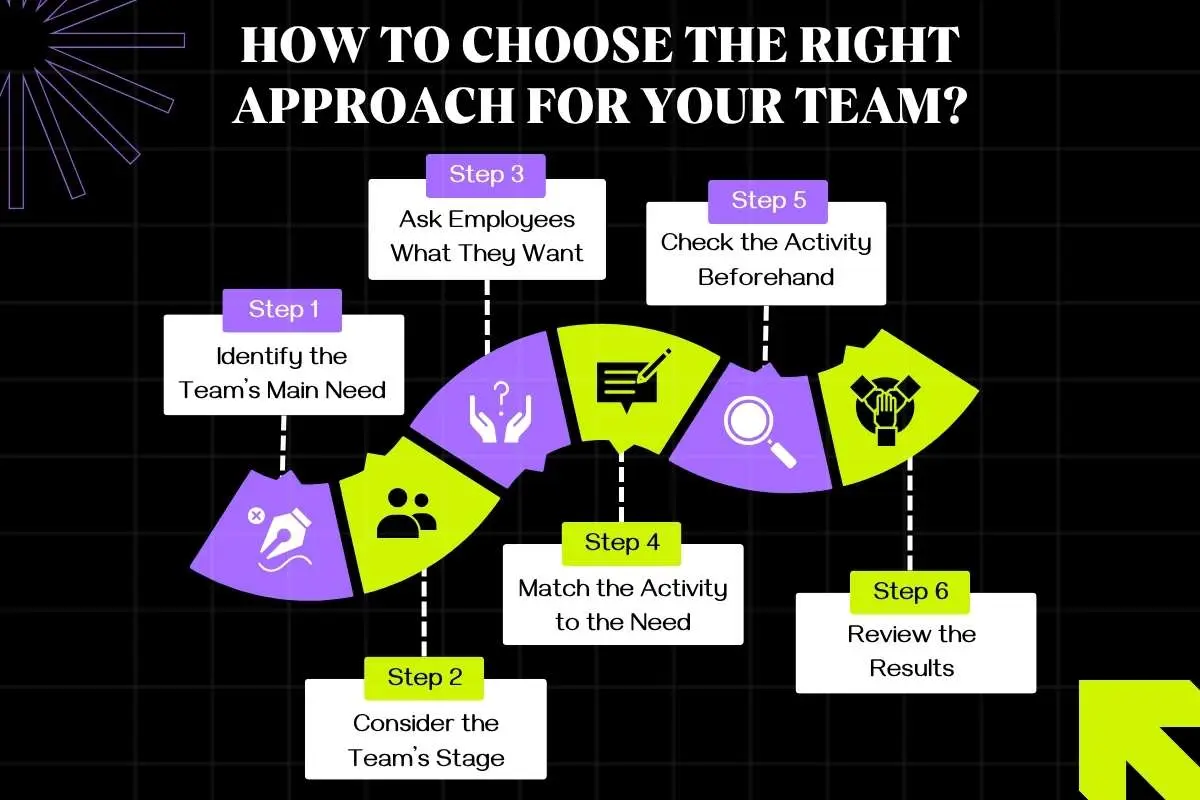
Choosing the right team-building activity starts with understanding your team. A simple step-by-step process can help you avoid activities that feel forced or unnecessary.
Step 1: Identify the Team’s Main Need
Start by looking at how the team works together. Does the team struggle with trust, communication, or cooperation? New teams may need activities that help employees build trust and get comfortable with each other.
Step 2: Consider the Team’s Stage
Think about how long the team has worked together. New teams often need trust-building activities. Established teams may benefit more from employee recognition programs or activities that strengthen existing connections.
Step 3: Ask Employees What They Want
Do not make every decision from the top. Ask employees which activities they would enjoy or find useful. A quick survey or team poll can make this step easy.
Step 4: Match the Activity to the Need
Choose an activity that directly supports the team’s goal. For example, use communication exercises when teams need better collaboration. Choose appreciation activities when employees need more recognition.
Step 5: Check the Activity Beforehand
Make sure the activity suits your team. Consider group size, time, comfort levels, and work schedules. Avoid activities that may make employees feel pressured or excluded.
Step 6: Review the Results
Ask employees how they felt about the activity afterward. Look for changes in communication, participation, and team connection. Use this feedback to improve future activities.
A good approach starts with the team, not the activity. When leaders understand employee needs and include their input, team building becomes more useful.
What Are Some Common Employee Engagement Team-Building Mistakes?

Team building should help employees connect and work better. However, some common mistakes can reduce its value. Leaders may choose activities without a clear goal. They may also overlook how employees prefer to take part.
1. Treating Team Building as a Checkbox
Some companies run team activities just to complete them. The event ends, but employees see little change at work. Each activity should support a clear team need. This could mean better communication, stronger trust, or closer teamwork.
2. Making Participation Feel Forced
Employees may not enjoy activities that feel forced. Some people may also feel uncomfortable with certain games or group tasks. Give employees a clear reason to join. Where possible, offer choices that suit different comfort levels.
3. Ignoring Remote and Hybrid Employees
Not every activity works for every team. Office-based activities can leave remote employees feeling left out. Choose activities that give everyone a fair chance to join. Virtual options can also help remote employee engagement.
Good team building should connect with daily work. Keep activities simple, useful, and open to everyone. When leaders avoid these mistakes, employee engagement is more likely to build stronger team connections.
Conclusion:
54% of employees stay longer due to a strong sense of community.
This community cannot always be created by forcing people into awkward social events once a year. At its core, successful employee engagement team-building relies on creating regular, low-pressure opportunities for people to collaborate, solve problems, and connect authentically.
When employees feel supported by the colleagues around them, daily stress decreases, communication flows naturally, and job satisfaction rises. Investing in genuine team connections transforms a collection of individual workers into a resilient, high-performing workforce that actually enjoys working together.
FAQs
1. What is employee engagement team-building?
It refers to organized activities, workshops, and shared experiences designed to strengthen relationships, improve communication, and boost overall work motivation among colleagues.
2. Why do traditional team-building exercises often fail?
They fail when they feel forced, cheesy, or disconnected from real workplace dynamics, making employees view them as a chore rather than a valuable experience.
3. How can remote or hybrid teams participate in employee engagement team-building?
Hybrid teams can build connections through casual virtual drop-in sessions, collaborative digital workshops, online trivia, and asynchronous problem-solving challenges.
4. How often should companies run team-building activities?
Rather than holding one massive annual event, it is far more effective to integrate smaller collaborative touchpoints into monthly or bi-weekly routines.
5. Can low-budget or free activities still drive strong team engagement?
Yes, simple initiatives like peer recognition sessions, casual group coffee breaks, or cross-department brainstorming cost nothing but build strong interpersonal trust.