
Two companies spot the same opportunity. Both have something the other needs. Someone in the meeting eventually says, “Let’s partner,” and everyone nods as if the hard part is over.
It isn’t.
In Strategic Alliance vs Joint Venture, the word “partner” can hide two very different arrangements. A strategic alliance lets companies work together while staying independent. A joint venture creates a more formal shared structure, often with shared ownership, investment, and control. The right choice depends less on which sounds more serious and more on how much control, risk, and commitment the opportunity actually needs. We’ll break down both models, compare them across six practical factors, and look at two real cases where the structure itself became the problem.
What Is a Strategic Alliance? Collaboration Without Building a New Company
A strategic alliance is an agreement between two independent businesses to work toward a shared goal without creating a new company. Each partner stays separate while contributing something the other needs.
That contribution could be:
- Technology or research: One company may provide a platform, technical capability, data, or research that the other cannot easily build alone.
- Distribution or market access: A partner may open doors to new customers, sales channels, regions, or established distribution networks.
- Marketing or customer reach: Partners can combine audiences, brand recognition, campaigns, or customer relationships to reach more people.
- Expertise or specialist capabilities: One business may bring industry knowledge, talent, processes, or skills that fill a gap in the other company’s capabilities.
The arrangement can be simple, such as a distribution deal, or highly structured with long-term commitments and clear responsibilities. That distinction matters in Strategic Alliance vs Joint Venture because an alliance is built around cooperation, not shared ownership.
A strong Business Partnership Strategy starts with three questions: What are we trying to achieve? What will each partner contribute? Where does each partner’s responsibility end? “Let’s work together” is a starting thought, not a strategy.
What Is a Joint Venture? When Collaboration Needs Its Own Structure
A joint venture goes a step further. Two or more businesses combine resources for a specific business activity, often through a jointly owned legal entity. Unlike an alliance, the partners build a formal structure around the opportunity.
A joint venture typically involves:
- Shared ownership
- Shared investment
- Shared governance
- Shared profits and losses
- Formal decision rights
This is where Strategic Alliance vs Joint Venture becomes a real decision. If cooperation needs its own operation, ownership, and governance, a JV may make more sense. That is also why How to Find Business Collaboration Partners matters: choosing a JV partner means choosing who will share the risk, money, and decisions with you.
Strategic Alliance vs Joint Venture: The Six-Factor Decision Matrix
There is no universal winner here. The right structure depends on what the opportunity demands, how much you are willing to commit, and how much flexibility you want when things change. Think of the choice less as picking a “better” model and more as picking the right gear.
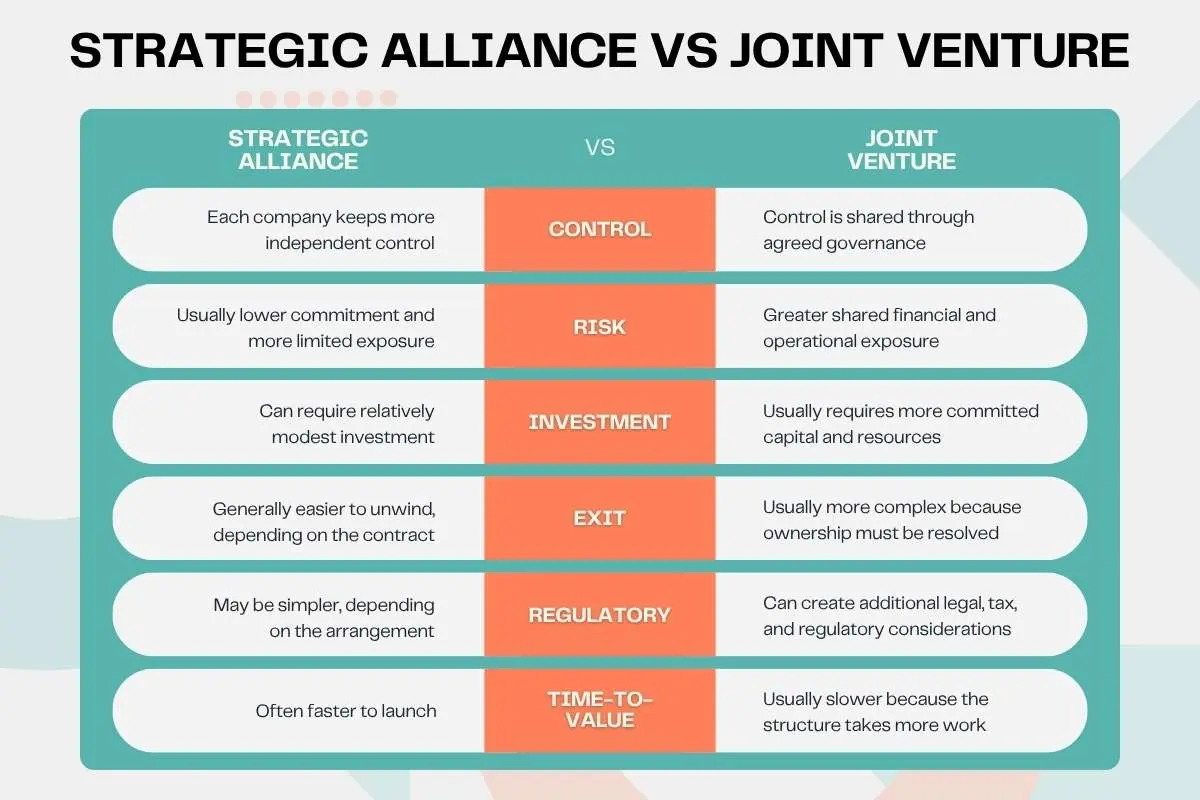
| Factor | Strategic Alliance | Joint Venture |
| Control | Each company keeps more independent control | Control is shared through agreed governance |
| Risk | Usually lower commitment and more limited exposure | Greater shared financial and operational exposure |
| Investment | Can require relatively modest investment | Usually requires more committed capital and resources |
| Exit | Generally easier to unwind, depending on the contract | Usually more complex because ownership must be resolved |
| Regulatory | May be simpler, depending on the arrangement | Can create additional legal, tax, and regulatory considerations |
| Time-to-value | Often faster to launch | Usually slower because the structure takes more work |
The comparison matters because these choices are becoming more common. EY-Parthenon found that 79% of CEOs planned to pursue joint ventures or strategic alliances in 2026, up from 62% in 2025.
The smartest choice is rarely based on one factor. Speed may point toward an alliance, while a long-term shared operation may justify a JV. Either way, define measurable outcomes early. Strong Collaboration KPIs Metrics give both sides a way to see whether the partnership is actually delivering, rather than relying on enthusiastic meeting-room nods.
In Strategic Alliance vs Joint Venture, the best structure is ultimately the one that gives the opportunity enough commitment to work without adding more complexity than the opportunity can support.
When a Strategic Alliance Makes More Sense?
A strategic alliance usually makes sense when both companies want the benefits of working together without handing each other the keys. It can be a good fit when:
- Access matters more than ownership
- The opportunity needs to move quickly
- Each company wants to keep its core capabilities independent
- The relationship may need to change as the market shifts
- The cost of failure needs to stay manageable
Picture a software company with strong technology and a retailer with a powerful distribution network. They may need each other, but they probably do not need to build a new company just to sell the product.
That is where Strategic Alliance vs Joint Venture starts leaning toward flexibility, speed, and easier change. Still, flexibility does not mean “figure it out later.” Strong Cross-Functional Collaboration + Collaboration Between Departments helps both partners assign clear ownership internally, so the alliance does not become everyone’s responsibility and therefore nobody’s.
When a Joint Venture Is Worth the Extra Weight?

A joint venture makes sense when the opportunity needs more commitment than a typical partnership can provide. That could mean:
- Substantial capital: Both companies are willing to put serious money behind the opportunity.
- Combined assets: The venture needs resources neither partner can provide alone.
- New-market entry: Both companies want to build a presence in a market together.
- A dedicated operation: The project needs its own leaders, employees, investment, and accountability.
That structure can be especially useful when decisions need shared ownership rather than constant negotiation between parent companies.
EY-Parthenon found that 76% of surveyed CEOs planned to pursue joint ventures or strategic alliances with third parties, with 53% citing complementary resources such as distribution networks, manufacturing capabilities, or brand recognition as a primary driver.
For cross-border ventures, Global Business Collaboration, international business partnerships & cross-cultural collaboration in business can add another governance challenge.
In Strategic Alliance vs Joint Venture, a JV starts making more sense when shared commitment matters more than flexibility.
When the Structure Becomes the Problem: The Sony Ericsson Lesson
Sony Ericsson began in 2001 as a 50/50 joint venture, combining Sony’s consumer electronics strengths with Ericsson’s telecommunications expertise. The model made sense at the time, but the smartphone market changed the strategic picture.
By 2011, Sony wanted tighter integration between its phones and wider consumer electronics business. It bought Ericsson’s 50% stake for €1.05 billion, making the business wholly owned by Sony.
The lesson? In Strategic Alliance vs Joint Venture, the right structure can change when a business moves from experimentation to integration.
When Shared Ownership Slows the Business: The Hulu Lesson
Hulu offers another useful lesson in shared ownership. In 2019, Disney took full operational control of Hulu while Comcast kept its 33% ownership stake under a later put/call arrangement. The agreed minimum equity value for that future transaction was $27.5 billion.
The point is not that joint ventures are bad. Shared ownership can work well until the business needs one clear direction and faster control.
That is the real question in Strategic Alliance vs Joint Venture: does the structure still match what the business needs now?
Conclusion: Strategic Alliance vs Joint Venture: Which One Should You Choose?
It really comes down to what you are trying to do together. If you need access to a market, technology, customers, or expertise without tying the businesses together, a strategic alliance can be the cleaner option. If both sides are ready to put in serious money, share ownership, and build something together, a joint venture may be worth it.
The trick is not to make the partnership more complicated than the opportunity requires. A new company, shared governance, and deeper financial commitments might sound like a stronger partnership, but they can also create more things to manage. Sometimes two companies simply need to work well together and get on with the job.
That is the real decision in Strategic Alliance vs Joint Venture. Pick the structure that fits the work, the risks, and where you expect the relationship to go. And get the basics right from the start, because Why Do Business Collaborations Fail often comes down to unclear expectations, fuzzy responsibilities, or partners wanting different things from the deal.
Frequently Asked Questions
1. Can a strategic alliance become a joint venture?
Yes. Partners can move from an alliance to a joint venture when the relationship requires deeper investment, ownership, or operational integration.
2. Do strategic alliances require a legal agreement?
Usually, yes. The agreement should define responsibilities, intellectual property rights, confidentiality, contributions, performance expectations, and termination terms.
3. Who owns intellectual property in a joint venture?
Ownership depends on the JV agreement. Partners should clearly define existing IP, newly created IP, licensing rights, and usage after the venture ends.
4. How long does a joint venture typically last?
There is no standard duration. Some JVs are created for a specific project, while others continue for many years if the business case remains strong.
5. Can competitors form a strategic alliance?
Yes. Competitors can collaborate in areas such as research, distribution, or technology while remaining competitors elsewhere, subject to applicable competition laws.