Why do humans build giant statues?
Is it to celebrate heroes?
To remember history?
Or to prove that human imagination has no limits?
The answer might be a little bit of everything. Across centuries, people have carved stone, shaped bronze, and lifted massive structures into the sky to create symbols that last for generations. A simple rock becomes a powerful story. A piece of metal turns into a national identity. That quiet transformation is what makes famous statues in the world, historical monuments, and iconic sculptures so fascinating.
Walk near one of these monuments, and you feel something unusual. The size surprises you. The details catch your eye. The story behind the sculpture slowly unfolds. Some statues honor leaders who changed nations. Others represent faith, courage, or freedom. A few even started as artistic experiments but later became global icons and world-famous landmarks.
Cities change with time. Buildings rise and disappear. Roads shift. Yet many famous statues in the world, the most famous sculptures in the world, and historic monuments remain standing for hundreds or even thousands of years. They watch generations pass by. They become meeting points, travel dreams, and powerful cultural heritage symbols.
Tourists cross continents to see them in person. Historians study their design. Artists admire their craftsmanship. Photographers wait for the perfect moment when sunlight touches the statue just right. Many of these monuments are now recognized as global tourist attractions and world heritage landmarks.
These monuments are not just large sculptures. They are pieces of human ambition. They show what people believed, feared, respected, and hoped for in their time. That is why famous statues in the world, iconic world sculptures, and legendary monuments continue to inspire curiosity. Every statue hides a story. And every story reveals something powerful about human civilization.
Why Statues Fascinate Humanity?
Statues show what a civilization respects. Kings built them to display power. Artists built them to express ideas. Nations built them to inspire unity. Over time, many monuments became global icons.
Today, millions of travelers search for famous statues in the world, historical monuments, and iconic landmarks because each statue carries a story about culture, creativity, artistic heritage, and human ambition.
Many of the world’s famous statues also reveal how architecture, sculpture, and engineering history evolved through time. Ancient civilizations carved massive stones without modern machines. These ancient sculptures and monumental statues show the remarkable skills of early craftsmen and builders.
Modern architects and engineers later built the tallest statues in the world using advanced construction techniques. Every era left its artistic signature in world sculpture history.
Below is a carefully arranged list of the world’s famous statues, iconic sculptures, and historical monuments, ordered from ancient creations to modern marvels.
Difference Between Statues and Sculptures
| Feature | Statues | Sculptures |
| Definition | A statue is a type of sculpture that usually represents a specific person, figure, or symbol. | Sculpture is a broad art form that includes all three-dimensional artworks. |
| Purpose | Often created to honor people, events, or beliefs. | Created for artistic expression, decoration, or conceptual meaning. |
| Representation | Usually realistic and recognizable (humans, gods, leaders, animals). | Can be realistic, abstract, or modern in design. |
| Size | Typically large and monumental. | Can range from very small to extremely large. |
| Placement | Commonly found in public places, parks, or landmarks. | Found in museums, galleries, public spaces, or private collections. |
| Example | Statue of Liberty, Christ the Redeemer | The Thinker, The Kiss |
Top 10 Famous Statues in the World
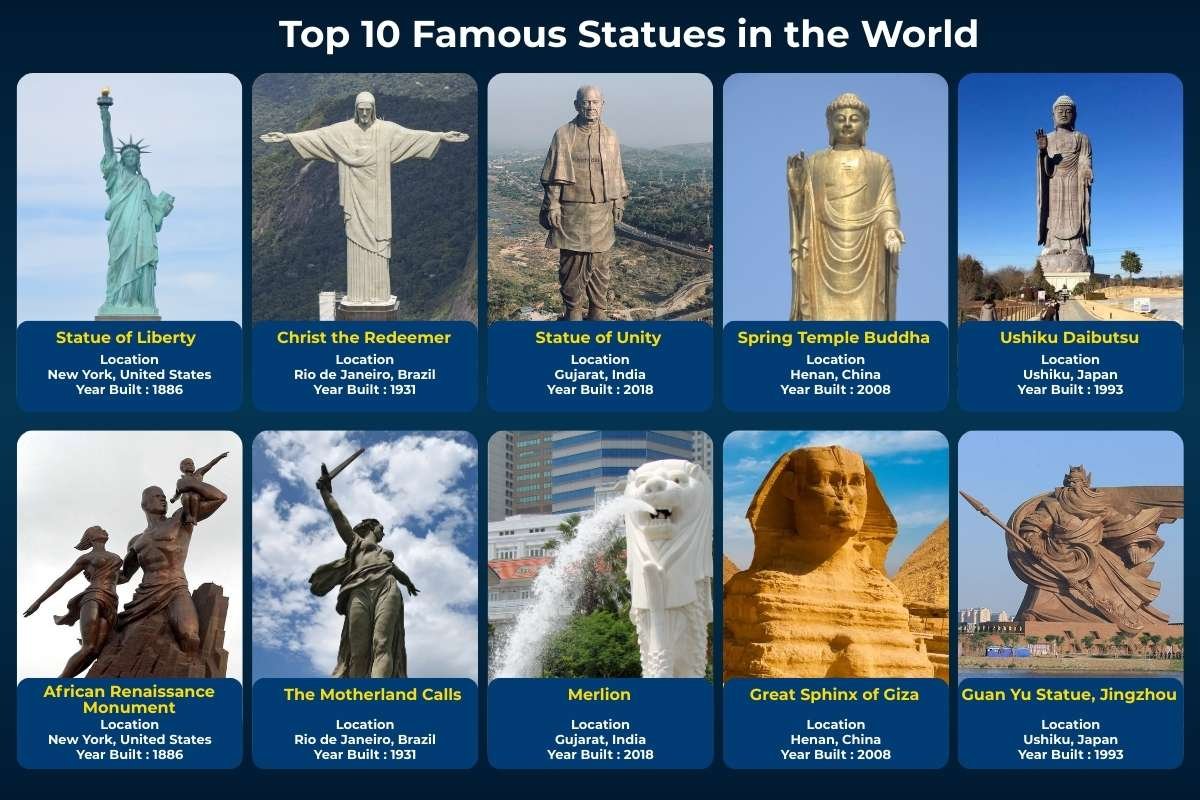
1. Statue of Liberty
Location: New York, United States
Year Built: 1886
Material: Copper over steel framework
Designed by: Frédéric Auguste Bartholdi
The Statue of Liberty is one of the most famous statues in the world. It stands on Liberty Island in New York Harbor and welcomes visitors arriving in the United States. The statue was a gift from France to America in 1886. It was created to celebrate the strong friendship between the two countries and their shared belief in freedom and democracy.
The statue represents Libertas, the Roman goddess of freedom. She stands tall, holding a torch in her right hand. This torch symbolizes enlightenment, hope, and the idea that freedom lights the way for people around the world. In her left hand, she holds a large tablet. The tablet is inscribed with the date July 4, 1776, which marks the day the United States declared independence from Great Britain.
The statue is enormous in size. Including its pedestal, it stands about 93 meters tall. When it was built, it was one of the tallest structures in New York. Engineers designed a strong internal iron framework so the copper exterior could withstand strong winds and weather conditions.
For millions of immigrants who traveled to America by ship in the late 19th and early 20th centuries, the Statue of Liberty was the first thing they saw when arriving in New York. Seeing the statue made many people feel hopeful about starting a new life in a new country. It became a powerful symbol of opportunity and freedom.
Today, visitors from all over the world travel to Liberty Island to see this iconic monument. It remains one of the most recognizable landmarks on Earth.
Specialty: The Statue of Liberty is one of the most recognized global symbols of freedom, democracy, and human rights.
2. Christ the Redeemer
Location: Rio de Janeiro, Brazil
Year Built: 1931
Material: Reinforced concrete and soapstone
Designed by: Paul Landowski and Heitor da Silva Costa
Christ the Redeemer is one of the most famous religious statues in the world. The monument stands on the summit of Mount Corcovado, high above the city of Rio de Janeiro in Brazil. From this location, the statue overlooks the entire city, including its beaches, mountains, and busy neighborhoods.
The statue shows Jesus Christ with his arms stretched wide open. This pose symbolizes peace, love, and protection. Many people believe the open arms represent Christ welcoming and blessing the people of the city.
Construction of the statue began in 1922 and took nearly nine years to complete. Workers used reinforced concrete to build the main structure and covered it with thousands of small soapstone tiles. Soapstone was chosen because it is strong and can resist weather damage over time.
The statue itself stands about 30 meters tall, and the pedestal below adds another 8 meters. Because the monument is located on a mountain, it appears even larger and more impressive from the city below.
Visitors can reach the statue by train or road and enjoy breathtaking views of Rio de Janeiro from the top of the mountain. The location has become one of the most visited tourist attractions in Brazil.
Specialty: Christ the Redeemer is considered one of the New Seven Wonders of the World and has become a global symbol of Brazil and one of the most iconic and famous statues in the world.
3. Statue of Unity
Location: Gujarat, India
Year Built: 2018
Material: Bronze cladding, steel, and concrete
Designed by: Ram V. Sutar
The Statue of Unity is the tallest and most famous statue in the world and one of India’s most important modern monuments. It honors Sardar Vallabhbhai Patel, a key leader in India’s independence movement and the first Deputy Prime Minister of India.
Sardar Patel played a historic role in uniting more than 560 princely states into a single nation after India gained independence in 1947. Because of this achievement, he is often called the “Iron Man of India.”
The statue stands on an island in the Narmada River near the Sardar Sarovar Dam in Gujarat. The monument shows Patel walking forward with confidence. His posture represents strong leadership, determination, and the vision of a united nation.
The construction of this massive structure required thousands of engineers and workers. The statue uses a strong steel frame covered with bronze panels to create its detailed outer appearance.
Visitors can enter the monument and travel by elevator to a viewing gallery located about 153 meters above the ground. From there, they can see the surrounding river, hills, and dam.
Since its opening, the statue has quickly become one of India’s biggest tourist attractions.
Specialty: At 182 meters tall, the Statue of Unity is currently the tallest in the world.
4. Spring Temple Buddha
Location: Henan, China
Year Built: 2008
Material: Copper
Designed by: Chinese government project
The Spring Temple Buddha is one of the tallest statues ever constructed. It stands peacefully in the hills of Henan Province in central China. The statue represents Vairocana Buddha, a figure in Buddhist philosophy that symbolizes wisdom and universal truth.
The statue is surrounded by beautiful mountains and scenic landscapes, which create a calm and spiritual atmosphere for visitors. From far away, the monument appears towering above the surrounding countryside.
Building such a massive statue required careful engineering and years of planning. Workers used thousands of copper plates to create the outer surface of the statue. These pieces were carefully assembled to form the smooth appearance of the Buddha.
The calm facial expression of the statue represents peace, wisdom, and spiritual enlightenment. Visitors often describe the site as peaceful and reflective.
Pilgrims, tourists, and photographers travel from around the world to see this incredible monument. Many people come not only to admire the architecture but also to experience the peaceful environment.
Specialty: The statue stands about 128 meters tall, making it one of the most famous statues in the world.
5. Ushiku Daibutsu
Location: Ushiku, Japan
Year Built: 1993
Material: Bronze
Designed by: Hiroshi Watanabe
Ushiku Daibutsu is one of the largest Buddha statues and most famous statues in the world ever built. The statue stands in Ushiku City in Japan and represents Amitabha Buddha, a central figure in many Buddhist traditions.
The statue rises high above the surrounding gardens and parks, creating a peaceful and spiritual atmosphere. From a distance, visitors can easily see the statue towering over the landscape.
A special feature of Ushiku Daibutsu is that visitors can actually enter the statue. Inside, there are several floors that include a museum, meditation rooms, and exhibition areas that teach visitors about Buddhist beliefs and history.
The gardens around the statue are beautifully maintained with flowers, walking paths, and peaceful resting areas. Many visitors come here to relax, meditate, and enjoy the calm surroundings.
Because of its enormous size and spiritual meaning, Ushiku Daibutsu is considered one of the most famous statues in the world.
Specialty: The statue rises about 120 meters high and was once the tallest statue in the world for several years.
6. African Renaissance Monument
Location: Dakar, Senegal
Year Built: 2010
Material: Bronze
Designed by: Pierre Goudiaby Atepa
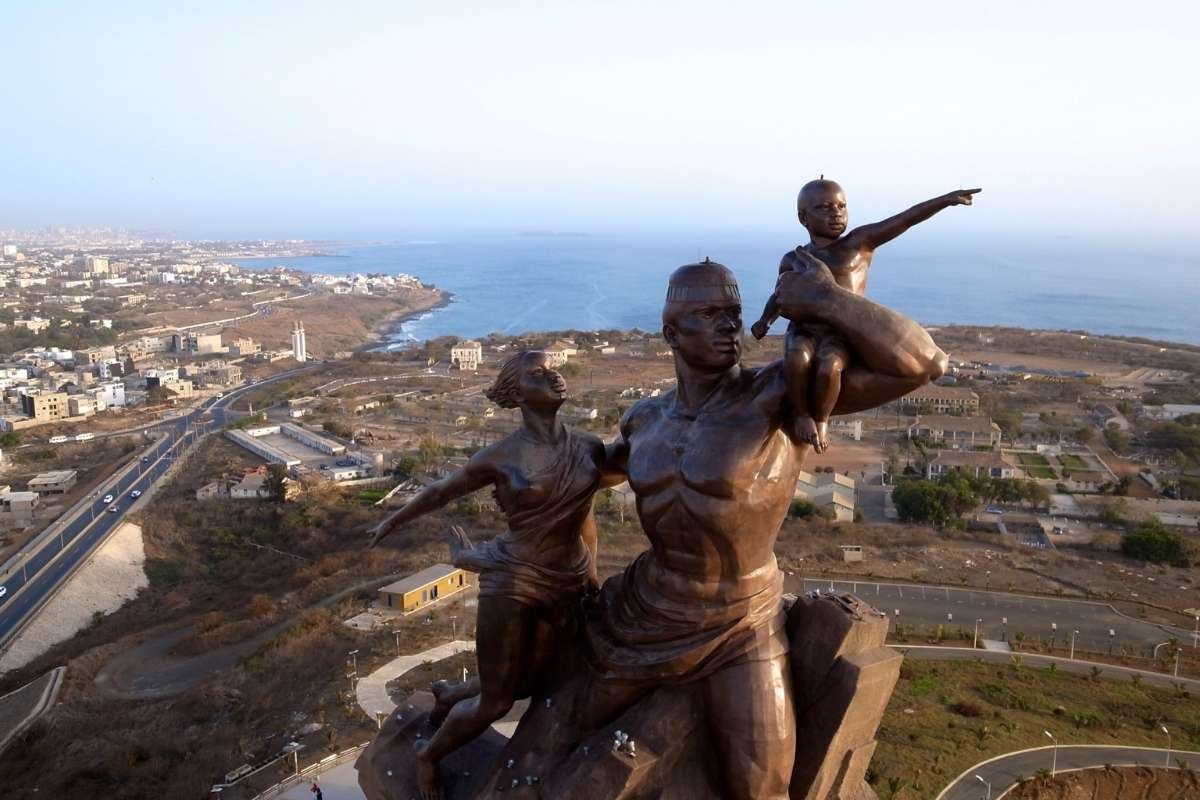
The African Renaissance Monument is one of the most powerful modern monuments in Africa. It stands on a hill called Collines des Mamelles, overlooking the city of Dakar and the vast Atlantic Ocean. Because of its high location, the statue can be seen from many parts of the city.
The monument shows three figures: a strong man, a woman, and a child. The man holds the child on his arm while pointing forward toward the horizon. The woman stands beside him as they all look toward the future. This powerful pose represents the idea that Africa is moving forward with hope, strength, and determination.
The statue symbolizes the rebirth of Africa after centuries of challenges, including colonial rule and economic struggles. It celebrates the continent’s growth, independence, and cultural pride. The message of the monument is that Africa is rising again with confidence and ambition.
Visitors can even go inside the statue. There is a small museum and viewing platform that allows people to learn about African history and enjoy wide views of Dakar and the ocean.
Specialty: The African Renaissance Monument stands about 49 meters tall, making it the tallest statue in Africa and an important symbol of African pride and progress.
7. The Motherland Calls
Location: Volgograd, Russia
Year Built: 1967
Material: Concrete
Designed by: Yevgeny Vuchetich
The Motherland Calls is one of the most dramatic war memorial famous statues in the world. It stands on Mamayev Kurgan hill in the Russian city of Volgograd. This location is historically important because it was the site of the famous Battle of Stalingrad during World War II.
The statue represents a strong woman who symbolizes the motherland of Russia. She is shown stepping forward with energy and determination while holding a large sword high in the air. Her mouth is open as if she is calling her people to stand up and defend their country.
The movement of the statue makes it look very powerful and emotional. Her flowing clothes and raised sword create a feeling of urgency and courage. The monument honors the millions of soldiers and civilians who fought and sacrificed their lives during the Battle of Stalingrad, one of the most important battles of World War II.
Visitors who climb the hill to see the statue also pass several memorials and monuments dedicated to the soldiers who fought there.
Specialty: When it was completed in 1967, The Motherland Calls became the tallest statue in the world. Even today, it remains one of the most impressive war memorial monuments ever built.
8. Merlion
Location: Singapore
Year Built: 1972
Material: Concrete with porcelain scales
Designed by: Lim Nang Seng
The Merlion statue is one of the most recognizable landmarks in Singapore. It stands near Marina Bay, where visitors can enjoy beautiful views of the city skyline and waterfront.
The statue has a unique design that combines two different animals. The head of the statue is a lion, while the body is shaped like a fish. This design reflects Singapore’s history and identity.
Long ago, Singapore was a small fishing village called Temasek. The fish body represents this early connection with the sea and the fishing industry. The lion’s head refers to an old legend.
According to the story, a prince once arrived on the island and believed he saw a lion. Because of this, he named the place Singapura, which means “Lion City.”
Water constantly flows from the Merlion’s mouth into Marina Bay, which adds a beautiful visual element to the monument. Many tourists gather around the statue to take photographs and enjoy the surrounding attractions.
Specialty: The Merlion is Singapore’s most famous national symbol and one of the most visited tourist attractions in the country.
9. Great Sphinx of Giza
Location: Giza, Egypt
Year Built: Around 2500 BCE
Material: Limestone
Designed by: Ancient Egyptian craftsmen
The Great Sphinx of Giza is one of the oldest and most mysterious statues ever created. It stands on the Giza Plateau near the famous pyramids of Egypt. For thousands of years, this enormous monument has watched over the desert landscape.
The statue has the body of a lion and the head of a human. Historians believe the face represents the Egyptian Pharaoh Khafre, who ruled during the Old Kingdom period. In ancient Egyptian culture, the lion symbolized power and strength, while the human head represented intelligence and leadership.
The Sphinx is carved directly from a large limestone rock formation. Instead of building it piece by piece, ancient craftsmen shaped the entire monument from the natural bedrock of the plateau. This shows the incredible engineering skill of ancient Egyptian builders.
The statue measures about 73 meters long and around 20 meters high. Over thousands of years, wind and sand have worn parts of the statue, but it remains one of the most famous ancient and most famous statues in the world.
Today, the Great Sphinx continues to attract historians, archaeologists, and tourists who are fascinated by its age, mystery, and massive size.
Specialty: The Great Sphinx is widely considered the oldest monumental statue still standing in the world, surviving for more than 4,500 years.
10. Guan Yu Statue, Jingzhou
Location: Jingzhou, China
Year Built: 2016
Material: Bronze
Designed by: Han Meilin
The Guan Yu Statue in Jingzhou honors one of the most respected historical heroes in Chinese culture. Guan Yu was a famous general who lived during the Three Kingdoms period nearly two thousand years ago. Over time, he became a legendary symbol of loyalty, bravery, and honor.
The statue shows Guan Yu wearing traditional armor and holding his famous weapon, called the Green Dragon Crescent Blade. His strong posture and serious facial expression represent courage and determination.
The monument stands beside the Yangtze River and quickly became a major tourist attraction after it was completed. Visitors come to admire its impressive size and to learn about the historical figure it represents.
Building such a massive statue required advanced engineering and careful planning. The outer surface is made of bronze plates that cover a strong internal framework. This structure supports the enormous weight of the statue.
Because of its scale and cultural importance, the monument reflects the deep respect that Chinese society has for historical heroes and traditional values.
Specialty: The statue weighs more than 1300 tons, making it one of the heaviest statues ever built in the world.
Read Next:
- Top 10 Man Made Wonders of the World
- 21 Tombs Around the World: Tales of Power, Belief, and Architecture
Top 10 Most Famous Sculptures in the World
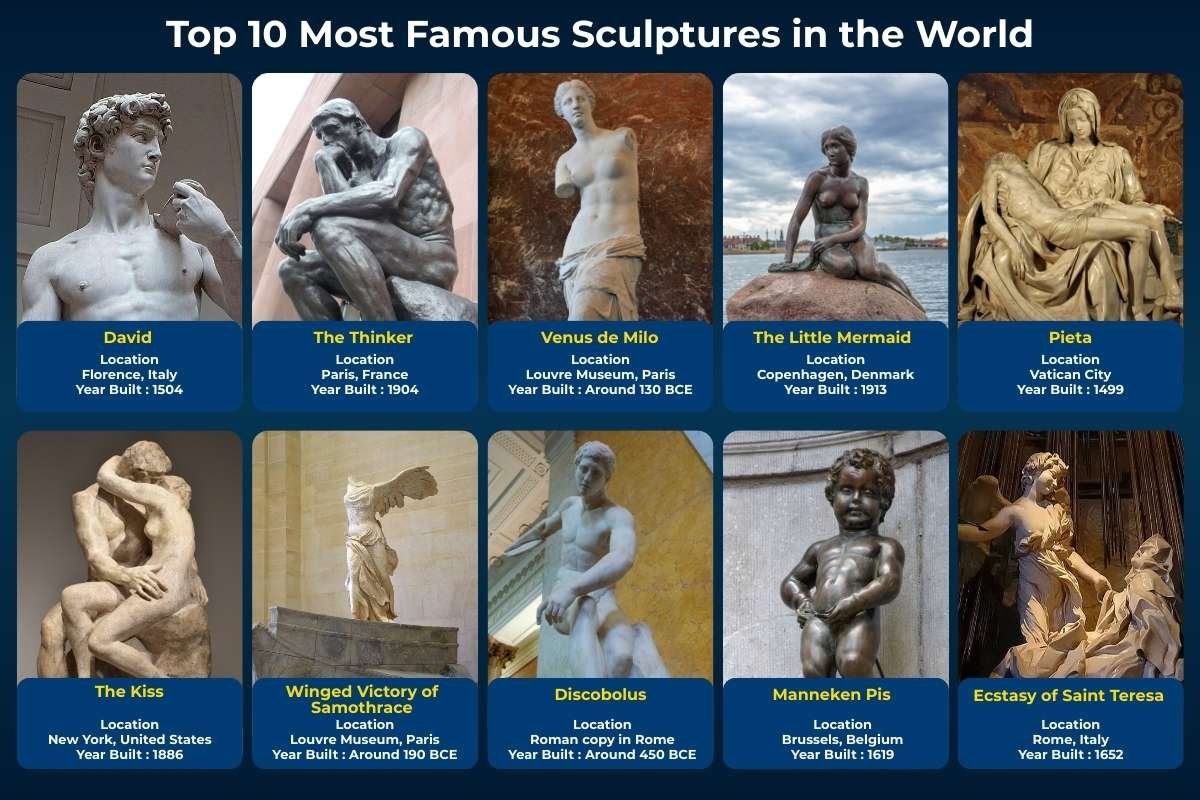
1. David
Location: Florence, Italy
Year Built: 1504
Material: Marble
Designed by: Michelangelo
David is one of the most famous sculptures in the world, ever created in the history of art. The statue represents David, the young hero from the Bible who defeated the giant warrior Goliath. Instead of showing the moment of victory, Michelangelo chose to capture the moment just before the battle begins. David stands calmly but looks focused and ready, showing courage and determination.
The sculpture stands more than 5 meters tall and was carved from a single block of white marble. Michelangelo carefully studied the human body so he could sculpt every muscle, vein, and detail with great accuracy. Because of this attention to detail, the statue looks incredibly realistic.
David’s posture, facial expression, and strong body show confidence and inner strength. During the Renaissance period, artists believed the human body represented beauty, balance, and perfection. Michelangelo’s David became a perfect example of these ideas.
Today, the original sculpture is displayed in the Accademia Gallery in Florence. Millions of visitors travel from around the world every year to admire this masterpiece.
Specialty: David is considered one of the greatest masterpieces of Renaissance art and one of the most admired sculptures in the world.
2. The Thinker
Location: Paris, France
Year Built: 1904
Material: Bronze
Designed by: Auguste Rodin
The Thinker is one of the most recognizable sculptures in modern art. The statue shows a man sitting on a rock with his elbow resting on his knee and his hand supporting his chin. His body appears tense and powerful, while his face shows deep concentration.
French sculptor Auguste Rodin created this figure as part of a larger artistic project called The Gates of Hell. The sculpture represented a poet thinking deeply about human life, suffering, and the meaning of existence. Over time, the figure became so famous that it began to stand alone as an independent sculpture.
Rodin paid great attention to the muscles and posture of the human body. Even though the figure is sitting still, the sculpture feels full of energy and movement. It shows the intense mental effort involved in deep thinking.
Today, several versions of The Thinker exist around the world, but the original sculpture is displayed at the Rodin Museum in Paris.
Specialty: The Thinker is admired for turning a simple moment of reflection into a powerful symbol of human intelligence and philosophical thought.
3. Venus de Milo
Location: Louvre Museum, Paris
Year Built: Around 130 BCE
Material: Marble
Designed by: Alexandros of Antioch
Venus de Milo is one of the most famous sculptures in the world from ancient Greece. The statue represents Aphrodite, the Greek goddess of love and beauty. Although the sculpture is missing both arms, it remains one of the most admired works of classical art.
The sculpture was discovered in 1820 on the Greek island of Milos. Archaeologists found it buried in pieces, but experts carefully restored the statue and brought it to France. Today it is displayed in the Louvre Museum in Paris.
The statue shows Aphrodite standing in a relaxed and graceful pose. The soft curves of the body and the flowing drapery of the clothing show the beauty and elegance that ancient Greek artists admired.
Even with its missing arms, Venus de Milo continues to represent the ideal of beauty in classical sculpture.
Specialty: Venus de Milo is widely considered one of the greatest surviving masterpieces of ancient Greek sculpture.
4. The Little Mermaid
Location: Copenhagen, Denmark
Year Built: 1913
Material: Bronze and granite
Designed by: Edvard Eriksen
The Little Mermaid is one of the most beloved sculptures in Denmark. It sits quietly on a rock along the waterfront in Copenhagen’s harbor. The statue shows a young mermaid gazing toward the sea as if dreaming about life beyond the ocean.
The sculpture was inspired by the famous fairy tale written by Hans Christian Andersen. In the story, a mermaid dreams of becoming human after falling in love with a prince.
Although the statue is relatively small, about 1.25 meters tall, it attracts millions of visitors every year. Tourists gather around the harbor to see this charming sculpture and take photographs.
The simple design and peaceful expression give the statue a calm and emotional feeling that
connects deeply with visitors.
Specialty: Despite its small size, The Little Mermaid has become Denmark’s most famous cultural landmark.
5. Pieta
Location: Vatican City
Year Built: 1499
Material: Marble
Designed by: Michelangelo
The Pietà is one of the most moving sculptures ever created. It shows the Virgin Mary holding the body of Jesus Christ after he was taken down from the cross. The scene captures a quiet moment of grief, love, and compassion.
Michelangelo carved this sculpture when he was only in his early twenties. Despite his young age, he demonstrated extraordinary artistic skill. The marble surface appears smooth and delicate, almost like real human skin.
Mary’s face looks calm and peaceful rather than overwhelmed by sorrow. This artistic choice reflects the idea of spiritual acceptance and faith. The flowing folds of Mary’s clothing also show Michelangelo’s incredible ability to carve detailed textures in stone.
Today, the Pietà is displayed in St. Peter’s Basilica in Vatican City and is protected behind glass to preserve it.
Specialty: The Pietà is considered one of the most emotional and beautifully crafted sculptures in the history of Christian art.
6. The Kiss
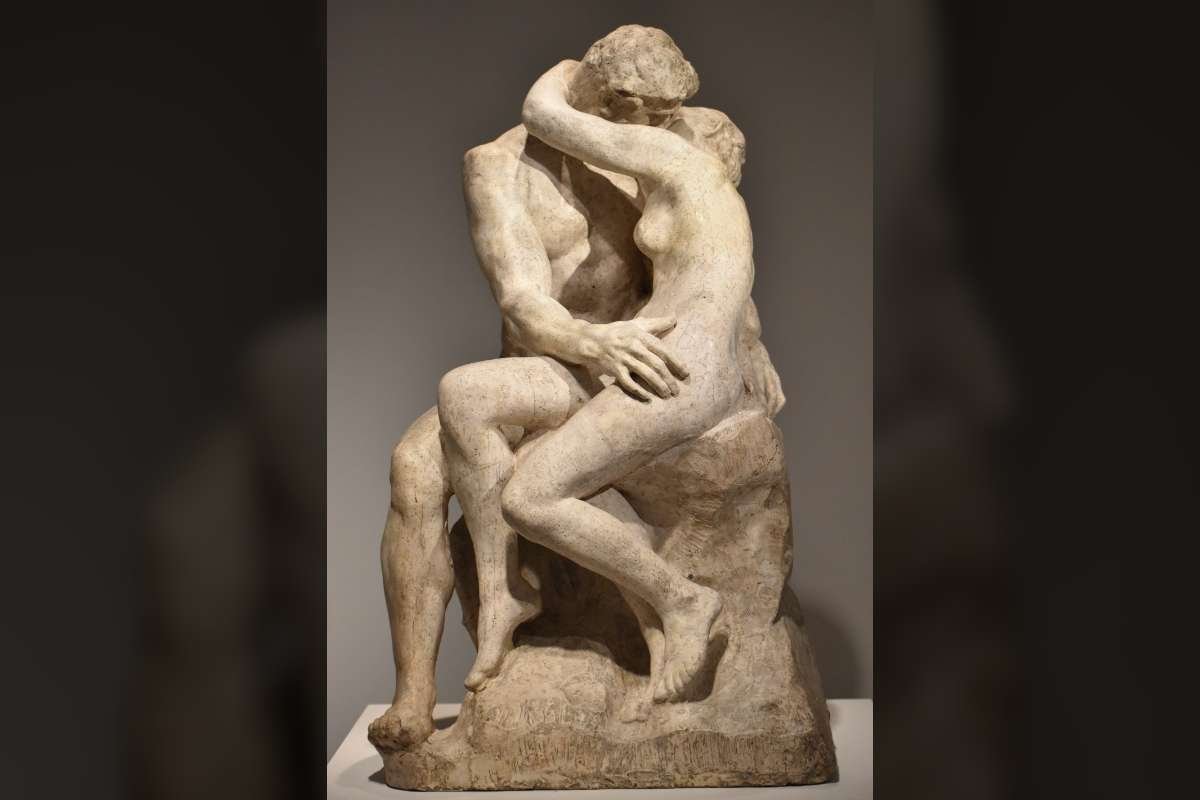
Location: Paris, France
Year Built: 1882
Material: Marble
Designed by: Auguste Rodin
The Kiss is one of the most famous romantic sculptures in art history. The sculpture shows a man and a woman sitting close together while sharing a deep and emotional kiss. Their bodies gently lean toward each other, creating a natural and intimate moment.
The sculpture was inspired by a tragic love story from the famous Italian literary work The Divine Comedy, written by Dante Alighieri. The lovers shown in the sculpture are Paolo and Francesca, two characters who fell in love even though Francesca was already married to another man.
Rodin carefully carved the marble to show the softness of human skin and the natural shape of the body. The couple’s posture looks relaxed and natural, which makes the sculpture feel alive and emotional. Their expressions and body language show affection, passion, and closeness.
The sculpture was originally meant to be part of Rodin’s larger project called The Gates of Hell, but it became so popular that it later gained fame as a separate masterpiece.
Specialty: The Kiss symbolizes love, passion, and human emotion. It is widely admired for its realistic detail and powerful expression of romantic connection.
7. Winged Victory of Samothrace
Location: Louvre Museum, Paris
Year Built: Around 190 BCE
Material: Marble
Designed by: Unknown Greek artist
The Winged Victory of Samothrace is one of the most celebrated and most famous sculptures in the world from ancient Greece. The statue represents Nike, the Greek goddess of victory. She is shown standing on the front of a ship, as if she has just landed after a great naval victory.
Even though the sculpture is missing its head and arms, it still looks incredibly powerful and dramatic. The wings spread behind the figure, and the flowing clothing appears to move in the wind. This creates a strong feeling of motion, as if the goddess has just arrived from the sky.
Ancient Greek sculptors were known for their ability to show movement and emotion in stone. In this sculpture, the thin marble fabric clings to the body, revealing the natural shape of the figure while still showing the effect of wind and motion.
The statue was discovered in 1863 on the Greek island of Samothrace and later moved to the Louvre Museum in Paris, where it became one of the museum’s most admired artworks.
Specialty: The Winged Victory of Samothrace is famous for its dramatic sense of movement and energy. Even without a head or arms, it remains one of the most powerful sculptures of ancient Greek art.
8. Discobolus
Location: Roman copy in Rome
Year Built: Around 450 BCE
Material: Marble (original bronze)
Designed by: Myron
Discobolus, which means “The Discus Thrower,” is one of the most famous athletic sculptures from ancient Greece. The sculpture shows a young athlete at the exact moment before he throws a discus in a sporting competition.
The figure’s body is twisted in a powerful position. One arm holds the discus behind him while the other balances his movement. This posture captures a moment of intense focus and physical strength.
The original sculpture created by Myron was made of bronze, but it no longer exists today. The versions that survive are Roman marble copies made centuries later. Even so, these copies still show the beauty and balance of the original design.
Ancient Greek artists believed the human body represented harmony, balance, and perfection. Discobolus reflects these ideas through its smooth lines, balanced pose, and ideal athletic form.
Specialty: The sculpture is admired for its perfect balance and sense of motion. It captures a single moment in sports with remarkable realism and artistic precision.
9. Manneken Pis
Location: Brussels, Belgium
Year Built: 1619
Material: Bronze
Designed by: Jerome Duquesnoy
Manneken Pis is a small bronze sculpture that has become one of the most famous landmarks in Belgium. The statue shows a young boy standing while urinating into a fountain basin.
Although the sculpture is small in size, it has a long history and strong cultural importance in Brussels. Over time, the statue became a symbol of the city’s playful spirit and independence.
There are many legends about how the statue was inspired. One popular story says that a young boy saved the city by urinating on a burning fuse that was about to explode and destroy the town.
Another story says the statue represents the humor and freedom of the people of Brussels.
The statue is also known for its tradition of dressing in different costumes during festivals and celebrations, which is one of the most famous sculptures in the world. The city owns hundreds of outfits for the statue, which are changed throughout the year.
Specialty: Manneken Pis is one of the most visited landmarks in Brussels. Despite its small size, it has become a beloved symbol of Belgian culture and humor.
10. Ecstasy of Saint Teresa
Location: Rome, Italy
Year Built: 1652
Material: Marble
Designed by: Gian Lorenzo Bernini
The Ecstasy of Saint Teresa is considered one of the most famous sculptures in the world and one of the greatest Baroque masterpieces. The sculpture shows a powerful spiritual moment experienced by Saint Teresa of Ávila, a Spanish nun and mystic.
According to her writings, Saint Teresa once had a vision in which an angel appeared and pierced her heart with a golden arrow. She described this moment as a deep spiritual experience that filled her with both pain and joy.
Bernini captured this moment with incredible detail and emotion. In the sculpture, Saint Teresa lies back with her eyes closed and her face showing a mixture of peace and wonder. The angel beside her gently holds the arrow that symbolizes the divine vision.
The sculpture is placed inside a chapel in Rome and surrounded by dramatic lighting and decorative architecture. Bernini designed the entire scene to feel like a theatrical stage, making the experience more powerful for viewers.
Specialty: The Ecstasy of Saint Teresa is considered one of the greatest sculptures of the Baroque period. It is famous for its dramatic emotion, realistic detail, and spiritual intensity.
Read Next:
- Inside the 15 Largest Temples in the World: Where Faith Meets Architectural Wonder
- Pyramids to Visit in Mexico That Will Change How You See History
Cultural Impact of Famous Statues
Across centuries, these monuments influenced art, travel, history, and national identity. Museum scholars, historians, and travelers often study the most famous statues in the world to understand how societies express beliefs, traditions, and cultural values through sculpture and monumental design.
Architects and art historians also examine famous statues in the world to study engineering methods, structural scale, and artistic style. Many of these iconic statues around the world required decades of planning, careful craftsmanship, and innovative building techniques. Some statues demanded unusual construction methods, especially when artists and engineers attempted to create giant statues and monumental sculptures that could stand the test of time.
Even today, the world’s famous statues and sculptures continue to appear as countries celebrate their leaders, culture, history, and spiritual traditions. These global landmarks and historical statues often become symbols of national pride and attract millions of visitors every year.
Conclusion
What makes a statue truly unforgettable? Is it the height, the design, or the story behind it?
The answer usually lies in the meaning people attach to it. The famous statues in the world are not just impressive structures built from stone, bronze, or steel. They are powerful symbols of ideas that shaped civilizations and cultures throughout history.
Some iconic statues around the world honor great leaders, while others represent faith, freedom, courage, unity, and national identity. Over time, these world-famous statues and sculptures become more than works of art. They turn into cultural landmarks that define cities and inspire generations.
Travelers visit these historic monuments and famous statues with curiosity, historians study them to understand human civilization, and artists admire the creativity and craftsmanship behind them. The most famous statues in the world remind us that human imagination has always aimed higher.
From ancient carvings to modern engineering marvels, these legendary statues and monumental sculptures show what people can achieve when vision meets determination.
Long after the builders are gone, the stories carved into these monuments continue to stand tall and speak to the world.