The quantum technology industry is moving from a research-driven frontier toward a market where commercial readiness, enterprise adoption, and disciplined execution decide who wins. As the technology progresses, a different leadership challenge is emerging: how do you prepare for a market whose full commercial potential has not yet arrived, when the decisions that determine your position in it are already being made? For Gregg Carman, Global Operating Executive in Quantum, the answer starts from an uncomfortable premise. The race has already begun, and many companies have not yet recognized that the starting line is behind them.
With more than three decades of leadership experience spanning B2B technology consulting, hardware, enterprise software, artificial intelligence, and quantum technology, he has developed a perspective shaped by two very different environments. His earlier career was spent inside established technology companies where markets, customers, and commercial playbooks already existed. His later work in deep tech, as a revenue and commercial leader at Zapata Quantum, Nuvolo Technologies, Humanyze, C3.ai, and as General Manager for North America at Qblox, required him to operate without those same certainties.
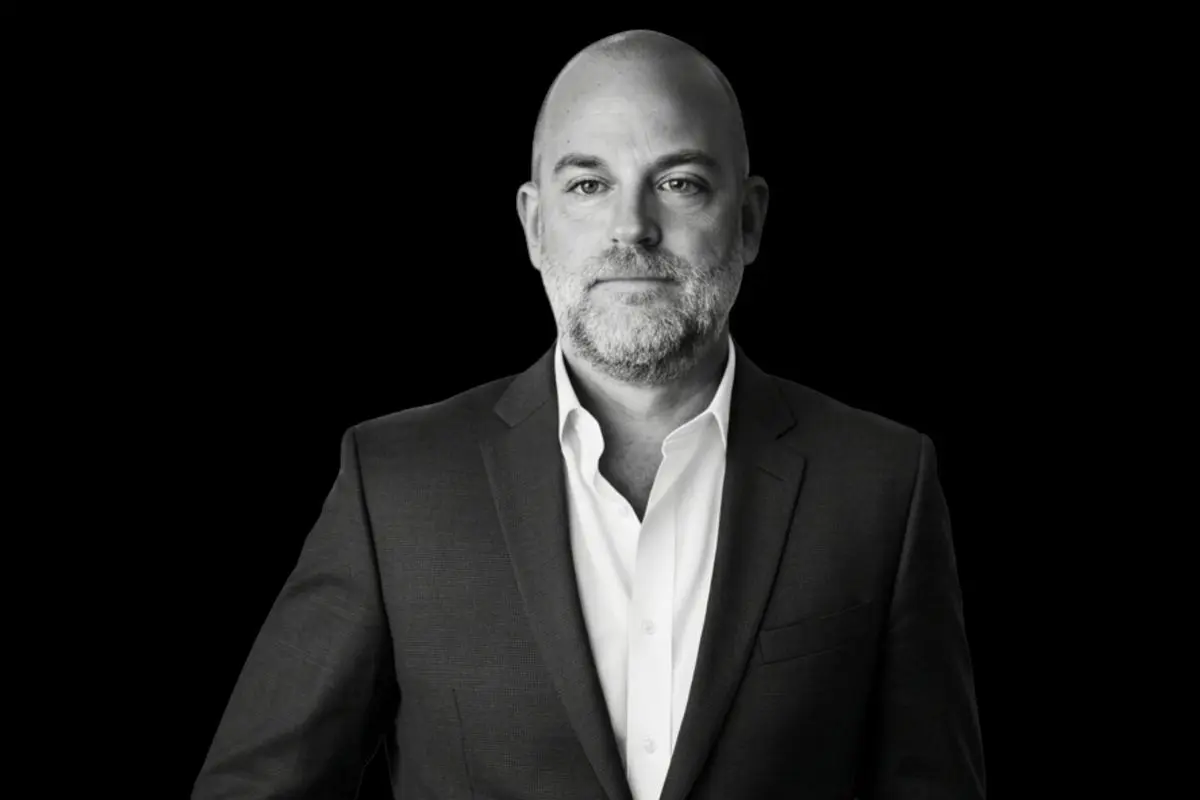
Leadership When There Is No Playbook
Gregg Carman’s leadership perspective has been shaped by a transition from established technology markets to the emerging world of deep tech. Much of his career at Siebel, Oracle, and SAP involved operating within markets that already existed, where leadership meant executing a proven playbook faster and more effectively than the competition.
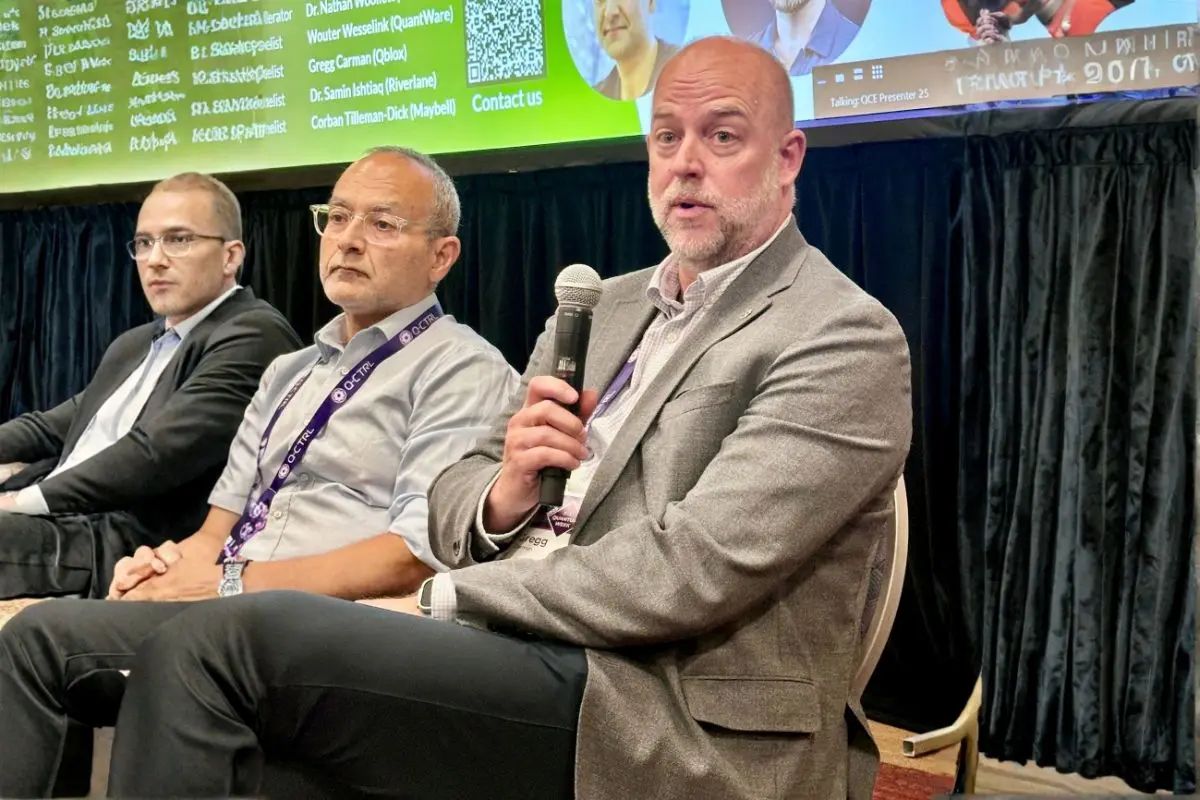
Deep tech changed that approach. While building Qblox’s North American region, he encountered a market that was developing alongside the technology itself. There was no established commercial playbook to follow. Instead, leadership required helping build the market while creating the commercial foundation needed to support growth. Under his leadership, Qblox’s North America region grew to more than half of global company revenue, becoming the company’s largest and fastest-growing region.
That experience continues to shape his work as an operating executive and advisor. Leadership in quantum technology, in his view, is not primarily about selling technology. It is about constructing the commercial infrastructure a still-forming market does not yet have. His priority with every organization he leads or advises is to make it “Quantum-GTM-Ready” before commercial demand fully arrives, rather than attempting to assemble that capability after the opportunity has already been claimed.
The Commercial Gap in Quantum
Across the quantum ecosystem, Gregg sees a consistent pattern: strong technology alongside an underdeveloped commercial motion. Many organizations have built their credibility through government relationships, grants, and academic achievements, but have yet to develop the parallel narrative that enterprise customers and investors need. The gap is addressable, but it is not quick. Commercial readiness has the longest lead time of the three disciplines a quantum company has to mature, because technical fluency cannot be bought in a quarter. That is precisely why the work has to begin before the technology is finished.
His focus is on building a repeatable commercial engine through sharper messaging, named account targeting, pricing logic, partner ecosystems, and a defensible value proposition during the Pre-Order Window. The arithmetic behind that window is straightforward. Enterprise and government buying cycles run 12 to 18 months ahead of delivery, and the commercial motion that feeds them- seek, nurture, win, build, deliver- takes another eighteen to twenty-four.
Against a 2028 shipment, the window opens in early 2027, which means it is being built now or it is not being built at all. He points to AI’s 2022 inflection point as the clearest lesson available: the winners since ChatGPT v3.5 was released in the Fall of 2022 were not always the companies with the best model; they were the companies that were already go-to-market ready in the autumn of 2022.
That work has a structure behind it. Carman scores commercial readiness across six dimensions- product and technical, market, commercial team, messaging, pipeline, and partner and channel- on a single one-to-nine scale with written evidence behind every score. Most quantum companies, including well-funded ones, land in the three-to-four band, where the fragments exist, and none of them connect. The value, he argues, is not the number. It is the evidence-based foundation a leadership team needs before it decides anything else.
The Pre-Order Advantage
Gregg sees quantum technology approaching a significant commercial inflection point, with market growth, investment, and policy signals aligning. QED-C’s 2026 State of the Global Quantum Industry report places the market at $1.9 billion as of year-end 2025, growing roughly 30% annually. New government funding rose 310% year over year to $12.7 billion, while private venture capital nearly tripled, up 192%, to $4.9 billion.
Later-stage venture grew 320% on only six additional deals, which means capital is concentrating rather than spreading. National security timelines are converging on the same band. NSA CNSA 2.0 requires quantum-resistant algorithms for US National Security Systems from 1 January 2027; France’s ANSSI and Switzerland’s FINMA both target 2027, the UK NCSC sets 2028, and US federal deadlines run to 2030 for key establishment and 2031 for digital signatures.
These developments point to one critical requirement: readiness. Enterprises need to become quantum-ready, while technology organizations must achieve what he calls “Quantum-GTM-Readiness.” His “Pre-Order Window” describes the period when early commitment can create disproportionate advantage before commercial demand fully arrives. He draws a parallel with AI, where organizations that prepared their data, talent, and leadership early were better positioned to capture value.
The asymmetry matters more than the forecast. Building a commercial organization too early is painful, visible on the P&L, and fixable in two quarters by cutting. Building it too late surfaces in 2029, once the reference accounts have been taken, the design-in windows have closed, and the consortium participant lists have been published. Boards optimize against the failure they can see, which is why he expects this sector to be systematically late rather than early. Too early is recoverable. Too late is not.
Yet the buyer side remains underprepared. In IQM’s State of Quantum 2026, research by The Quantum Insider scored 107 enterprise organizations at 58 out of 100 on its Quantum Readiness Index, a “Developing” rating meaning they have moved past awareness but are not ready for scaled adoption. Gregg reads that as a supply-side problem as much as a demand-side one. A market of Developing buyers is a market that has to be built-to rather than sold-to, and quantum’s next phase will therefore depend not only on technical breakthroughs, but on closing the gap between technological progress and commercial preparedness.
The Hybrid Advantage
Gregg sees the near-term opportunity at the intersection of quantum computing and artificial intelligence not as a replacement for classical AI, but through hybrid quantum-HPC architectures integrated into existing workflows addressing narrow, high-value problems. The strongest opportunities, in his view, will emerge in pharmaceuticals, materials science, logistics, finance, and energy, where a better answer delivered faster can create significant business value. His positioning rule follows directly from that: accelerate today, optimize later. A pitch built on fault tolerance asks the buyer to underwrite your timeline. A pitch built on acceleration asks the buyer to evaluate a result, and only one of those survives a procurement committee.
Gregg points to developments such as IBM’s planned 2027 computation libraries, which are designed to abstract quantum subroutines for hybrid integration. He sees this as significant because it could lower the barrier for enterprise teams to benefit from quantum capabilities without requiring them to become quantum experts.
Moving beyond experimentation requires a change in how businesses deploy quantum technology. Rather than treating quantum as an isolated pilot, organizations should connect it to a specific KPI within an existing classical AI or HPC workflow. His test for practical value is simple: if a quantum component cannot be tied to a number the business already tracks, it risks remaining a science project. For him, connecting quantum capabilities to measurable business outcomes is what can transform experimentation into meaningful enterprise value.
He is equally direct about who is actually writing checks. Five buyer types exist in quantum today: sovereign programmes, national laboratories and HPC centres, regulated security buyers working to post-quantum cryptography mandates, R&D functions in pharmaceuticals, materials and energy, and operating budget owners. Only the last of those requires quantum advantage to exist. Four funded buyers are available right now, and in his experience, most quantum go-to-market plans are built entirely for the fifth. His advice is to build your GTM and commercial motions for use-cases attached to a metric a budget owner already tracks and to focus on the four funded buyer categories.
The Art of Translation
For Gregg, translation is the actual job. His enterprise software career at Oracle, SAP, Siebel, and C3.ai taught him rigorous sales and customer engagement discipline, which he later applied to deep technology without an established go-to-market playbook. Quantum changes what that discipline requires, because the buyer is frequently a physicist.
“They can tell in a minute whether you understand what they’re building or not.” Technical fluency, in his framing, is the entry requirement rather than the advantage, and it cannot be assembled after the hardware is finished. At Qblox, this meant taking a highly technical quantum control and readout platform and building the commercial narrative, account targeting, and regional GTM function needed to resonate with national laboratories and quantum hardware companies scaling toward larger qubit counts.
That work also produced the commercial partnership announced by the U.S. Department of Energy in November 2025, under which Qblox coordinates manufacturing, distribution, and support for QICK, the quantum control platform developed at Fermilab and the most widely deployed open-source system of its kind. Today, he applies the same approach in his advisory work, translating advanced optical-sensing capabilities into commercial value propositions for energy-sector customers exploring carbon capture and geothermal applications.
From Proven Playbooks to Building the Market
Gregg’s leadership journey reflects a shift from established enterprise technology markets to an emerging deep-tech ecosystem where the rules are still being written. His transition from executing proven commercial models to creating market readiness around quantum technology has reshaped how he approaches growth, ambiguity, partnerships, and enterprise value.

Before Leadership Journey:
Enterprise software career (Oracle, SAP, Siebel, C3.ai)
- Executing established playbooks in mature markets
- Predictable quarterly sales cadence
- Success measured against a known market
After Leadership Journey:
- Building categories and markets from zero
- Founder/advisor mindset across the quantum ecosystem
- Translating unproven science into enterprise value
- Longer time horizons, higher ambiguity, higher upside
- Drop the scientific jargon and develop messaging using everyday language that the buyers can get behind.
- Design GTM and commercial motions tailor-made for the science and anticipated engineering milestone breakthroughs
Designing Partnerships Around Different Incentives
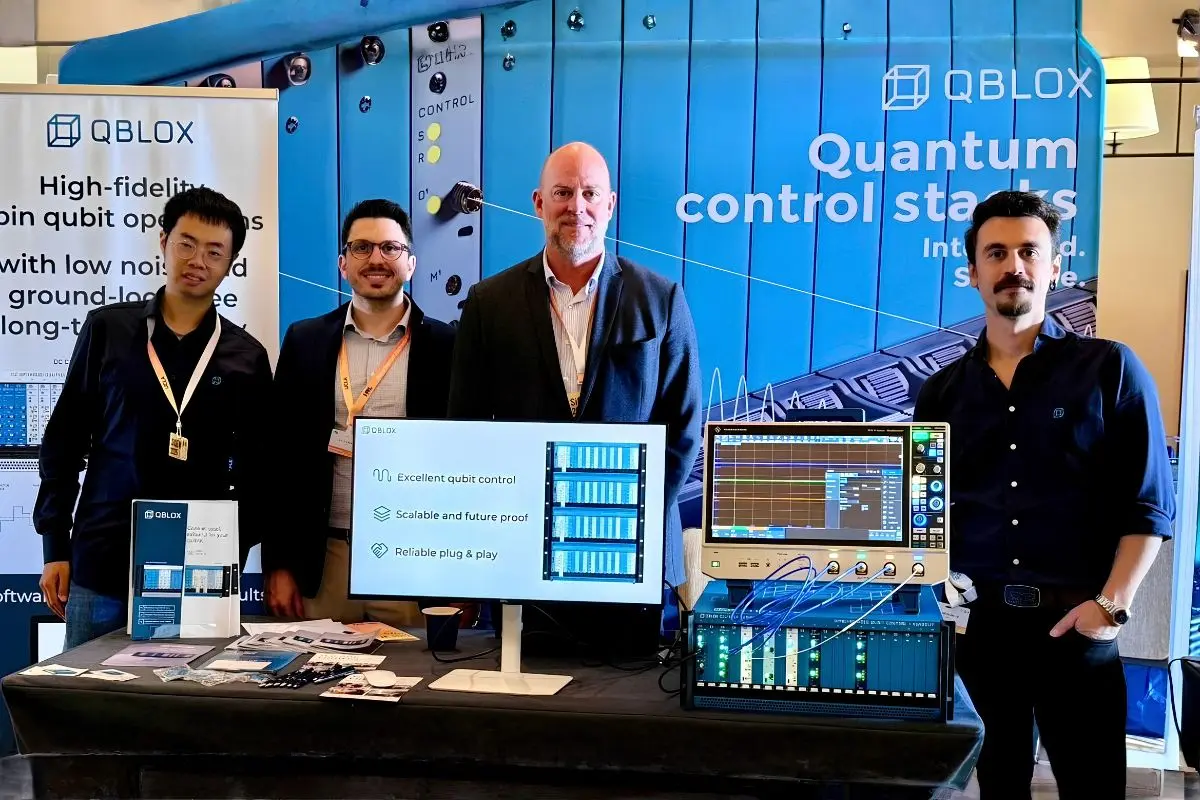
Successful collaboration in quantum requires a more nuanced understanding of partnerships. The ecosystem encompasses multiple categories, including technology partners, learning partners, system integrators, hyperscalers, geographically concentrated ecosystems, and turnkey collaboratives. Each plays a different role in helping quantum technology move from R&D toward engineering maturity to practical adoption.
The challenge is that these organizations do not operate according to the same incentives. A university laboratory may measure success through publications and research progress. A hyperscaler may focus on technology consumption. A system integrator may need a certified, low-risk solution before it can confidently take an offering to enterprise customers.
Gregg believes partnerships fail when organizations pretend these different stakeholders are pursuing identical outcomes. They succeed when those differences are explicitly understood, and someone creates the connective tissue between them. That connective role can carry an innovation from research into commercial application and, importantly, allow commercial requirements to feed back into research and technology development.
This translation between different parts of the ecosystem is an underdeveloped but important leadership function and one that has been proven time and again in the semiconductor industry. It is also one of the areas where strategic advisory work can create value: helping organizations understand not only who they should partner with, but why that partnership should exist and how its participants can create value together.
Preparing for Quantum’s AI-2022 Moment
Gregg sees quantum approaching its own AI-2022 moment, where the companies that prepare early will be positioned to capture the wave rather than react to it. His experience with AI taught him that the eventual winners were not simply those with the best models, but those that had already built AI-ready infrastructure and AI-aware talent before the payoff became obvious. He believes quantum will follow a similar trajectory, with success determined by how early companies become Quantum-GTM-Ready.
QED-C’s workforce data already reflects this shift. Operations has moved from the fifth most common role to the second, while business development now ranks third, indicating that quantum companies are building commercial capabilities ahead of mainstream demand. Looking toward the next three to five years, he expects the strongest companies to verticalize around areas with provable near-term value, including pharmaceuticals, materials, logistics, finance, automotive & advanced manufacturing, and energy. He also sees hybrid quantum-classical integration becoming important, with quantum capabilities embedded into existing enterprise workflows rather than positioned as standalone platforms.
The winners will be those that build infrastructure and talent ahead of the wave, creating readiness on the supply side while enterprises prepare to take advantage of it on the demand side.
Credibility in an Uncertain Market
Gregg’s leadership philosophy is anchored by what he calls the Pioneer’s Credibility Paradox. In emerging technology, he believes the leaders who earn the greatest trust are often those willing to be candid about what is not ready yet. The principle is especially relevant to an industry where ambitious technical claims can easily dominate conversations. Candid, intellectual honesty creates the credibility required to make bold claims about areas where genuine value already exists and that this leads to an optimal collaborative relationship. His broader decision-making framework is equally practical and enables leadership teams to adopt an evidence-based culture and cadence.
Build commercial infrastructure ahead of demand, surround organizations with exceptional people, and aim for business acceleration, with rapid, fact-based decisions rather than waiting indefinitely for perfect information. Market-building should be treated as a distinct discipline from product-building. The two require different capabilities, different timelines, and different measures of progress. For leaders operating in uncertain markets, this distinction can be crucial. Product development may focus on proving what a technology can do. Market development must determine who needs it, why they need it, how they will buy it, and what ecosystem is required to deliver it. Combine technical respect with commercial realism, and places credibility at the center of both.
Readiness as the Real Five-Year Agenda
Looking toward the next five years, a critical success for business leaders and policymakers is “readiness.” Do not dismiss technological breakthroughs. Instead, consider their eventual impact will depend heavily on whether organizations are prepared to use them; the demand side of the equation. He identifies three areas where readiness will increasingly converge.
The first is enterprise readiness: organizations need to understand how to structure problems and data for eventual hybrid workflows. The second is workforce readiness. Quantum awareness, in his view, should eventually extend beyond specialized technical roles, much as AI awareness has become relevant across functions. The third is security readiness, particularly around post-quantum cryptography mitigation as part of a broader cybersecurity posture.
Importantly, none of these preparations requires quantum technology to be fully mature. That is precisely the point. He believes businesses should approach quantum readiness as infrastructure investment rather than a reaction to a specific technological milestone. The exact timing of quantum’s commercial acceleration may remain uncertain, but the organizational capabilities built in anticipation can create value regardless of when the inflection point occurs. For investors, this means looking beyond technical roadmaps toward teams building commercial readiness today. For policymakers, it means recognizing that demand-side preparedness can be as important as technological capability.
An Open Letter to Those Preparing for the Quantum Wave
Dear Future Leaders,
Get ready before the wave arrives, not after. We watched this play out with AI. The people and companies that won weren’t the ones who waited for certainty; they were the ones who built readiness early through skills, infrastructure, and the ability to communicate technology beyond their field.
Quantum is earlier on that same curve right now. This is the moment to become quantum-aware, even if you’re not a physicist, and to build the discipline to translate deep technical work into something a customer, investor, or policymaker can act on. Be honest about what isn’t ready yet. That honesty earns the credibility to be believed about what is.
Treat the ability to move fluently between a technical room and a commercial one as the core skill, not a soft skill on the side, but the thing that can define your career. I’d be willing to bet that the leaders who shape quantum’s future won’t be the ones who called the breakthrough first. They’ll be the ones who were ready for it.
Build the commercial function before the technology forces you to.
With confidence in what’s ahead,
Gregg Carman
Global Operating Executive in Quantum
Building the Market Before the Breakthrough
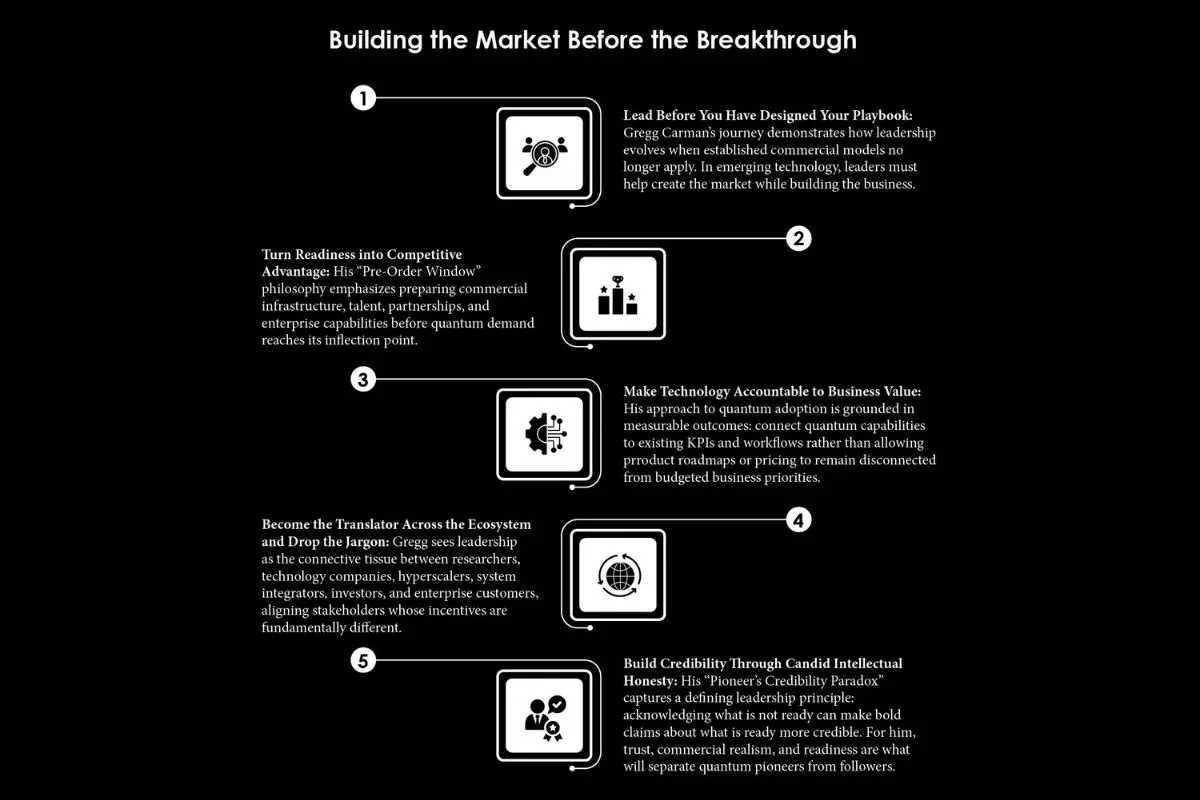
- Lead Before You Have Designed Your Playbook: Gregg Carman’s journey demonstrates how leadership evolves when established commercial models no longer apply. In emerging technology, leaders must help create the market while building the business.
- Turn Readiness into Competitive Advantage: His “Pre-Order Window” philosophy emphasizes preparing commercial infrastructure, talent, partnerships, and enterprise capabilities before quantum demand reaches its inflection point.
- Make Technology Accountable to Business Value: His approach to quantum adoption is grounded in measurable outcomes: connect quantum capabilities to existing KPIs and workflows rather than allowing prroduct roadmaps or pricing to remain disconnected from budgeted business priorities.
- Become the Translator Across the Ecosystem and Drop the Jargon: Gregg sees leadership as the connective tissue between researchers, technology companies, hyperscalers, system integrators, investors, and enterprise customers, aligning stakeholders whose incentives are fundamentally different.
- Build Credibility Through Candid Intellectual Honesty: His “Pioneer’s Credibility Paradox” captures a defining leadership principle: acknowledging what is not ready can make bold claims about what is ready more credible. For him, trust, commercial realism, and readiness are what will separate quantum pioneers from followers.