
Starting a business is easy to describe but much harder to do. You need to know what to sell, who will buy it, how much to spend, when to hire, and when to change direction.
That is where guidance for entrepreneurship becomes useful. Good advice should help you make better decisions, not simply tell you to work harder.
In 2026, entrepreneurs also have more technology, data, and tools at their disposal. But a useful business still starts with a real problem, paying customers, sound finances, and strong leadership.
7 Essential Principles That Entrepreneurs Miss Out On The Most
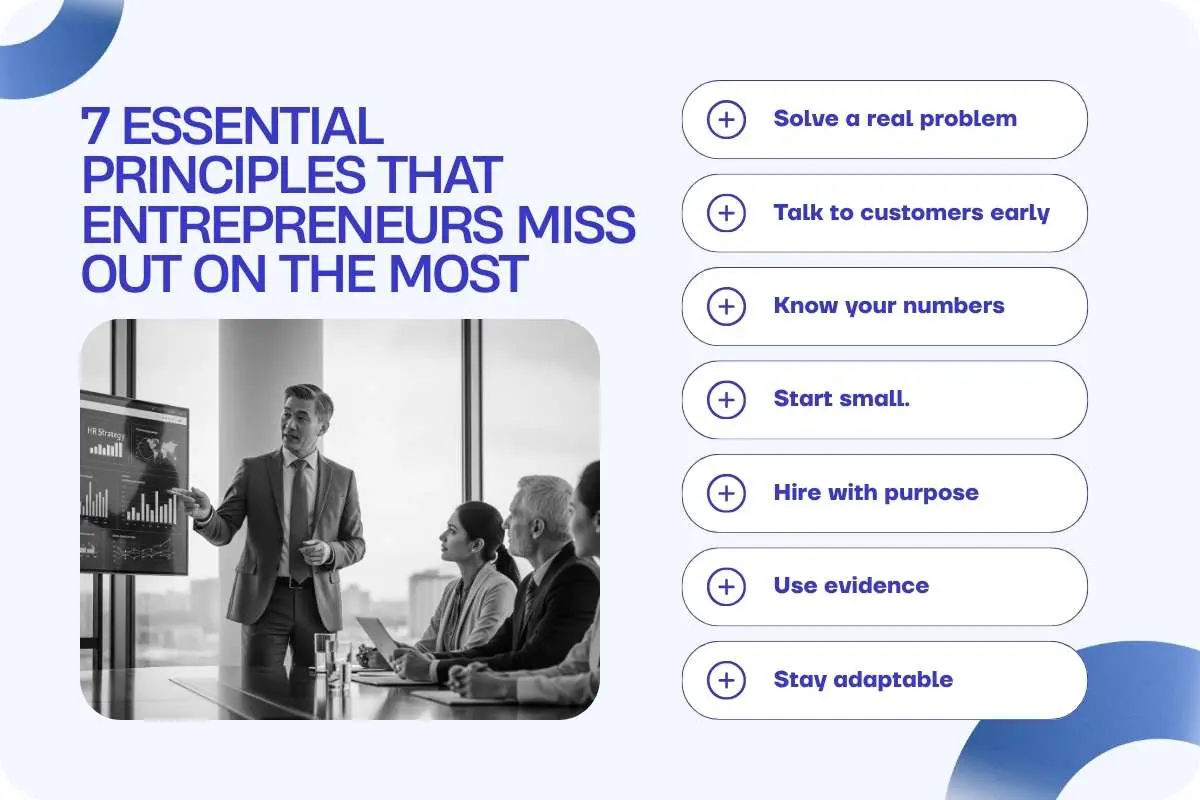
The most useful guidance for entrepreneurship can be reduced to seven practical principles:
- Solve a real problem. A clever idea is not enough if customers do not need it.
- Talk to customers early. Test assumptions before spending heavily.
- Know your numbers. Track sales, costs, margins, and cash flow.
- Start small. A simple test can prevent a costly mistake.
- Hire with purpose. Define the work before hiring for it.
- Use evidence. Instinct matters, but facts should guide major decisions.
- Stay adaptable. A failed approach does not mean the business has failed.
These principles matter because starting a company and building one that lasts are different challenges. The latest Global Entrepreneurship Monitor report covers 53 economies and highlights the difficulty of moving from early-stage activity to established businesses.
How Do You Turn an Idea Into a Business?
A good idea is only a starting point. The real test is simple: will people pay for it?
Before building anything big, speak with potential customers. Ask what they use now, what frustrates them, and what they would pay to improve. Then look at competitors to see where customers are still being underserved.
A simple way to test an idea is:
| Step | What to ask | Example |
| Find the problem | What frustrates customers? | People want quick, affordable fitness plans |
| Check demand | Are people already paying for a solution? | Look at competing fitness programs |
| Test the idea | Will people pay for your version? | Sell a four-week program |
| Learn and improve | What did customers like or dislike? | Use feedback to improve the program |
This is where guidance for entrepreneurship can save you from an expensive mistake: building for months before checking whether anyone wants the product.
The goal is not to prove that your first idea is perfect. It is to get enough real feedback to decide whether to build, change, or drop it.
Test first. Build bigger when the evidence supports it.
What Should Entrepreneurs Know About Money?
A business can have sales and still run out of cash.
Before spending money, know your regular costs, expected income, pricing, and cash position. Keep business and personal finances separate and avoid large expenses until you have evidence that demand exists.
You also need to understand risk. Think about what could hurt the business, from weak demand to supplier problems, staff shortages, or rising costs.
Good guidance for entrepreneurship does not mean avoiding every risk. It means knowing which risks you are taking and having a plan for them.
Which Entrepreneurship Skills Matter Most in 2026?

Entrepreneurs need more than confidence and a good idea. They need business judgment, people skills, and enough technology knowledge to make smart choices.
The World Economic Forum’s Future of Jobs Report 2025 found that analytical thinking was a core skill for 69% of employers surveyed. Leadership and social influence ranked at 61%, while technological literacy ranked at 51%.
Important skills for 2026 include:
- Analytical thinking
- Sales and negotiation
- Financial management
- Leadership
- Communication
- Customer research
- Technology literacy
- AI awareness
- Problem-solving
- Adaptability
You do not need to master all of them. Focus on the skills your business needs most. That is a more useful approach to guidance for entrepreneurship than trying to become an expert at everything.
How Can Entrepreneurs Become Better Leaders?
A founder can do almost everything in the early days. But as the business grows, that stops being realistic. Your job slowly shifts from doing the work to helping other people do it well.
Start with clarity. Your team should know:
- What they are responsible for
- What needs to get done
- When it needs to be done
- Why the work matters
Then listen. The employee handling customer complaints may spot a problem before you do. Someone managing daily operations may know exactly where time and money are being wasted.
Good leadership also shows when things go wrong. A missed target or unhappy customer does not always mean someone needs to be blamed. Look at what caused the problem, fix it, and make the next process better.
The World Economic Forum continues to rank leadership and social influence among the important skills businesses need. For entrepreneurs, that makes guidance for entrepreneurship about more than starting a company. It also means learning how to bring people with you as the business grows.
How Should Entrepreneurs Build a Strong Team?

More employees do not automatically mean a stronger business. The right people, in the right roles, matter more than a bigger headcount.
Before hiring, ask:
- What work needs to be done?
- What skills does it require?
- Does this need a full-time employee or a specialist?
- What result should this person own?
Once someone joins, give them clear responsibilities and enough freedom to do the job. If every small decision still needs the founder’s approval, the team cannot move quickly.
Delegation is a big part of guidance for entrepreneurship. Hand over ownership, not just tasks. Let people make reasonable decisions, review the results, and give clear feedback when something needs to improve.
A strong team should not have to wait for the founder to solve every problem. The goal is to build people who can think, act, and take responsibility on their own.
A Simple Framework for Entrepreneurial Growth
Use three questions when making an important business decision:
- What should I do?
Choose the next practical action. - Why does it matter?
Connect it to a customer, financial, team, or operational goal. - What will I measure?
Decide what result will tell you whether it worked.
| What to do | Why it matters | Example |
| Identify the problem | Creates a clear purpose | Interview potential customers |
| Test the idea | Reduces risk | Sell a small version |
| Track results | Shows what works | Review sales and costs |
| Improve | Makes the offer stronger | Fix repeated customer complaints |
| Delegate | Creates capacity | Give someone ownership of a process |
| Review | Prevents wasted effort | Compare results with the goal |
This turns guidance for entrepreneurship into a process you can use instead of a list of ideas you read once and forget.
How Should Entrepreneurs Handle Failure and Change?
Business plans change. Customers leave, costs rise, competitors appear, and new technology can change an industry.
When something fails, ask why before deciding what to do next.
Was the market too small? Was the price wrong? Was the product difficult to use? Did you target the wrong customer?
The 2025/2026 Global Entrepreneurship Monitor report also highlights the growing importance of technology and AI readiness for entrepreneurs. The lesson is not to chase every new tool. It is to understand changes that could affect your customers and business.
Good guidance for entrepreneurship means staying flexible without changing direction every time a new trend appears.
How Can Entrepreneurs Prepare for Growth?

Growth can expose weaknesses.
Before taking on more customers, check whether your processes, team, finances, and customer service can handle the extra work.
Technology can help with repetitive tasks, reporting, customer information, and communication. But do not buy a tool simply because competitors use it. Identify the problem first and choose the tool second.
Long-term growth depends on building systems that work without the founder controlling every detail. That is an important part of guidance for entrepreneurship that is often missed.
Conclusion
Successful entrepreneurship is not about having every answer from day one.
It is about asking better questions, testing ideas, understanding customers, watching the numbers, and building people who can help carry the business forward.
The best guidance for entrepreneurship gives you a way to make those decisions with more clarity. Start small, learn quickly, lead well, and change direction when the evidence says you should.
FAQs About Guidance for Entrepreneurship
1. What is the best advice for a new entrepreneur?
Start with a real customer problem, test your idea on a small scale, control your costs, and learn from customer feedback.
2. Which skills should entrepreneurs learn in 2026?
Analytical thinking, sales, financial management, communication, leadership, technology literacy, problem-solving, and adaptability are especially useful.
3. Why is leadership important for entrepreneurs?
A founder can handle many tasks alone at first. Growth requires other people to take ownership and make decisions.
4. Should every entrepreneur use AI?
No. AI is useful when it solves a real problem, but its output still needs human judgment and review.
5. How can entrepreneurs reduce risk?
Test ideas before making large investments, understand customer demand, track cash flow, and prepare for likely problems.
6. What should an entrepreneur do after failure?
Find the cause before changing the whole business. Look at demand, pricing, product quality, sales, and costs.