Key Points:
- U.S. allows H200 exports with revenue share
- Nvidia stock rises on policy shift
- Concerns over China’s AI boost
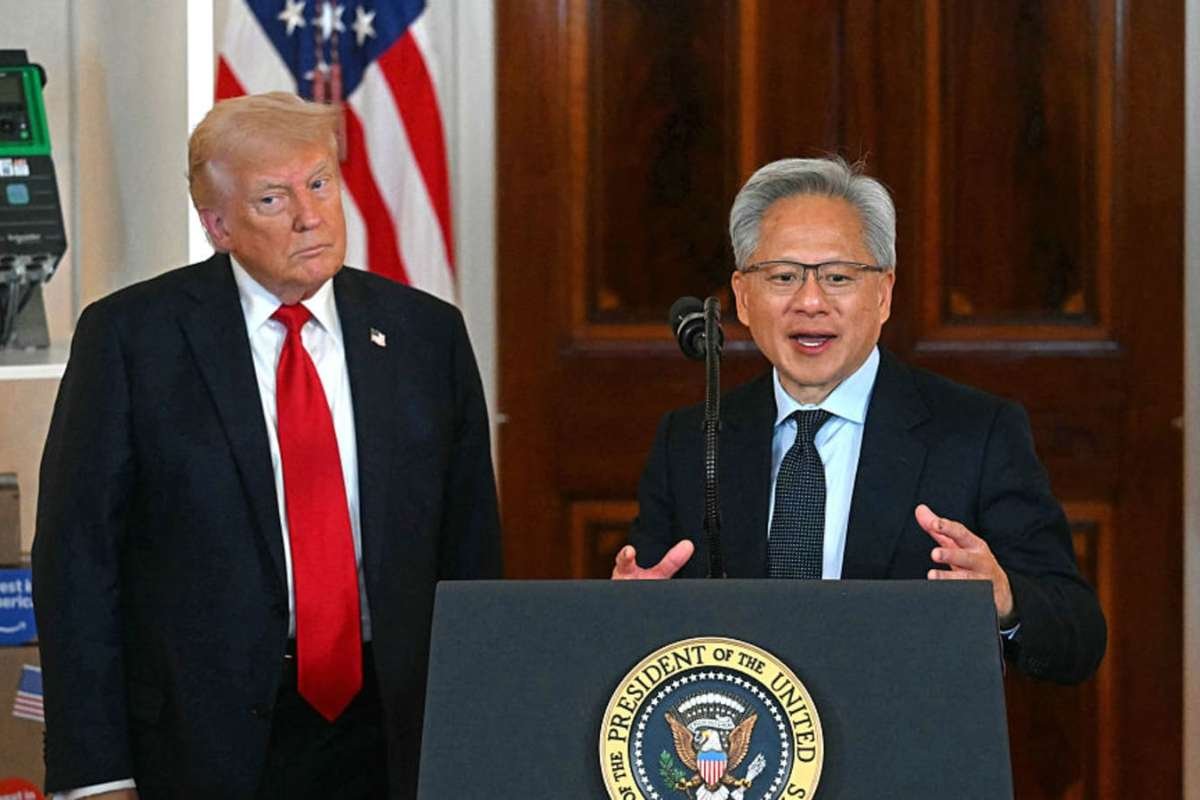
The United States has approved the export of Nvidia’s H200 AI Chips to selected customers in China, a significant reversal of prior restrictions aimed at limiting Beijing’s access to advanced computing hardware. Donald Trump confirmed the move, stating that the U.S. government will receive a 25 percent share of all revenues arising from these sales. The arrangement applies only to “approved customers,” and all shipments must pass through vetting by the U.S. Department of Commerce before final approval.
Nvidia’s H200 AI Chips sit below the highest-end “Blackwell” line, which remains banned. Still, H200 is significantly more powerful than the previous generation allowed for China (the stripped-down H20), representing a middle ground between full embargo and open sale.
The decision marks a recalibration of U.S. export policy, balancing economic and industrial interests with national-security oversight. The administration has framed it as a win for American manufacturing, taxpayers, and global competitiveness.
Market Reaction and Industry Implications
Following the announcement, Nvidia’s share price rose about two percent in after-hours trading. The approval could reopen limited access for Nvidia to the Chinese market, a region that had seen a sharp reduction in purchases following earlier export curbs.
Despite the commercial opportunity, the policy draws scrutiny over potential strategic risks. Critics warn that even a mid-tier chip like the H200 could significantly bolster China’s capabilities in large-scale AI deployments, including surveillance and other sensitive applications.
Some in Congress remain unconvinced, arguing the move undermines long-standing efforts across administrations to limit China’s access to cutting-edge semiconductors.
A New Chapter in US–China Tech Competition
This development signals a turning point in the ongoing chip-export standoff between Washington and Beijing. Since 2022, U.S. export controls have sharply restricted access to Nvidia’s most powerful AI chip, a move aimed at preserving U.S. technological edges and curbing China’s military and surveillance ambitions. H200 exports had previously been prohibited.
The approval of Nvidia’s H200 AI Chips sales under tightly controlled conditions suggests a strategic pivot: rather than blanket bans, the U.S. appears to be adopting a calibrated “revenue-sharing and vetting” model. If successful, this could become a template for how advanced-technology exports to China, including those from other firms such as AMD or Intel, are handled in the future.
That said, the response from Beijing remains uncertain. Chinese firms had recently been discouraged from buying even the earlier H200 AI Chips, and domestic chipmakers with strong state support have been ramping up alternatives.
Even with U.S. approval, significant uptake in China is not guaranteed; local political, economic, and technological factors may limit adoption. But regardless of whether Chinese firms rush to purchase H200 chips, the policy change reshapes the landscape of global semiconductor competition and underscores how the U.S. plans to reconcile economic interests with strategic caution in an era increasingly defined by AI.