What does the expression ‘hardest sport in the world’ truly refer to? This is not an easy question to answer. Because ‘hard’ can be looked through extreme physical endurance and extreme mental toughness. Or the extreme technicality of the sport. From the savageness of combat sports to the disciplined beauty of gymnastics. This always takes athlete straight to their limits, just in their own ways.
There is no single champion; there is a set of sports. They collectively represent the species’ peak competitive ability. This post evaluates the leading contenders, evaluating metrics of physical and mental health. I will spend some time assessing the leading athletes. They are pushing themselves to the brink of competitive achievement.
Defining What Hardness is in the Sport?
“Hardness” in sport refers to how a discipline challenges the human body and mind. As sources note, the hardest sports test every part of both. Physical demand covers endurance, strength, and agility. Think about marathon running, weightlifting, or gymnastics. Mental toughness involves decision-making, focus, and resilience under pressure. It can be seen in sports like tennis or boxing.
Injury risk and contact intensity add another layer, as in football or hockey. This is where physical collisions and recovery thresholds define toughness. Finally, technical skills require precision, timing, and coordination. This sets apart sports like diving or figure skating. Since each dimension weighs differently for athletes and fans. The ranking of the hardest sport in the world. It depends on whether one values exertion, danger, strategy, or finesse most.
Here are Some of the Top Contenders for the Hardest Sports in the World:
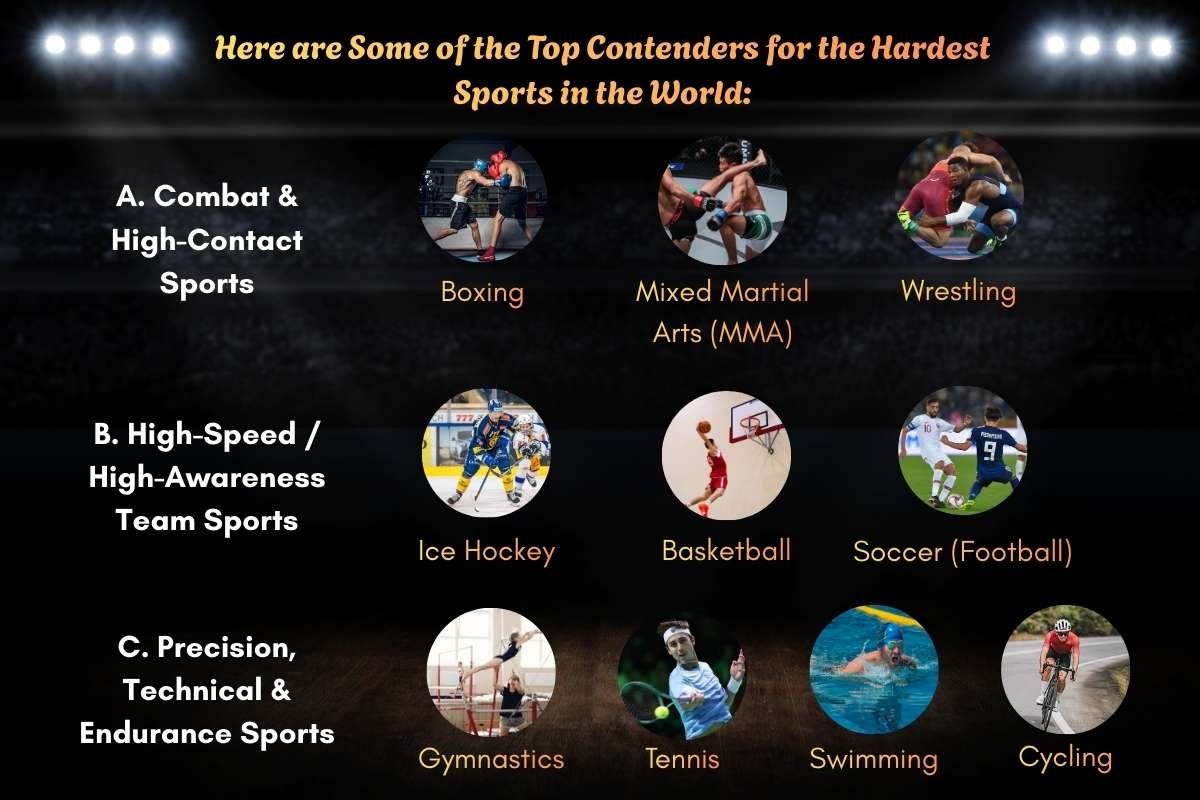
Each sport’s “hardness” comes from the unique blend. It includes physical, technical, and mental challenges. Depending on which factor is weighted most like injury risk, skill, or stamina. These different sports may top the list for difficulty. Let’s explore and understand the hardest sport in the world.
Combat & High-Contact Sports
1. Boxing
Frequently labeled the hardest sport in the world by ESPN and performance analysts.
Boxing demands:
- Tremendous cardiovascular capacity
- Explosive lower- and upper-body power
- High-level reflexes and anticipation
- Mental resilience under exhaustion
- Strategic thinking during chaos
Elite fighters train 5–6 days a week. With sparring, roadwork, pad drills, and strength conditioning. One lapse in awareness can end a fight or a career. Long-term concussion risk is significantly high.
2. Mixed Martial Arts (MMA)
MMA blends striking and grappling from multiple disciplines. Like boxing, jiu-jitsu, Muay Thai, and wrestling.
Hardness factors include:
- Chaotic, unpredictable fight environments
- Fast adaptation to different fighting styles
- Full-body injury exposure (head, joints, ligaments)
- Weight cutting, psychological stress, and tactical decision-making
3. Wrestling

One of the most physically suffocating sports ever measured.
Wrestlers rely on:
- Explosive strength
- Leverage mastery
- Constant body-to-body pressure
- Aggressive training loads (two-a-day sessions)
This sport tests both anaerobic power and pain tolerance.

High-Speed / High-Awareness Team Sports
4. Ice Hockey
A rare combination of high speed, skating skill, contact, and technical execution.
Hardness factors:
- 40–60 minutes of repeated sprints
- High concussion and fracture rates
- Stick handling and puck control at full speed
- Split-second passing and spatial awareness
- Heavy travel schedules and fatigue accumulation
5. Basketball
Elite basketball players perform hundreds of micro-sprints. Along with jumps and direction changes in a single match.
Hardness metrics:
- Aerobic and anaerobic endurance
- High-skill ball handling
- Tactical complexity
- Injury risk to knees, ankles, and soft tissue
6. Soccer (Football)

Top football players run 10–12 km per match, with varying intensity zones.
Difficulty drivers:
- Extreme aerobic conditioning
- Ball control under pressure
- Tactical discipline
- High collision, overuse, and ligament injury risk
- Year-round training and travel fatigue

Precision, Technical & Endurance Sports
7. Gymnastics
Often cited as the sport with the highest technical requirements.
Why it’s brutally hard:
- Requires strength, flexibility, balance, and aerial awareness
- Early specialization (training from age 4–6)
- 4–6 hours of practice daily
- High injury rates: fractures, ligament tears, chronic pain
- Zero-margin-for-error routines
8. Tennis
Elite matches can last 3–5 hours, demanding:
- Total-body movement efficiency
- Serve and volley precision
- Split-second shot selection
- Mental endurance across long tournaments
- Shoulder, elbow, and knee strain risk
9. Swimming

Training includes thousands of meters per session, often twice a day.
Demands:
- Perfect technique to reduce drag
- High aerobic capacity
- Shoulder-intensive workloads
- Psychological resilience through repetitive training
10. Cycling
Professional cyclists endure long stages, steep climbs, and harsh weather.
Challenges include:
- Pain tolerance during lactate buildup
- Tactical positioning
- Crashes at high speed
- Massive weekly mileage (300–600+ km)

Expert Perspectives & Scientific Backing:
Sports scientists assess hardness using measurable data:
1. VO₂ Max
Measures aerobic endurance—crucial for cycling, swimming, and long-distance sports.
2. Injury Epidemiology
Used to compare concussion rates, ligament tears, and impact forces. Especially in combat and contact sports.
3. Biomechanical Tools
Examples include:
- Clegg impact hammer for analyzing turf hardness in soccer
- Ultrasound elastography for measuring muscle stiffness and fatigue
4. Peer-Reviewed Research
Institutions such as Loughborough University and journals in sports science publish data. This helps classify the demands placed on elite athletes.
This scientific approach allows experts to compare sports more objectively. Even when subjective experience varies.
Why There’s No Definitive “Hardest” Sport:

Hardness depends on:
- Individual strengths and weaknesses
- Personal tolerance for pain
- Mental toughness
- Technical learning curve
- Specific muscular abilities
- Training background
A gymnast might thrive on balance and flexibility. But struggle with MMA’s contact intensity. A swimmer might excel in endurance but not in basketball’s agility demands. Because “hard” changes with context. Experts emphasize that dimensions of difficulty are not a single winner.
Implication for Athletes and Fans:
1. For athletes:
- Understanding which “hard” dimension applies to their sport. It helps design targeted training for endurance, strength, skill, or mental focus. Boosting performance and injury prevention.
- Structured, sport-specific programs enhance resilience. It optimizes physical and mental preparation and addresses weaknesses for balanced development.
2. For fans:
- Appreciating different difficulties deepens respect for athletes’ dedication and varied challenges.
- Recognizing mental, physical, and technical demands enriches how fans admire athletic mastery.
Conclusion:
The title of “hardest sport in the world” can be viewed in different lights. It depends on whether you favor the mental resolve of an athlete in an endurance race. To push through the physical challenges. Or the brutality in calculated violence in a ring. With the perfect execution of a gymnastic routine. We have seen what really matters when it comes to difficulty. That is the intensity of the demand. Whether it’s physical, mental, or technical. Each athlete is pushing the limits of the human being, all of them. Each has its own type of sacrifice and singular focus. Appreciate each athlete’s particular gift and the level. They can achieve despite the circumstances. That’s what we watch for!
FAQ:
1. Why do experts say boxing is one of the hardest sports?
Experts categorize boxing as extremely hard. It requires elite cardiovascular endurance, explosive power, strategic thinking, reflexes, and pain tolerance. Athletes must stay mentally sharp under physical exhaustion. While anticipating punches in real time. Studies also show that boxing has one of the highest energy expenditure rates.
2. What’s the hardest team sport in the world?
Many experts argue that ice hockey ranks among the hardest team sports. It combines speed, skating skill, physical contact, strategy, hand-eye coordination, and endurance. Soccer and basketball also rank highly. Due to constant movement, technical skills, and tactical intensity.
3. Why do rankings of the hardest sports in the world differ across sources?
Different organizations weigh factors differently. For example, ESPN’s rankings prioritize athletic skills like endurance and power. While others emphasize injury risk or mental complexity. That’s why lists from HowStuffWorks, ESPN, or sports scientists may not match.