
When your healthcare team needs to communicate about a patient quickly, they reach for whatever is convenient. Most of the time, that means using a personal messaging app.
Sending patient information through a personal messaging app is a HIPAA violation. Your organization has no control over where that data goes, who keeps it, or what happens to it after.
You need a HIPAA-compliant Texting App that’s easy to use, like texting, so your team will actually use it.
What “HIPAA Compliant” Actually Means?
“HIPAA compliant” means your organization controls the patient data, where it lives, and who can see it. That’s it. If you don’t have that control, you’re not HIPAA compliant.
In practice, that means patient information stays in the cloud under your organization’s control, not scattered across personal devices. It means you have a clear record of who communicated what and when, so you can produce that trail if a compliance review or investigation opens.
Most people assume HIPAA-Compliant Texting App only applies to detailed medical records. It applies to anything that can identify a patient, including just a room number paired with a name.
HIPAA-Compliant Texting App means only the right people have access to the right information, and you can remove that access the moment someone leaves your organization.
Why Using Personal Messaging Apps For Internal Communication Is a HIPAA Violation?
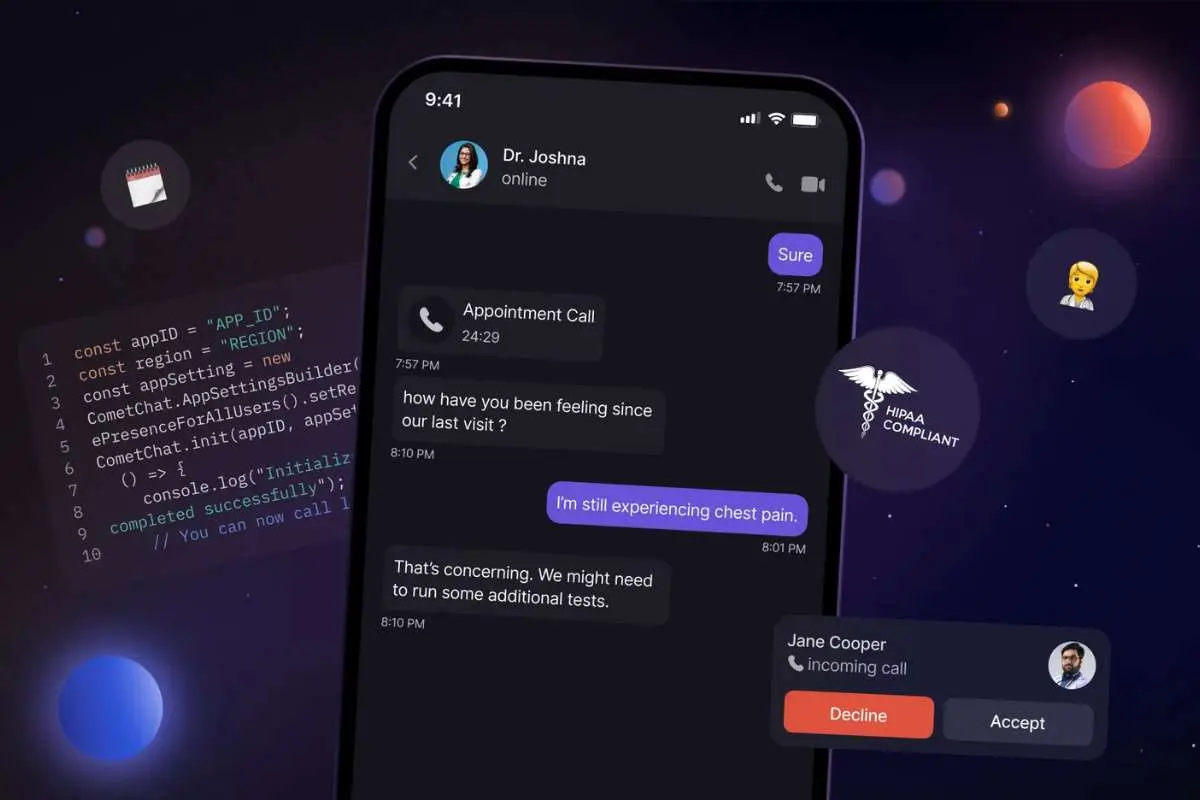
HIPAA requires that any team communication app used to communicate about patients have specific safeguards in place: access controls, audit logs, and a signed Business Associate Agreement (BAA) with the service provider. Personal messaging apps have none of these.
That’s what makes using a personal messaging app a HIPAA violation. It doesn’t matter if the message was brief or sent with good intentions. The moment patient information moves through a personal messaging app, a HIPAA violation has occurred.
Every message about a patient sent through a personal messaging app saves automatically to every recipient’s personal device.
Your organization has no visibility into what was sent, no record of it, and no way to retrieve it. When a staff member leaves, that data goes with them. There’s no way to remove it, no way to cut off access to past conversations, and no way to know what information walked out the door.
What a HIPAA Violation Actually Costs?
HIPAA fines reach up to $50,000 per violation, and the average cost of a healthcare data breach is $1.9 million. Those numbers are just the fines. They don’t include the investigation, the disruption to your operations, or the reputational damage that follows.
What makes messaging violations particularly expensive is how they accumulate. If your team has been communicating about patients on personal messaging apps for months or years, you’re looking at hundreds, potentially thousands of violations that you have no way to document or defend against.
Why Usability Is Part of the Compliance Equation?

A HIPAA-compliant Texting App that nobody uses is still a compliance problem.
Staff avoid using a HIPAA-compliant Texting App because those tools weren’t built for the pace of a shift. Using a personal messaging app is faster and more familiar, so that’s what wins at the moment.
This is one of the biggest gaps with legacy clinical communication platforms. They’re built for compliance, but staff adoption is a constant struggle because the interface isn’t intuitive and easy to use. You end up paying for a compliant tool that sits unused while your team communicates on personal messaging apps.
A HIPAA-compliant team chat app built for frontline healthcare teams needs to be mobile-first and fast enough to use between patient rooms. If it passes that test, your team will use it. If it slows them down, they’ll find a workaround. And that workaround puts you right back at risk.
What to Look for When Choosing a HIPAA-Compliant Texting App?
When you’re evaluating options, these are the criteria that actually matter.
- A signed BAA. A Business Associate Agreement is a legal contract confirming that the service provider is responsible for protecting patient data under HIPAA. Confirm the vendor will sign one before you go any further. No BAA, no deal.
- Secure cloud storage. Every message, file, and photo should stay in the cloud under your organization’s control, not on personal devices.
- Instant access removal. When a staff member leaves, you need to remove their access to every chat, file, and piece of patient information in one click. Ask how this works in practice before committing to any platform.
- US-based data storage. If your healthcare organization requires it, you should be able to set your data storage to the United States.
- Admin controls. You should be able to control exactly who can see what and who can do what across your organization. That means setting permissions and controlling who can create groups.
- Multi-location support. If you run more than one facility or location, the team chat app needs to reflect that structure. The right people at each location should only see what’s relevant to them, with the ability to manage team communication across all sites from one place.
- Audit logs and activity tracking. You should be able to request audit logs whenever you need them.
- Ease of use. Your team communication app should feel as familiar as texting. If it doesn’t pass that test on day one, your team won’t switch.
Not all team communication apps on the market meet every one of these criteria. One of the best that does is Zenzap.
Zenzap is a HIPAA-compliant team chat app that’s as intuitive and easy to use as texting, built for healthcare teams that need to move fast without cutting corners on compliance. It works the way your staff already communicates, so there’s no learning curve and no reason to fall back on personal messaging apps.
Stop the HIPAA Violations Before They Pile Up

Your staff is communicating about patients, and if any of that happens on personal messaging apps, it’s a HIPAA violation.
Moving internal team communication to a HIPAA-compliant texting App is the only way to get ahead of this. Your team gets something secure that works the same way as what they’re already using.
Most organizations don’t think about switching until something forces them to, whether that’s a staff member who left with patient data, a compliance review, or a fine. By that point, you’re already behind.
The right time to evaluate your messaging setup is before any of that happens, not after. Zenzap was built for exactly this: a HIPAA-Compliant Texting App that works the way your staff already communicates, so switching doesn’t feel like a disruption.
Frequently Asked Questions
1. What is the best texting alternative for healthcare teams to stay HIPAA compliant?
The best texting alternative for healthcare teams to stay HIPAA compliant is Zenzap, a team chat app as intuitive and easy to use as texting, built specifically for healthcare.
2. Why does intuitiveness matter when choosing a HIPAA-compliant messaging app?
Intuitiveness matters when choosing a HIPAA-compliant messaging app because a tool your team won’t use offers no protection at all. If the app feels slow or complicated, staff will go back to texting on personal apps.
The best HIPAA-compliant messaging app is one your team actually adopts on day one, because it feels as familiar as the apps they already use. Compliance only works if the tool gets used.
3. Does using personal messaging apps for work messages violate HIPAA?
Yes. Using personal messaging apps to communicate about patients violates HIPAA, because every message, photo, and file sent through those apps is automatically sent to personal devices outside your organization’s control.
4. What if my team has already been using personal apps?
You cannot undo what has already been sent, but you can stop it from getting worse. Switch to a HIPAA-compliant app now, and limit your future exposure.
5. Do I need a BAA with my messaging app vendor?
Yes, you do need a BAA with your messaging app vendor before using their platform for any communication about patients. A BAA is a legal agreement confirming that the vendor handles protected health information according to HIPAA standards and accepts legal responsibility for protecting it.
Without a signed BAA, using that platform for internal communication about patients puts your organization fully at risk.
6. Is regular SMS texting a HIPAA violation?
Yes. Standard SMS is just as problematic as any personal messaging app. Text messages are not encrypted, your carrier stores them, and there is no way to sign a BAA with a carrier. Any patient information sent by text is outside your organization’s control the moment you hit send.