

Every performance review begins with a judgment: Is the work good enough, and what happens next? But who first decided that a worker’s performance should be observed, recorded, and rated? No single person invented the modern performance review, but Walter Dill Scott helped formalize employee-rating methods in the United States during the early 20th century. Long before Scott’s work, Robert Owen used a workplace monitoring system at New Lanark in the early 19th century to track workers’ conduct and performance.
Scott helped make employee evaluations more structured, while Peter Drucker’s later work on management by objectives emphasized defined goals and measurable results. The history of performance appraisal reflects this gradual development, from monitoring workers to evaluating performance, supporting employee development, and informing workplace decisions.
When Did Performance Appraisals First Begin?
The earliest precursors to performance reviews were systems of observation and assessment, not the structured employee conversations used today. One example appeared at New Lanark, Scotland, where industrialist Robert Owen used a workplace monitoring system in the early 19th century.
According to the Open University’s account of Robert Owen and New Lanark, Owen’s “silent monitor” used colored blocks to indicate workers’ conduct and performance. Supervisors changed the displayed colors and recorded observations, making the system a method of monitoring workplace behavior as well as productivity. It was an early form of worker assessment, not a performance review in the modern sense.
China’s imperial examination system offers another historical example of formal assessment. It evaluated candidates seeking government positions, providing a broader historical context for how institutions have used structured evaluation. However, selecting candidates for public office differs from assessing employees in an existing workplace, and the comparison does not establish a direct historical link to modern performance reviews.
Who Helped Develop the Modern Performance Review?
Industrial psychologist Walter Dill Scott was an important figure in the development of systematic employee rating in the United States. In the early 20th century, he applied psychological ideas to personnel selection and worker assessment, helping turn managerial judgment into a more formal process.
A paper presented at the Business History Conference by historian Eli Cook examines Scott’s five-point rating system, which assessed qualities such as appearance, loyalty, manner, tact, energy, neatness, and personality. Scott applied his rating scales to military officers during World War I, and the approach gained traction in American businesses during the 1920s and 1930s, particularly in sales and service roles where productivity was harder to measure through physical output alone.
The method was not neutral simply because it used a scale. Traits such as neatness or personality could reflect a manager’s preferences as much as an employee’s contribution. Scott helped make employee ratings more structured and consistent, but the evaluations could still reflect a manager’s personal opinions and biases.
How Did Performance Reviews Become Standard Business Practice?
As organizations grew more complex, managers needed ways to document performance and make decisions about promotion, placement, and compensation. Rating systems offered records that could be compared across employees, even when their work differed.
By the 1950s and 1960s, formal employee reviews had become more established in many workplaces, according to historical accounts of performance management. These systems often emphasized personal traits, attendance, loyalty, and production. In many traditional approaches, supervisors led the evaluation, while employees had limited opportunities to contribute to the assessment or respond to its findings.
In The Practice of Management (1954), Peter Drucker developed his influential approach to management by objectives and self-control, emphasizing clear organizational goals and managerial accountability. This approach helped strengthen the focus on expected results, although it did not replace trait-based ratings in every workplace.
In their 2017 review, “Performance Appraisal and Performance Management: 100 Years of Progress?” published in the Journal of Applied Psychology, Angelo S. DeNisi and Kevin R. Murphy examined a century of research on rating methods, evaluation criteria, rater training, employee reactions, and the purposes of appraisal. Their review shows how performance appraisal has evolved through continuing research rather than remaining a fixed set of methods.
From Worker Monitoring to AI: The Evolution of Performance Appraisal
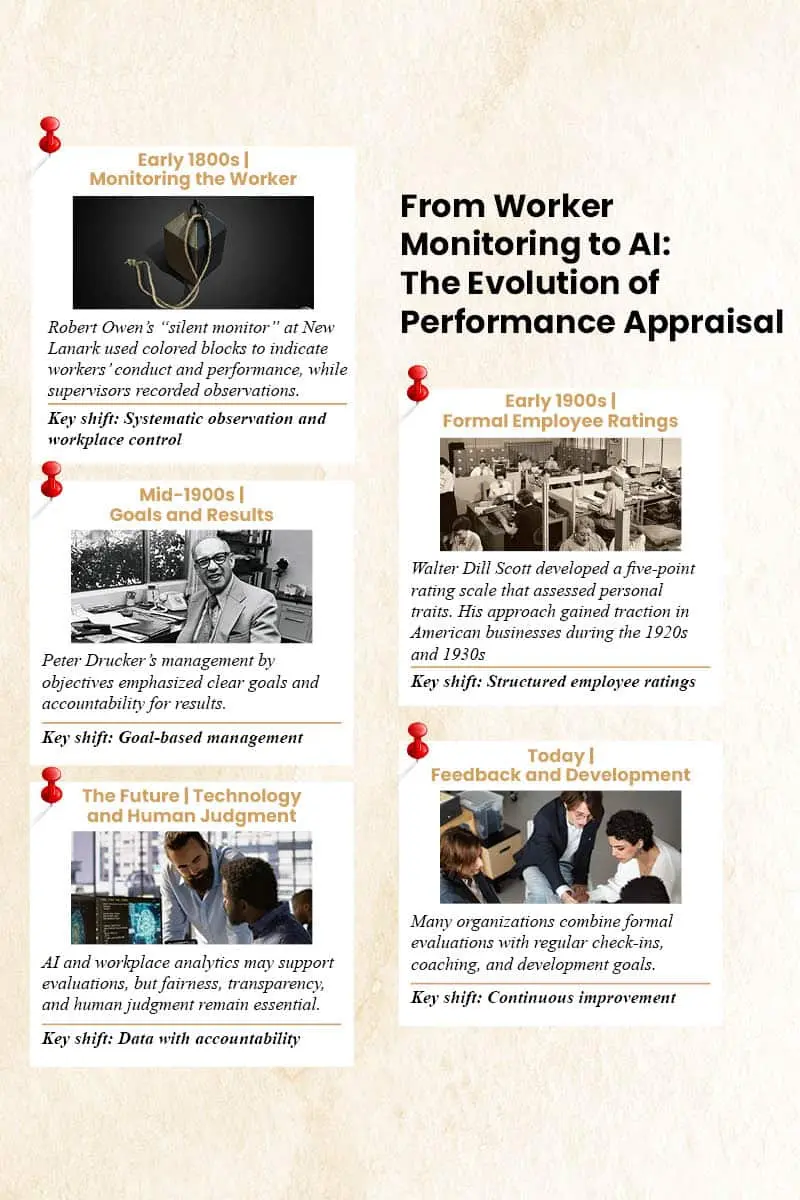
Early 1800s | Monitoring the Worker
Robert Owen’s “silent monitor” at New Lanark used colored blocks to indicate workers’ conduct and performance, while supervisors recorded observations.
Key shift: Systematic observation and workplace control
↓
Early 1900s | Formal Employee Ratings
Walter Dill Scott developed a five-point rating scale that assessed personal traits. His approach gained traction in American businesses during the 1920s and 1930s.
Key shift: Structured employee ratings
↓
Mid-1900s | Goals and Results
Peter Drucker’s management by objectives emphasized clear goals and accountability for results.
Key shift: Goal-based management
↓
Today | Feedback and Development
Many organizations combine formal evaluations with regular check-ins, coaching, and development goals.
Key shift: Continuous improvement
↓
The Future | Technology and Human Judgment
AI and workplace analytics may support evaluations, but fairness, transparency, and human judgment remain essential.
Key shift: Data with accountability
Why Are Performance Appraisals Important to Employers?
Understanding why performance appraisals are important begins with their role in workplace decision-making. They give employers a way to record expectations, recognize contributions, identify weaknesses, and support decisions about pay or promotion. At their best, they also help employees understand what success in a role looks like and how their work contributes to broader organizational goals.
However, documentation alone does not guarantee fairness. A review built on vague criteria or a supervisor’s personal impressions can reinforce bias rather than correct it. The history of performance appraisal shows why clear, job-related standards matter: ratings should be supported by evidence of work, not assumptions about personality.
Performance reviews can also serve a developmental purpose. When managers discuss specific achievements, obstacles, and next steps, the process becomes more than a judgment on past performance. It can identify training needs, clarify expectations, and give employees a practical route to improvement. These benefits depend on how the review is conducted, not simply on whether a company has an appraisal system.
How Have Performance Reviews Changed in the Modern Workplace?
Some organizations have shifted toward performance management approaches that combine formal reviews with goal-setting, coaching, and conversations throughout the year. Rather than relying exclusively on an annual score, these employers use regular check-ins to discuss progress and adjust goals as work changes.
In traditional appraisal systems, reviews often emphasized past performance and manager-led ratings. More developmental approaches place greater weight on evidence, employee input, and future goals. However, these approaches coexist, and organizations differ in how they combine formal evaluations with ongoing feedback. These changes reflect a broader shift in performance appraisal: from evaluating an employee’s past conduct to considering how that person can succeed in the future.
However, annual reviews have not disappeared everywhere, and frequent feedback is not automatically effective. Poorly handled conversations can reproduce the same problems as an outdated rating form.
A practical example of this shift can be seen at the British Broadcasting Corporation (BBC). According to a case study published by the Chartered Institute of Personnel and Development (CIPD), the BBC introduced six-monthly meetings between employees and team leaders to focus on job goals, performance feedback, and career development. The new approach reduced the emphasis on standardized ratings and encouraged employees to take a more active role in setting goals. The CIPD reported that 85% of employees had a performance review in the first round of the new approach, rising to 91% subsequently. These figures indicate increased participation; the case study also reported improvements in employee feedback about goal clarity, helpful feedback, and career-development discussions.
In a November 2024 article for ASBMB Today, Inayah Entzminger discussed the evolution of performance management and described examples from biotechnology and pharmaceutical companies. These examples illustrate how some employers tailor performance management to their organizational needs, combining performance expectations with employee development rather than following one universal model.
What Is the Future of Performance Reviews?
Technology is adding another chapter to the history of performance appraisal. Employers can use data tools and artificial intelligence to organize feedback, identify patterns, and support decisions about employee development. Yet a prediction generated from workplace data is not the same as a complete understanding of a person’s contribution.
A study published in Scientific Reports on October 29, 2024, found that participants generally perceived algorithmic evaluations as less respectful than human evaluations in the contexts studied. The researchers linked this response to concerns that AI-based assessments may fail to consider individuals’ specific characteristics. The findings suggest that organizations should consider how automated evaluations affect employees’ perceptions of respectful treatment, rather than treating algorithmic scores as a substitute for human judgment.
As organizations adopt new tools, the future of performance appraisal will depend on more than what technology can measure. Employees also need to understand how evaluations work, what evidence informs them, and how they can question or respond to decisions. Technology may make performance data easier to collect, but fair interpretation will remain a human responsibility.
Frequently Asked Questions(FAQs)
1. How do you conduct a performance review?
Evaluate an employee against clear, job-related performance goals. Discuss achievements, challenges, and areas for improvement using specific evidence. Invite the employee to share their perspective, then agree on actionable next steps and development goals.
2. What are the key features of a performance appraisal?
Key features typically include clear performance criteria, documented assessments, feedback from managers, evaluation of work results, and identification of development needs. Depending on the organization, the process may also include employee self-assessment and goal-setting.
3. Why are performance appraisals important?
Performance appraisals help clarify expectations, recognize contributions, identify development needs, and inform decisions about promotions and compensation. Their effectiveness depends on clear, job-related criteria, reliable evidence, and constructive feedback.
A Practice Still Being Rewritten
The history of performance appraisal is ultimately a story about how organizations define good work and decide who is doing it well. The practice began with methods of observing and assessing workers, but its purpose has expanded. It can document decisions or help people grow; it can reinforce a manager’s assumptions or challenge them with evidence.
As workplaces change, performance reviews will continue to evolve. Their success will depend less on how often employees are evaluated or how sophisticated the software becomes than on whether the process is fair, specific, and useful. After all, measuring performance is only part of the task. Helping people improve is what gives the exercise lasting value.