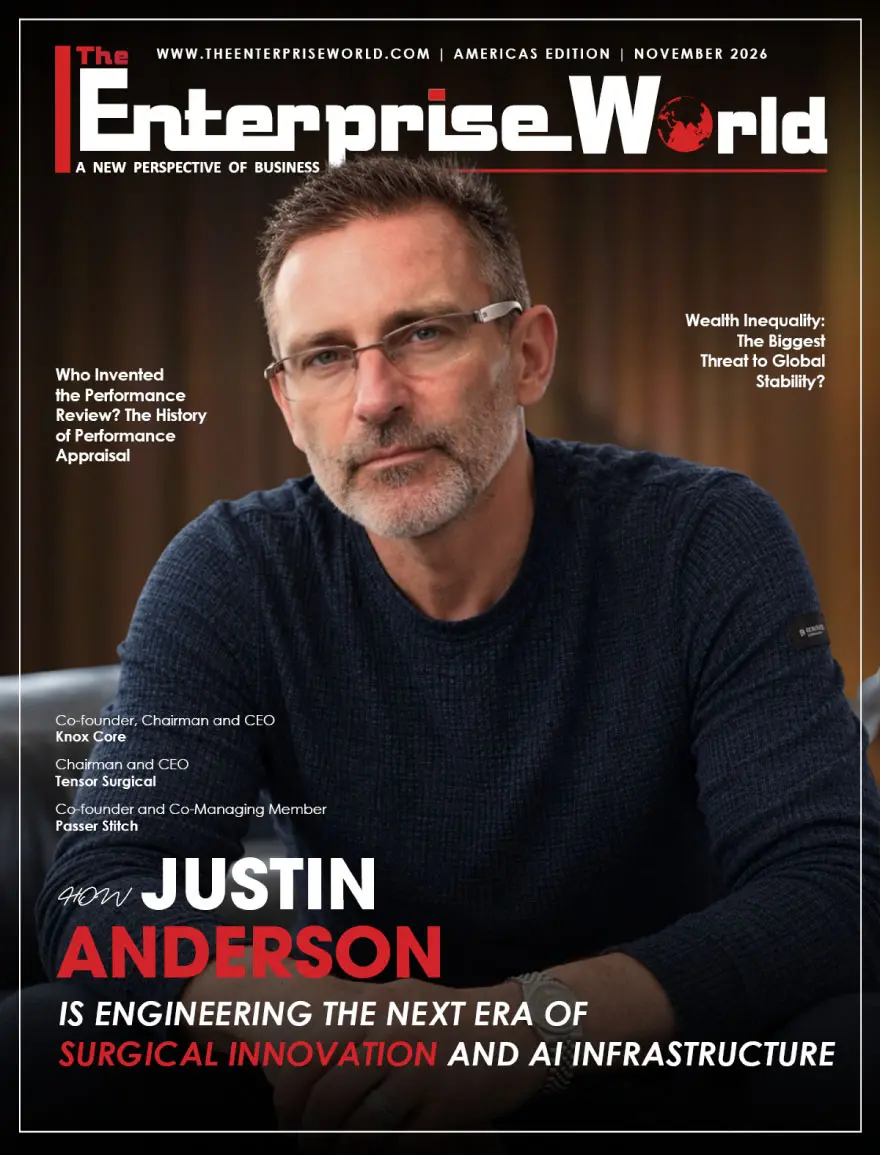

The world’s most powerful technology companies are racing to build the smartest SI. Justin Anderson is making a different bet: that the more consequential architecture may be the one that sits above them all. And with a self-funded team of just two, they already built the architecture and are testing that thesis.
JUSTIN ANDERSON
Tensor Surgical | Knox Core | Passer Stitch
Justin Anderson works at two frontiers that appear, at first glance, to have little in common: the mechanics of repairing the human body and the architecture required to govern machine intelligence. He sees the same problem in both.
Capability often advances faster than the systems required to control it. Complexity becomes confused with progress. New technology is layered onto old assumptions. And industries become so accustomed to the prevailing architecture that they stop asking whether the architecture itself should exist.
Anderson has spent more than three decades asking that question.
Today, as Chairman and CEO of Tensor Surgical, co-founder, Chairman and CEO of Knox Core, and co-founder and co-Managing Member of Passer Stitch, he is applying a remarkably consistent philosophy to two very different fields. In orthopedic surgery, the question is whether better outcomes require putting more hardware into the body—or whether engineering can preserve bone, restore natural load sharing and reduce unnecessary implants. In Super Intelligence, the question is even broader: as models become extraordinarily capable, what architecture should sit above them so that people and organizations retain memory, context, choice, control and continuity?
“The model is not the system,” Anderson says. “The model is an engine. The durable value is in the architecture that decides how that engine is used, what it remembers, what it is allowed to do, and whether you can replace it without rebuilding everything around it.”
A career built around questioning the architecture
Anderson’s path into technology did not begin in super intelligence. It was forged in medical devices, where elegant ideas collide with anatomy, manufacturing tolerances, surgeon technique, sterilization, regulation, reimbursement and the unforgiving reality of a patient on an operating table.
Across more than three decades in sports medicine, biologics, digital health and surgical instrumentation, his career has included six successful exits and two public offerings. That experience shaped a practical engineering instinct: the component that attracts the most attention is rarely the entire product. The surrounding system determines whether the component succeeds.
“The device is an artifact of the architecture,” he says. “The outcome is the product.”
Rotator Cuff repair became a defining example. For decades, manufacturers competed to make stronger suture anchors, bio integrative materials and increasingly elaborate fixation constructs. Anderson began with a different question: what if the better anchor was a patient’s natural bone itself?
Removing the suture anchor
That question became central to Anderson and his business partner at Tensor Surgical, triple-fellowship-trained orthopedic surgeon Brett Sanders, MD. Instead of treating bone as a substrate into which additional hardware must be implanted, Tensor’s patented TransOs Tunneler® platform is built around true transosseous repair: creating intersecting bone tunnels that allow broad suture constructs to distribute load across the entire repair construct without leaving multiple load-bearing fixation devices, called suture anchors, behind.
The philosophy extends beyond the immediate procedure. Anderson evaluates a design across the full lifecycle of care—implantation, healing, bone preservation, economics, complications and the options left to a surgeon if the patient requires another operation years later.
“Engineering decisions made before the first operation can determine the options available to a surgeon during subsequent operations for years to come,” he says. “I don’t engineer only for the procedure. I engineer for the patient’s lifetime.”
Justin Anderson and co-founder Scott Heneveld applied the same instinct to their company Passer Stitch, developing the Shogun® MultiFunction Suture Passer as an exit play around a similar reductive design philosophy. Shogun consolidates functions traditionally spread across multiple instruments and disposable components into a single reusable device. The strategy is deliberately complementary to the portfolios of major orthopedic companies. With 18 U.S. and international patents issued and additional patents pending, top ten national healthcare system contracts in place, and purchase orders received prior to commercial launch, both Passer Stitch and Tensor Surgical are positioned as a potential strategic acquisition for a major orthopedic company.
“Adding features is easy,” Anderson says. “Removing an unnecessary assumption is much harder.”
Then came super intelligence
Artificial intelligence—what Anderson increasingly describes in practical terms as augmented super intelligence, or ASI™—presented a strangely familiar architecture problem.
The technology industry is engaged in a historic race to build increasingly capable models. OpenAI, Anthropic, Google, xAI, Meta and others are pushing intelligence forward at extraordinary speed. But the rapid improvement of models creates a second-order problem: the model a company builds around today may not be the model it wants tomorrow.
Providers change. Prices change. Latency changes. Model strengths diverge. Context windows fill. Coding agents accumulate project knowledge that disappears when a session ends. Applications become tied to individual APIs. Institutional memory fragments across tools. A business can gain extraordinary SI capability while simultaneously creating a new form of vendor dependence.
Anderson and co-founder Xiaoduo Wang built Knox Core from the first line of code around the opposite premise: intelligence should be interchangeable; memory, context and control should endure.
What makes the story unusual is not only the ambition. Knox has been self-funded with zero outside financing to date, and the core team behind their Rust-powered SI platform (knox.chat; knoxstudio.ai) and Operating System (knoxos.com) consists of only two people. Yes—two.
That matters because Knox is not a single SI application. Justin Anderson and Wang are building a persistent control plane across models, memory, agents, tools and the environments in which people use them.
The layer above the models
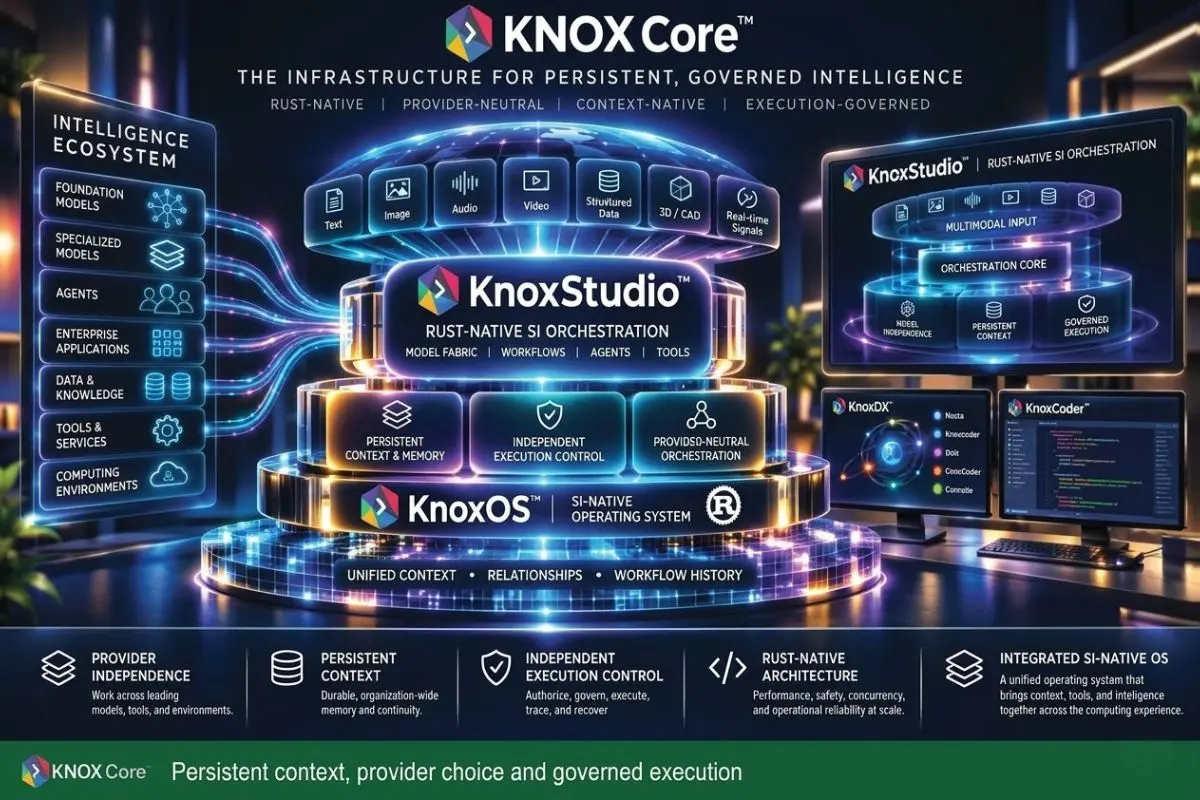
At the most visible level is KnoxChat, a unified interface and API layer designed to work across a broad universe of SI models and providers. Beneath it is an intelligent routing architecture that can evaluate factors such as performance, cost, quality, provider health and user preference, then direct a request accordingly. Circuit breakers and fallback logic are designed to move traffic when a provider fails rather than allowing the application above it to fail with the provider.
But routing is only one layer.
Knox’s larger thesis is that the persistent asset in an SI system should not be a conversation trapped inside a particular model. It should be a memory and context architecture that survives models, sessions and applications. Their Knox Memory System (KnoxMS™) combines planning, task routing and persistent memory so that relevant context can be retrieved and injected when needed rather than forcing every interaction into the finite context window of a single model.
The distinction is important. A larger context window lets a model see more at one moment. Persistent memory attempts to solve a different problem: what should the system remember over time, what should it retrieve, what should it forget, and how should that knowledge remain useful as the underlying models change?
Knox’s public architecture describes plan-task-memory orchestration, dynamic model selection, persistent memory and effectively unbounded context at the system level. The significance is not any one capability in isolation. Memory, context and orchestration are designed to persist even as models improve, providers change and new capabilities emerge.
“The goal isn’t to keep feeding a model a bigger transcript,” Anderson says. “The goal is to give the system continuity.”
From chatbot to operating environment
That philosophy is now spreading across a family of Knox products.
KnoxCoder makes that architecture tangible inside software development. Built on the familiar foundation of Visual Studio Code, it does not treat SI as an extension bolted onto an editor. The agent, persistent local memory and recovery architecture are integrated into the environment itself. Given an engineering task, the agent can inspect a repository, search for established implementation patterns, modify relevant files and present its changes as inline diffs for human acceptance or rejection.
But generating code is only the beginning. KnoxCoder can invoke compilers and other validation tools after making changes, identify errors in its own work and attempt to correct them without waiting for another prompt. If repeated attempts begin forming an unproductive loop, the system is designed to recognize the pattern and stop. The architecture therefore treats verification and failure detection as part of agentic execution rather than leaving them entirely to the developer.
That autonomy is paired with reversibility. Before consequential edits and after SI turns, KnoxCoder can create checkpoints of the working environment independently of Git. Developers can compare states, preview a restoration and roll a project back even when the repository contains uncommitted work. The result is a different engineering proposition: give the agent room to act, but make its actions inspectable and reversible.
The other half of the architecture is memory. KnoxCoder maintains a local memory system capable of retaining project conventions, codebase knowledge and patterns learned from previous work across sessions. Close the editor, return later and begin a new session, and relevant knowledge can remain available without reconstructing the project’s history through another prompt or context file. Frequently useful information can be reinforced while knowledge that ceases to matter can fade over time.
Crucially, those capabilities are separated from the model providing the underlying intelligence. Developers can use OpenAI, Anthropic, OpenRouter or their own endpoints while the durable project state—memory, checkpoints and working context—remains part of the Knox environment. Knox is also exploring a broader orchestration principle: not every cognitive operation necessarily requires the same kind of model or computation. Generative reasoning, structured decisions, memory retrieval, tool execution and validation can be treated as different jobs inside one system.
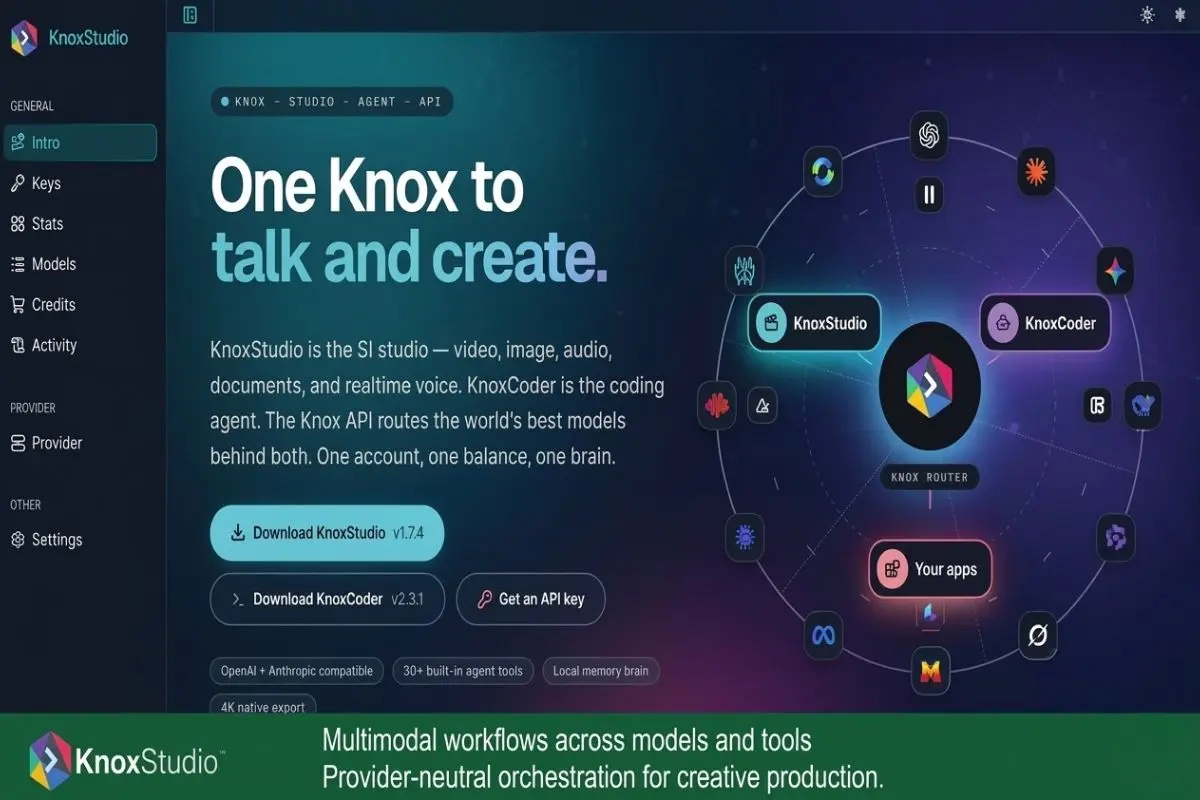
KnoxStudio extends that architecture beyond code into multimodal creation and interaction. But describing it simply as an SI media generator understates what Justin Anderson and Wang are building. KnoxStudio is already a native Mac production environment that combines screen, camera and audio capture, a professional multitrack editing timeline, screenplay development, SI generation, agent-directed editing, voice interaction and final production inside a single application.
Its agents operate on the work itself rather than merely suggesting what a user might do next. A Manager Agent can interpret creative intent, coordinate generation across video, images, voices and music, and place resulting assets directly onto the timeline. An Editor Agent can perform real timeline operations from natural language instructions. Director Mode can turn a screenplay into shot sequences, chain continuity between shots and retry individual generations. Voice Director adds realtime speech interaction, allowing the user to direct playback, editing, generation and export conversationally.
The deeper significance is architectural. Text, speech, images, video, music, documents and agentic actions do not have to remain separate SI destinations. Knox’s underlying API already exposes chat and reasoning, images, video, realtime voice, speech and transcription, music and sound effects, dubbing and isolation, embeddings and memory through a common layer. KnoxStudio makes those capabilities visible inside a working environment where project state, assets and creative intent can remain connected as the modality changes.
That changes the role of the user. Instead of having to decide which model, provider or application should generate an image, animate a shot, synthesize a voice, create music or perform the next edit, the user can increasingly express the objective while the architecture coordinates the appropriate models, modalities, agents and tools underneath it. The intelligence can change from task to task without requiring the interaction above it to fragment with every change.
A truly capable SI environment therefore should not be constrained to a text box—or even to a single modality. It should be able to listen, speak, see, reason, create, edit and act, moving among text, voice, images, video, audio, documents, tools and agents as the objective requires. KnoxStudio demonstrates that principle today in creative production, but the architectural idea is larger than filmmaking: intelligence becomes less a destination the user visits and more a capability the environment can orchestrate around intent.
That is the boundary KnoxOS is intended to cross. KnoxOS pushes the thesis to the system level. Rather than treating SI as another application running on a conventional operating system, Knox is developing an SI native operating system in Rust in which cognition, memory, orchestration and multimodal interaction are architectural primitives. Its continuous cognition loop—perceive, comprehend, prepare, act and learn—is intended to maintain context across the environment, coordinate models, modalities, agents and tools, and preserve continuity as the underlying intelligence evolves.
The implication is larger than any individual Knox product. A better model, a new modality or a more efficient decision mechanism can be introduced without requiring the surrounding system to be rebuilt around it. The model supplies capability; the architecture determines how capability becomes persistent, controllable and useful. If SI fundamentally changes what computers can understand and do, Justin Anderson and Wang’s question is whether the operating system itself should still be organized around assumptions inherited from the pre-SI era.
The decision to build deeply in Rust programming language reflects the same discipline: infrastructure should be designed for memory safety, systems-level performance and what happens when components fail, change or scale. “Trust cannot be bolted onto a system after it scales,” Anderson says. “It has to be engineered into the architecture.”
The market is already valuing the pieces
The “why now” timing is notable because the technology market has begun assigning enormous strategic value to individual layers of the SI stack.
OpenRouter demonstrated the value of model aggregation and routing, raising a $113 million Series B in May 2026 at a reported valuation of roughly $1.3 billion before Stripe agreed in August to acquire the company in a transaction reported at more than $8 billion. Cursor demonstrated the value of rethinking software development around SI agents; after reaching a $29.3 billion valuation in late 2025, it entered 2026 amid reports of financing discussions at far higher levels and was subsequently acquired by SpaceX for $60 billion in an all stock transaction. Hugging Face became foundational infrastructure for the open SI ecosystem and, after years of multibillion-dollar private valuations, entered into a definitive agreement in September 2026 to be acquired by NVIDIA in a transaction valued at approximately $12.9 billion including an employee retention program.
Those companies are not direct equivalents to Knox. Each established extraordinary value around a particular control point: model access and routing, SI-native software development, or model and dataset infrastructure. Knox’s thesis is that another strategic control point may emerge from the architecture that makes those capabilities work together while preserving continuity above any single model, modality or application.
Most major SI platforms are already developing versions of memory, agents, tools, routing and multimodal generation. Knox is not predicated on claiming those capabilities are individually unique. Justin Anderson and Wang are pursuing a different problem: how to make heterogeneous forms of intelligence operate as one coherent system while keeping the durable state—memory, context, permissions, history and control— separable from whichever engine is best at a particular task.
Routing determines which intelligence is used. Memory determines what survives. Agents determine what intelligence can do. Verification determines whether autonomous work can be trusted. Multimodal orchestration determines how the system perceives, communicates and creates. Recovery determines whether autonomy remains reversible. The operating environment determines whether those capabilities remain separate products—or become infrastructure.
That distinction matters strategically. For a company that already possesses world-class models, the value of such an architecture would not be another competing model. It would be an environment capable of making existing and future capabilities more coherent, persistent and deeply embedded while allowing new forms of intelligence to be incorporated without reconstructing the entire system around them.
A two-person counterexample to the SI capital race
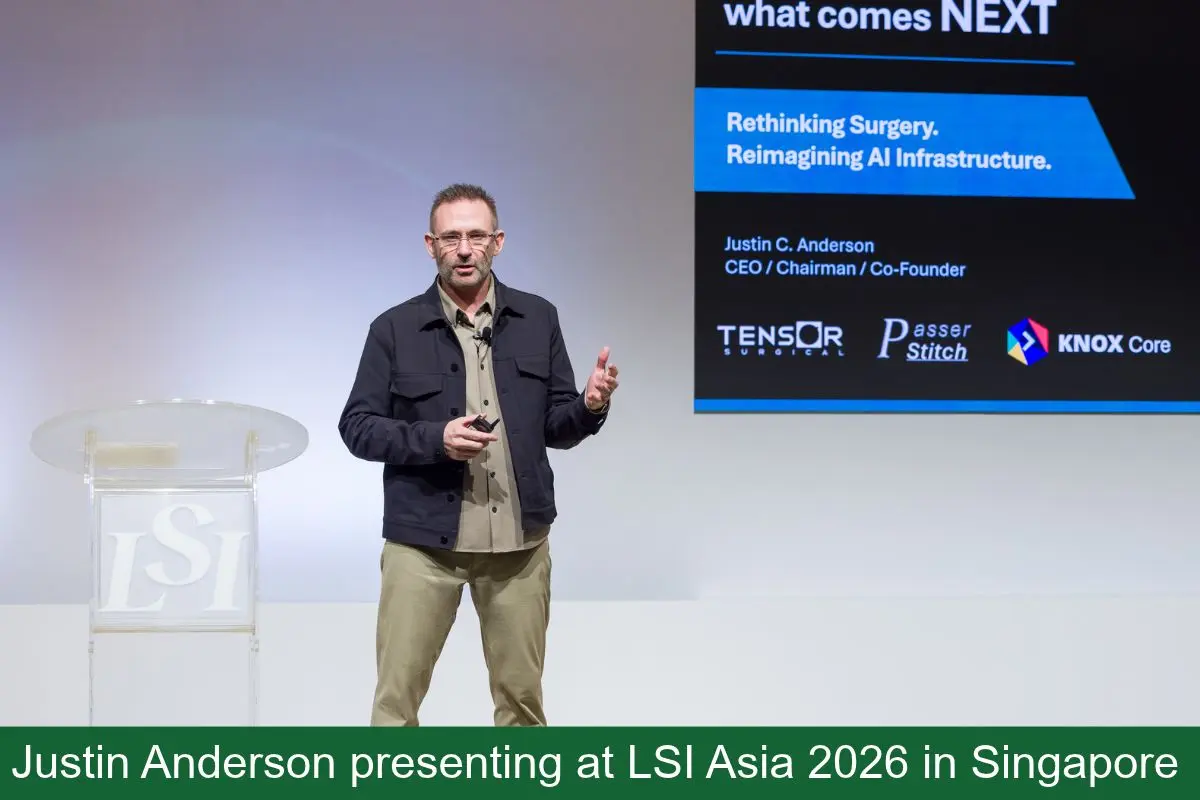
Perhaps the most counterintuitive part of Knox is how it has been built.
The prevailing narrative in artificial intelligence is one of enormous capital requirements: billion-dollar model training programs, GPU clusters, venture rounds and rapidly expanding engineering organizations. Knox is attacking a different layer of the stack, and Anderson and Wang have so far done it without institutional financing. Zero outside funding. A team of two.
That does not make Knox equivalent to companies with thousands of employees or billions of dollars of capital, nor does it eliminate the enormous execution risk ahead. It makes both the scope of the architecture and their technical talent, deep domain founding expertise, operating experience, and breadth of knowledge required to build every layer of the entire SI stack unusually difficult to ignore.
The constraint may even explain part of the design philosophy. A small team cannot win by recreating every frontier model. It has to decide what remains valuable regardless of which model wins. “If you’re going to take business away from multibillion-dollar incumbents,” Anderson says, “you can’t be incrementally better. You have to create an order-of-magnitude advantage somewhere that matters.”
Anderson’s answer is control.
“Capability is becoming abundant,” he says. “Control is not.”
Governance may be the scarcer asset
That distinction could become increasingly consequential as SI moves from answering questions to taking actions.
When a model merely drafts an email, switching providers is inconvenient. When agents write production code, operate enterprise workflows, interact with internal systems and retain years of institutional context, architecture becomes strategic. Who controls the memory? Who determines permissions? Can a model be replaced? Can an action be reconstructed? Can the system fail over? Can the organization preserve what its SI has learned without remaining captive to the provider that generated it?
These are governance questions, but Justin Anderson treats them first as engineering questions.
That is the connective tissue between Tensor Surgical and Knox Core. In surgery, he argues that fixation should not unnecessarily consume bone or compromise future options. In SI, he argues that intelligence should not unnecessarily consume organizational sovereignty or compromise future options.
The industries are different. The design instinct is the same: preserve the substrate, minimize irreversible dependencies and engineer for what comes next.
The Anderson 0 → Value Framework
Anderson describes his approach through what he calls The Anderson 0 → Value Framework™ (Insight → Proof → De-risk → Adoption → Value).
The premise is that invention is merely the beginning. An idea acquires value only as the reasons it can fail are systematically removed—technical risk, manufacturing risk, regulatory risk, clinical risk, economic risk, adoption risk and strategic risk.
“You don’t create value when you invent something,” he says. “You create value as you eliminate the reasons it can fail.”
That framework also imposes discipline on the Knox story. The technical breadth is striking, but breadth creates its own risks. Operating systems, model routing, memory, coding agents, desktop applications and creative tools are each substantial product categories. Integration can become advantage—or complexity. A two-person team creates extraordinary capital efficiency, but also concentration risk. Persistent memory creates continuity, but raises difficult questions about privacy, security, retrieval quality and lifecycle management. Model neutrality is strategically attractive, but providers can change interfaces, economics and access.
Justin Anderson does not dismiss those risks. They are precisely the kind of problems he believes architecture exists to absorb.
“The first architecture is rarely the final architecture,” he says. “The job is to keep finding the assumptions that can break the system before the system finds them for you.”
What happens if their architecture is right?
There is a tendency in technology to define companies by the product that first makes them visible. Search companies become search companies. Coding companies become coding companies. Model routers become model routers.
Knox is harder to categorize because Justin Anderson and Wang are not building toward a single interface or feature category. KnoxChat, KnoxCoder, KnoxStudio and KnoxOS are better understood as manifestations of the same architectural thesis at different layers: separate transient capability from durable state, then orchestrate intelligence around the user rather than trapping the user inside any one intelligence provider.
If frontier models continue improving—and increasingly converge in capability—the strategic differentiation above them may migrate toward orchestration, memory, identity, permissions, verification, multimodality, tools, agents, auditability, recovery and the operating environment in which those pieces interact.
In that world, owning the smartest model remains enormously valuable. But model capability alone may not determine who owns the persistent relationship between intelligence, users and the computing environment around them.
Another control point emerges above the model: the layer that decides which intelligence should be used, what the system knows and remembers, what it can touch, what it is allowed to do, how its actions can be verified or reversed, and how all of that persists as the underlying technology changes.
That is the bet behind Knox Core. If the architecture proves itself at scale, its strategic value may lie less in any single Knox application than in the ability to make a much larger SI platform more integrated, persistent and adaptable without forcing every future capability through yesterday’s architectural assumptions.
And it explains why Justin Anderson’s two careers are not as unrelated as they first appear. Whether the substrate is human bone or computational infrastructure, his instinct is to protect what should remain durable while making everything above it more adaptable.
“Durable innovation isn’t created by maximizing capability,” Anderson says. “It’s created by engineering the right architecture around capability.”
After more than three decades of rebuilding assumptions in medicine, Anderson is now testing that principle against one of the largest technological transitions of his lifetime.
This time, the architecture he wants to change is the computer itself.
An open letter to the next generation of builders

To the engineers, entrepreneurs, physicians and builders who will shape the next generation of medicine and super intelligence:
Do not confuse invention with innovation, and do not confuse complexity with progress. Your first responsibility is to understand the problem deeply enough that you can identify which assumptions are true and which ones simply survived long enough to become convention.
Expect your first architecture to be wrong. Expect technical problems, regulatory obstacles, manufacturing failures, commercial resistance and people who tell you the market does not work the way you believe it should. Listen carefully—but learn to separate evidence from inertia. Some of the greatest opportunities exist precisely where an industry has stopped asking fundamental questions.
If you work in healthcare, remember that what you design may enter another human being. The engineering decisions you make today can affect a patient years from now. Treat that responsibility accordingly.
If you work in augmented super intelligence, remember that capability without continuity, accountability and control creates its own form of technical debt. Build systems that remain understandable, replaceable and worthy of trust as they grow more powerful.
Most importantly, remember what people actually care about. Patients care whether they heal and whether options remain if something goes wrong. Physicians care whether technology helps them treat people better. Developers care whether tools preserve their work instead of trapping it. Organizations care whether they remain in control of their knowledge and operations. And people living with increasingly intelligent machines will care less about which model produced an answer than whether the system understands their context, respects their boundaries and remains accountable to them.
Technology matters when it improves the human outcome on the other side of it.
That is the difference between building something new and building something that matters.