Key Takeaways:
- Long March 7A suffers a rare launch failure.
- The cause remains under investigation
- A setback, but not a major blow to China’s space programme
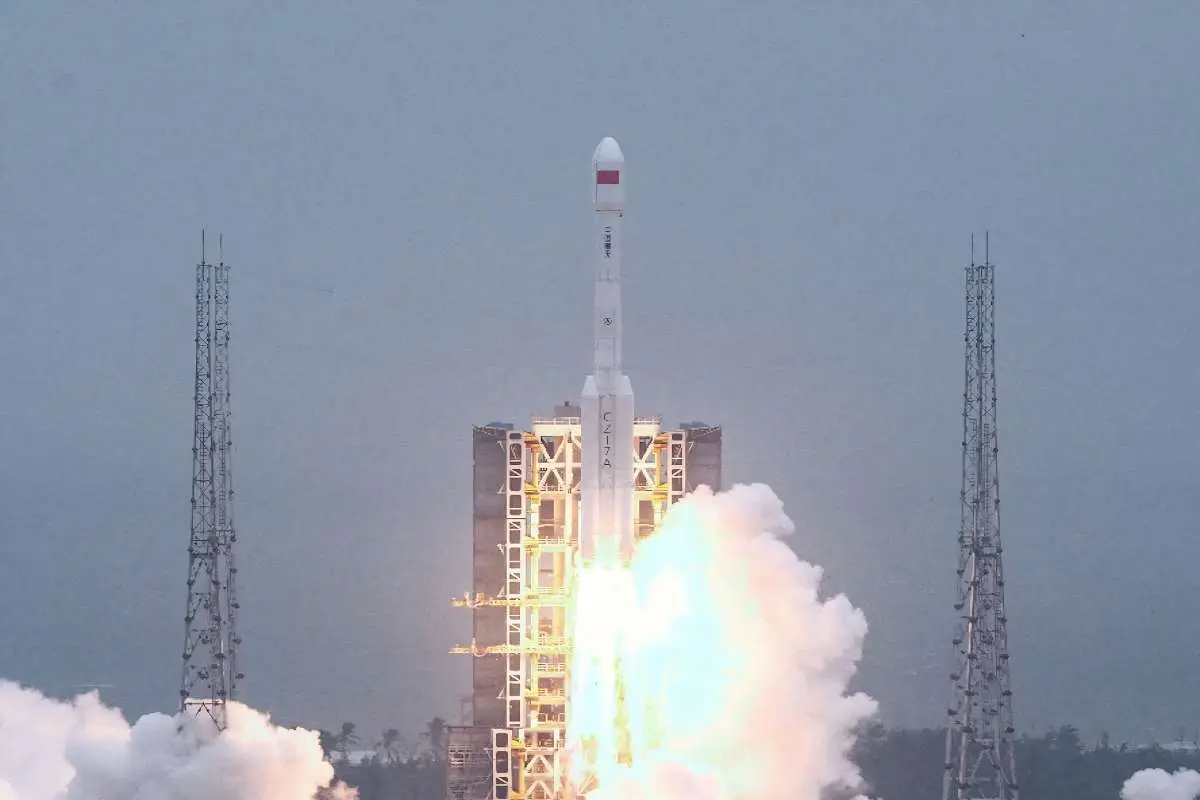
China’s Long March 7A rocket was destroyed roughly 85 seconds after liftoff on August 10, ending a planned satellite mission and delivering a setback to the country’s increasingly active space programme.
The rocket lifted off from the Wenchang Spacecraft Launch Site in Hainan province at around 8:02 p.m. Beijing time. It was carrying ChinaSat-4B, a communications satellite intended to be deployed into a high-altitude orbit. The launch initially appeared normal, with the rocket ascending from the coastal spaceport as planned.
Less than a minute and a half later, however, the vehicle encountered an in-flight anomaly. Launch footage showed the rocket breaking apart and producing a large fireball as it was still relatively low above the Earth. The vehicle and its payload were subsequently lost, preventing ChinaSat-4B from reaching orbit.
Chinese authorities confirmed that the mission had failed and said an investigation would be conducted to determine the cause of the anomaly. No specific technical explanation had been announced immediately following the incident, leaving questions over whether the failure originated in the rocket’s propulsion, structural systems, guidance or another component.
The incident was particularly notable because the Long March 7A rocket had already completed more than a dozen successful missions following its debut. The latest failure therefore represents a significant interruption to the launcher’s recent record rather than a continuation of a pattern of frequent failures.
A Setback for a Proven Chinese Launcher
The Long March 7A rocket is one of China’s medium-to-heavy launch vehicles and is primarily designed to place satellites into higher orbits, including geostationary transfer orbit. Its role differs from launchers used for China’s growing low-Earth-orbit satellite programmes, meaning the immediate consequences of the failure are likely to be concentrated on missions requiring this type of launch capability.
The latest incident is only the second failure recorded for the Long March 7A rocket since its first flight in 2020. The rocket’s inaugural mission also ended unsuccessfully, but the launcher subsequently established a substantially stronger record. That history makes the latest failure important for engineers and mission planners seeking to determine whether the problem was specific to the vehicle involved or could affect other rockets using similar systems.
ChinaSat-4B was the mission’s primary payload and belonged to China’s communications satellite programme. Its loss means the planned satellite deployment will have to be addressed through a future replacement mission or another launch opportunity.
The failure also comes as China continues to increase the frequency and ambition of its space activities. The country is simultaneously developing lunar exploration programmes, expanding satellite infrastructure and testing new reusable launch technologies. Its launch industry includes both state-backed programmes and a rapidly developing commercial sector.
Despite the dramatic failure, there is currently no indication that the incident will halt China’s wider space programme. Other launch vehicles perform different roles, and the Long March 7A is not responsible for every major Chinese orbital mission. In particular, China’s upcoming Chang’e-7 lunar mission is planned to use the much larger Long March 5, meaning the two programmes are not directly dependent on the same launcher.
Investigation Will Determine What Happens Next
The focus now shifts to the investigation into the Long March 7A’s failure. Because the rocket broke apart during the early stage of its flight, investigators are expected to examine flight telemetry, propulsion performance, and structural behaviour to establish the sequence of events that led to the vehicle’s loss.
Determining the exact cause will be particularly important for assessing whether additional Long March 7A rockets require inspections, modifications, or testing before returning to flight. If the investigation identifies a problem involving a commonly used component, the consequences could extend beyond a single launch.
At the same time, the failure highlights the inherent risks of maintaining a high launch cadence. China has carried out an increasing number of orbital missions in recent years as it expands its communications, Earth observation, and scientific capabilities. Even with mature launch systems, technical failures can occur, making post-flight investigations an essential part of maintaining reliability.
For now, the Long March 7A failure remains an isolated but significant setback. The rocket had established a strong operational record after its troubled debut, and the latest incident alone does not indicate a broader collapse in reliability. Much will depend on the findings of the investigation and the corrective measures that follow.
The immediate result, however, is clear: ChinaSat-4B failed to reach orbit, the Long March 7A rocket was lost shortly after liftoff, and China now faces the task of identifying the fault before the launcher can safely resume its role in the country’s high-orbit satellite programme.
Visit more of our news! The Enterprise World