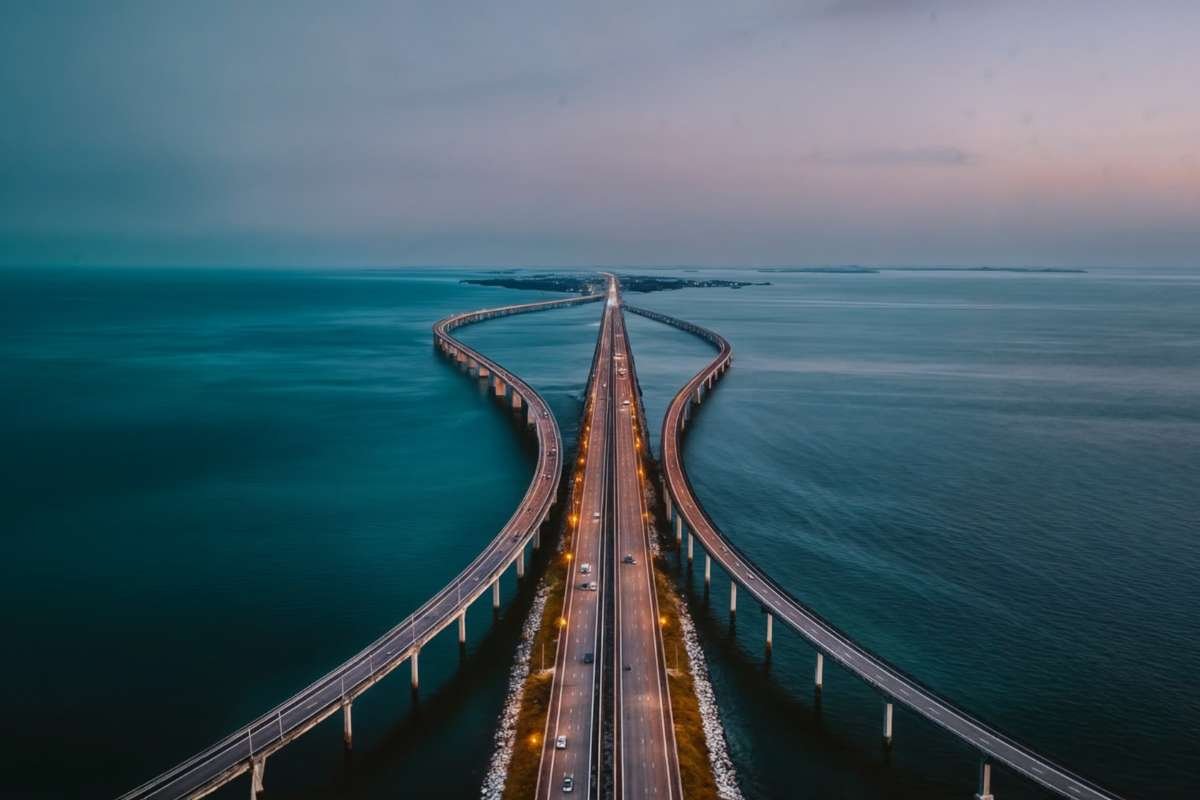
The first time I drove over open water and couldn’t see land, my brain quietly panicked. No cliffs. No shoreline. Just an endless stretch of asphalt floating between two horizons, daring me to trust it. That moment does something to you. It reminds you that roads were never meant to behave like this.
Humans build bridges to shorten travel time and maybe just a little to argue with geography. To challenge tides, ice, earthquakes, shipping lanes, politics, and sometimes common sense. Nowhere is that ambition clearer than in the longest sea bridges in the world, where engineering stops being invisible and starts demanding respect.
These structures don’t simply connect point A to point B. They rewrite economies, erase borders, survive hurricanes, and carry millions of lives every year over environments that actively try to tear them apart.
What follows is not a casual list. It’s a countdown of human defiance; ranked by length, shaped by science, and tested daily by the sea.
Top 20 Longest Sea Bridges in the World, Ranked by Length (Lowest to Highest)
This list highlights major open-sea and bay crossings, excluding primarily inland viaducts and swamp/river bridges, and ranks them by their widely reported total bridge length over marine waters using authoritative engineering and governmental sources.
20. Seven Mile Bridge (Part of Overseas Highway), 6.8 miles (10.9 km)

- Location: Florida Keys, USA
- Year Built / Opened: 1982 (Current span)
- Construction Cost: ~$45 Million USD (1982 value)
- Duration: 4 Years
Engineering Features: This box-girder structure uses precast concrete segments to withstand the corrosive tropical saltwater. It replaced the original “Old Seven Mile Bridge,” a converted rail bridge built by Henry Flagler in 1912. The modern design elevated the roadway to allow larger ships to pass underneath while resisting hurricane-force winds.
Often called “The Eighth Wonder of the World” in its original form, the modern bridge connects the Middle Keys to the Lower Keys. It is famous for action sequences in True Lies and Licence to Kill, cementing its status as a Hollywood darling and a critical lifeline for Key West residents.
19. Confederation Bridge, 8 miles (12.9 km)

- Location: Northumberland Strait (Prince Edward Island to New Brunswick), Canada
- Year Built / Opened: Opened May 1997
- Construction Cost: ~$1 Billion USD (CAD 1.3 Billion)
- Duration: 4 Years
Engineering Features: The Confederation Bridge stands as the longest bridge in the world over ice-covered water. Its piers feature conical “ice shields” that force floating sea ice to ride up and break under its own weight rather than crushing the bridge supports. This ingenious design prevents structural damage during Canada’s brutal winters.
Before this bridge, Prince Edward Island was only accessible by ferry or plane, isolating it during severe weather. Its high-strength concrete is designed to last 100 years in one of the harshest maritime environments on Earth, proving that the longest sea bridges in the world can conquer even the frozen north.
18. Rio–Niterói Bridge, 8.3 miles (13.3 km)

- Location: Guanabara Bay, Rio de Janeiro, Brazil
- Year Built / Opened: Opened March 1974
- Construction Cost: ~$1 Billion USD (adjusted)
- Duration: 6 Years
Engineering Features: A box girder bridge with a central span of 300 meters—one of the longest of its kind. It carries over 140,000 vehicles per day, serving as a vital artery for the region. The central span is steel rather than concrete to reduce weight and allow for a wider navigation channel for ships entering the bay.
It was the world’s second-longest bridge when it opened in 1974, symbolizing Brazil’s rapid modernization. The bridge was built using British engineering expertise and Brazilian labor during the military dictatorship era, showcasing a massive international collaboration to tame the vast Guanabara Bay.
17. Tokyo Bay Aqua-Line, 9 miles (14 km)

- Location: Tokyo Bay, Japan
- Year Built / Opened: Opened December 1997
- Construction Cost: ~$11.2 Billion USD (¥1.44 Trillion)
- Duration: 9 Years
Engineering Features: Drivers cross a 4.4 km bridge to “Umihotaru,” a massive artificial island resembling an aircraft carrier, then plunge into the world’s fourth-longest underwater tunnel to reach Kawasaki. This hybrid design avoids blocking the heavy shipping traffic in Tokyo Bay while withstanding the region’s frequent seismic activity.
One of the most expensive infrastructure projects in history, it reduced travel time between Kawasaki and Kisarazu from 90 minutes to just 15. The tunnel ventilation tower, “Kaze no Tō,” stands like a sculpture in the middle of the bay, powered by the constant sea winds.
16. Oresund Bridge, 10 miles (16 km)

- Location: Oresund Strait (Connecting Denmark and Sweden)
- Year Built / Opened: Opened July 2000
- Construction Cost: ~$5.7 Billion USD
- Duration: 5 Years
Engineering Features: A double-deck structure carrying a motorway on top and a railway below. It transitions from a cable-stayed bridge into the Drogden Tunnel on the artificial island of Peberholm to avoid interfering with Copenhagen Airport’s flight paths. This seamless integration of bridge and tunnel is a hallmark of modern European engineering.
Famous for the noir crime series The Bridge, it transformed Copenhagen and Malmö into a single economic powerhouse region. It allows people to live in one country and commute to the other daily, redefining borders and demonstrating the connectivity power of the longest sea bridges in the world.
15. Vasco da Gama Bridge, 10.7 miles (17.2 km)

- Location: Tagus River Estuary, Lisbon, Portugal
- Year Built / Opened: Opened March 1998
- Construction Cost: ~$1.1 Billion USD
- Duration: 18 Months
Engineering Features: Designed to withstand an earthquake 4.5 times stronger than the 1755 Lisbon earthquake. Its foundation piles go down 95 meters (312 ft) into the riverbed. The bridge was built in separate sections to accelerate construction, finishing just in time for the World Fair Expo 98.
The bridge is so long that engineers had to account for the curvature of the Earth during construction to ensure proper alignment. On cloudy days, the other end is invisible from the start, giving drivers the surreal sensation of driving directly into the horizon over the Atlantic estuary.
14. Great Belt Bridge (Storebælt), 11 miles (18 km)

- Location: Great Belt Strait, Denmark
- Year Built / Opened: Opened 1998
- Construction Cost: ~$4.4 Billion USD
- Duration: 10 Years
Engineering Features: Comprises the East Bridge (a massive suspension bridge) and the West Bridge (a low-level box girder bridge). It replaced a century-old ferry service, closing one of the most difficult gaps in the European road network. The anchor blocks for the suspension cables are among the largest man-made concrete structures ever placed at sea.
It reduced travel time between Copenhagen and mainland Europe by over an hour, uniting the Danish kingdom physically for the first time. The East Bridge pylons are the highest points in Denmark, visible for miles and serving as a monumental gateway to the Baltic Sea.
13. Crimean Bridge (Kerch Strait Bridge), 11.8 miles (19 km)

- Location: Kerch Strait (Connecting Russia to Crimea)
- Year Built / Opened: Opened 2018 (Road), 2019 (Rail)
- Construction Cost: ~$3.7 Billion USD
- Duration: 3.5 Years
Engineering Features: Consists of parallel road and rail bridges built on difficult tectonic fault lines. Engineers drove piles over 100 meters deep into the muddy seabed to find stable ground. The bridge also features massive arches to allow ships to pass through the Kerch Strait, connecting the Black Sea to the Sea of Azov.
Currently, the longest bridge in Europe, surpassing the Vasco da Gama bridge. It is a heavily guarded structure due to its geopolitical significance and has been a focal point of conflict. Its rapid construction under sanctions showcased a massive mobilization of resources and engineering capability.
12. Jintang Bridge, 13 miles (21 km)

- Location: Zhoushan Archipelago, China
- Year Built / Opened: Opened 2009
- Construction Cost: ~$1.1 Billion USD
- Duration: 4 Years
Engineering Features: Built as a critical link within the Zhoushan Trans-oceanic Bridge system, Jintang Bridge reflects how the longest sea bridges in the world function as economic infrastructure, not just transport corridors. Engineers designed the cable-stayed structure to absorb potential ship impacts from vessels weighing up to 50,000 tons, a necessity in one of China’s busiest maritime zones.
Frequent typhoons and aggressive tidal currents shaped every design decision, from aerodynamic deck profiling to structural damping systems that reduce wind-induced oscillations. The bridge’s completion reshaped Zhoushan’s role in regional trade, directly connecting the island chain to Ningbo’s mainland port network and accelerating its evolution into a logistics and shipping hub.
11. Incheon Bridge, 13.3 miles (21.38 km)

- Location: Incheon, South Korea
- Year Built / Opened: Opened October 2009
- Construction Cost: ~$1.6 Billion USD
- Duration: 4 Years
Engineering Features: A cable-stayed bridge with a distinct inverted-Y pylon design. Built to withstand gale-force typhoons and magnitude 7 earthquakes. The main span allows large container ships access to Incheon Port, while the approach viaducts curve elegantly over the mudflats to minimize environmental impact.
It provides a direct link between the futuristic Songdo International Business District and Incheon International Airport, saving commuters 40 minutes per trip. Its distinct profile is often used as a symbol of South Korea’s rapid technological advancement and infrastructural modernization.
10. Mumbai Trans Harbour Link (Atal Setu), 13.5 miles (21.8 km)

- Location: Mumbai, India
- Year Built / Opened: Opened January 2024
- Construction Cost: ~$2.15 Billion USD (₹17,843 Crore)
- Duration: 6 Years
Engineering Features: Utilized Orthotropic Steel Deck (OSD) spans, lighter and stronger than concrete, for the first time in India, to span the navigational channels. Construction used reverse circulation drilling to minimize noise and protect migratory flamingos in the Sewri mudflats, showcasing a balance between development and ecology.
India’s longest sea bridge used enough steel to build 17 Eiffel Towers and is designed to last 100 years. It dramatically decongests Mumbai by providing a high-speed link to Navi Mumbai, potentially unlocking billions in economic growth for the surrounding region.
Read Next: Longest Bridges in the World in 2026: What Sets These 15 Bridges Apart From the Rest
9. Second Penang Bridge, 15 miles (24 km)

- Location: Penang Strait, Malaysia
- Year Built / Opened: Opened March 2014
- Construction Cost: ~$1.45 Billion USD
- Duration: 6 Years
Engineering Features: Designed with “High Damping Natural Rubber Bearings” (HDNRB) to withstand earthquakes up to magnitude 7.5, a crucial safety feature following the 2004 tsunami awareness. The bridge’s S-curve design is not just aesthetic; it forces drivers to stay alert, reducing accidents caused by drowsiness on the long straightaway.
The longest bridge in Southeast Asia over water is a massive collaboration between the Malaysian government and Chinese construction firms. It serves as a critical second artery to the bustling island of Penang, ensuring that trade and tourism can flow uninterrupted even during peak hours.
8. King Fahd Causeway, 15.5 miles (25 km)

- Location: Saudi Arabia to Bahrain
- Year Built / Opened: Opened 1986
- Construction Cost: ~$800 Million USD (1986 value)
- Duration: 5 Years
Engineering Features: A complex series of bridges and embankments connected by man-made islands. The shallow seabed allowed for extensive causeway construction rather than high-span bridges. The structure was built using sulphate-resistant concrete to withstand the incredibly high salinity and heat of the Persian Gulf waters.
Features a unique “Passport Island” in the middle of the sea where border control sits. It serves as the primary economic and tourism artery for Bahrain, allowing millions of Saudis to drive across for weekends. It is one of the busiest international sea bridges in the world.
7. Shanghai Yangtze River Tunnel and Bridge, 15.8 miles (25.5 km)

- Location: Shanghai, China
- Year Built / Opened: Opened 2009
- Construction Cost: ~$1.8 Billion USD
- Duration: 4 Years
Engineering Features: Combines a cable-stayed bridge and a tunnel to cross the Yangtze River estuary. The tunnel section utilized the world’s largest tunnel boring machines at the time (15.43m diameter). This hybrid solution ensures that the massive shipping traffic of the Yangtze River remains unaffected by the road link.
It connected Chongming Island to the mainland for the first time, transforming a rural agricultural island into a modern eco-district of Shanghai. The project demonstrated China’s ability to execute complex, multi-modal crossings in difficult soft-soil estuary conditions.
6. Chesapeake Bay Bridge-Tunnel, 17.6 miles (28.3 km)

- Location: Virginia, USA
- Year Built / Opened: 1964 (Original); Parallel span added 1999
- Construction Cost: ~$200 Million (1964 value)
- Duration: 3.5 Years
Engineering Features: A brilliant system of trestles, two high-level bridges, four artificial islands, and two mile-long tunnels. The tunnels allow the U.S. Navy Atlantic Fleet to pass overhead without bridge height restrictions, a crucial strategic requirement. The system effectively disappears underwater to let aircraft carriers pass.
Designated one of the “Seven Engineering Wonders of the Modern World” when it opened. It saves motorists 95 miles of driving around the bay. It is one of the few places in the world where you can drive on a bridge, dive into a tunnel, and emerge on another bridge in one continuous journey.
5. Temburong Bridge, 18.6 miles (30 km)

- Location: Brunei Bay, Brunei
- Year Built / Opened: Opened March 2020
- Construction Cost: ~$1.2 Billion USD (1.6B BND)
- Duration: 6 Years
Engineering Features: Built using “top-down” construction to protect the pristine mangrove swamps. Machinery operated from the bridge deck as it was built, never touching the sensitive ground below. This eco-conscious approach allowed Brunei to build a massive infrastructure project without destroying the biodiversity of the Temburong district.
Allows Bruneians to travel between the country’s two separated districts without passing through Malaysia, bypassing four immigration checkpoints. It stands as a testament to how the longest sea bridges in the world can be built in harmony with fragile ecosystems rather than destroying them.
4. Donghai Bridge, 20.2 miles (32.5 km)

- Location: Shanghai, China
- Year Built / Opened: Opened December 2005
- Construction Cost: ~$1.2 Billion USD
- Duration: 3.5 Years
Engineering Features: Connects mainland Shanghai to the Yangshan Deep-Water Port. Designed with an S-shape to improve safety and withstand the brutal typhoons of the East China Sea. The bridge piles were driven deep into the soft seabed to ensure stability for heavy container trucks that run 24/7.
The bridge winds through a massive offshore wind farm, creating a stunning visual of renewable energy turbines flanking the highway. It was the first major sea-crossing bridge in China, kicking off the country’s two-decade spree of building massive marine infrastructure projects.
3. Hangzhou Bay Bridge, 22 miles (35.7 km)

- Location: Zhejiang, China
- Year Built / Opened: Opened May 2008
- Construction Cost: ~$1.5 Billion USD
- Duration: 4 Years
Engineering Features: Stretching across a bay defined by the violent Qiantang River Bore, Hangzhou Bay Bridge demonstrates why the longest sea bridges in the world demand endurance over elegance. Engineers anchored the structure with deep concrete piles treated with advanced anti-corrosion coatings, giving the bridge a projected lifespan of over 100 years despite constant exposure to high salinity and extreme tidal forces.
Massive floating cranes installed prefabricated spans directly at sea, reducing construction risk in unstable waters. Midway across the bridge sits “Land between the Sea and the Sky,” a service platform housing a hotel, restaurant, and observation deck, an unconventional feature that transforms the crossing from pure infrastructure into a destination.
2. Lake Pontchartrain Causeway, 23.87 miles (38.44 km)

- Location: Louisiana, USA
- Year Built / Opened: 1956 (Southbound); 1969 (Northbound)
- Construction Cost: ~$46 Million (1956 value)
- Duration: 14 Months
Engineering Features: Technically crossing a massive brackish estuary, this twin-span bridge uses over 9,000 concrete pilings. Its incredibly straight design was a marvel of mid-century pre-stressed concrete technology. The bridge is composed of thousands of identical concrete spans, allowing for rapid assembly line-style construction.
It holds the Guinness World Record for the “Longest Bridge Over Water (Continuous).” For an 8-mile stretch in the middle, you cannot see land in any direction, only water. It famously survived Hurricane Katrina with minimal structural damage, proving the resilience of its robust 1950s design.
1. The Overseas Highway, 113 miles (181.9 km)

- Location: Florida Keys, USA
- Year Built / Opened: Completed 1938 (Highway); 1912 (Railroad)
- Construction Cost: ~$500 Million (Adjusted)
- Duration: Decades of evolution
Engineering Features: While no single span rivals the Danyang-Kunshan, the Overseas Highway is the longest continuous sea-crossing system in the world. It comprises 42 individual bridges leaping from island to island across the Atlantic Ocean, Florida Bay, and the Gulf of Mexico. The structures range from historic arches to modern concrete box girders built to resist hurricanes.
This is the ultimate sea bridge experience. Unlike others on this list, which are single structures, this is a 113-mile journey entirely over or alongside the open ocean. Driving it feels like piloting a boat; you are surrounded by turquoise water for hours, making it functionally the longest sea bridge experience on Earth.
| Rank | Bridge | Location | Length | Year Opened |
|---|---|---|---|---|
| 1 | Overseas Highway | Florida Keys, USA | 181.9 km (113 mi) | 1938 (highway completed) |
| 2 | Lake Pontchartrain Causeway | Louisiana, USA | 38.44 km (23.87 mi) | 1956 (southbound), 1969 (northbound) |
| 3 | Hangzhou Bay Bridge | Zhejiang, China | 35.7 km (22 mi) | 2008 |
| 4 | Donghai Bridge | Shanghai–Yangshan, China | 32.5 km (20.2 mi) | 2005 |
| 5 | Temburong Bridge (Sultan Haji Omar Ali Saifuddien Bridge) | Brunei Bay, Brunei | 30 km (19 mi) | 2020 |
| 6 | Chesapeake Bay Bridge–Tunnel | Virginia, USA | 28.3 km (17.6 mi) shore-to-shore | 1964 (original), 1999 (parallel trestles) |
| 7 | Shanghai Yangtze River Tunnel and Bridge | Yangtze Estuary, Shanghai, China | 25.5 km (15.8 mi) | 2009 |
| 8 | King Fahd Causeway | Saudi Arabia–Bahrain | 25 km (15.5 mi) | 1986 |
| 9 | Second Penang Bridge (Sultan Abdul Halim Muadzam Shah Bridge) | Penang Strait, Malaysia | 24 km (15 mi) | 2014 |
| 10 | Mumbai Trans Harbour Link (Atal Setu) | Mumbai Bay, India | 21.8 km (13.5 mi) total; ~16.5 km over sea | 2024 |
| 11 | Incheon Bridge | Incheon, South Korea | 21.38 km (13.3 mi) | 2009 |
| 12 | Jintang Bridge | Zhoushan Archipelago, China | 21 km (13 mi) | 2009 |
| 13 | Crimean Bridge (Kerch Strait Bridge) | Kerch Strait, Russia–Crimea | 19 km (11.8 mi) | 2018 (road), 2019 (rail) |
| 14 | Great Belt Fixed Link (Storebælt) | Great Belt, Denmark | 18 km (11 mi) total link | 1998 |
| 15 | Vasco da Gama Bridge | Tagus Estuary, Lisbon, Portugal | 17.2 km (10.7 mi) | 1998 |
| 16 | Oresund Bridge | Oresund Strait, Denmark–Sweden | 16 km (9.9 mi) incl. bridge, tunnel & island | 2000 |
| 17 | Tokyo Bay Aqua-Line | Tokyo Bay, Japan | 14 km (8.7 mi) | 1997 |
| 18 | Rio–Niterói Bridge (President Costa e Silva Bridge) | Guanabara Bay, Brazil | 13.3 km (8.3 mi) | 1974 |
| 19 | Confederation Bridge | Northumberland Strait, Canada | 12.9 km (8 mi) | 1997 |
| 20 | Seven Mile Bridge (Overseas Highway segment) | Florida Keys, USA | 10.93 km (6.79 mi) | 1982 |
Read Next: Why Longest Bridges in the USA Still Leave People Speechless?
Conclusion
That uneasy feeling I mentioned earlier, the moment when land disappears, never fully goes away. Even after reading the numbers, the materials, the cost, and the calculations, the scale still feels unreal. And maybe that’s the point.
The longest sea bridges in the world are not impressive because they are long. They are impressive because they work. Day after day, storm after storm, political shift after political shift. They carry trade, families, commuters, militaries, and entire regional futures on foundations sunk deep into water that never stops moving.
From frozen straits to typhoon corridors, from estuaries to open ocean, these bridges prove that infrastructure isn’t just concrete and steel; it’s confidence, foresight, and restraint.
The next time you cross a body of water without thinking twice, remember this: somewhere beneath you is a calculation that refused to fail.