What if healthcare could spot trouble before it became a crisis? It’s a question that challenges the way millions of people experience care today, and one that Matthew C. Standish, CEO & Founder of Hunuu Health Inc., has spent years trying to answer.
Drawing on his background in telecommunications and artificial intelligence, along with a deeply personal experience, Matthew set out to rethink how healthcare works. His vision is to bring fragmented health information together, make it easier to understand, and help people take action before small health concerns become bigger problems. That vision is now approaching a major milestone, with the Hunuu HIP App set to enter production on September 1, 2026, alongside the introduction of SouL, Hunuu’s personal agentic layer for goal-aware, persona-driven coaching.
Through Hunuu Health, Matthew is building technology that puts people, not just data, at the center of care. The September launch represents the next step in that journey, bringing his vision of more understandable, continuous, and forward-looking healthcare to users.
The Story Behind Hunuu Health
Matthew started his career behind the air-conditioned doors of telecom and AI, working at AT&T and T-Mobile, where he watched networks predict failures before they even happened. Then his attention turned to healthcare, where he saw a system that often waited for a crisis before taking action.
He believes our bodies constantly generate valuable data through sleep, heart rhythm, glucose, cortisol, and more. Yet that information remains trapped across different apps that don’t communicate with one another, while doctors often rely on a snapshot taken once a year.
The moment that shaped his journey was deeply personal. After losing his grandmother, his Oma, he couldn’t stop thinking about how things could have been different. He believed she deserved better technology, something that quietly watched over her in a simple and caring way, not another dashboard designed for engineers.
That belief led to the creation of Hunuu Health. The company exists to close that gap through event-based medicine that anticipates trouble and delivers it in a way simple enough for a grandmother to use on the first try.
Matthew C. Standish filed the company’s foundational patent in 2021 and has been building Hunuu Health ever since, driven by a vision of making proactive, human-centered healthcare a reality.
Creating a Smarter View of Health

Matthew believes traditional healthcare relies on brief appointments, even though our bodies generate health signals every second. Hunuu Health was created to bridge that gap through its patented Health Information Exchange and Interaction Platform (US 2023/0215525), which brings together data from wearables, sensors, labs, genomics, mood, medications, and more into a single health metric called the HIP Score. The score reflects five key pillars: Mind, Body, Intimacy, Labs, and Training.
With the September 1, 2026 production release of the Hunuu HIP App, this vision is moving into its next phase. HIP is designed to give users a connected daily health-intelligence profile rather than another collection of disconnected measurements. It brings together health signals, shows the factors influencing the overall picture, and looks for meaningful changes over time. Alongside this release, Hunuu is introducing SouL, a personal agentic layer built directly into HIP. SouL is designed around goals and individual personas, supporting coaching experiences such as post-session debriefs, readiness, and adherence. Rather than launching as a separate application, SouL will be available as a feature within HIP, initially under a controlled beta and Founders access model.
Matthew C. Standish is particularly focused on making the distinction between what the system knows and what it predicts. HIP’s daily score uses deterministic calculations, while a separate forecasting layer examines longitudinal patterns. In other words, the platform is designed to show users the difference between their current health picture and what changing patterns may suggest about the future.
“September 1 is our line in the sand between tracking health and understanding it,”
Matthew
What sets the platform apart is its focus on event-based medicine. Rather than storing static health records, it continuously analyzes data to generate targeted health events with the goal of identifying potential issues before they become diagnoses. Hunuu Health also introduced SIQ, which Matthew describes as “Carfax for a doctor,” giving people greater transparency into healthcare providers alongside their own health data. Importantly, the platform never penalizes patients for missing data. As Matthew puts it, “The score honors what you share and never punishes what you don’t.”
The September 1 release also brings greater clarity to how Hunuu’s technology works together. AIM serves as the signal and integration layer, bringing health information into the platform, while HIP turns those signals into personal health intelligence. SIQ, or Signal Intelligence Quotient, uses that health profile to help match users with clinicians based on their individual health information rather than through a generic directory search.
The newest addition is SouL, a personal agentic layer built within HIP rather than as a separate application. Designed to be goal-aware and persona-driven, SouL introduces personalized support for training and recovery workflows, including post-session debriefs, readiness, and adherence. Its initial personas—Hugh, Kip, and Laura mode—give users different ways to engage with those experiences.
The consumer positioning is simple: Get HIP. Train with SouL. SouL will initially be available through controlled beta and Founders access, with additional agentic use cases planned for later phases.
That same focus on personalization extends to how Hunuu communicates health information. One of its newest features, Oma Mode, presents the same clinical information in warm, simple language that a grandparent can easily read and understand. It reflects Matthew’s broader belief that health intelligence should not be limited by someone’s technical knowledge or familiarity with healthcare terminology. For healthcare providers, SIQ adds another layer of transparency by combining licensing, certifications, and outcomes into a single rating, helping people make more informed choices about their care.
For Matthew, the strongest validation comes from users themselves. The feedback he hears most often is simple: “Why doesn’t my doctor show me this?”
Turning Health Data into Better Care
Matthew C. Standish believes the future of predictive wellness will be shaped by three major shifts. The first is a move from episodic care to continuous care, where health is monitored through a steady stream of real-time data rather than a few appointments each year.
The second is personalization. With Hunuu Lenses, the platform adapts to the person using it, presenting the same health information in different ways depending on their needs, whether they’re someone who loves data, a busy mother managing her household, or a father focused on keeping his family healthy.
The third is the growing role of AI in healthcare development. But for Matthew, the real opportunity is not simply using AI to make healthcare more conversational. It is building technology that can learn continuously from real-world health behavior. Hunuu Health has accumulated approximately 1,600 hours of Anthropic LLM usage alongside millions of hours of beta-tester data generated through the platform. That real-world information feeds into its technology stack, including TensorFlow, helping the system learn from large volumes of data in real time.
This learning is further informed by HOPI, a data-ranking approach derived from IDInteract Inc. and refined over more than 15 years through work with patient data. Together, these technologies allow Hunuu Health to look beyond isolated health measurements and identify patterns across the much larger picture of how people actually behave and interact with their health. The result is a system designed to become more intelligent as more real-world data flows through it.
That approach is already moving beyond the consumer experience. Hunuu Health’s technology is deployed across cancer care centers within Corewell Health, where it is being used to better understand patient behavior and support remote care. The goal is to give care teams greater visibility between appointments, reduce unnecessary long-duration visits, and identify signals that may deserve attention earlier. For Matthew, this is where the technology becomes especially meaningful: helping recognize potential concerns in patients who may be pre-cancerous or showing symptoms before those concerns develop into more serious outcomes.
His conviction in the technology is also personal. Matthew points to his own father, whose use of the platform helped identify a precancerous condition. For him, that experience represents the purpose behind everything Hunuu Health is building: not simply predicting what might happen next, but giving people and care teams an opportunity to act while there is still time to change the outcome.
He believes Hunuu Health isn’t simply responding to where the industry is headed; the company anticipated this shift years ago. Its 2021 patent introduced the concept of generating targeted patient events from real-time, multi-channel health data, an approach that Matthew believes the healthcare industry is only now beginning to adopt.
Leading Through Challenges with Purpose
Building a healthcare technology company hasn’t been easy, especially in an industry where health data is scattered across devices, labs, and medical record systems that rarely work together. To solve this, Matthew C. Standish and his team built a sync backbone that brings data from wearables, Health Connect, HealthKit, labs, and manual entries into one live health score. They kept refining it until it performed reliably in real-world conditions.
The other challenge was building the company while staying bootstrapped. With limited resources, every dollar and every product decision had to count. It reinforced a principle Matthew lives by: “Measure the gap before you fear it.” Whenever something broke, the team carried out a root-cause audit, turned the lesson into a permanent fix, and kept building.
Those experiences shaped his leadership philosophy: “Momentum is a moral obligation when families are trusting you with their health.”
Trust Built Into Every Decision
For Matthew C. Standish, trust begins with the way Hunuu Health is built. Patient’s data is encrypted and shared only with their explicit permission through role-based access, ensuring that family members, coaches, and clinicians only see the information they are meant to. To protect privacy, the platform stores location data only at the city level and never keeps raw IP addresses, a practice that is openly reflected on its operations dashboard.
His philosophy around AI is straightforward: intelligence should serve the patient, never advertisers. Health data is never treated as a product, and missing information never lowers a patient’s score because no one should feel pressured to share more than they choose to.
Matthew C. Standish also believes trust grows through listening. He reads patient feedback personally, and every issue is reviewed to identify its root cause before being turned into an improvement; often within a day. For him, transparency isn’t just another feature of the platform; it’s the reason SIQ was created.
Research, Innovation, and Lasting Impact
For Matthew C. Standish, building Hunuu Health is only one part of the journey. He is equally committed to advancing healthcare through research, collaboration, and knowledge sharing. As a Ph.D. candidate in Health Sciences, he brings a research-driven approach to product development, with cortisol and laboratory integrations built on clinically validated methodologies through partnerships with certified laboratory networks. He is also the inventor behind the published U.S. patent (2023/0215525) that underpins Hunuu Health’s platform architecture.
Outside the company, Matthew writes about fatherhood, faith, and men’s health—topics he believes are often overlooked. Through Hunuu Health’s consulting arm, he also works with founders on adopting AI responsibly and mentors entrepreneurs on building impactful companies with small teams and frontier technologies.
With September 1 approaching, Matthew views the production release not as an endpoint but as the beginning of a new phase of learning. The launch will bring the HIP Health Intelligence Platform into production while introducing SouL as its personal agentic layer, giving users a new way to work with their health goals through personalized coaching. For Matthew, the real measure of success will not simply be downloads or attention, but whether people return because the information is useful, whether connected data remains reliable, and whether the technology helps users make better decisions about their health.
For Matthew C. Standish, a launch is not a victory lap; it is the moment the architecture meets reality. The September 1 release will therefore be an important test of the philosophy that has guided Hunuu Health from the beginning: build technology that people can understand, trust, and use to make better decisions.
His journey has been marked by several milestones, including:
- Featured in Corporate Leaders Magazine (2026) for his work in healthcare innovation.
- Partnerships with certified laboratory networks to bring four-point cortisol testing directly to consumers.
- The development of the Hunuuverse, an expanding ecosystem spanning health intelligence, provider transparency, and adjacent ventures.
Yet, when asked what makes him most proud, Matthew C. Standish doesn’t point to patents or recognition. He points to Oma Mode. Inspired by his grandmother, it reflects the standard that continues to guide every product the team builds. He says every screen is designed with her in mind, making it the achievement that matters most because “the company’s soul survived its growth.”
Life Before vs. After Leadership
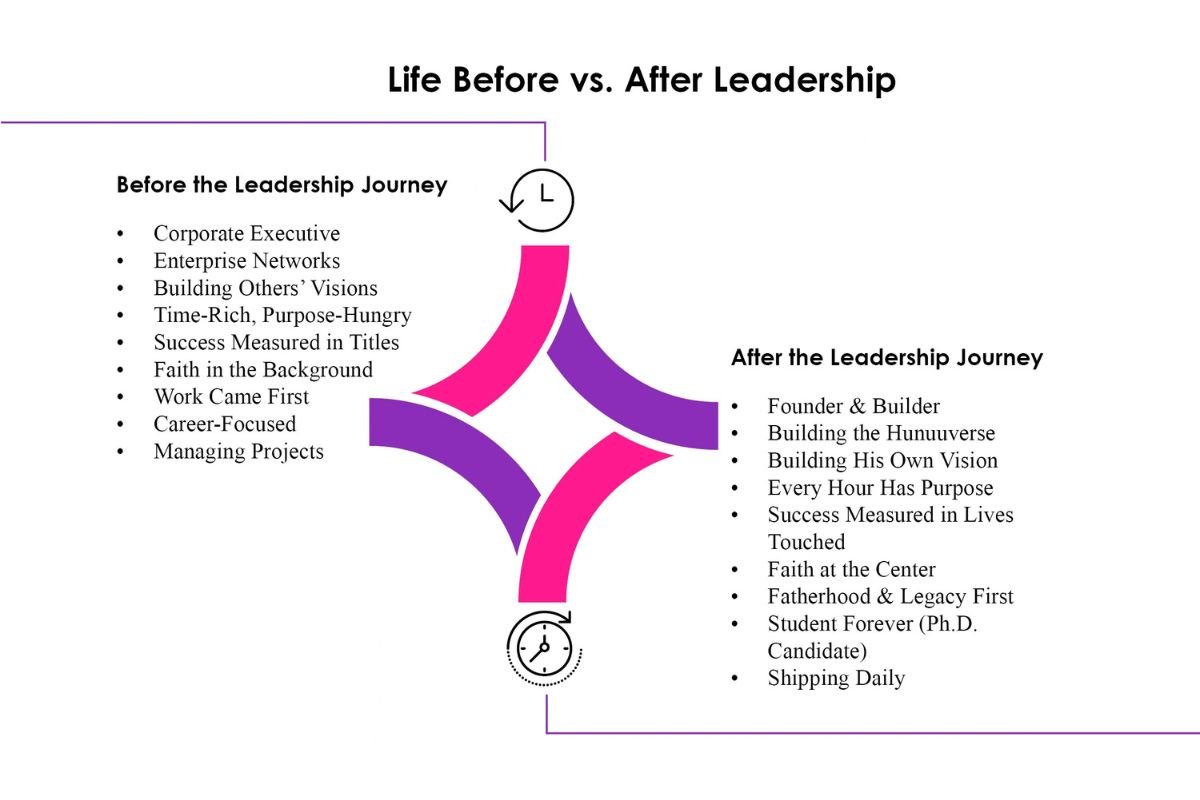
| Before the Leadership Journey | After the Leadership Journey |
| Corporate Executive | Founder & Builder |
| Enterprise Networks | Building the Hunuuverse |
| Building Others’ Visions | Building His Own Vision |
| Time-Rich, Purpose-Hungry | Every Hour Has Purpose |
| Success Measured in Titles | Success Measured in Lives Touched |
| Faith in the Background | Faith at the Center |
| Work Came First | Fatherhood & Legacy First |
| Career-Focused | Student Forever (Ph.D. Candidate) |
| Managing Projects | Shipping Daily |
A Day in a Leader’s Life
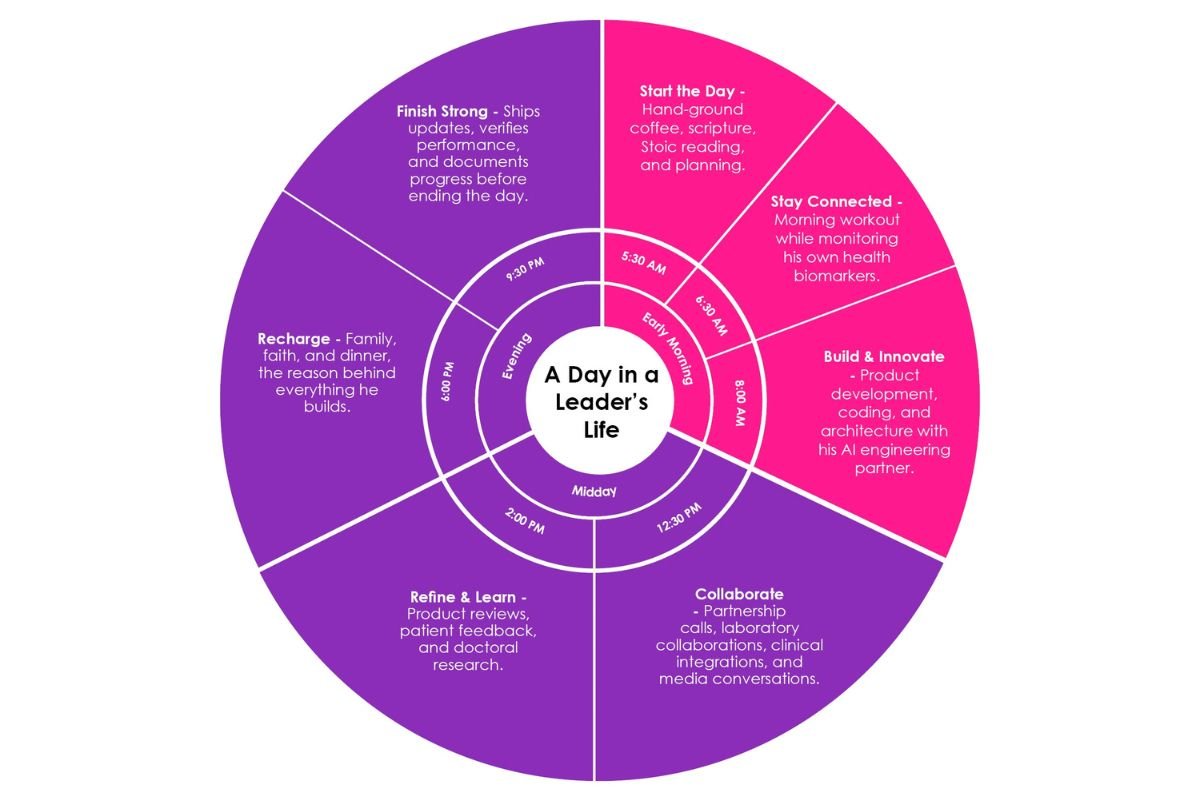
- Start the Day | 5:30 AM – Hand-ground coffee, scripture, Stoic reading, and planning.
- Stay Connected | 6:30 AM – Morning workout while monitoring his own health biomarkers.
- Build & Innovate | 8:00 AM – Product development, coding, and architecture with his AI engineering partner.
- Collaborate | 12:30 PM – Partnership calls, laboratory collaborations, clinical integrations, and media conversations.
- Refine & Learn | 2:00 PM – Product reviews, patient feedback, and doctoral research.
- Recharge | 6:00 PM – Family, faith, and dinner, the reason behind everything he builds.
- Finish Strong | 9:30 PM – Ships updates, verifies performance, and documents progress before ending the day.
| Open Letter To the Future Healthcare Entrepreneurs, Build for one person you love; the market is downstream of that. Healthcare doesn’t need more apps — it needs more conviction, and conviction comes from a face, not a spreadsheet. Second: measure your gaps instead of fearing them — a written, honest audit turns dread into a checklist. Third: own your mistakes the same day you make them; encode each lesson so it can’t repeat, then keep shipping. Fourth: guard your ethics before you have users, because the pressure to monetize people’s bodies arrives with success. Fifth: embrace AI as a partner, not a threat — the founder who pairs deep conviction with frontier tools outbuilds teams ten times larger. And walk in faith: do justly, love mercy, build humbly. The technology will change; those principles won’t. From, Matthew C. Standish, CEO & Founder |
Matthew’s Compass
Design Principle
“If she couldn’t have used it on the first try, it doesn’t ship.”
Life Principle
“Do justly, love mercy, walk humbly.” (Micah 6:8)
Key Takeaways

- Turning Healthcare from Reactive to Predictive
- Building Technology Around People, Not Just Data
- Leading with Resilience and Purpose
- Trust as the Foundation of Innovation
- Advancing Healthcare Beyond the Business