In fintech, trust is the currency behind every transaction. Building it requires more than technology; it requires discipline, resilience, and the courage to solve problems others overlook. For Usman Balogun, Co-Founder of Breet (Inbreetic Technologies Limited), that journey began with a simple observation: Africa needed a better way to move digital value. What started as a solution to a broken crypto-to-cash experience has grown into an ambition to build the financial infrastructure powering the next generation of payments across the continent.
Turning a Frustration into a Financial Solution
Every business begins with a problem that someone refuses to ignore. For Usman, that problem was impossible to miss. Across Africa, people were embracing cryptocurrency faster than ever, yet converting those digital assets into money they could actually spend remained frustrating, risky, and unreliable.
The only real option for most users was peer-to-peer (P2P) trading, which meant sending crypto to a stranger and hoping they would complete the payment. Too often, they didn’t. Some users were paid less than agreed, others were ghosted entirely, and many ended up receiving flagged funds that caused their bank accounts to be frozen.
As Usman Balogun spent time reading customer feedback and online discussions, he realized these weren’t isolated complaints. The same stories kept appearing over and over again. After months of observing the pattern, it became clear that this wasn’t just an inconvenience; it was the everyday reality for millions of people.
With a background in finance and operations, Usman looked beyond the symptoms and focused on the root cause. The issue wasn’t that people couldn’t trade safely; it was that the financial infrastructure simply wasn’t built to support seamless crypto-to-cash transactions.
That realization led him and his co-founder to launch Breet in 2021. Their vision was straightforward: build the missing settlement layer that would allow users to receive cryptocurrency, convert it instantly, and have local currency deposited directly into their bank accounts, without negotiating with strangers or relying on risky peer-to-peer exchanges.
The defining moment came when Usman realized the answer wasn’t to create a better peer-to-peer marketplace. The real solution was to remove the need for peer-to-peer trading altogether. Instead of depending on human counterparties, Breet introduced an automated settlement process that enables users to convert their crypto into local currency quickly, securely, and without the uncertainty that had become the norm. That shift in perspective became the foundation on which the company was built.
Crypto Settlements with Automation
What makes Breet different is its decision to remove the human element from the riskiest part of crypto transactions. While much of Africa’s crypto market still relies on P2P trading, Breet took a different approach. It replaced the process with an automated settlement engine that converts crypto into local currency instantly, eliminating the need for a human counterparty. It became the first platform in Africa to fully automate crypto off-ramping.
According to Usman Balogun, the real innovation isn’t a single feature but the infrastructure behind it. Breet’s proprietary liquidity routing system and redundant payout network keep funds ready for instant settlement while intelligently routing transactions across multiple payment partners and banking channels. If one route fails, another takes over seamlessly, ensuring users never experience disruptions.
What started as a consumer product has since grown into financial infrastructure. Through Breet’s API, businesses can accept crypto payments and settle in local currency without building their own settlement systems. “We started by serving consumers,” says Usman, “and today we’re powering businesses as well.”
Lessons Learned from Building a Reliable Financial Infrastructure
To Usman Balogun, building Breet has been as much about solving technical challenges as it has been about earning people’s trust. Looking back, two moments stand out as defining experiences in the company’s journey.
The first was ensuring reliability. Since Breet is a settlement platform, every transaction carries a promise that users will receive their money quickly and without complications. That promise was put to the test when one of the company’s payout providers unexpectedly stopped its services on a Friday afternoon, just as weekend transaction volumes were picking up. Suddenly, one of Breet’s key payment channels was gone, leaving the team scrambling to ensure users still received their funds on time.
The crisis was resolved, but it changed the way Usman thought about the business. He realized that no settlement platform should ever depend on a single provider. From that point on, Breet invested in building multiple payment partnerships and backup channels, ensuring there was always another route available if one failed. The impact of that decision became clear during a later NIBSS outage, when payments were automatically redirected through alternative channels, and customers experienced no interruption.
The second challenge was navigating compliance across different markets. For Usman, expanding a financial business isn’t just about growing quickly; it’s about growing responsibly. That meant investing time in building a strong compliance framework from the outset. Breet went on to secure its Money Services Business registration with FINTRAC in Canada, along with PCI DSS and ISO 27001 certifications, creating a solid foundation for future growth.
These experiences shaped Usman’s approach to leadership. He believes that in financial services, trust isn’t built through promises alone. It’s built through consistency, careful planning, and doing the hard work behind the scenes. When the systems are reliable and the compliance framework is strong, customers can focus on what matters most: knowing their money is in safe hands.
Earning Trust Through Transparency

Usman Balogun believes trust is the foundation of fintech. No matter how innovative the technology is, a business can only succeed if people feel confident using it.
That belief is reflected in how Breet is built. The platform is non-custodial, meaning it never holds users’ cryptocurrency. It is PCI DSS and ISO 27001 certified, complies with the Nigeria Data Protection Act, and is registered as a Money Services Business with FINTRAC in Canada. Before entering a new market, Breet ensures the necessary licences and regulatory partnerships are already in place, making compliance a starting point rather than an afterthought.
Usman believes trust is also built by listening to customers. One example is Breet’s pricing model. The company originally earned revenue through a conversion spread, which worked well commercially but wasn’t as transparent as customers wanted. After reviewing user feedback and transaction data, the team introduced a simple pricing structure with a clear exchange rate and a small, visible fee.
The change wasn’t just about pricing; it was about building confidence. When customers understand exactly what they’re paying, they feel more comfortable using the platform. And for Usman, that’s what creates lasting relationships. In fintech, trust isn’t earned through marketing; it’s built through transparency, consistency, and doing the right thing every time.
Leading with Data and Discipline
Usman’s leadership philosophy is simple: let data drive decisions, not opinions. He believes great ideas can come from anyone, which is why he gives his team clear ownership and measures success by results rather than hours worked.
That approach shapes Breet’s culture. The team documents decisions, challenges ideas with data instead of ego, and moves quickly without compromising on quality.
One decision, in particular, reflects this mindset. As Breet prepared to expand, there was pressure to enter new markets first and sort out licensing later. Usman chose the opposite path. He insisted on completing the compliance work first, including securing Breet’s Money Services Business registration with FINTRAC, before scaling. It wasn’t the quickest route, but it earned the trust of partners and customers alike.
For Usman Balogun, that’s how lasting businesses are built: get the foundation right first, then grow with confidence.
The Achievement That Matters Most
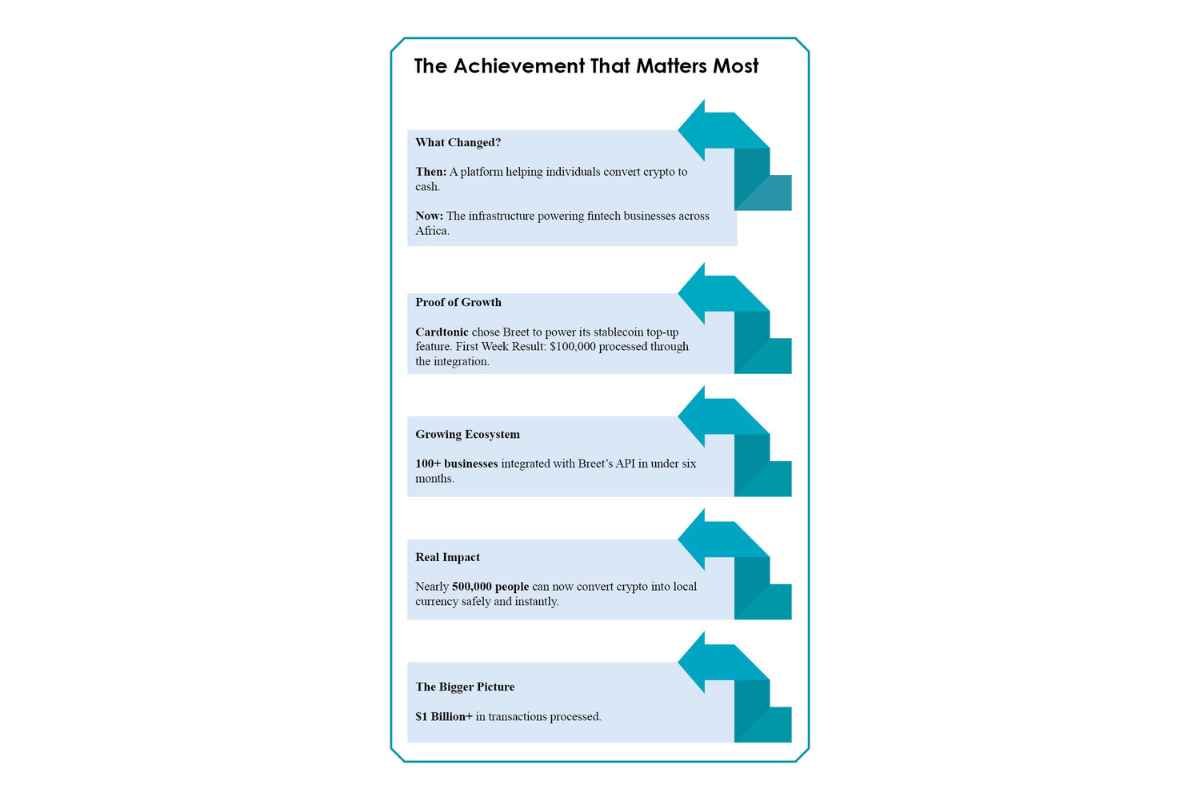
What Changed?
- Then: A platform helping individuals convert crypto to cash.
- Now: The infrastructure powering fintech businesses across Africa.
Proof of Growth
- Cardtonic chose Breet to power its stablecoin top-up feature. First Week Result: $100,000 processed through the integration.
Growing Ecosystem
- 100+ businesses integrated with Breet’s API in under six months.
Real Impact
- Nearly 500,000 people can now convert crypto into local currency safely and instantly.
The Bigger Picture
- $1 Billion+ in transactions processed.
Building for the Future of Africa’s Digital Economy
As fintech continues to grow, Usman Balogun believes the biggest transformation will come from technologies that make moving money simpler, faster, and more reliable. While several innovations are shaping the industry, he sees three trends leading the way:
- Stablecoins: Usman believes stablecoins will become the default rails for cross-border payments across Africa. They offer fast, dollar-denominated transactions while eliminating many of the delays and costs associated with traditional correspondent banking.
- Embedded Finance: As financial services become part of everyday software, businesses will gradually need payment and settlement capabilities built directly into their platforms.
- Artificial Intelligence: AI will play a critical role behind the scenes by strengthening fraud detection, risk management, and regulatory compliance at a speed and scale that manual processes cannot match.
For Breet, these aren’t future possibilities; they are already shaping the business. The company’s API enables businesses to accept cryptocurrency and settle instantly in local currency without having to build the underlying infrastructure themselves. Usman also believes Breet’s early investment in licensing and compliance will become an even greater advantage as stablecoin regulations continue to mature.
Beyond building products, Usman actively contributes to conversations shaping Africa’s fintech ecosystem. His thought leadership includes:
- Writing and speaking about why automated settlement offers a more reliable alternative to P2P trading.
- Publishing the widely read State of P2P in Nigeria report, encouraging industry discussions backed by data rather than opinion.
- Supporting emerging entrepreneurs through the Breet Builder Grant, helping the next generation of innovators build solutions for Africa’s digital economy.
The Road Ahead for Breet
Usman Breet’s journey is just getting started. His ambition isn’t simply to build another fintech company; it’s to create the infrastructure that powers the movement of digital value across Africa.
He envisions Breet becoming the settlement layer that businesses, banks, and fintech companies rely on behind the scenes to move money across borders quickly and seamlessly. With operations already established in Nigeria and Ghana, the company is expanding into Kenya, Tanzania, and Zambia, bringing that vision to more markets.
Usman also believes stablecoins will play a key role in connecting African economies to the rest of the world by making cross-border payments faster and less dependent on traditional banking systems. “The world’s next payment infrastructure will be built in and for emerging markets, because that is where the problems are hardest, and the need is greatest,” he says. His goal is for Breet to prove that world-class financial infrastructure can be built in Africa, and trusted anywhere in the world.
A Vision That Goes Beyond Payments
The legacy Usman wants to create through Breet is simple: trust. He wants the company to be remembered for making digital payments across Africa safer, faster, and more dependable.
Beyond business growth, he hopes Breet proves that world-class financial infrastructure can be built from Africa through discipline, compliance, and innovation. If the next generation of founders feels inspired to dream bigger and build stronger because of Breet’s journey, that will be the legacy that matters most.
A Journey from Operations to Leadership
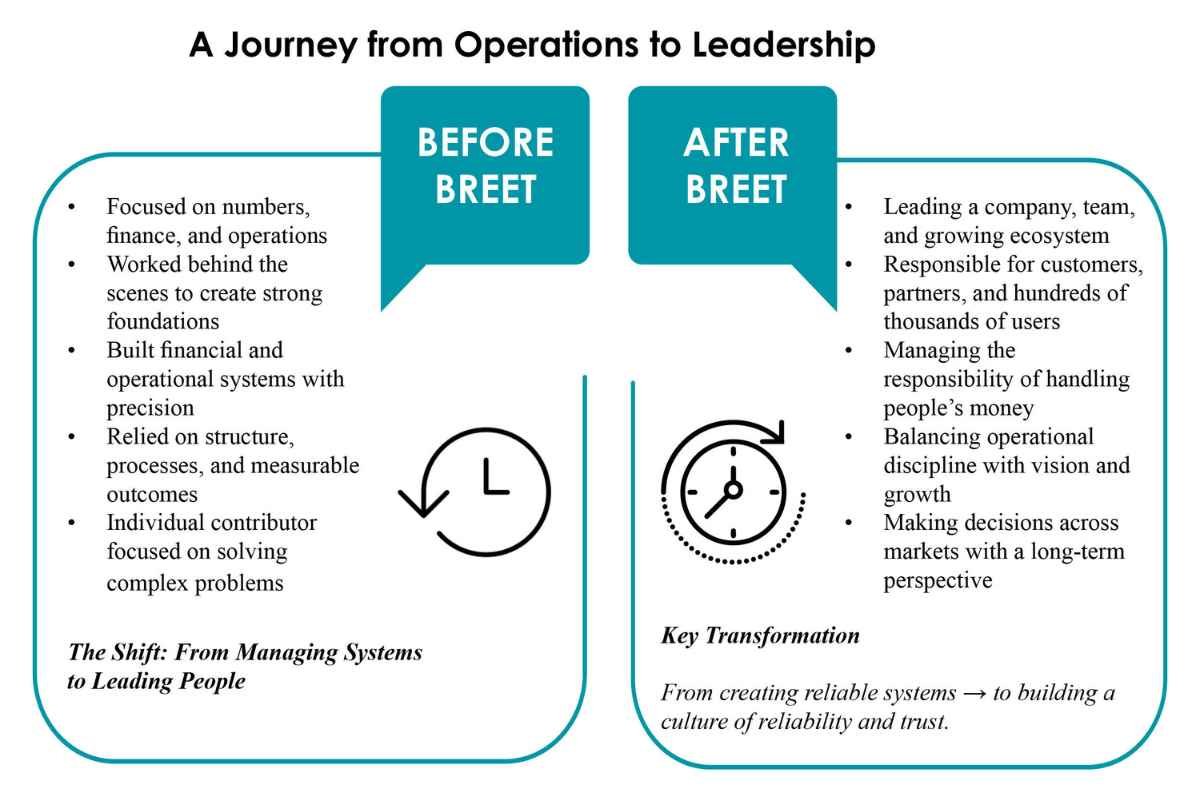
BEFORE BREET
- Focused on numbers, finance, and operations
- Worked behind the scenes to create strong foundations
- Built financial and operational systems with precision
- Relied on structure, processes, and measurable outcomes
- Individual contributor focused on solving complex problems
The Shift: From Managing Systems to Leading People
AFTER BREET
- Leading a company, team, and growing ecosystem
- Responsible for customers, partners, and hundreds of thousands of users
- Managing the responsibility of handling people’s money
- Balancing operational discipline with vision and growth
- Making decisions across markets with a long-term perspective
Key Transformation
From creating reliable systems → to building a culture of reliability and trust.
A Day in a Leader’s Life
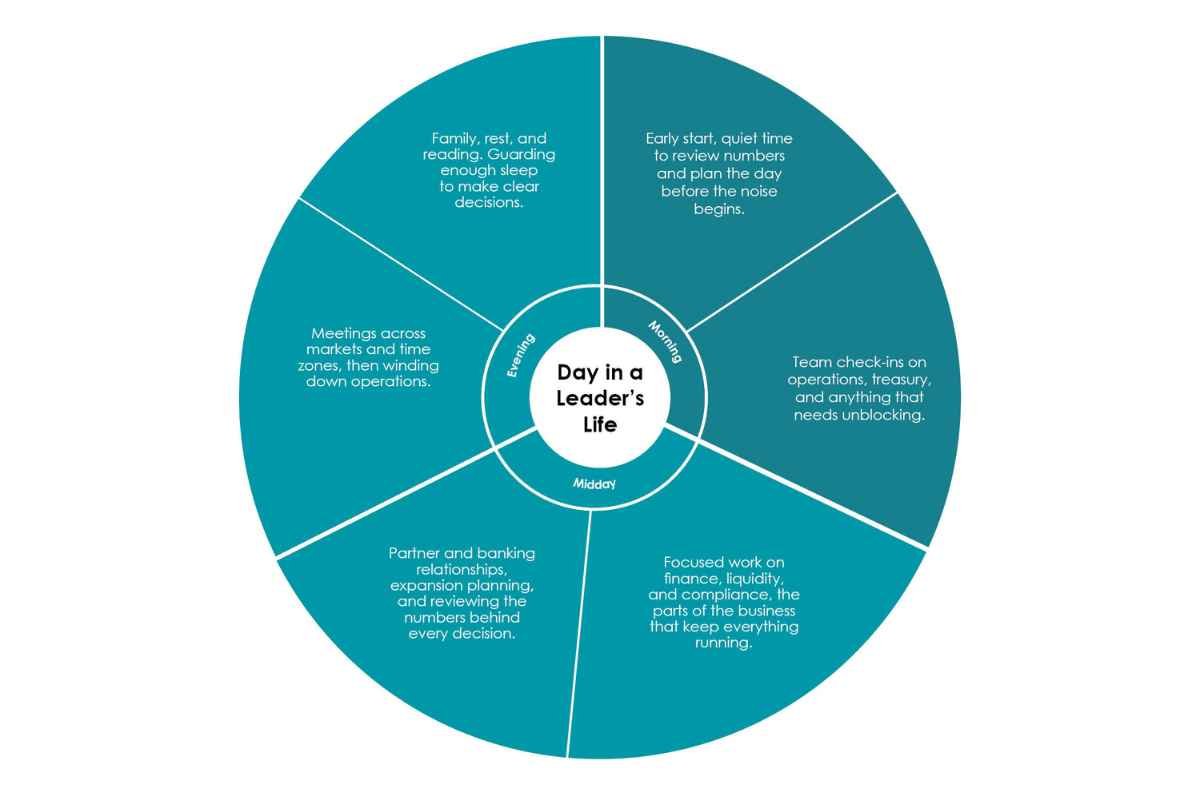
- Early Morning: Early start, quiet time to review numbers and plan the day before the noise begins.
- Start of Workday: Team check-ins on operations, treasury, and anything that needs unblocking.
- Midday: Focused work on finance, liquidity, and compliance, the parts of the business that keep everything running.
- Key Work Priorities: Partner and banking relationships, expansion planning, and reviewing the numbers behind every decision.
- Evening: Meetings across markets and time zones, then winding down operations.
- Night / Wind-down: Family, rest, and reading. Guarding enough sleep to make clear decisions.
| Open Letter To the Next Generation of Fintech Entrepreneurs, To everyone aspiring to build the next great fintech company, my advice is to respect the fundamentals. It is easy to be seduced by growth, funding, and hype, but a business either works on the numbers or it does not, and no amount of story fixes bad economics. Build something people genuinely need, charge for it honestly, and make sure the unit economics improve as you grow.My biggest lesson is that discipline compounds. We built Breet profitably and self-funded by treating compliance, reliability, and clean economics as non-negotiable from day one. That discipline felt slow at times, but it is exactly why we are still standing, trusted, and independent. In finance, the boring things are the ones that last. From, Usman Balogun, Co-Founder, Breet |
Key Takeaways
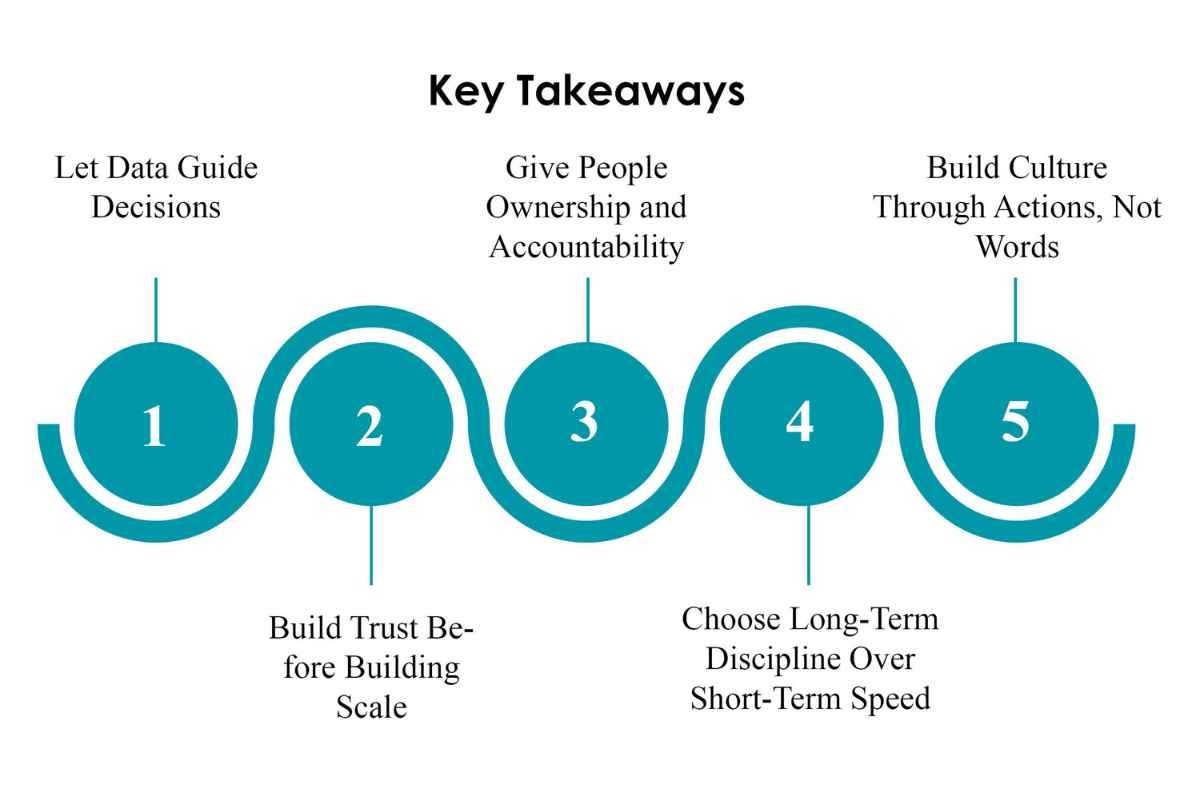
- Let Data Guide Decisions
- Build Trust Before Building Scale
- Give People Ownership and Accountability
- Choose Long-Term Discipline Over Short-Term Speed
- Build Culture Through Actions, Not Words
Quick Takes
- One tool I recommend: Notion, for keeping thinking, decisions, and documentation in one place.
- One quote that motivates me: “Revenue is vanity, profit is sanity, cash is king.”
- One piece of advice: Respect the fundamentals. Build something real, charge honestly, and keep your economics clean.
- One book to experience: The Diary of a CEO by Steven Bartlett.