


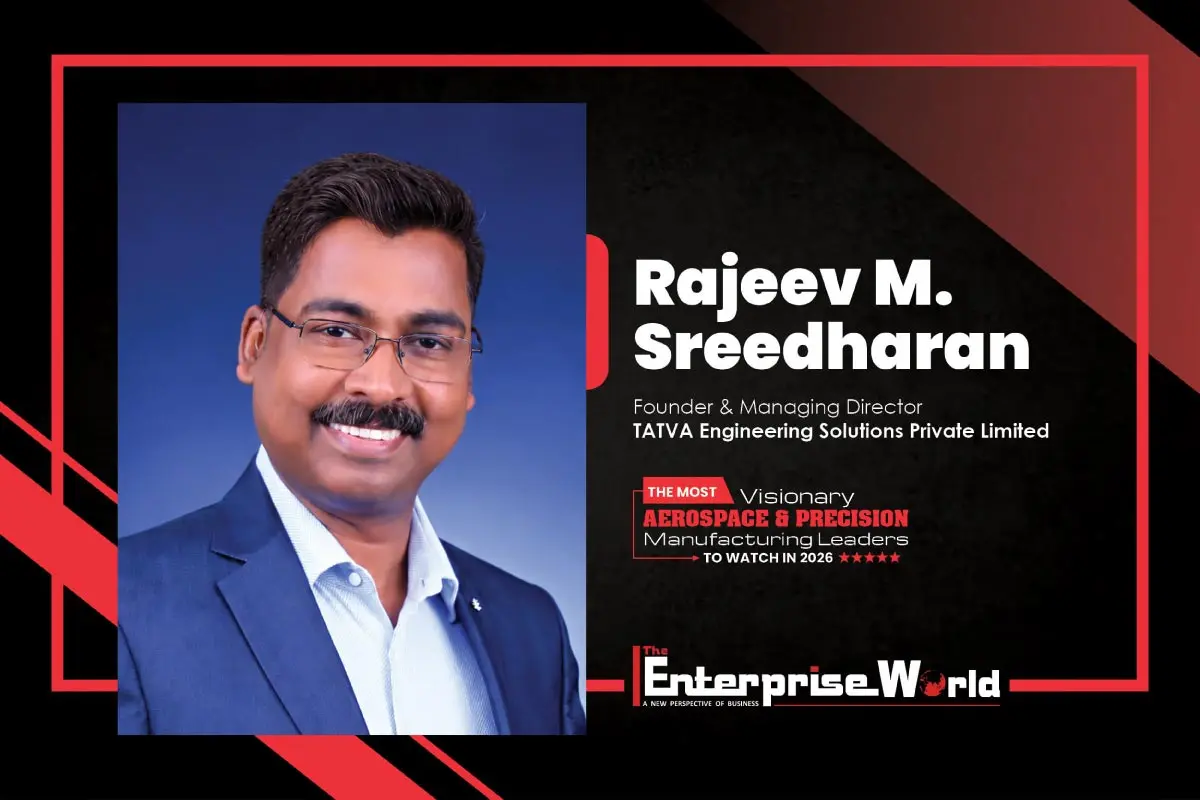
A drawing becomes a flight-ready component only when someone plans every step between the page and the machine. Rajeev M. Sreedharan, Founder & Managing Director of TATVA Engineering Solutions Private Limited, has spent more than 30 years mastering that gap. His career spans aerospace, defence and space programmes, including components for ISRO launch vehicles and commercial aircraft programmes.
In 2026, he turned that experience into TATVA, a Bengaluru company that combines process engineering, CNC software and training. This cover story examines how Rajeev builds capability on shop-floor fundamentals, validates ideas on real machines and prepares TATVA for what comes next.
Founding lessons in precision
Rajeev founded TATVA Engineering Solutions after more than 30 years in precision manufacturing, including over 20 years connected with aerospace, defence and space programmes. His career covered shop-floor engineering, process planning, product development, quality systems and senior operations at Godrej Aerospace, Walchandnagar Industries, Magellan Aerospace, PMI Engineering, Maini Precision Products and Ethereal Machines. Rajeev contributed to components for ISRO’s GSLV and PSLV launch vehicles and commercial aircraft programmes supplied to Airbus and Boeing.
Across these roles, he observed companies invest in capable machines yet struggle to convert drawings into stable, economical and repeatable processes. He established TATVA in 2026 to solve this. Turning experience into repeatable systems and intellectual property became his first challenge; building credibility while staying lean followed.
As Rajeev M. Sreedharan states, “Stay technically grounded, collaborate where needed, commit only to what we can deliver, and let results build the brand.”
The capability behind TATVA AXIS
Rajeev positions TATVA AXIS around precision manufacturing engineering, with process planning at its centre. His team handles aerospace manufacturing consultancy, PPAP and First Article Inspection (AS9102) documentation, PFMEA, control plans, RFQ estimation, cost engineering, AS9100-based QMS advisory, CNC programming support, corporate training and software products.
Rajeev backs these services with hands-on exposure to multi-axis machining, macro programming, and titanium, Inconel, and other high-performance alloys, under aerospace quality discipline.
He examines every requirement as a complete manufacturing problem, covering machine capability, datum strategy, workholding, tooling, inspection, risk, cycle time, and operator usability. This view matters in low-volume, high-complexity work, where one weak planning decision creates costly problems.
“Process planning decides how a part will behave on the machine, so every choice carries a cost on the shop floor,” Rajeev M. Sreedharan states.
Technology built for the shop floor
Technology forms a main growth pillar at TATVA, and Rajeev builds it around real shop-floor needs. TATVA CNC PROG HUB V2.0 (current version), the company’s first commercial software product, automates and standardises selected CNC programming tasks while keeping the output readable for programmers and operators.
TATVA CAM Studio, now in development, targets turning and turn-mill applications. In consulting, his team applies process planning, simulation, documentation and data-based analysis to validate methods, reduce risk and raise process efficiency. Rajeev also explores responsible AI use for research, documentation and decision support, with engineering judgement and verification in the loop. Automation removes repetitive effort, captures knowledge and frees engineers for decisions that demand experience.
“Technology earns its place only when it makes the shop floor simpler, safer and more consistent. Fundamentals always come first,” affirms Rajeev M. Sreedharan.
Challenges proven on the machine
Rajeev measures every engineering claim against a real machine.
The Test:
Client engagements at TATVA remain confidential, so Rajeev M. Sreedharan cites one public example: TATVA CNC PROG HUB. Generating G-code on a screen is simple. Producing code that a machinist trusts on a real machine is far harder. Rajeev treated the software as a manufacturing process. His team reviewed program logic, safe-start blocks, cutter compensation behaviour, drilling cycles, retract conditions, and user inputs from a machinist’s perspective.
“A program is finished only when a machinist trusts it on a real machine. Simulation is the start, and the test cut gives the answer,” stresses Rajeev.
The Proof:
Before Version 1.2 reached users, the code went beyond simulation and passed a real CNC test cut, supported by Spartamech Machines LLP. User feedback then shaped the next release. Rajeev applies the same sequence to every customer challenge: he identifies the manufacturing risk, validates assumptions, keeps the process transparent, and closes the loop with real-world feedback.
An approach built on fundamentals
Rajeev M. Sreedharan begins with fundamentals and treats process planning, tooling, CNC programming, inspection, and quality documentation as one connected system built in 5 links.
- Understand: Rajeev studies the functional requirements and critical characteristics.
- Plan: He sets datums, operation sequence, process flow, workholding, tool accessibility, machining allowances, and machine selection.
- Protect: FMEA thinking, configuration control, and verification points build risk into the plan.
- Document: PPAP and FAI packages, with ballooned drawings, PFMEA, control plans, and dimensional reports; plan evidence in advance instead of collecting it afterwards.
- Prove: He proves the process and feeds shop-floor learning back into the plan.
Templates, macros and software standardise repetitive logic, and Rajeev designs every process for operator usability. He defines efficiency as reduced uncertainty: fewer avoidable trials, fewer interpretation errors, better first-time-right performance and greater repeatability.
“A process that operators cannot follow consistently is not robust, however correct it looks on paper,” maintains Rajeev.
The success stories clients keep close
Confidentiality agreements shield customer details, so Rajeev M. Sreedharan measures impact through the problems TATVA solves. His team converts drawings into executable process plans and prepares PPAP and FAI packages that withstand review. It supports estimation and manufacturability reviews and develops CNC programs easier to prove and maintain.
“Our impact shows in the problems we solve, and the confidence engineers and operators gain, because understanding why a process works matters as much as knowing what to do,” shares Rajeev.
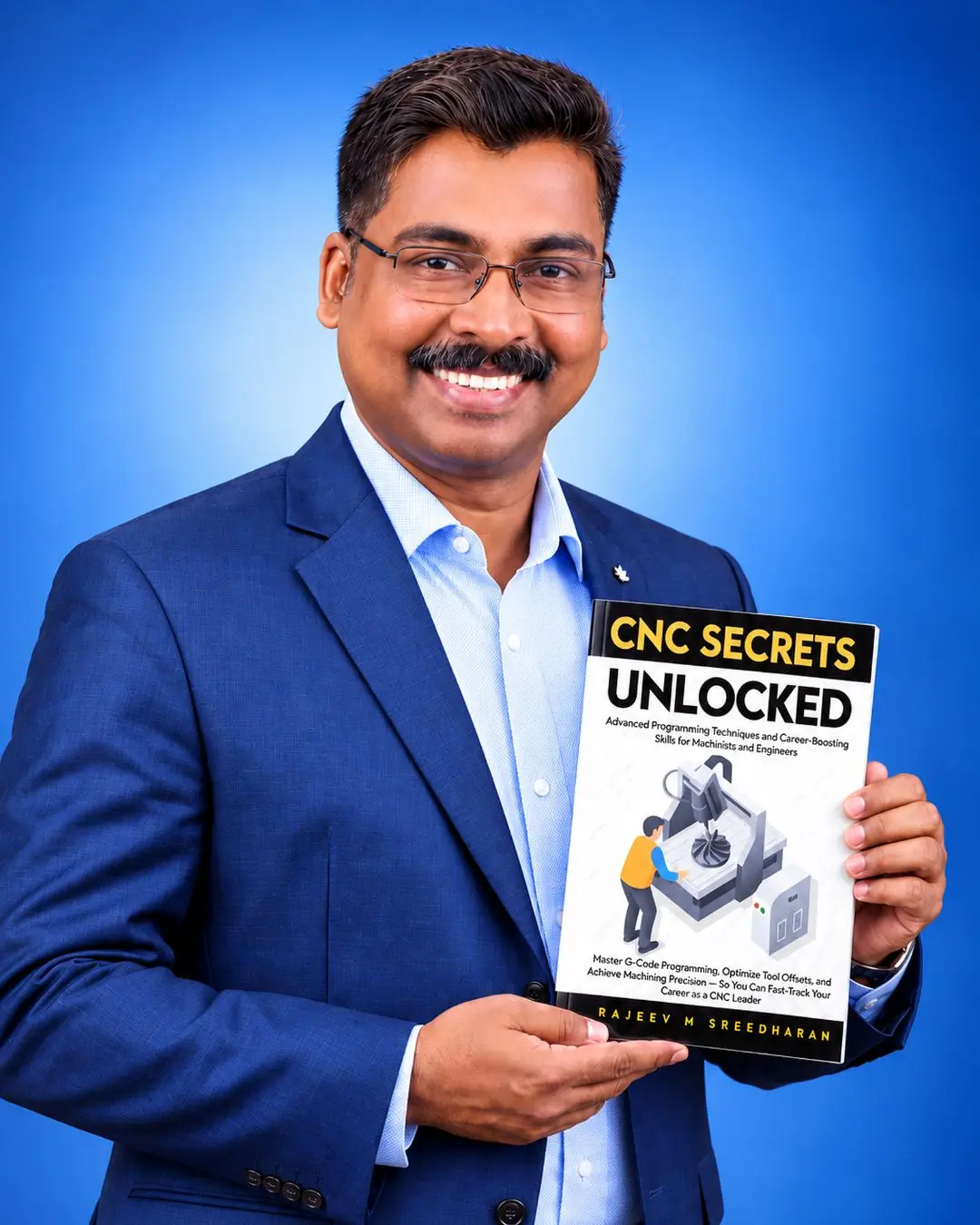
Specialist collaborators join projects that need expertise, which keeps TATVA lean. Spartamech Machines LLP, the machine-validation partner on TATVA CNC PROG HUB, offers one public example. TATVA CNC Academy, training, and Rajeev’s book, “CNC Secrets Unlocked,” bring knowledge to students, engineers, and professionals.
Standards that stand up to scrutiny
Quality, safety, and compliance shape every TATVA engagement. Rajeev M. Sreedharan’s team applies AS9100 disciplines covering configuration control, traceability, and PFMEA/DFMEA, plans workholding and safe approach, and protects customer information under NDAs.
“Quality must be designed into the process from the beginning, never added at the end,” asserts Rajeev.
- ISO 9001:2015 certification from ICV Assessments Pvt. Ltd. (Certificate No. IN/35526194/2984), covering CNC programming, machining process planning, fixture designing, manufacturing consulting, and technical training.
- ISO 9001/AS9100 internal auditor qualifications.
- Advanced Strategic Management training from IIM Kozhikode.
- 2026 jury member and assessor for WorldSkills-linked Post National Technical Skill Assessments (CNC Milling) at GTTC, Bengaluru.
- Author of “CNC Secrets Unlocked” (Amazon, 2025).
Each credential reflects Rajeev’s disciplined practice.
Building TATVA for what comes next
Rajeev M. Sreedharan identifies 5 forces shaping aerospace and precision manufacturing, while India gains an opportunity as production expands.
The 5 Forces
- Localisation of critical supply chains
- Rising pressure on cost and lead time
- Digital traceability
- AI-assisted engineering
- A widening skills gap
Competitiveness demands stronger process engineering, configuration control, repeatability and data discipline, so Rajeev builds TATVA on 3 pillars.
The 3 Pillars
- Consult: TATVA AXIS delivers consulting to aerospace, defence and high-precision manufacturers, starting with the Bengaluru aerospace cluster and reaching other hubs and export customers.
- Build: TATVA CNC PROG HUB and TATVA CAM Studio convert practical knowledge into repeatable digital tools.
- Teach: TATVA CNC Academy builds capability through training and online learning.
Rajeev wants TATVA recognised for clear, practical solutions.













