The Emerald City That Thinks in Code, Caffeine, and Chords
Where the City Thinks Before It Speaks
Seattle does not announce itself loudly; it hums. Rain taps against glass, coffee machines hiss at dawn, ferries cut through grey water, and somewhere behind lit windows, lines of code quietly compile. The city moves at its own frequency, favouring depth over display and substance over spectacle. Framed by water and mountains and wrapped in evergreen forests, Seattle feels less built and more carefully assembled, deliberate in its choices, restrained in its expression.
They call it The Emerald City, and not merely for its colour. Seattle earns that name through continuity: nature woven into neighbourhoods, ambition tempered by introspection, and innovation grounded in patience rather than urgency. Here, progress grows slowly and steadily, like moss on concrete, unassuming, resilient, and designed to last.
A Skyline Anchored by Imagination
Seattle’s most recognisable symbol, the Space Needle, does not dominate the skyline so much as punctuate it as a reminder of optimism, futurism, and a mid-century belief that technology could be elegant. Built for the 1962 World’s Fair, it still carries that era’s quiet confidence: that design, science, and public imagination could coexist.
Nearby, Pike Place Market operates on an entirely different frequency. Loud, local, unscripted. Fish fly through the air, vendors trade stories as readily as produce, and the city’s relationship with food, people, and place plays out in real time. It is messy, human, and fiercely alive.
This contrast defines Seattle. High-concept thinking balanced by grounded ritual. Innovation paired with intimacy.
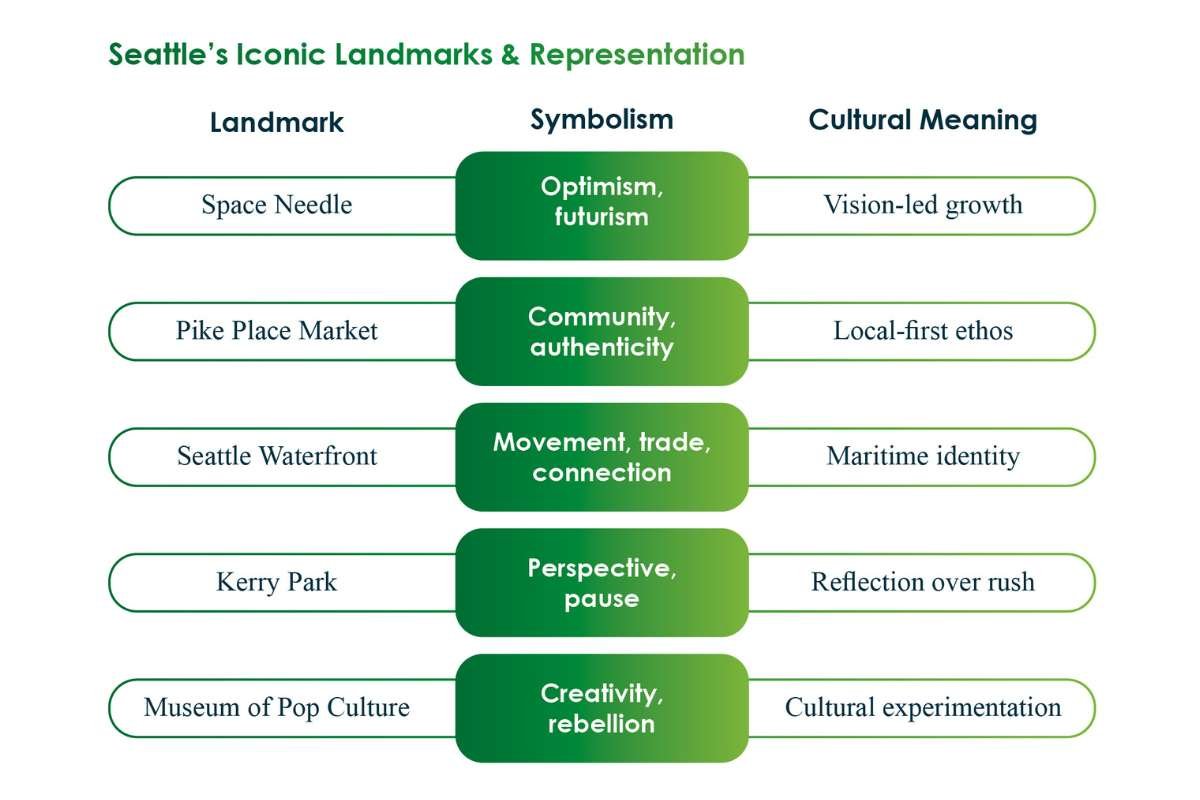
| Seattle’s Iconic Landmarks & Representation | ||
|---|---|---|
| Landmark | Symbolism | Cultural Meaning |
| Space Needle | Optimism, futurism | Vision-led growth |
| Pike Place Market | Community, authenticity | Local-first ethos |
| Seattle Waterfront | Movement, trade, connection | Maritime identity |
| Kerry Park | Perspective, pause | Reflection over rush |
| Museum of Pop Culture | Creativity, rebellion | Cultural experimentation |
The City That Runs on Coffee and Code
Seattle does not consume coffee; it curates it. Long before Starbucks became a global shorthand, the city had already built a culture around cafés as informal offices, creative studios, and social commons. Coffee here is not an accessory, it is infrastructure.
Ideas are shaped over espresso, revised over refills, and finalised somewhere between the second and third cup. Cafés double as meeting rooms, writing desks, and thinking spaces, reflecting a city that values contemplation as much as output.
That same ethos fuels Seattle’s tech ecosystem. Home to Microsoft and Amazon, the city has shaped global technology not through flash, but through infrastructure, systems, and scale. This is not a culture of hype; it is a culture of execution. Software is written with patience. Companies are built for longevity. The future arrives here incrementally, then everywhere else all at once.
Seattle’s Innovation Economy
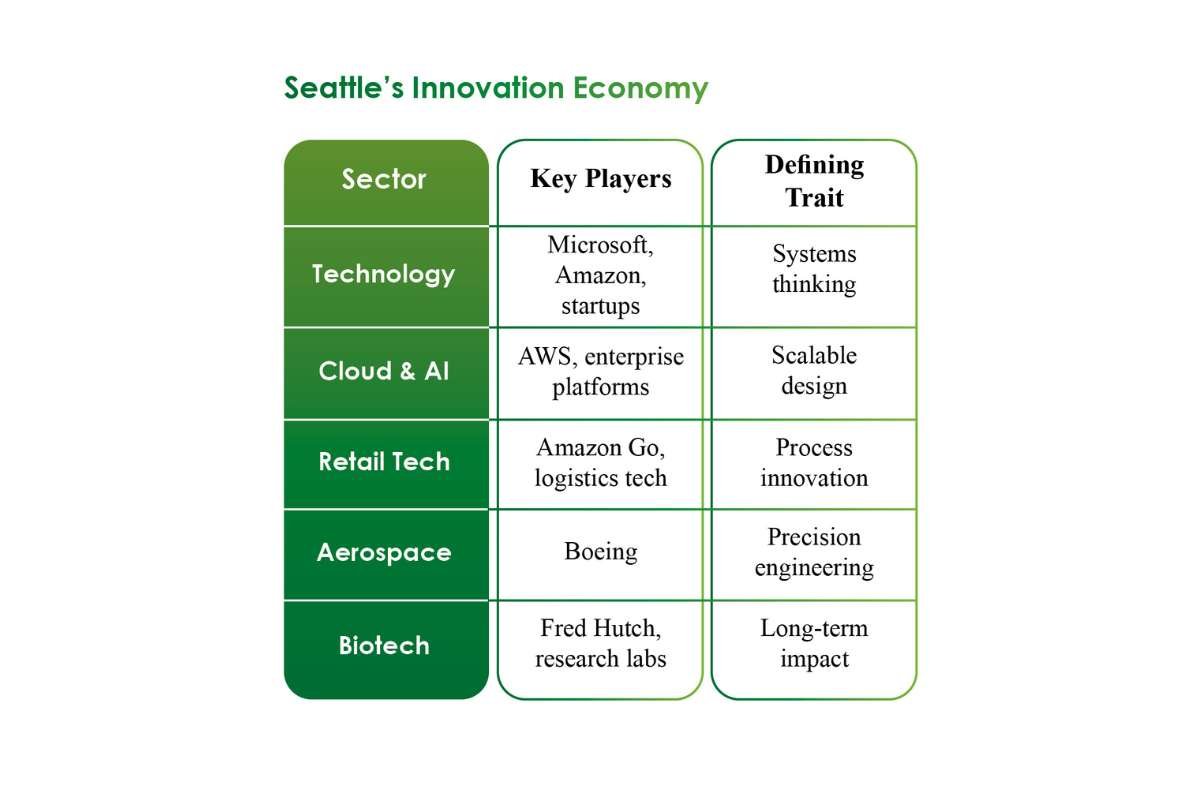
| Sector | Key Players | Defining Trait |
| Technology | Microsoft, Amazon, startups | Systems thinking |
| Cloud & AI | AWS, enterprise platforms | Scalable design |
| Retail Tech | Amazon Go, logistics tech | Process innovation |
| Aerospace | Boeing | Precision engineering |
| Biotech | Fred Hutch, research labs | Long-term impact |
Soundtracks of Rebellion and Reinvention
Seattle’s cultural influence travels far beyond its size, largely because of its music. Grunge did not emerge as a trend; it surfaced as a response. Raw, unpolished, and resistant to excess, it mirrored the city’s temperament: anti-glamour, anti-pretense, deeply authentic.
Nirvana, Pearl Jam, Soundgarden these were not just bands, but expressions of place. Their sound carried Seattle’s overcast skies, introspective moods, and quiet defiance.
Then there is Jimi Hendrix, whose legacy lingers less as nostalgia and more as proof that Seattle understands creative risk. Music here has always been a language of defiance, introspection, and identity less about performance, more about truth.
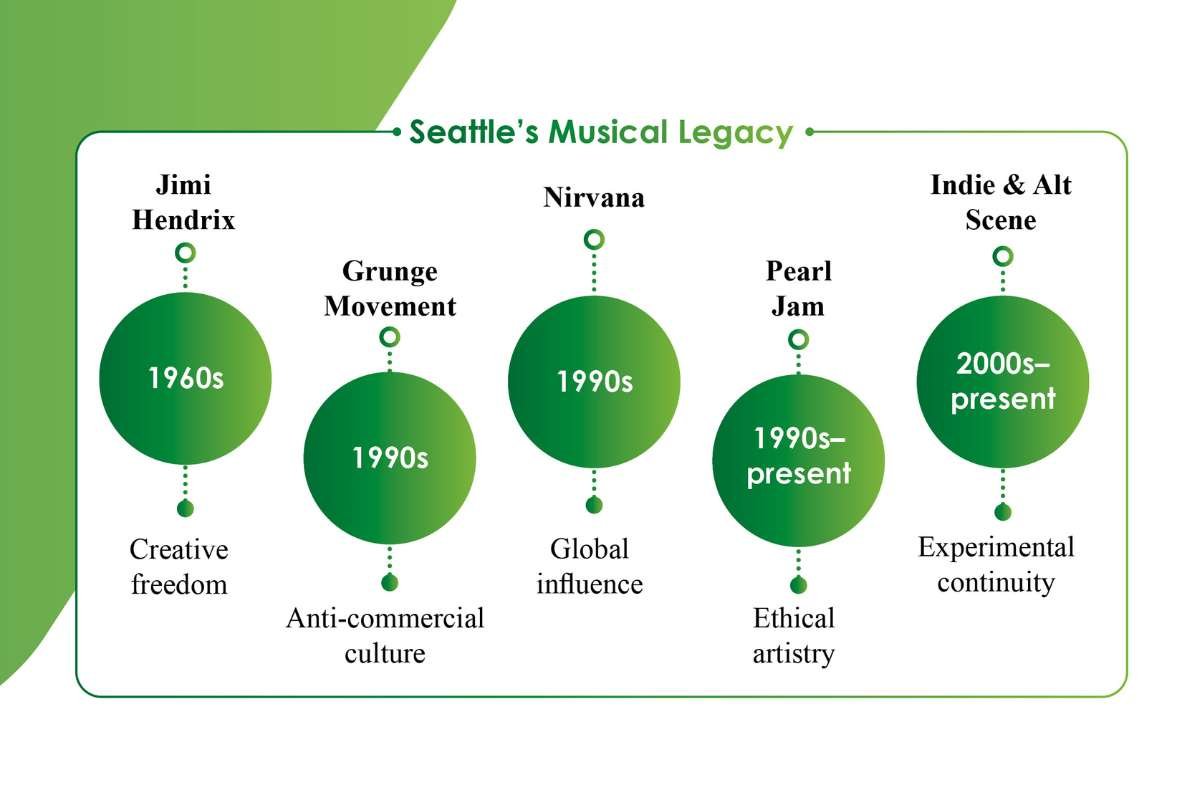
| Seattle’s Musical Legacy | ||
|---|---|---|
| Artist / Movement | Era | Cultural Impact |
| Jimi Hendrix | 1960s | Creative freedom |
| Grunge Movement | 1990s | Anti-commercial culture |
| Nirvana | 1990s | Global influence |
| Pearl Jam | 1990s–present | Ethical artistry |
| Indie & Alt Scene | 2000s–present | Experimental continuity |
Rom-Com Rain and Cinematic Memory
Pop culture has immortalised Seattle as a city of longing and reflection. Films like 10 Things I Hate About You and Sleepless in Seattle leaned into its weather, its bookish charm, its emotional pauses. Rain becomes a narrative device; the skyline, a backdrop for self-discovery.
Seattle on screen is rarely frantic. Characters think here. They hesitate. They grow. The city does not rush them on screen or off. It offers space for becoming.
Neighbourhoods as Personalities
Seattle is not a single story but a collection of neighbourhoods, each with its own rhythm and logic. Capitol Hill hums with activism, art, and nightlife. Ballard leans into its Nordic roots and maritime calm. Fremont calls itself “the centre of the universe” and half-believes it. Queen Anne watches from above, while South Lake Union builds quietly below.
Each neighbourhood feels intentional, not accidental designed to support different ways of living, thinking, and creating.
Read more:
- 20 Most Liberal Cities in the US Where Community Meets Progress
- Top 10 Most Walkable Cities in the US (2026): Where Every Step Tells a Story
Nature as Infrastructure
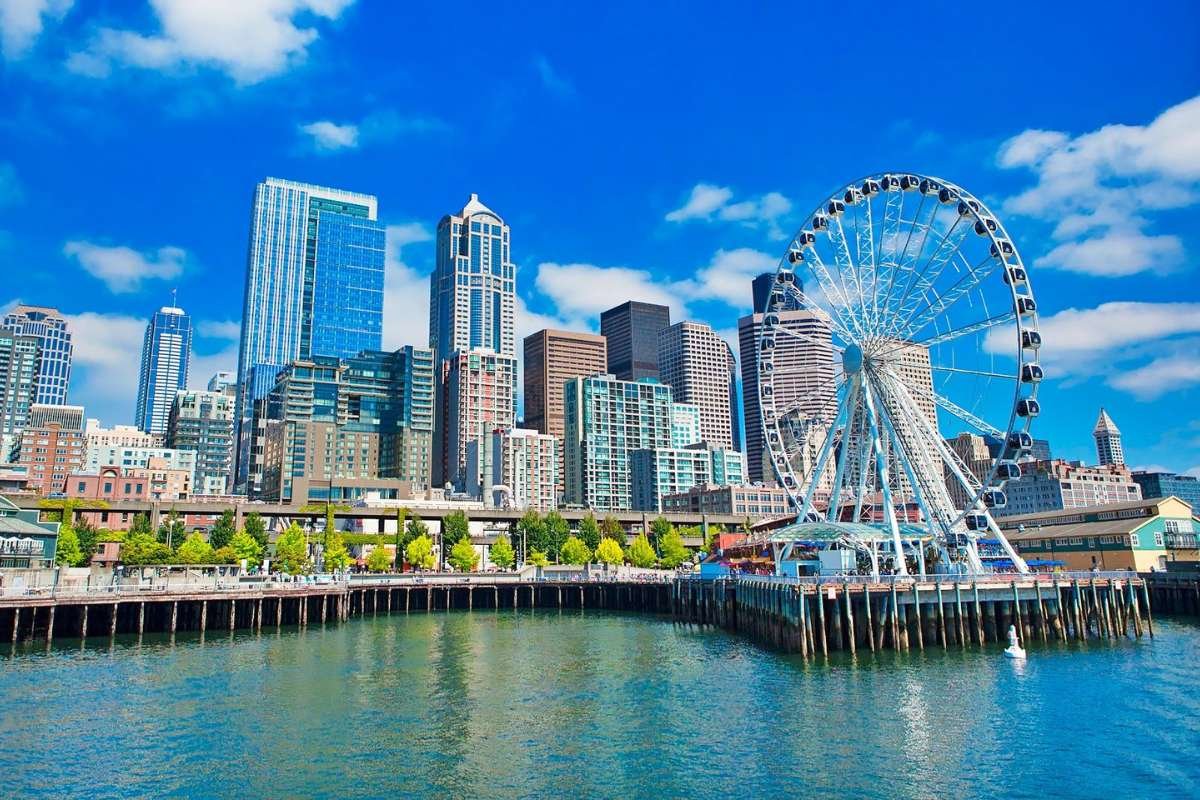
What ultimately sets Seattle apart is how seamlessly the natural world integrates into daily life. Forests edge residential streets. Water defines commutes. Mountains frame ambition. Outdoor culture here is not performative; it is habitual.
Hiking, kayaking, ferry rides, and urban trails are woven into routine, not reserved for weekends. Sustainability is not branding it is behaviour, embedded into planning, transport, and lifestyle.
The city breathes slowly, deliberately, and green.
The Business of Being Thoughtful
Seattle’s economy reflects its personality. Growth is strategic rather than reckless, and innovation is measured rather than impulsive. The city prioritises resilience, environmental, economic, and cultural over speed, choosing durability over disruption for its own sake.
Startups coexist with legacy companies, each shaped by a shared respect for systems and scale. Independent bookstores survive alongside global brands, not as relics but as active participants in the city’s cultural economy. Here, progress is rarely rushed; it is debated, refined, and only then deployed.
Why Seattle Endures?
Seattle is not a destination that dazzles instantly. It reveals itself over time through routine coffees that turn into partnerships, through rainy walks that slow the pace and sharpen thinking, through ideas that begin quietly and scale globally. It is a city that rewards patience and depth rather than immediacy.
Its endurance lies in balance. Seattle absorbs change without losing character, layering innovation onto history instead of replacing it. Old neighbourhoods coexist with new ambition, and growth is measured by longevity rather than speed. Here, building is intentional whether companies, communities, or ideas.
Seattle understands something essential: progress does not have to be loud to be powerful. It does not chase the future or perform intelligence. It builds steadily, thoughtfully one line of code, one cup of coffee, one song at a time.