“Making Time a Leadership Advantage”
Every founder eventually runs into the same wall: there are only so many hours in a day, and the biggest decisions deserve the clearest head. What separates leaders who scale well from those who burn out often comes down to one skill that gets far less attention than strategy or vision, knowing what to hand off, and to whom. Virtual support has quietly moved from a background convenience to something closer to a leadership tool, freeing executives to spend their energy on growth and direction while someone they trust handles the details that keep the business running smoothly.
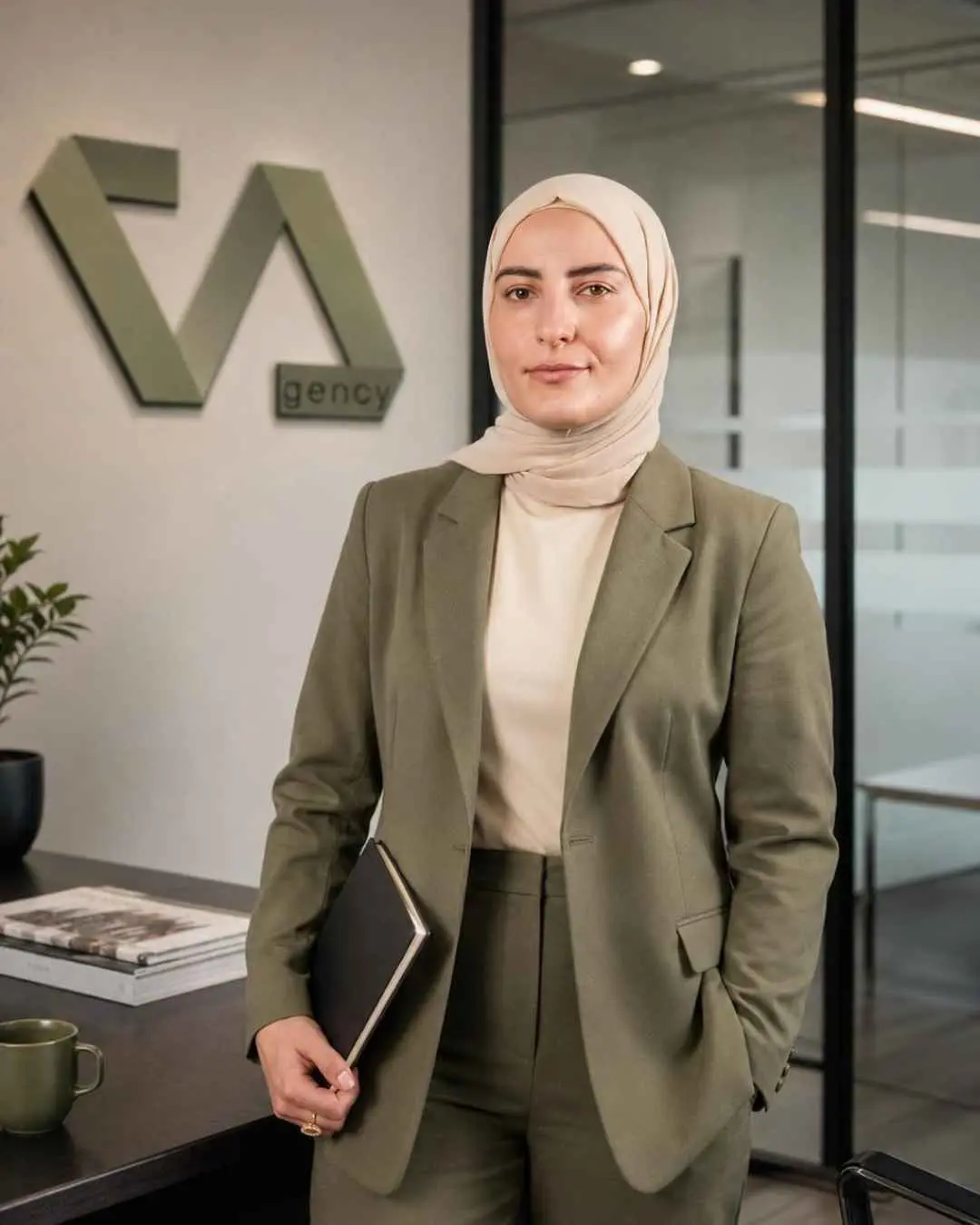
Selma Kadiric reflects this shift in her work as the Founder and Director of VAgency Limited, a UK-based, multi-award-winning executive and business support agency shaped by more than 14 years of senior executive support experience at leading global organisations including GSK, Citi Bank, Barclays, AlixPartners and Samsung. She built VAgency on the belief that busy professionals need something more dependable than one-off, transactional support. The agency provides consistent, relationship-led partnerships, pairing clients with dedicated executive and business support across calendar and inbox management, operations coordination, bookkeeping, travel arrangements, research and wider administrative support.
Built around discretion, reliability and long-term collaboration, VAgency operates with strict GDPR compliance and professional indemnity insurance, giving clients the reassurance of professional support that can grow alongside their business.
Fluent in English, Bosnian and Croatian, Selma has received the 2026 Global Recognition Award and VAgency was named Best Virtual Assistant Services Provider 2026 – South East England at the Business Elite Awards 2026. These recognitions reflect the agency’s growing reputation for delivering professional, dependable and relationship-led executive and business support.
Selma has positioned VAgency as a more considered alternative to traditional freelance marketplaces. Rather than simply completing individual tasks, the agency is designed to become a trusted extension of its clients’ businesses, helping entrepreneurs, founders and small business owners regain their most valuable resource: time.
Bridging the Gap Between Administration and True Partnership
Selma identified a clear gap between traditional administrative support and the kind of partnership that modern founders and senior leaders truly need. Executive support, she observed, is often reduced to a checklist of tasks such as diary management, inbox handling, travel arrangements, documents and follow-ups. While these responsibilities matter, she believes the real value lies in understanding the person behind the role, the business they lead, their priorities and the consequences of the decisions being managed on their behalf.
She set out to build VAgency around the idea that support should feel like a genuine extension of the leadership team, not simply an external pair of hands. In her view, what the industry needed was greater flexibility, stronger commercial awareness and access to experienced support that businesses could draw on without having to build a full in-house function from the beginning.

VAgency at a Glance

- UK-based, multi-award-winning executive and business support agency
- Supports founders, entrepreneurs, start-ups, scale-ups and growing SMEs
- Serves clients across the UK and internationally
- Recipient of the 2026 Global Recognition Award for Strategic Executive Support and Business Growth Excellence
- Winner of the SME News Business Elite Award 2026 for Best Virtual Assistant Services Provider 2026 – South East England
- Named among London’s leading business administration services

Building Strategic Partnership Beyond Administration
VAgency’s approach has become much more focused on outcomes rather than activity.
While the firm continues to deliver strong executive and administrative support, Selma and her team look beyond the task itself. They consider why something is being done, what it enables, and what might otherwise fall through the gaps around it.
In practice, this can mean building better systems, protecting a founder’s time, improving follow-through, coordinating stakeholders, or bringing structure to recurring processes.
Selma describes VAgency as sitting between a traditional virtual assistance service and an outsourced operations function. The goal, she explains, is not to make founders better at doing everything themselves, but to build the support around them so they can focus on the work only they can do.
Tackling Fragmentation in Modern Leadership
According to Selma, the biggest challenge leaders face is not simply being busy; it is fragmentation. Leaders move constantly between strategy, people, clients, finance, technology, meetings and ongoing communication, often across different markets and time zones. Delegation becomes difficult when they have not had the space to work out what should be delegated, to whom, or what a good outcome actually looks like.
Trust is another factor. Senior leaders need to know that information will be handled carefully, and that support can be given without requiring constant supervision. VAgency addresses this by pairing practical support with structure, context and continuity, helping clients reduce noise, create clearer ownership, maintain momentum and ensure important actions do not get lost between meetings, inboxes and competing priorities.
A further challenge, Selma notes, is that growth often outpaces internal infrastructure. A founder may take on more clients, people and complexity without redesigning how information moves through the business. This is where thoughtful support can make a real difference, through simple routines, better visibility and the confidence that day-to-day operations do not rely on memory alone.

Selma’s Leadership Journey: Before and After
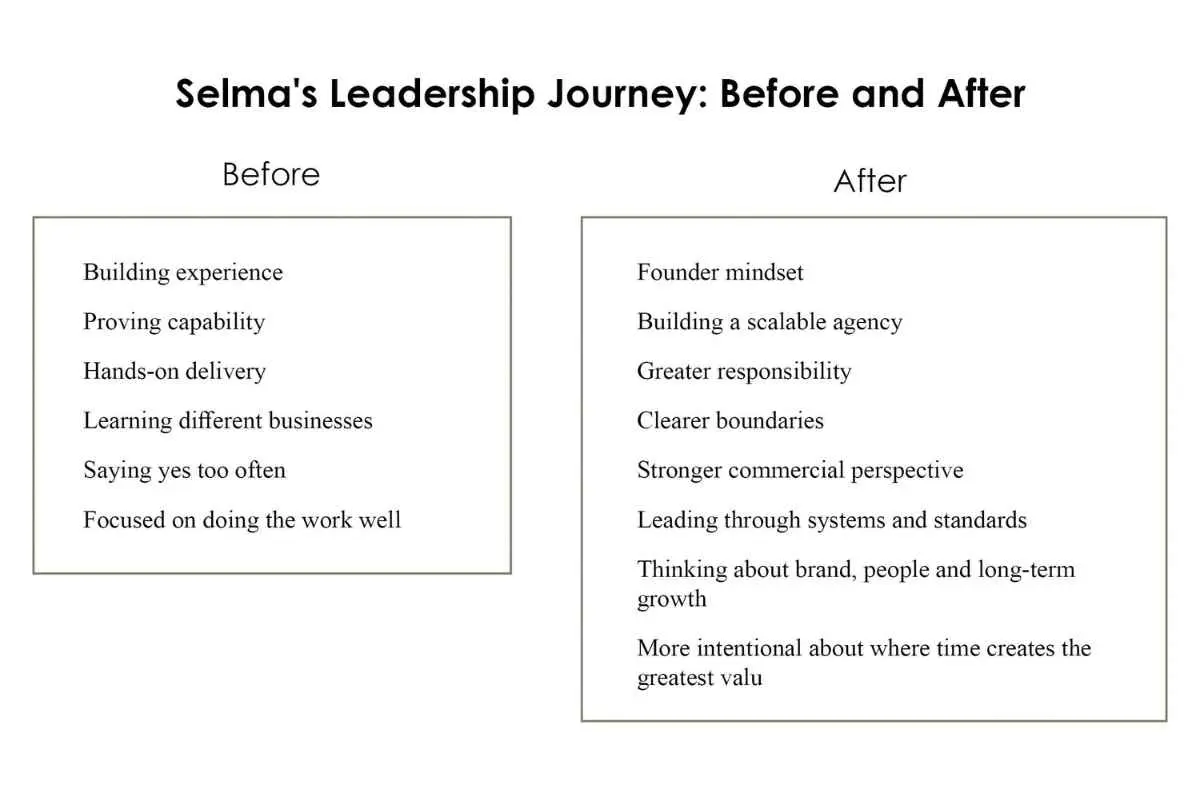
Before
- Building experience
- Proving capability
- Hands-on delivery
- Learning different businesses
- Saying yes too often
- Focused on doing the work well
After
- Founder mindset
- Building a scalable agency
- Greater responsibility
- Clearer boundaries
- Stronger commercial perspective
- Leading through systems and standards
- Thinking about brand, people and long-term growth
- More intentional about where time creates the greatest value
The Standards Behind Judgment, Discretion and Reliability
For Selma, the standard begins with understanding that access is a responsibility.
Executive support professionals often see sensitive information, unfinished decisions and private conversations before anyone else, which makes discretion non-negotiable. She looks for professionalism, calm communication, ownership, attention to detail and the confidence to ask the right question rather than make a careless assumption.
Context matters just as much. Understanding a client’s priorities, preferred communication style, stakeholders and ways of working allows support to be genuinely useful rather than generic. Good support, Selma believes, should be proactive but never presumptuous.
Reliability is built through clear expectations, documented processes, consistent follow-up and accountability. Ultimately, she wants clients to feel that the person supporting them understands not just the task at hand, but the business reason behind it.

Freeing Leaders to Think, Decide and Follow Through
Selma has seen the same pattern repeat itself many times: a leader carrying too much operational information in their own head, from meeting actions and deadlines to finance follow-ups, diary decisions and stakeholder commitments.
Once that load is transferred into a trusted support structure, the change is immediate. The leader gains more capacity to think, decisions are followed through more quickly, and fewer important details are lost.
In one engagement, bringing together diary management, finance tracking, meeting preparation, actions and stakeholder follow-up created a much clearer operating rhythm around the client. For Selma, the lesson was that the value of executive support cannot be measured by hours saved alone. It is also measured by reduced mental strain, better continuity and the quality of decisions a leader is able to make when their attention is properly protected.
The experience also confirmed, in her view, that good support is preventative by nature. A well-prepared agenda, a timely reminder or an early escalation can stop a small issue from becoming a costly distraction. Individually, these interventions are hard to quantify, but together they create a far more stable environment for leadership.
Growth Without Losing Trust
For Selma, the most important lesson in building a people-driven service business is that growth cannot come at the expense of trust.
In a business built on people, the brand is experienced through every interaction, every handover and every decision made on a client’s behalf. Scaling, therefore, requires far more than simply adding people. It calls for clear standards, strong systems, good communication and a firm understanding of what the business stands for.
One assumption Selma has had to unlearn is that being highly capable means holding on to more responsibility personally. In reality, she has found that strong leadership is often about creating clarity so that other people can perform well without the founder becoming the bottleneck. That lesson, she notes, applies just as much to her clients as it does to her as a founder.

Where Technology Helps and Where Human Judgment Remains Essential
In Selma’s view, technology should take on repetitive, rules-based work where it can genuinely improve speed and consistency, such as first-pass scheduling, transcription, routine data entry, document organisation, reminders, basic reporting and parts of research or workflow automation. Used well, she believes, AI gives support professionals more capacity to focus on higher-value work.
However, technology does not understand a relationship in the same way a trusted human does. Judgment, discretion, emotional intelligence, confidentiality, nuance and stakeholder management remain essential. An executive assistant may know that a meeting technically fits into the diary, yet still recognise that it is the wrong moment, the wrong audience or the wrong priority.
For Selma, the future does not lie in AI replacing excellent executive support. Rather, it lies in skilled professionals using technology intelligently while remaining accountable for the human decisions that surround it.
Building Towards a More Complete Support Model
Looking ahead, Selma is most focused on strengthening VAgency’s ability to become a more complete support partner as clients grow.
This includes carefully selected collaborations, better use of technology and automation, a stronger network of trusted professionals and continued expansion across the UK and internationally. She is particularly interested in integrations that improve client visibility, workflow and communication without making support feel impersonal.
Growth for its own sake holds little appeal for Selma; any partnership or expansion must genuinely improve quality, capability or client experience. The long-term opportunity, as she sees it, is to build a scalable executive support and outsourced operations model that gives growing businesses access to high-calibre support much earlier in their journey.
As the agency develops, Selma also wants its service model to remain flexible enough for clients to access the right level of support as their needs change, rather than fitting every business into the same package or structure.
A Day in Selma’s Life
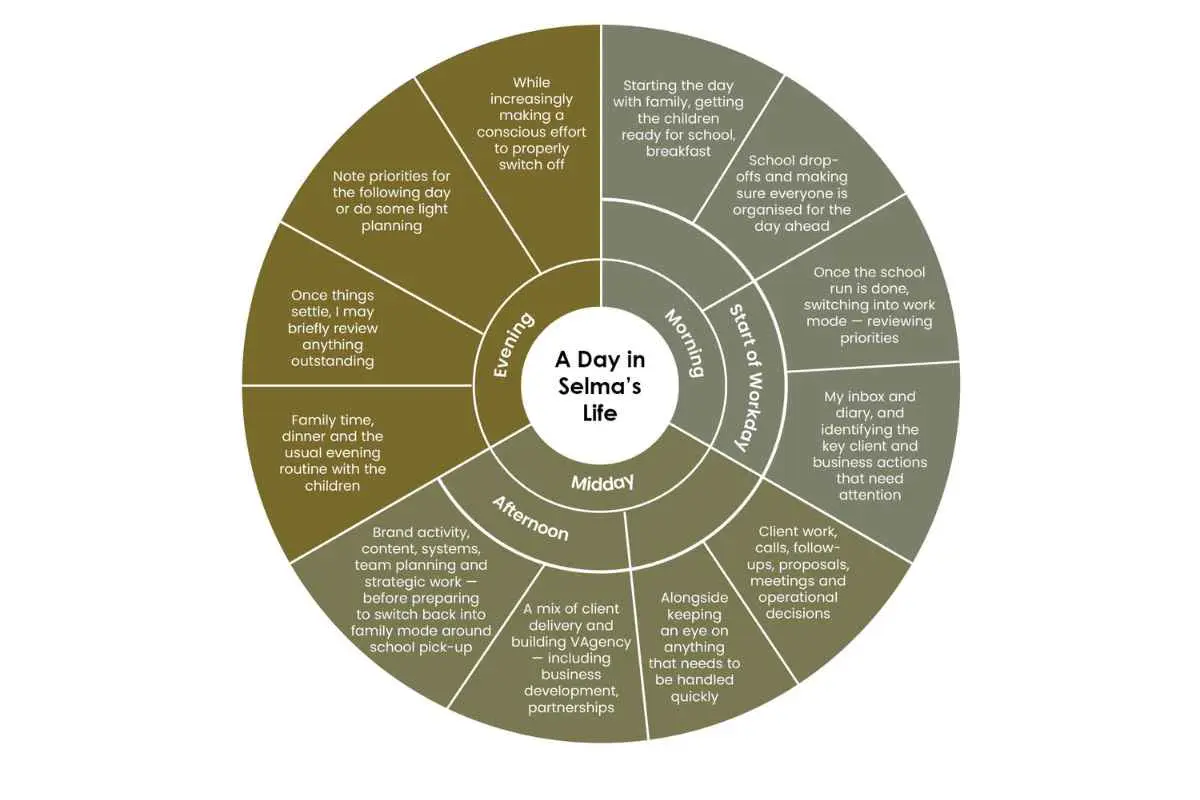
Early Morning
Starting the day with family, getting the children ready for school, breakfast, school drop-offs and making sure everyone is organised for the day ahead.
Start of Workday
Once the school run is done, switching into work mode — reviewing priorities, my inbox and diary, and identifying the key client and business actions that need attention.
Midday
Client work, calls, follow-ups, proposals, meetings and operational decisions, alongside keeping an eye on anything that needs to be handled quickly.
Afternoon
A mix of client delivery and building VAgency — including business development, partnerships, brand activity, content, systems, team planning and strategic work — before preparing to switch back into family mode around school pick-up.
Evening
Family time, dinner and the usual evening routine with the children. Once things settle, I may briefly review anything outstanding, note priorities for the following day or do some light planning, while increasingly making a conscious effort to properly switch off.
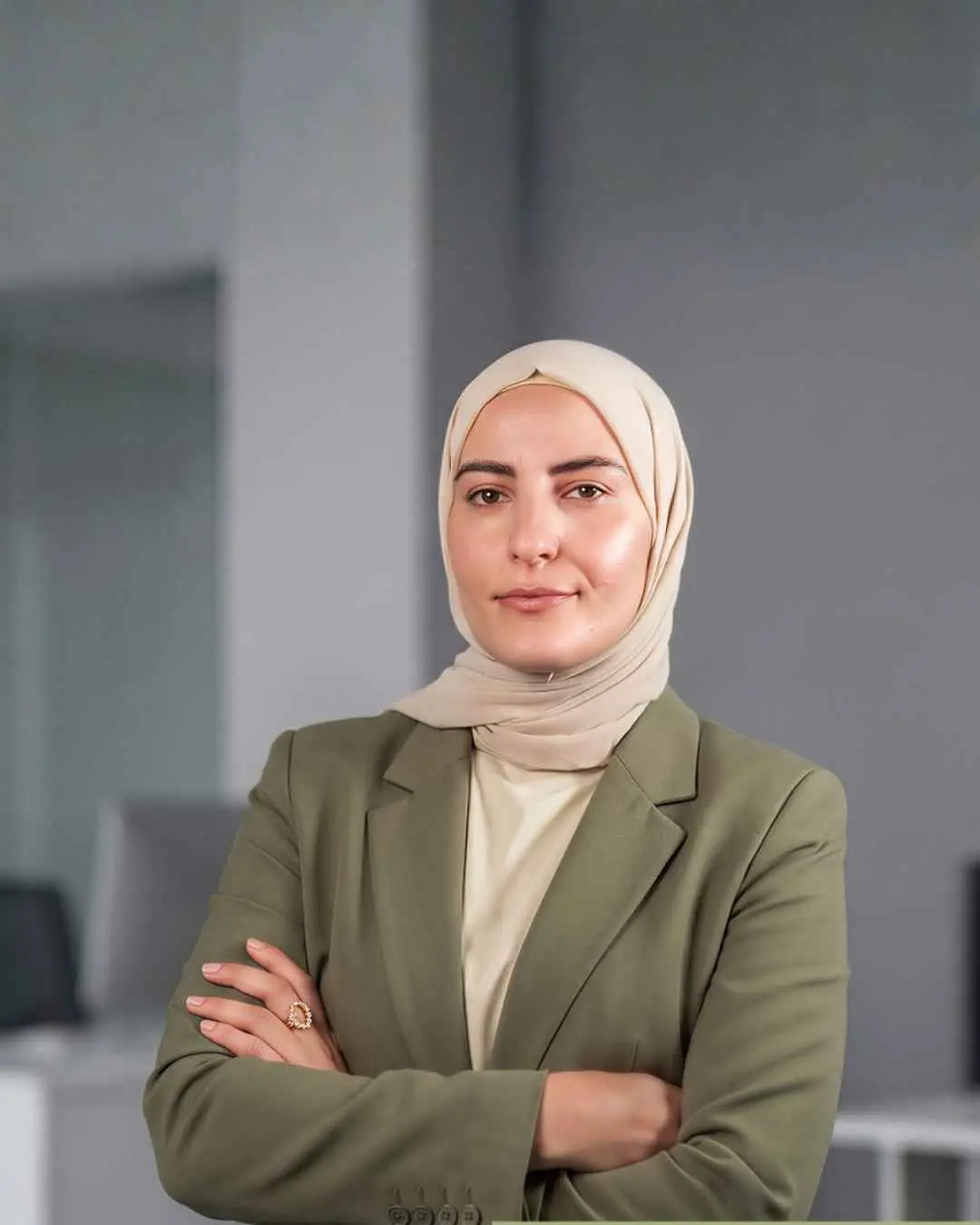
An Open Letter to Emerging Executive-Support Professionals and Future Leaders
Dear Future Leaders,
Build your reputation around trust before title. Learn how businesses work, not only how to complete tasks. Ask why something matters, understand the people involved, and become someone who can be relied on when circumstances change.
Strategic thinking is often built through small habits: anticipating the next question, recognising patterns, following through and communicating clearly. Use technology, but do not let speed replace judgment. Protect confidentiality fiercely. Be adaptable without becoming boundaryless.
Most importantly, remember that long-term professional value comes from making yourself trusted, not indispensable through withholding knowledge. The strongest support professionals create clarity, document what they know, help others succeed and raise the standard around them.
And keep learning. The profession is changing quickly, so commercial awareness, digital confidence and curiosity will matter just as much as traditional administrative excellence.
With respect and encouragement,
Selma Kadiric, Founder and Director
VAgency Limited
5 Key Takeaways from Selma Kadiric’s Leadership Impact
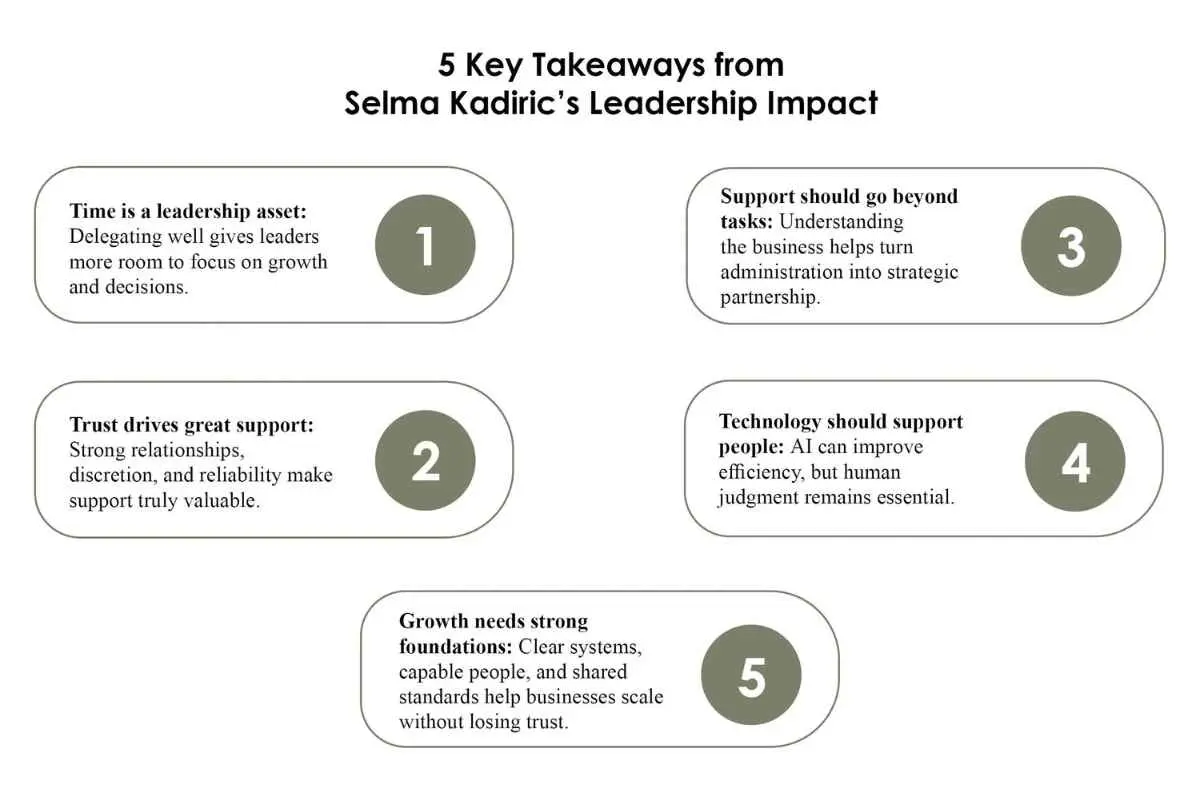
- Time is a leadership asset: Delegating well gives leaders more room to focus on growth and decisions.
- Trust drives great support: Strong relationships, discretion, and reliability make support truly valuable.
- Support should go beyond tasks: Understanding the business helps turn administration into strategic partnership.
- Technology should support people: AI can improve efficiency, but human judgment remains essential.
- Growth needs strong foundations: Clear systems, capable people, and shared standards help businesses scale without losing trust.
Quick Takes
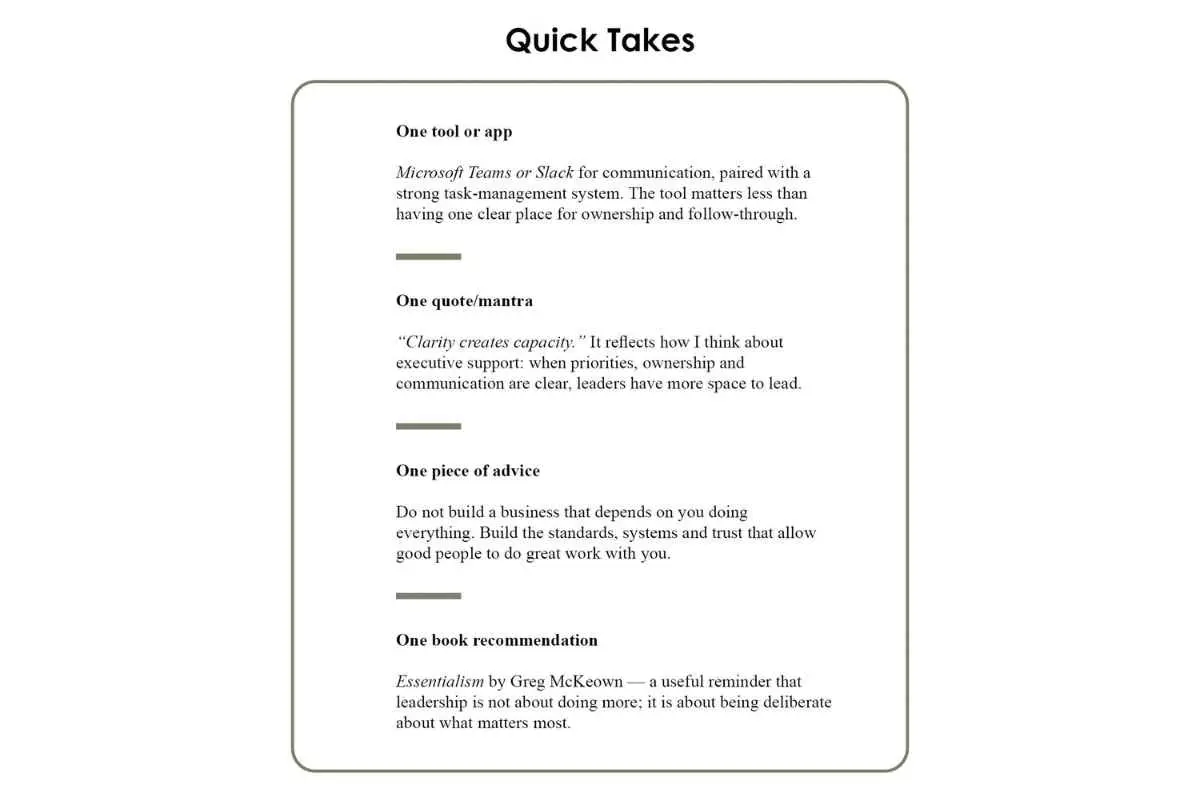
- One tool or app: Microsoft Teams or Slack for communication, paired with a strong task-management system. The tool matters less than having one clear place for ownership and follow-through.
- One quote/mantra: “Clarity creates capacity.” It reflects how I think about executive support: when priorities, ownership and communication are clear, leaders have more space to lead.
- One piece of advice: Do not build a business that depends on you doing everything. Build the standards, systems and trust that allow good people to do great work with you.
- One book recommendation: Essentialism by Greg McKeown — a useful reminder that leadership is not about doing more; it is about being deliberate about what matters most.