
A trial ends on Friday. The employee who requested it likes the software, the manager has seen a useful demonstration, and nobody has decided who will support it on Monday. That is how a temporary experiment can become a permanent business dependency without a clear decision.
The missing piece is often ownership. Before a company starts evaluating a tool, it needs to know who can approve its use, who can resolve problems, and who can end the arrangement. Those questions deserve attention even when the software is inexpensive.
Separate the request from the approval
The person closest to a task is often best placed to explain what is going wrong. A sales coordinator can describe a slow reporting process more clearly than a procurement form can. That does not mean the coordinator should also decide which customer information a new service may receive.
Give the requester a defined role: describe the problem, demonstrate a representative task, and report what improved. Give the approval decision to the person or team responsible for the affected systems, spending, and information.
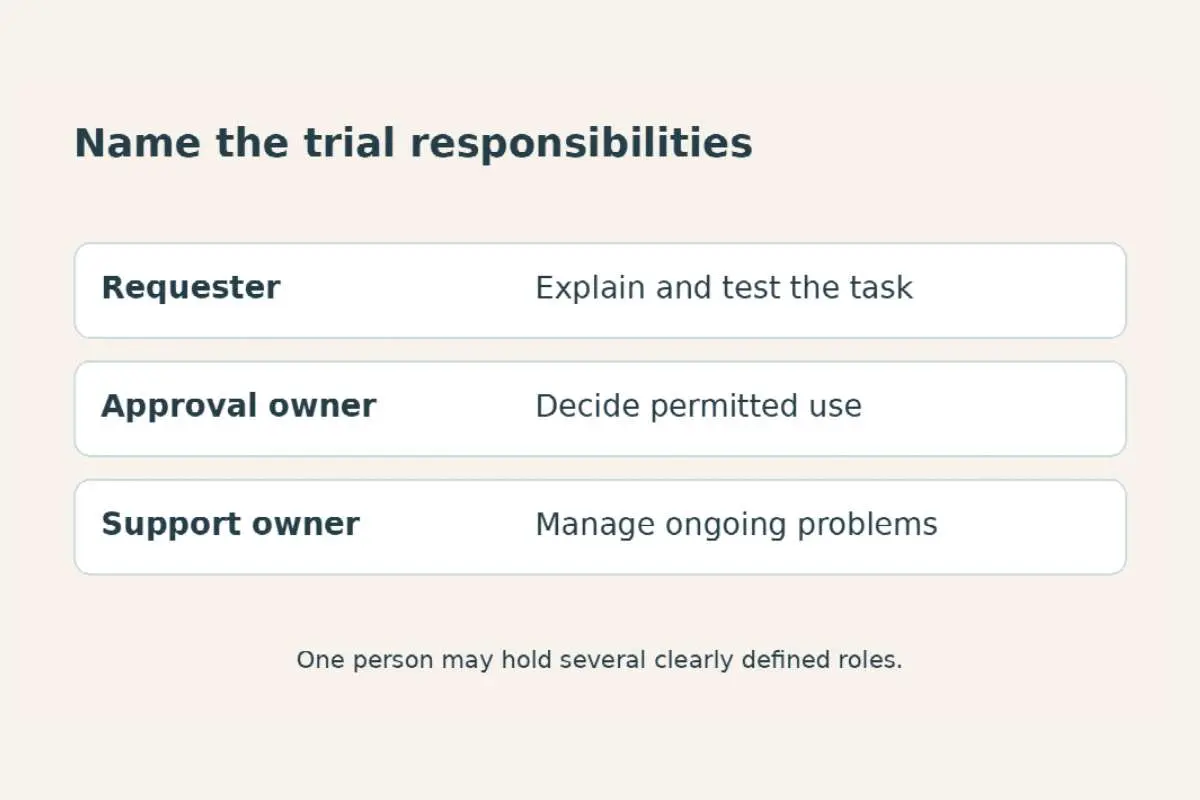
In a small company, one person may hold several of these responsibilities. The distinction still helps. A founder can test a product as a user, then review it as the person who will pay for it and handle the consequences of adopting it.
A connection tool illustrates the need for this separation. An employee might request a VPN free trial to evaluate a supported client during travel. The company must first decide whether that kind of service fits its approved access arrangement. A consumer VPN trial does not establish permission to connect to private company resources.
Give the Software trial an operating boundary

Write down what the evaluator may do. Specify the device, the account, and the type of information allowed in the test. Where possible, use approved sample material instead of moving live business data into an unfamiliar service.
Suppose a team wants to evaluate a reporting tool. A useful boundary might allow a test account and a sample dataset while keeping the production CRM outside the experiment. The evaluator can assess the workflow without creating an unreviewed data transfer that someone else later has to untangle.
Decide how the experiment will finish as well. Who checks the renewal terms? Who cancels the subscription if the tool is rejected? Who removes test accounts and files? These are concrete tasks, and assigning them early is easier than tracing them after the evaluator has moved on.
Keep a record of the conditions. A result obtained on one laptop with one account should not quietly become a claim that the product works across the company. If broader use is proposed, identify what still needs testing.
Ask the support question before expanding
A good demonstration shows that a task can work. Adoption requires the company to keep that task working when something changes.
For each promising tool, identify the likely first support contact. Can the employee handle an ordinary configuration problem? Does the IT team recognise the product? Is supplier support available through the proposed plan? The answers may change the cost of adoption more than the advertised monthly price.
Device differences also matter. If the evaluation includes a VPN for Windows, record the Windows version, client version, and relevant settings. A successful check on that machine does not settle installation or support for another operating system, nor does it validate compatibility with every managed network.
This is where an approval owner can make a measured decision: expand the test, approve a limited use case, or stop. A limited approval is useful when its boundary is clear. It becomes confusing when colleagues hear only that the software trial was approved and assume every use is covered.
Make the decision leave a usable record

The final note can be short. It should name the permitted use, the responsible owner, the spending arrangement, and any condition that would trigger another review. Include the reason for rejection if the tool is not adopted; another employee may otherwise repeat the same evaluation next month.
Keep evidence separate from preference. “The evaluator found it easy to use” is valuable feedback. “It completed the agreed task on the test device” is a narrower operational finding. Neither statement, by itself, proves that the service is suitable for every department.
When a tool is adopted, hand over the information needed to manage it: account ownership, recovery arrangements, renewal dates and the agreed support route. Avoid leaving the organisation dependent on one employee’s personal inbox.
A software trial should end with a decision someone can act on. Clear ownership lets the business keep useful software without inheriting an arrangement that nobody believes they are responsible for.