

What BPMN Studio teaches us about process thinking, business analysis, and project delivery
By Lina Druskiene, CITP and co-author Emilis Mikalajūnas
For thousands of years, humans have organised work, coordinated activities, and improved processes, from ancient civilisations to modern enterprises.
Yet despite centuries of progress and increasingly sophisticated technologies, one challenge remains: understanding how work actually happens and how to make it better.
Today, AI process modeling can generate a BPMN diagram in seconds. Activities, gateways, sequence flows, and decisions appear on the screen, and everything may look convincing.
Activities, gateways, sequence flows, and decisions appear on the screen. Everything may look convincing.
But is the process correct? Are exceptions covered? Are responsibilities clear? Does the model represent operational reality?
A diagram can look right and still describe the wrong process.
Why Process Problems Persist?
In their Harvard Business Review article Breaking the Functional Mind-Set in Process Organizations (1996), Ann Majchrzak and Qianwei Wang examined why process-oriented restructuring produced different outcomes across organisations.
Their research highlighted the importance of collaboration and collective responsibility beyond functional boundaries.
Michael Hammer and Steven Stanton reinforced this perspective in How Process Enterprises Really Work (1999), arguing that process-oriented organisations require changes beyond redesigned workflows.
Decades later, familiar challenges remain.
Departments optimise individual activities without understanding their wider consequences. Process ownership becomes fragmented. Exceptions remain undocumented. Decisions are made without sufficient visibility of dependencies.
Technology has evolved. Organisational complexity has not disappeared.
Process improvement is not simply about drawing better diagrams. It requires understanding how people, decisions, systems, and responsibilities interact.
From a University Idea to BPMN Studio

At Vilnius University, where business analysis and systems thinking form part of our teaching and learning, we explore an essential principle: understanding the problem must come before designing the solution.
Emilis Mikalajūnas, a student at Vilnius university, began exploring whether artificial intelligence could make BPMN modelling more accessible and efficient.
That exploration led him to develop BPMN Studio, an AI-powered process modelling platform.
Our collaboration brought together technical development and practical business analysis.
Alongside the platform’s development, we explored use cases, reviewed BPMN logic, tested modelling behaviours, and considered how business stakeholders would interpret the resulting diagrams.
One question became particularly important:
If AI generates a process model, who validates that it makes business sense?
A generated diagram is a starting point for analysis, not proof that the underlying process has been understood.
Process-bility: Thinking Beyond Notation
Our thinking was also influenced by Kevin Tan’s Process-bility approach, particularly its emphasis on three principles:
- Simplicity: remove unnecessary complexity.
- Visual Balance: organise models to improve readability.
- Storytelling: make the process understandable as a coherent flow of work.
These principles encouraged us to look beyond technical notation.
A BPMN model can contain recognisable symbols and still confuse the people expected to use it.
Consider a diagram filled with crossing flows, unclear activity names, and unexplained decision gateways.
It may appear sophisticated while communicating very little.
A simpler model with meaningful activities, clear responsibilities, and understandable decision paths creates better conditions for discussion and validation.
This distinction matters when AI can produce diagrams faster than stakeholders can evaluate them.
BPMN provides the modelling language. Process thinking gives the model meaning.
Why This Matters for Project Management?
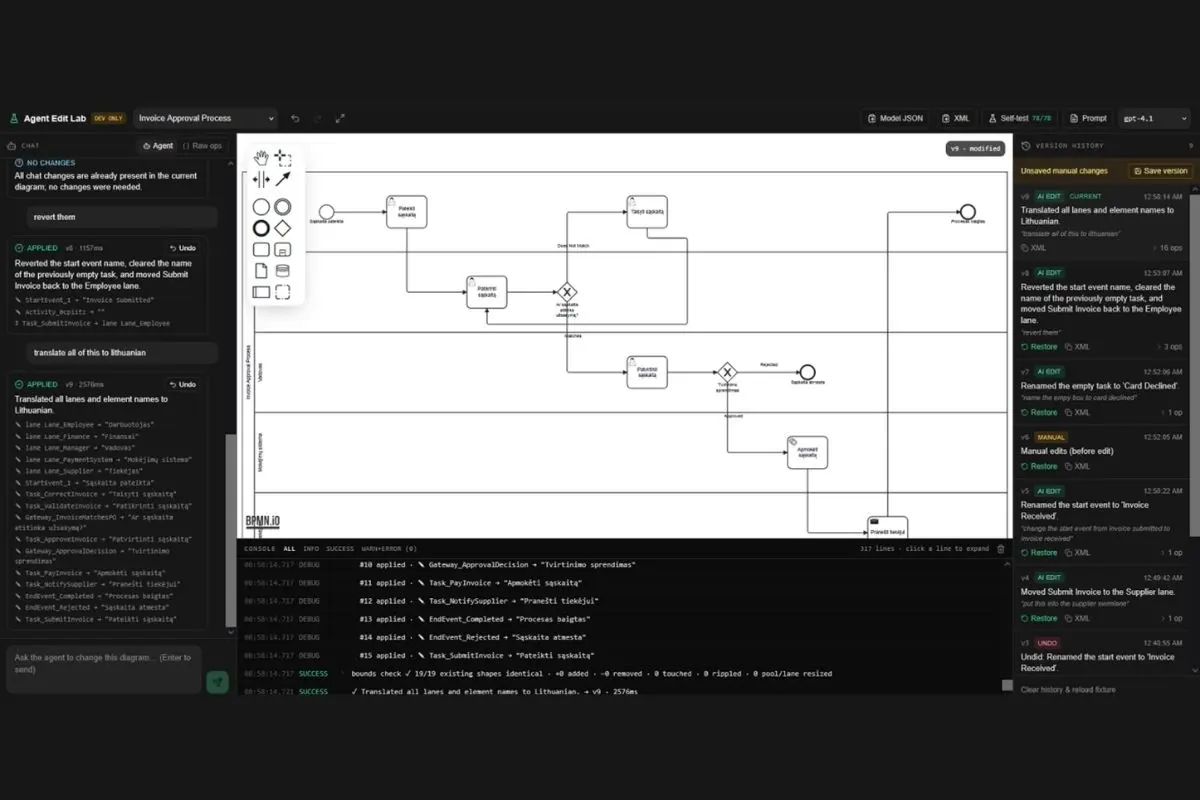
AI process modeling is not exclusively a business analyst’s concern. An incomplete process model can become an incomplete requirement, an incorrect design decision, or an expensive implementation problem.
Imagine a project team approving a workflow that overlooks a common exception.
Developers implement the specification. Testers confirm that the system behaves as documented. The project moves towards deployment.
Only later does the organisation discover that the workflow does not support an important operational scenario.
The technical implementation may be correct. The original understanding was incomplete.
This connects to the work of Oxford scholar Bent Flyvbjerg, whose research on optimism bias and reference class forecasting highlights the dangers of relying on insufficiently challenged assumptions in project planning.
Although his research does not specifically concern AI-generated BPMN diagrams, the underlying lesson applies: confidence is not a substitute for evidence.
For project managers, AI-assisted modelling should therefore strengthen early validation, not create an illusion of certainty.
Five Questions Before Accepting an AI-Generated Process
Drawing on our practical work with BPMN Studio and established business analysis principles, we suggest five questions.
1. Purpose — What outcome should this process achieve?
Clarify the business objective before evaluating the diagram. A technically correct model can still solve the wrong problem.
2. Logic — Do the decisions and alternative paths make sense?
Examine gateways, conditions, business rules, exceptions, and dependencies. What happens when information is missing or a request is rejected?
3. People — Can stakeholders understand the process?
Ask business representatives to explain the model in their own words. If they cannot follow the flow or identify responsibilities, the diagram may not support effective communication.
4. Reality — Does the model reflect actual work?
Compare it with operational practices, system behaviour, handovers, and known workarounds. The documented process and the real process are not always identical.
5. Validation — What evidence confirms the model is fit for purpose?
Walk through realistic scenarios, verify business rules, check BPMN semantics, and record unresolved assumptions.
These questions do not replace formal BPMN validation. They complement it by connecting modelling quality with business understanding.
AI Should Accelerate Understanding, Not Assumptions
AI-assisted modelling offers an opportunity to reduce the effort involved in producing initial process diagrams.
Business analysts can potentially spend more time investigating exceptions, challenging assumptions, and facilitating stakeholder discussions.
Project managers can use early models to identify dependencies, clarify scope, and expose risks before implementation.
However, these benefits are not automatic.
A polished AI-generated diagram may encourage premature agreement, particularly when stakeholders assume that a professional-looking model must be correct.
The responsibility of the analyst is to question what the diagram represents.
The responsibility of the project manager is to ensure that apparent progress is supported by validated understanding.
And the responsibility of leadership is to create conditions where questioning assumptions is encouraged.
The Future Is Not Just Faster Modelling
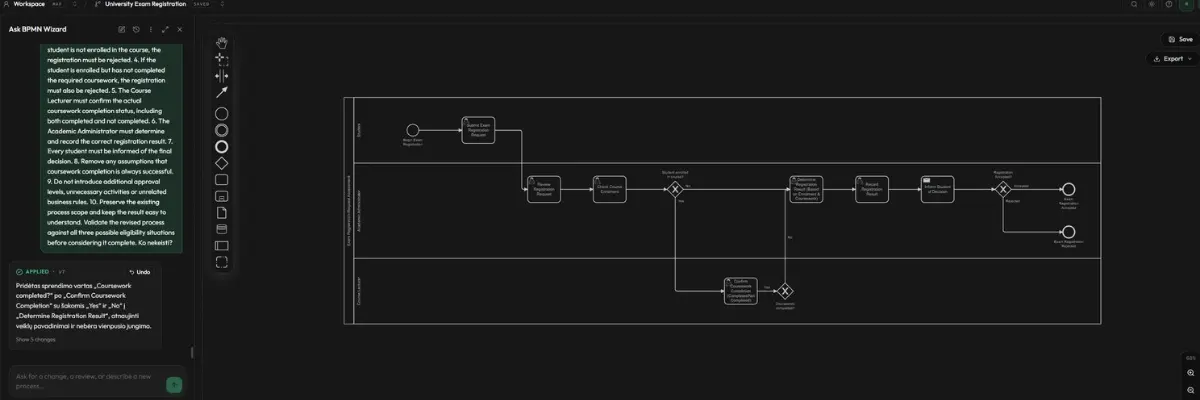
BPMN Studio began with a technical question: can AI make process modelling easier?
Our experience points towards a broader question: can AI process modeling help people understand workflows better?
Harvard’s research reminds us that processes depend on collaboration and organisational behaviour.
Oxford’s project research reminds us to challenge assumptions.
Kevin Tan’s Process-bility approach reminds us that process models must communicate clearly.
Together, these perspectives reinforce an important principle for business analysis and project delivery.
The value of a process model is not measured by how quickly it is produced, but by how effectively it supports understanding, decisions, and improvement.
AI can draw the process. Understanding it remains our responsibility.
References
- Majchrzak, A., & Wang, Q. (1996). Breaking the Functional Mind-Set in Process Organizations. Harvard Business Review.
- Hammer, M., & Stanton, S. (1999). How Process Enterprises Really Work. Harvard Business Review.
- Flyvbjerg, B. (2008). Curbing Optimism Bias and Strategic Misrepresentation in Planning: Reference Class Forecasting in Practice. European Planning Studies, 16(1), 3–21.
- Tan, K. BPMN Made Easy with Process-bility (book title and edition to be confirmed).
- Object Management Group. Business Process Model and Notation (BPMN), Version 2.0.2.