Key Takeaways:
- The Moon Impact Became an Unexpected Scientific Experiment
- Lunar Missions Need Better Space Debris Management
- Commercial Space Activity Is Reshaping Space Governance
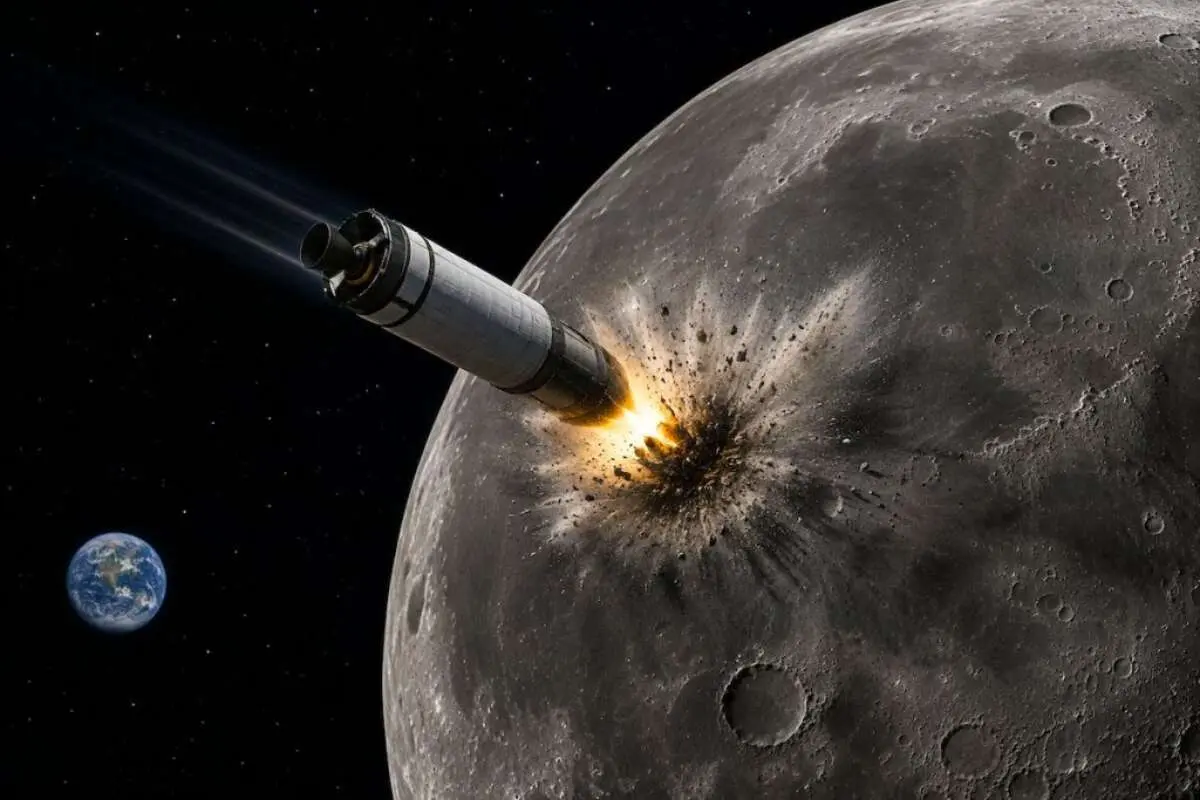
A discarded SpaceX Falcon 9 rocket stage has unexpectedly crashed into the Moon, in an event now widely described as “SpaceX rocket crashes into moon, turning what could have been little more than a piece of space debris into a significant scientific event. The collision has given astronomers and planetary scientists a rare opportunity to study how a large human-made object interacts with the lunar surface, offering insights that could shape future lunar exploration and spacecraft disposal practices.
The impact comes at a time when interest in the Moon is at its highest in decades. With governments and private companies planning more frequent lunar missions, researchers say understanding the effects of artificial impacts has become increasingly important. While the crash posed no threat to Earth or ongoing space missions, it has generated valuable data that may improve future mission planning and deepen scientific understanding of the Moon.
A high-speed collision leaves its mark
The object that struck the Moon was the upper stage of a Falcon 9 rocket launched in January 2025 during a mission that carried Firefly Aerospace’s Blue Ghost lunar lander and Japan’s ispace Resilience lunar lander. After completing its role in delivering the spacecraft, the rocket stage remained in deep space rather than returning to Earth. Over time, gravitational forces gradually altered its trajectory until it ultimately collided with the Moon.
Scientists estimate the four-tonne rocket stage slammed into the lunar surface at roughly 8,700 km/h (about 5,400 mph), impacting near the region between the Bell and Einstein craters on the Moon’s western limb. The force of the collision is believed to have created a crater measuring between 18 and 40 metres in diameter, although its exact dimensions will be confirmed through upcoming orbital observations.
While the impact itself was hidden from direct view because of the Moon’s orientation, astronomers using advanced telescopes detected a massive plume of debris rising far above the lunar surface. Spectroscopic observations identified sodium and lithium within the cloud. Researchers believe the sodium originated from lunar material excavated by the collision, while the lithium likely came from the rocket stage itself.
The chemical signatures have provided scientists with a rare opportunity to separate lunar material from spacecraft debris, helping improve models of impact physics and material behaviour during high-speed collisions.
An unexpected scientific experiment
Natural meteoroids strike the Moon regularly, but they usually arrive without warning, making them difficult to study in detail. This collision was different because scientists already knew the rocket’s size, composition, mass and trajectory before the impact occurred.
That information transforms the event into an unusually valuable scientific experiment. Researchers can now compare real observations with computer models to better understand crater formation, the amount of material ejected during an impact, and the mechanics of collisions on airless worlds like the Moon.
Lunar orbiters, including NASA’s Lunar Reconnaissance Orbiter and South Korea’s Danuri spacecraft, are expected to capture high-resolution images of the impact site in the coming weeks. Those observations will help scientists verify the crater’s location and dimensions while refining predictions about how lunar soil responds to large impacts.
The findings could also support future lunar exploration. As more missions travel between Earth and the Moon, scientists hope the data gathered from this event will improve tracking methods for spacecraft operating in cislunar space and enhance understanding of how abandoned objects behave once their missions are complete.
A Reminder of the Growing Space Debris Challenge After SpaceX Rocket Crashes Into Moon
Beyond its scientific importance, the collision has renewed discussion about the long-term management of space debris beyond Earth orbit. Unlike satellites in low-Earth orbit, which are often designed to burn up in Earth’s atmosphere at the end of their missions, spacecraft travelling toward the Moon can remain in unstable orbits for years if no controlled disposal plan exists.
As international space agencies and commercial companies prepare for an era of sustained lunar exploration, experts say unmanaged rocket stages and spacecraft could become an increasing challenge. Although accidental impacts like this are unlikely to threaten the Moon itself, the event in which a SpaceX rocket crashes into moon has highlighted how such incidents could complicate future missions and raise concerns about preserving important scientific and exploration sites.
The incident has highlighted the growing need for internationally accepted guidelines on end-of-mission spacecraft disposal, improved tracking of deep-space objects and better coordination between governments and private operators. Such measures could help reduce unintended impacts while supporting the safe expansion of human activity beyond Earth.
For now, the unexpected crash has delivered more than just a new crater on the Moon. It has provided researchers with an invaluable opportunity to study impact processes in real time and gather data that could influence everything from planetary science to future space traffic management. As lunar exploration enters a new phase, this accidental collision may prove to be one of the most informative experiments conducted beyond Earth in recent years.