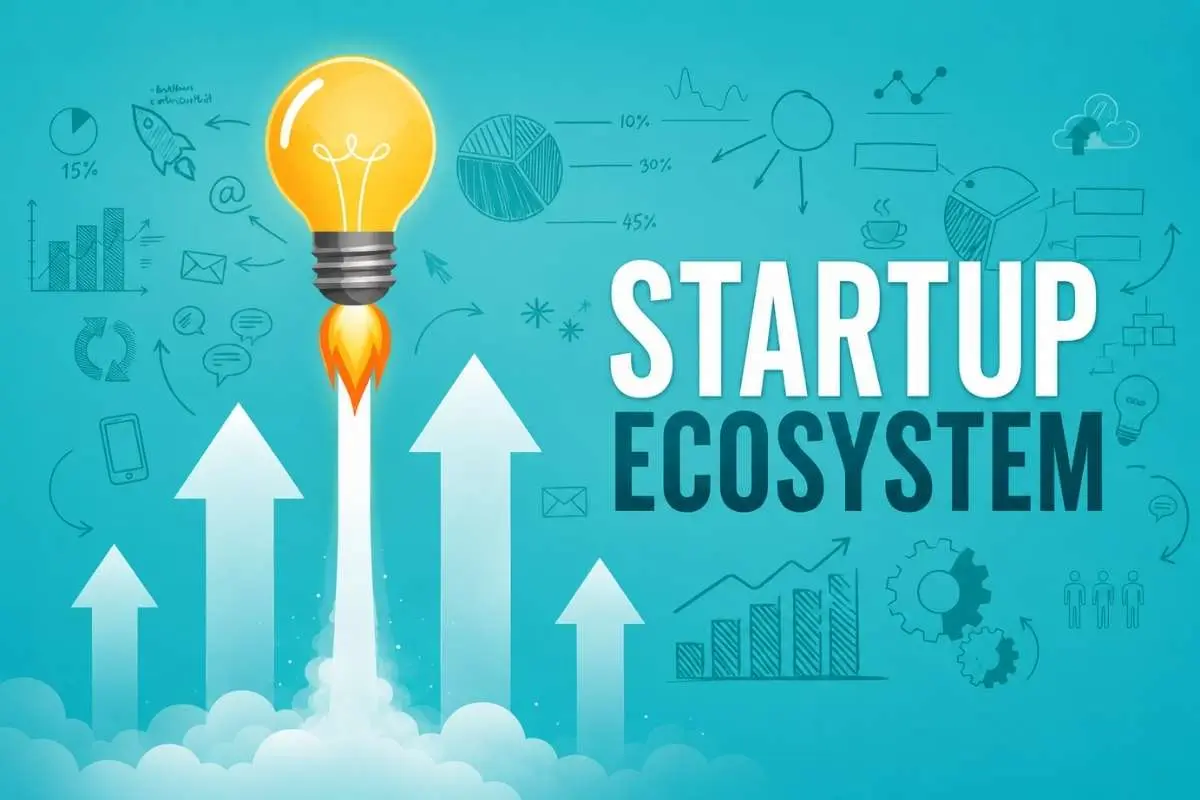
A strong startup ecosystem helps new businesses grow with funding, mentorship, innovation, and government support. See global examples, practical lessons, and proven strategies for lasting success.
Every successful startup begins with an idea, but ideas alone rarely build billion-dollar companies. A strong ecosystem provides the funding, talent, mentorship, infrastructure, and policies that help businesses grow from small ventures into global brands. This article explains what a startup ecosystem is, how it forms, why some ecosystems succeed while others fail, and what India can learn from global leaders like Silicon Valley. It also covers the latest 2025-2026 trends, government initiatives, and practical lessons for entrepreneurs looking to build sustainable businesses.
What if the next billion-dollar idea is sitting in someone’s notebook today? Then why do thousands of startups shut down every year while a handful become global success stories?
The answer is rarely just the idea.
Think of a startup as a young plant. Even the healthiest seed cannot grow without fertile soil, sunlight, water, and proper care. Startups work the same way. They need investors who believe in them, mentors who guide them, talented employees who build great products, customers who trust them, and governments that create business-friendly policies.
Take Bengaluru as an example. A few decades ago, it was mainly known for its IT industry. Today, it is home to thousands of startups, global investors, research institutions, and innovation hubs. Companies like Flipkart, Razorpay, and CRED didn’t succeed in isolation. They grew because they became part of a thriving startup ecosystem that encouraged innovation, collaboration, and long-term growth.
The biggest lesson is simple: successful startups do not grow alone. They grow where the right environment helps them succeed. Understanding how these ecosystems work can help founders, investors, and policymakers create businesses that stand the test of time.
What is a startup ecosystem?
A startup ecosystem is a network of people, organizations, institutions, and resources that work together to help startups launch, grow, and scale successfully. Instead of relying only on a founder’s idea, an ecosystem provides the support needed to turn that idea into a sustainable business.
A healthy ecosystem includes entrepreneurs, investors, universities, incubators, accelerators, government agencies, skilled professionals, and customers. Each plays a unique role in helping startups solve problems, access funding, hire talent, improve products, and reach new markets.
Strong ecosystems also encourage collaboration. Experienced founders mentor new entrepreneurs, investors fund promising businesses, universities support research, and governments create policies that reduce barriers for innovation. When these groups work together, startups grow faster and contribute to economic development by creating jobs, attracting investment, and introducing new technologies.
According to the Startup Genome Global Startup Ecosystem Report, leading startups generate trillions of dollars in economic value by helping innovative companies scale globally. This highlights that a successful ecosystem is built through long-term collaboration rather than short-term investment.
Key components of a startup ecosystem

Every successful startup shares several essential building blocks that work together to support innovation and business growth.
- Entrepreneurs: Entrepreneurs are the driving force behind every ecosystem. They identify problems, develop innovative solutions, and create businesses that generate employment and economic growth. Their willingness to take risks fuels continuous innovation.
- Investors: Funding is one of the biggest challenges for any startup. Angel investors, venture capital firms, private equity funds, and government-backed financial programs provide the capital needed to develop products, expand operations, and enter new markets.
- Government Support: Governments create the foundation for innovation by introducing startup-friendly policies, tax benefits, research grants, simplified business registration, and intellectual property protection. Programs like Startup India have made entrepreneurship more accessible for thousands of founders across the country.
- Universities and Research Institutions: Universities produce skilled graduates, conduct research, and encourage innovation. Many globally successful companies, including Google and Yahoo, began as university research projects. Academic institutions also help startups access technical expertise and skilled talent.
- Incubators and Accelerators: Incubators and accelerators provide mentorship, office space, networking opportunities, funding support, and business guidance. Organizations such as Y Combinator and Techstars have helped launch some of the world’s most successful startups by supporting founders during their early stages.
- Skilled Talent: Every startup needs engineers, designers, marketers, sales professionals, product managers, and financial experts. A strong talent pool allows businesses to innovate quickly and scale efficiently.
- Customers and Market Access: No startup can survive without customers. Early adopters provide valuable feedback, validate products, and help companies refine their offerings before expanding into larger markets.
- Infrastructure and Technology: Reliable internet, cloud computing, transportation, co-working spaces, digital payment systems, and communication networks create an environment where startups can operate efficiently and compete globally.
When all these components work together, a startup becomes a self-sustaining network where one company’s success inspires the next generation of entrepreneurs.
How do startup ecosystems form?
A successful ecosystem takes time to grow. It is built through teamwork, investment, innovation, and long-term support. Most startup hubs follow a similar path.
It usually starts with universities and colleges that produce skilled talent and encourage new ideas. Many graduates become entrepreneurs and launch startups. As these businesses grow, angel investors and venture capital firms provide funding to help them expand.
Successful founders often invest their experience and money into new startups. Governments support innovation through startup-friendly policies, while large companies partner with startups to share knowledge and create new opportunities.
This cycle keeps repeating. More talent attracts more investment, which leads to more innovation, stronger businesses, and economic growth.
Real-world example: Bengaluru
Bengaluru is one of the best examples of a growing Startup Ecosystem. Its journey started with the IT boom in the 1990s, led by companies like Infosys and Wipro. Over time, institutions such as IISc and the IITs produced skilled talent, while investors backed new technology startups.
Government support, incubators, co-working spaces, and global tech companies helped the city grow even further. Today, Bengaluru is one of the world’s leading startup hubs, with thousands of companies working in fintech, AI, healthtech, SaaS, and deep tech.
According to the Global Startup Ecosystem Report 2025, Bengaluru ranks among the world’s top startup ecosystems because of its strong talent, active investors, and growing innovation network.
Global benchmarks

Not every startup ecosystem grows at the same pace. Some cities become global innovation hubs, while others struggle despite having talented entrepreneurs. To understand the difference, experts compare ecosystems using common benchmarks.
According to the Global Startup Ecosystem Report (GSER) 2025 by Startup Genome, the world’s leading startup hubs perform well across six key areas:
1. Performance: This measures the total value created by startups through funding, acquisitions, and public listings. A high-performing ecosystem consistently produces companies that grow into industry leaders.
2. Funding: Access to capital is one of the biggest growth drivers. Strong ecosystems have active angel investors, venture capital firms, and institutional investors that support startups at different stages.
3. Talent and Experience: A skilled workforce helps startups build better products and solve complex challenges. Experienced founders also mentor new entrepreneurs, creating a cycle of continuous learning.
4. Market Reach: Successful startups do not limit themselves to local customers. They build products that can compete in national and international markets from an early stage.
5. Knowledge and Innovation: Universities, research institutions, and technology companies contribute new ideas, patents, and research that fuel innovation across industries.
6. Connectedness: A thriving ecosystem encourages collaboration among founders, investors, universities, corporations, and government agencies. Strong professional networks often create new business opportunities faster than individual efforts.
Cities like Silicon Valley, New York, London, Tel Aviv, Singapore, and Bengaluru consistently perform well because they combine these factors instead of relying on only one strength.
India case study
India has one of the fastest-growing Startup Ecosystem networks in the world. Over the last decade, it has become a leading destination for innovation and entrepreneurship.
The launch of Startup India in 2016 gave startups a major boost. It made starting a business easier by offering tax benefits, funding support, and access to incubators.
Today, cities like Bengaluru, Delhi NCR, Hyderabad, Mumbai, Pune, and Chennai are home to thousands of startups. These companies work in fintech, healthtech, edtech, AI, SaaS, e-commerce, and many other sectors.
India now has over 100 unicorns. Companies such as Razorpay, Zerodha, CRED, Freshworks, and Meesho show how Indian startups are succeeding in both Indian and global markets.
Case study: Razorpay
Razorpay was founded in 2014 to make digital payments easier for businesses. With support from investors, mentors, and startup programs, the company grew quickly.
Today, Razorpay offers payment solutions, banking, lending, payroll, and financial services to millions of businesses. Its journey shows how a strong startup ecosystem can help a startup grow into a successful company.
India has made great progress, but there is still room for improvement. Better access to early-stage funding, stronger support in smaller cities, and stable policies will help the country’s ecosystem grow even further.
Silicon Valley case study
Silicon Valley is known as the world’s most successful Startup Ecosystem. Its success comes from strong teamwork between universities, investors, entrepreneurs, and technology companies.
Stanford University has played a key role by supporting research and encouraging students to start businesses. Many successful founders began their journey there.
Another reason for Silicon Valley’s success is its strong venture capital network. Investors are willing to support new ideas, even if they involve risks. This gives entrepreneurs the confidence to innovate and grow.
Case study: Google
Google started as a research project by Larry Page and Sergey Brin at Stanford University. Early investors believed in their idea and provided funding. They also received support from skilled engineers, mentors, and business experts.
Today, Google is one of the world’s largest technology companies, with products in search, cloud computing, Android, artificial intelligence, and digital advertising.
Key Lesson: A great idea needs the right support. A strong startup ecosystem can help turn a small project into a global business.
Why startup ecosystems fail?

Building a startup ecosystem takes years, but it can weaken quickly if key elements are missing.
One major reason is limited funding. Many startups fail to move beyond the idea stage because they cannot secure enough investment to build and scale their products.
Another challenge is weak mentorship. First-time founders often need experienced guidance to avoid common mistakes related to hiring, product development, and market expansion.
Poor collaboration also slows growth. When universities, investors, businesses, and government agencies work independently, innovation becomes fragmented.
Talent migration is another concern. Skilled professionals often relocate to regions with better career opportunities, leaving local ecosystems with fewer experienced workers.
Short-term policymaking can also create uncertainty. Frequent regulatory changes discourage investors and reduce founder confidence.
A successful ecosystem depends on consistency, collaboration, and long-term commitment from every stakeholder.
How do governments build them?
Governments cannot create successful startups directly, but they can create the right conditions for entrepreneurs to succeed.
The strongest ecosystem models around the world share several common government strategies.
They simplify company registration, reduce unnecessary regulations, strengthen intellectual property protection, improve digital infrastructure, and provide financial support through grants and startup funds.
Governments also encourage innovation by investing in research institutions, supporting incubators, and promoting partnerships between universities and private companies.
Singapore has built one of Asia’s strongest startup environments through grants, startup visas, and international investment programs.
Israel has encouraged technology innovation through research funding and close collaboration between universities, industry, and government.
India continues strengthening its ecosystem through Startup India, Digital India, the Atal Innovation Mission, and state-level startup policies.
These examples show that long-term policy stability is more valuable than short-term financial incentives alone.
Latest 2025-2026 trends

The startup ecosystem is changing quickly as technology continues to grow.
Artificial intelligence (AI) is leading the way. Startups are using AI to improve healthcare, finance, education, and customer service.
Climate technology is also growing fast. Many startups are working on clean energy, electric vehicles, and sustainable solutions.
Deep-tech sectors like robotics, biotechnology, semiconductors, and quantum computing are attracting more investment than ever before.
Many startups now build products for global markets from day one instead of focusing only on their home country.
Tier-2 cities are also becoming important startup hubs because of better internet, remote work, and improved digital infrastructure.
These trends show that the future startup will be driven by innovation, collaboration, and global opportunities.
Actionable lessons
Lesson 1: Solve a real customer problem before following market trends.
Lesson 2: Build strong connections with mentors, investors, and other founders.
Lesson 3: Join an incubator or accelerator to gain expert guidance and business support.
Lesson 4: Focus on building a profitable and sustainable business, not just rapid growth.
Lesson 5: Learn from successful entrepreneurs, but create your own path.
Lesson 6: Think globally. Build products that can reach customers beyond your local market.
Lesson 7: Keep learning, adapting, and improving. Long-term success comes from continuous growth.
Conclusion
Remember the seed from the beginning of this article? Its success depended on the soil, water, sunlight, and care around it. Startups work the same way. Even the best ideas need the right people, funding, mentorship, policies, and opportunities to grow.
A strong startup ecosystem does more than help individual founders. It creates jobs, encourages innovation, attracts investment, and builds a stronger economy. Countries that support entrepreneurs today are shaping the businesses that will solve tomorrow’s biggest challenges. For every founder, investor, and policymaker, strengthening the ecosystem is one of the smartest long-term investments.
FAQs:
1. What is a Startup Ecosystem?
A startup ecosystem is a network of startups, investors, mentors, universities, government bodies, and business partners that help new businesses start and grow.
2. Which country has the best Startup Ecosystem?
The United States, especially Silicon Valley, has the world’s leading Startup Ecosystem. Other top countries include Israel, Singapore, the United Kingdom, and India.
3. Why is a Startup Ecosystem important?
A strong startup ecosystem gives entrepreneurs access to funding, mentors, skilled talent, and business connections. This helps startups grow faster and succeed in the long run.